

American Healthcare: The Billing System with a Waiting Room
Make America Grow Again Series | Episode 2: How the richest country in the world pays the most, dies youngest among its peers, and has the audacity to call it freedom.
MAKE AMERICA GROW AGAIN · Episode 2 of 25 · Root Fix · Full Series Index
By Rxan Smith · Uncomfortable · DIFFICULTY: 5/5 TIMELINE: 24–36 MONTHS
← Ep. 1: Government Transparency | Series Index | Ep. 3: Value Added Tax →
“We fund the research, pay the ransom, and call the whole arrangement a healthcare system. Every prescription is a reminder that your survival was always somebody else’s revenue model.”
What We’re Covering in This Episode
The One Number Everyone Avoids
Bipartisan Failure, Documented
The Profit Machine Disguised as a Health System
The Pharma Shakedown
What Actually Works — And What’s Theater
The Five Structural Fixes
The Uncomfortable Honest Part
Epilogue: And Finally...
The One Number Everyone Avoids
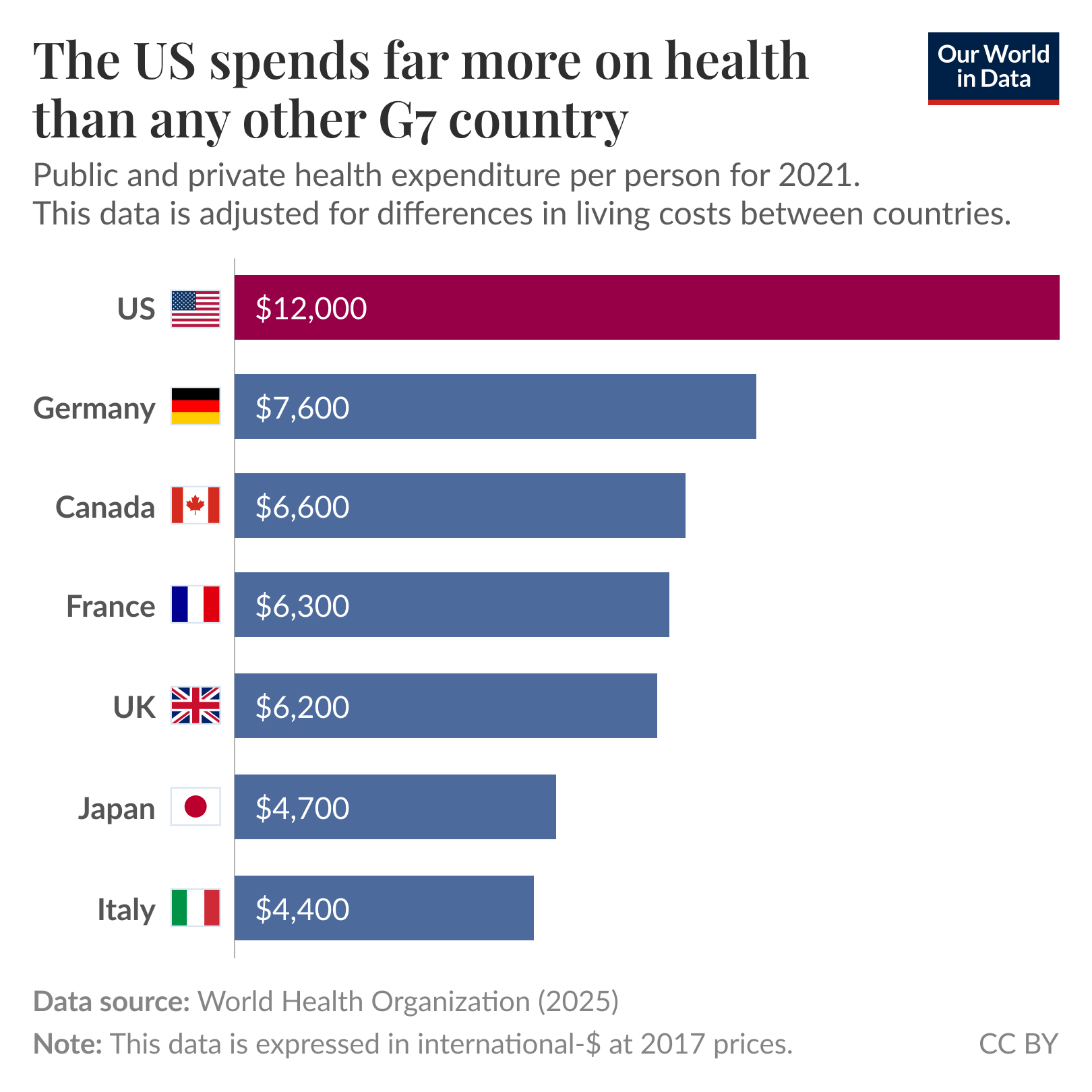
Picture this: You’re born in America — land of the free, home of the brave, and apparently the undisputed global champion of going bankrupt from a broken leg. In 2024, the U.S. spent $5.3 trillion on healthcare. That’s $15,474 per person — the highest of any nation on Earth. Other wealthy nations spend roughly half that. Their people live longer.
$15,474 per person per year in 2024.
The U.S. spends 2x the OECD average. We rank 26th in life expectancy. That’s not a tradeoff. That’s a scam.
America doesn’t have a healthcare system. It has a billing system with a waiting room — and if you’re fortunate, another waiting room after that. We’re not just bad at this. We’re comically, outrageously bad at it — like a guy who buys a Ferrari, drives it into a ditch every morning, and brags to his neighbors about what the repairs cost. The system isn’t broken. It’s working exactly as designed: to transfer wealth from the sick to the shareholders, from the desperate to the executives collecting bonuses for denying your MRI.

This is Fix #2 of the Make America Grow Again series. If you haven’t read Episode 1 on Government Transparency yet, start there — because every drug price that never gets negotiated and every hospital contract that stays buried runs through the same opacity architecture we dismantled in that episode. These problems aren’t adjacent. They’re the same problem wearing different clothes.
Critics love to weaponize the Medicare for All price tag — $32–$38 trillion over ten years — as a conversation-ender. Here’s what they omit: CMS projects U.S. healthcare spending will reach 20.3% of GDP by 2033 under the current system. We’re already on track to spend more. The difference isn’t total expenditure. The difference is who pockets the margin and how much gets incinerated in administrative theater that produces zero health outcomes for anyone.
Interactive: Peterson-KFF Health System Tracker — U.S. vs. peer countries
📬 Get Every Episode the Moment It Drops
No algorithms. No outrage bait. Just the uncomfortable truth, twice a week.
Or subscribe directly at rxansmith.substack.com
Bipartisan Failure, Documented
The American healthcare system isn’t broken by accident. Both parties have had the wheel, and both drove into the same ditch — because the same donors were riding in the backseat of both cars, giving directions.
Republicans voted 74 times between 2011 and 2017 to repeal the ACA. Seventy-four. They never produced a viable replacement because there was never supposed to be one. The repeal was a fundraising vehicle, not a governing plan. John McCain’s theatrical thumbs-down on the skinny repeal looked like a profile in courage. It was a performance for a base that was never going to get anything structurally different regardless of the outcome.
Democrats spent a decade defending the ACA as a sacred achievement — and to be fair, Medicaid expansion, pre-existing condition protections, and marketplace subsidies helped real people. But the ACA left insurance middlemen fat, comfortable, and entirely unchallenged. Drug pricing? Barely touched. Administrative waste? A trillion-dollar annual leak, still running. Executive pay at insurance companies? Record-setting, every year, without interruption.
“Republicans spent years trying to kill Obamacare with no plan behind it. Democrats defended half-measures that kept insurers in the driver’s seat. Both parties kept cashing checks from the industry eating you alive. That’s not a coincidence. That’s a business arrangement.”
The Captured Governance Loop Healthcare industry lobbying spent over $600 million in 2023. It's more than any other sector in America. That money flows to both parties strategically, to ensure that no reform ever reaches structural profit centers: insurance denial practices, pharmaceutical pricing opacity, hospital billing complexity, and administrative overhead costs THAT IS MORE THAN most countries spend on care itself. Every reform that passes leaves those four mechanisms intact. Per Commonwealth Fund’s 2023 global comparison, the U.S. ranks last in healthcare system performance among 11 wealthy nations — despite spending the most. That’s not dysfunction. That’s the product being protected.
The Profit Machine Disguised as a Health System
Let’s be precise about what’s actually happening, because “the system is broken” has been repeated so many times it’s become furniture — present but no longer visible.
Insurance companies are not in the business of keeping people healthy. They are in the business of managing risk while extracting margin. Denials, delays, billing complexity, and opaque pricing structures are not flaws in the insurance model. They are the model. Americans spend over $1,000 per person on administrative costs — approximately five times more than peer nations. Sweden spends 22x more on long-term care than on admin costs. The U.S. spends roughly the same on both.
Insurance companies: Their business model is denial. You pay premiums in; they find reasons to pay less out. The incentive structure rewards this explicitly — and legally.
Pharma: Prescribes at roughly twice the volume and seven times the per-unit price of comparable wealthy nations for the same molecules.
Hospitals: Hide line items with the discipline of a forensic accountant working in reverse. The same procedure at the same facility carries three different prices depending on who’s asking and what coverage they carry. U.S. hospitals spend roughly 25% of operating budgets on billing and insurance navigation alone — vs. 10–15% in Canada and Germany.
Doctors: Many are trapped in a fee-for-service structure that rewards volume over outcomes. A 2021 JAMA study found physicians spend 16–18% of working hours on administrative tasks. That is time not spent on patients. Multiply by every physician in the country and the cost — in money and in lives — is staggering.
📊 View administrative cost comparison chart → Peter G. Peterson Foundation
U.S. spends ~5x more per person on health admin than peer nations. Source: Peter G. Peterson Foundation / OECD
This is capitalism functioning correctly inside an industry where “correctly” produces systematically wrong outcomes. Nobody screams socialism when the fire truck shows up. The fire department doesn’t run a credit check before pulling up to your house. The logic gap only materializes when the industry demanding your confusion has a financial interest in maintaining it.
The Slow Death Revenue Model America has the best research institutions and most advanced clinical technology on the planet. The system built around them has a structural preference for treatment over cure — because cures eliminate revenue streams while chronic disease management generates recurring billing. This isn’t conspiracy. It’s an incentive structure that, absent a countervailing force, optimizes for billing over health every single time. Per KFF’s international comparison, the U.S. performs more knee replacements, MRIs, and C-sections per capita than most developed nations — even when medically unnecessary. Other countries built the countervailing force. We decided that was socialism.
The Pharma Shakedown — We Fund the Research, Then Pay the Ransom
In 2022, federal investment in pharmaceutical research through NIH and related programs exceeded $40 billion. American taxpayers funded the science. American patients then paid — at prices 5 to 10 times higher than Europeans pay for the identical drugs, produced by the same companies, developed with that same public money.
Insulin. EpiPens. Cancer medications. The pricing logic isn’t supply and demand — it’s “what can we extract from someone who will die without this.” Patent manipulation, evergreening strategies, pay-for-delay agreements with generic manufacturers, and regulatory capture at the FDA keep competition suppressed and prices sovereign.
“We subsidize the research with our taxes. We fund the trials with our grants. Then we pay $400 for insulin that costs $6 to make and $30 across the border in Canada. That’s not a market. That’s a hostage arrangement with a co-pay.”
Germany, Switzerland, Australia, and essentially every other wealthy nation use centralized negotiation to cap drug costs — and achieve equivalent or better health outcomes at a fraction of the price. Medicare’s newly authorized limited negotiating power, beginning in 2026, is projected to cut select drug costs by roughly 50%. Meaningful. Also a first step in a 200-step process — and the pharmaceutical lobby spent years and hundreds of millions of dollars trying to kill even that.
The VA Baseline Nobody Talks About | The VA already negotiates drug prices and pays roughly 40% less than Medicare Part D for the same medications. The VA’s negotiating authority exists because the pharmaceutical lobby couldn’t quite kill it. Scale that model to the entire country and the arithmetic changes substantially. The industry understands this, which is why their lobbying spend on this specific policy fight has been the largest of any single issue in modern American political history. They’re not spending $600M/year to protect your healthcare. They’re spending it to protect their margins.
What Actually Works — And What’s Theater
Every couple of election cycles, one party promises to fix healthcare and the other promises to protect you from the fix. The actual scoreboard across decades: premiums up, deductibles up, medical debt is the leading cause of personal bankruptcy, and both parties’ healthcare industry PAC receipts are up. Correlation isn’t always causation. This one is.
Meanwhile, look at what has actually moved the needle in other systems:
Germany’s regulated multi-payer model covers everyone, negotiates prices aggressively, and spends about half what the U.S. does per capita. Private insurance exists. Competition exists. The guardrails are enforced, not decorative.
Canada’s single-payer system has legitimate wait time issues for elective procedures — a real critique. No Canadian has ever filed for personal bankruptcy because their child got leukemia. That’s not a minor distinction.
Taiwan’s 1995 single-payer implementation started from a system more fragmented than America’s and achieved near-universal coverage within two years at administrative costs among the lowest in the developed world.
Australia’s mixed model combines universal public coverage with private options, achieves better health outcomes than the U.S., and does it at roughly 60% of American per-capita cost.
Per 2025 patient surveys, 36% of U.S. adults reported skipping or delaying needed medical care because of cost — including more than one-third of insured adults. In the EU, only 3.6% reported unmet medical needs due to cost, distance, or waiting lists combined.
Prevention: Cheapest Healthcare Nobody Makes Money From Chronic diseases like obesity, Type 2 diabetes, heart disease are preventable with accessible nutrition, exercise infrastructure, early mental health support, basic primary care. OECD data consistently shows countries with serious preventive investment spend far less per capita to produce longer, healthier populations. Prevention doesn’t show up on pharmaceutical earnings, generate procedure fees, or fill hospital beds. It’s the intervention that would save hundreds of billions annually while being the one thing every profit center in current system has a structural interest in ignoring. That’s not a bug. It’s the budget model.
How This Connects to the Rest of the Series: The healthcare cost crisis feeds directly into Episode 4 (Income Inequality) — medical debt is one of the fastest drivers of the wealth gap. It connects to Episode 18 (Social Security & Medicare) — a shrinking workforce can’t sustain a system this expensive. And it runs straight through Episode 1 (Government Transparency) — because you cannot fix prices you aren’t allowed to see. The tree is one system. Pull one root, the others move.
The Five Structural Fixes
Not ideology. Not campaign slogans. Mechanics — what a functioning legislature, freed from the donor relationships that built and maintain this system, would actually implement.
Fix 1: Medicare Negotiation — Expanded, Mandatory, Without the Carve-Outs
The 2022 Inflation Reduction Act authorized Medicare to negotiate prices on a limited drug list starting in 2026. That’s the floor, not the ceiling. Expand negotiating authority to all drugs purchased with federal funds. Remove the non-interference clause that has protected pharmaceutical pricing since 2003. Index U.S. drug prices to international benchmarks as a ceiling. If Germany and Australia can negotiate fair prices for their populations, the largest federal buyer in the world can do it for ours. The only reason we haven’t is because the lobbying math has worked in pharma’s favor. Change the math.
Fix 2: Crush the Administrative Overhead
Standardize billing codes, claim forms, and reimbursement protocols across all payers — not necessarily single-payer, but single-format. A unified claims processing standard eliminates the hospital billing departments that exist solely to navigate thousands of different insurance plan requirements. This alone could recover hundreds of billions annually in pure waste — money spent on paperwork rather than patients. It’s operationally achievable. It’s blocked because the people staffing those billing departments constitute an industry, and industries have lobbyists and PAC money and revolving doors into the agencies that would regulate them. See Episode 1.
Fix 3: A Public Option That Actually Competes
A Medicare buy-in available to any American, priced at actual cost plus a modest administrative margin, creates genuine market competition for the first time. Private insurance survives if it offers superior value. If it can’t, the market delivers its verdict. The political advantage: it doesn’t require dismantling employer-sponsored coverage for 160 million people during a switchover. It creates a real alternative for the 30 million currently uninsured and the tens of millions more who are underinsured by plans that collect premiums and deny claims with equal enthusiasm.
Fix 4: Hospital Price Transparency — With Penalties That Actually Sting
A 2021 federal rule required hospitals to publish their prices. Compliance in the first two years was abysmal — hospitals posted incomplete, unusable data or ignored the requirement entirely, because the daily fines were so modest that non-compliance was the rational economic choice. Reform the penalty structure: fines as a percentage of annual revenue, not a flat daily rate. Require machine-readable, searchable price lists for every procedure. Assign independent auditing authority rather than hospital self-reporting. Sunlight functions when it’s enforced. Transparency laws without enforcement teeth are wallpaper — a pattern we covered extensively in Episode 1.
Fix 5: Pay for Outcomes, Not Volume
Fee-for-service medicine rewards doing more, not doing better. A physician earns more from an unnecessary imaging order than from a preventive conversation that avoids it entirely. Value-based care models — payments tied to patient health outcomes over time rather than procedure volume — already exist within Medicare and have demonstrated cost savings in pilot programs. The obstacle is scaling them against six decades of institutional inertia. Phase the transition. Fund the infrastructure. Make the alternative financially viable for providers, not just philosophically appealing to policy academics.
The Ladder, Not the Cliff Systemic healthcare reform doesn’t require a single catastrophic switchover. A sequenced approach: lower Medicare eligibility from 65 to 55, then to 45; expand the public option simultaneously; negotiate drug prices progressively; standardize billing in parallel. Each step reduces private leverage while building the administrative infrastructure required for the next. Administrative savings, negotiating power, and post-Boomer demographic shifts make the math increasingly viable over a 10–15 year window. The goal is a ramp with handrails - and a clear view of where it leads. For the fiscal side of this equation, see Episode 3 on Tax Reform - that's the funding conversation for you.
The Uncomfortable Honest Part
Here’s what doesn’t get said in polite policy discussions: the entities with the strongest interest in maintaining this system are not cartoon villains. They’re institutions staffed by people who coach little league and go home to their families. The insurance executive who spent a career optimizing denial rates is a product of an incentive structure, not a uniquely malevolent individual. A perfectly rational, well-meaning person placed inside these structures will make the same decisions — because the incentive structure rewards those decisions and penalizes alternatives.
You don’t fix that by finding better people. You fix it by changing the structure.
Countries we casually dismiss as less advanced still draw a moral line that America erased decades ago: they do not convert basic survival into a shareholder profit center. Healthcare. Education. Prisons. These aren’t public goods anymore — they’re industrial complexes. They prey on your livelihood because they know you’ll pay anything when the alternative is suffering. We covered the prison version in Episode 7 on Criminal Justice. The playbook is identical.
Fifty years ago, describing schools, prisons, and hospitals as growth sectors for private equity would have sounded like dystopian satire. Today it’s defended as freedom. That’s not a linguistic accident. Someone paid for that framing, and it was a very good investment for them.
This is not an argument against capitalism. Capitalism built most of what works in this country. The argument is against applying market logic to contexts where the profit motive and the human outcome are structurally opposed — where the business does better when you do worse. Healthcare, prisons, addiction treatment: in these sectors, desperation is the product being monetized and the customer has no exit option. That’s not a market. That’s a captive audience with a billing department attached to it.
And Finally...
Exploitation in Lab Coats is Still Exploitation.
We have the best scientists on the planet. The most advanced medical technology. The most prolific research infrastructure in human history. And the system built around all of it has a structural preference for treatments over cures, management over resolution, and recurring billing over health — because health, once achieved, doesn’t generate recurring billing.
That’s not innovation. That’s the oldest extraction scheme in the book, dressed up in a white coat and a patient outcomes mission statement.
The fix isn’t complicated. It is resisted. Those are different things, and conflating them is itself part of the strategy. “It’s too complex to change” is what you say when you need to run out the clock on a conversation that, if it concluded with action, would cost you money. Complexity is the camouflage. Profit is the motive.
Every other wealthy nation made a decision at some point: some things shouldn’t be gambled on your employer, your zip code, your credit score, or your luck. Healthcare is one of those things. Not because it’s radical — it’s the boringly obvious adult conclusion that 30 other countries reached before us, at lower cost, with better outcomes.
We can make the same decision. We just have to want the answer more than we fear the people currently profiting from the question.
— Rxan Smith
Uncomfortable
📬 Subscribe to Uncomfortable
25 hard fixes. Two episodes a week. No algorithm required.
Get Every Episode
Free and paid tiers available at rxansmith.substack.com
Support Independent Media
Algorithms don’t push truth-tellers. They push outrage. Only we can change that.
$5 | $10 | $20 | $50 | $75 | $100 | $250 | $500 (RXAN OWES ME)
Substack · YouTube: @RealRxanSmith · X: @rxannsmith · Instagram · Facebook · Buy Me a Coffee
uncomfortablerxansmith@gmail.com
← Ep. 1: Government Transparency | Series Index | Ep. 3: Value Added Tax→

Connect With Rxan Smith Across the Web
📺 YouTube🐦 X (Twitter)📸 Instagram (Main)📸 Instagram (Alt)🧵 Threads (Main)🧵 Threads (Alt)📘 Facebook☕ Buy Me a Coffee💰 PayPal🎭 Patreon
25 Fixes Make America Grow Again (Full List)
Listen
— Rxan Smith
Uncomfortable
Making America Grow Again, One Uncomfortable Truth at a Time
3/3
Also consider the UK national health service. The British are extremely unhappy with the way it’s going because essentially politicians wrote a check they can’t cash, and it gets worse and worse every year—they have waiting lists, shortages of personnel and state-of-the-art equipment, dilapidated facilities, and other severe shottcomings. It’s a hot mess— it’s crushing them, and it will crush them even faster now that they’ve got an immigration influx of people who don’t pay into the system, but are, as most people are, insatiable users thereof; there’s no way out. Their safety valve is that, unbeknownst to most single payer fans in the US is that they have a robust private insurance market, and many, if not most, corporate employees have that private insurance, which allows them to see private providers outside of the NHS.
The strength of the United States is innovation. We have more innovation in this country than the rest of the world combined, and that’s largely because that’s where, for example, the Pharma industry earns all its money. Trump has pointed out that we basically subsidize all the single-payer types of systems that you list with the profit margins we give to Pharma and other suppliers.
So my government purchasing organization solution is a good first step toward bringing down costs for the taxpayers, at least without killing access or innovation--the goose that lays the golden egg. You could also make it politically acceptable to the industry and its lobbying problems by saying it’s either this or Medicare for all. What do you prefer? Because Medicare for all isn’t the end of the game for them, but a boy sure does take a lot of the fun out of it, and there could be a legitimate loss in innovation. That’s the saber the industry often rattles on capital ill and elsewhere, but there’s validity to it: capital goes where it can make profits, and if the profit margins go down in healthcare, they will go elsewhere, and there are plenty of other places to go. Talent will go elsewhere, too.
So that’s the stick you can use to beat the providers and suppliers into compliance, but the carrot is that you can give them liability shields. Professional and product liability at a ton of cost to the system, and this is another thing progressive never talks about because they’re bought and paid for by the trial bar, which makes an obscene amount of money by suing doctors and pharmaceutical companies in hospitals and nursing homes and everything else that moves. The industry has deep pockets, and trial lawyers pick up the scent and dive on it like vultures. That’s another thing that the European countries don’t have to worry about because their legal systems do not facilitate the personal injury industry that we’ve got here.
Now, probably, in my estimation, we will end up with Medicare for all anyway. Obviously, I have absolutely no platform to push my government purchasing organization idea, so barring some miracle, it will not gain traction, even though it is so obvious I’m sure I’m not the only one who’s ever thought of it. Certainly, if the DSA-captured Democrats regain power, Medicare for all could happen in my lifetime, which doesn’t have that much time left I would anticipate by the end of the century if not mid century, we will join the rest of the OECD in the single payer club, for better for worse, but I think it would be better for all the reasons I say above for us to at least go through a transitionary phase by consolidating the public sector purchasing power; best case, that that would be enough to fix it.
The other thing about the GPO is that it would tend to persuade people who are still in the private sector to get on the ACA, especially if there is a public option established at some point, which was a part of the ACA that got dropped. I can tell you personally that the industry heaved a sigh of relief when that happened, because the public option was just the tip of the wedge for Medicare for all.
I’m also critical of Republicans for being obsessed with repealing the Affordable Care Act; that was a nice sop for the people who wanted to go with single-payer Medicare for all. I’ve never understood why the Republicans were so opposed to it, and one of the saddest political spectacles I ever saw was the 2017 effort of Congress to repeal and replace the ACA. That was the day I realized that there is no way to do the one thing that would really cut costs in this country, which is to abolish third-party payment, whether it be public or private; that is never going to happen, so all we can do is make the best of the third-party payment system we've got by maximizing its efficiency and effectiveness. In fact, there’s still talk in GOP circles about repealing Nd replacing the ACA, which ironically was modeled on a GOP program in the People's Republic of Massachusetts called Romneycare, but they have no serious proposal. My government purchasing organization proposal would be a nice solution there for the Republicans. Unfortunately, I have no direct line to Donald Trump, so that’s probably not going to happen. That’s an idea that should get bipartisan support. The only reason the DSA in the Democrats wouldn’t want to do it is that they probably figure the worse, the better, as Lenin said. In that spirit, they would love to see a healthcare crisis metastasize until people are ready for the radical solution of a single payer, which is what they want.
What they don’t know is that there are no easy solutions or panaceas in healthcare. The problem is you have basically unlimited demand and limited supply. Nobody works for free, and to get the best and brightest in healthcare, you gotta pay. It’s not a fun job. There are Florence Nigfingales and Mother Teresa’s in the business, but not that many of them. We don’t run on nuns anymore.
There’s certainly a lot of rent-seeking behavior. PBM’s are probably the worst example. They don’t seem to add aany discernable value and yet they make a ton of money; you can tell that by their stock prices; insurance companies are demonized is the devils incarnate in this business—the reality is their margins aren’t nearly as high as people seem to think; their profits seem extraordinary, but that’s because of the scale, the sheer number of dollars that flow through them—as you say, they’re 20% of GDP. But really, most health insurance companies spend the majority of the dollars administering corporate programs; the corporations use the insurance companies as the fall guy for the policies that they tell the companies to implement
So, Donald Trump once famously said, " Healthcare is complicated,’ but I hope I’ve been able to point out some low-hanging fruit that maybe you can incorporate in the healthcare plank of your 25-point plan. As I said in another thread, it probably takes me the better part of a day to go through all your proposals, and I don’t know nearly as much about most of those as I do about healthcare, so I hope you find my two cents on that topic valuable.
1/3
As someone with 45 years of experience in healthcare, I give your solution a B+.
I’ll cut the chain and give you the quickest fix, which is to establish a public sector monopsony.
About 60% of the total healthcare spend is directly or indirectly coming from the public sector. This includes spending at all levels: municipal, county, state, and federal. But even within the federal government, we don’t consolidate the purchasing into what I would call a government purchasing organization (GPO). Medicare, Medicaid, the VA, CHAMPUS, the Department of War, and all the others have their individual, balkanized purchasing and payment policies.
The logical thing to do is to consolidate all that spending at all levels into one government purchasing organization that negotiates with all providers and suppliers to get the best deal.
The reason we don’t do this is in all probability primarily, as you say, that providers and suppliers hate the idea because they’ll take a haircut on price, and as a result, they spend one great deal of lobbying money and energy on preventing it from happening; in addition, there’s the usual intra-agency distrust and disharmony, lack of cooperation, inefficiency, ineffectiveness, and outright slot; but at this point the alternative is slipping into Medicare for all, which providers and suppliers will hate even more.