



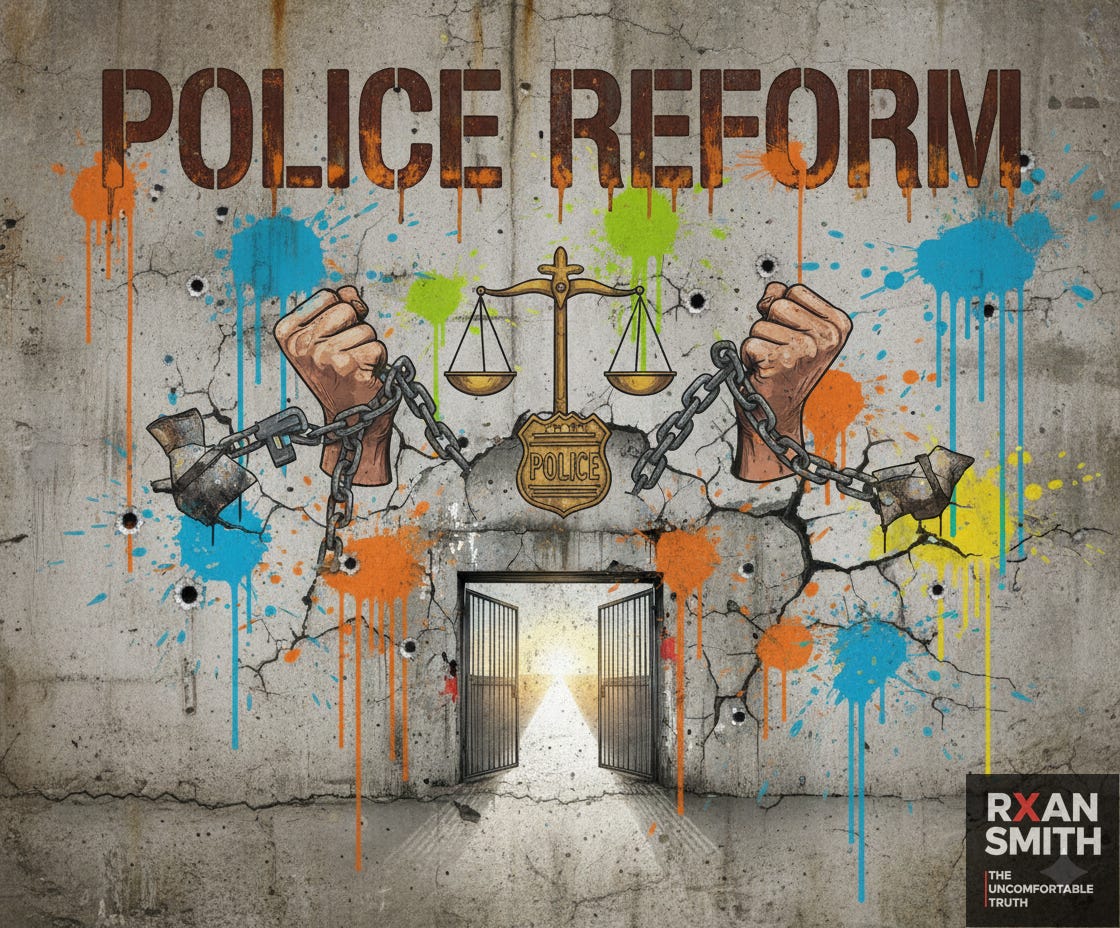
America Doesn’t Reform Its Police. It Feeds Them.
Then they guzzle down fear like cheap whiskey, and slap a label on it calling it “public safety.”
Decade after decade, we latch onto a new phantom to panic over:
Communists
Crack dealers
Immigrants
Protesters
Fentanyl
Whatever is screaming across the cable news ticker this week
If you graphed a century of American policing, you wouldn’t see a steady climb toward enlightenment.
You’d see an EKG.
Not the calm kind.
The kind from a guy hauling a refrigerator up an endless staircase while someone yells that civilization is collapsing.
Each jagged spike is a crisis.
Each crisis makes the system bigger.
And each expansion guarantees the next meltdown.
Every panic expands the machine.
Every expansion creates the next panic.
We keep calling this “reform.”
If the medicine keeps making the patient sicker, maybe the medicine is the disease.
.
The Uncomfortable Version of Events
Here’s the part nobody likes:
American policing didn’t “go wrong” in some recent decade.
It evolved, step by step, into exactly what it was incentivized to become.
A fragmented, politically useful enforcement machine that:
Expands during every panic
Absorbs every reform
Survives every scandal
Thrives on crisis
Because crisis is profitable for the people who run it.
This is not a bedtime story about good apples and bad apples.
It’s a structural story.
Seven eras. Seven waves of hysteria.
Each one bolting new armor onto the same machine:
Slave patrols and strike-breakers
Post-war paranoia
Civil rights backlash
The War on Crime
The War on Drugs
The Union Fortress
The Camera Era
The spotlight changed.
The incentives didn’t.
..
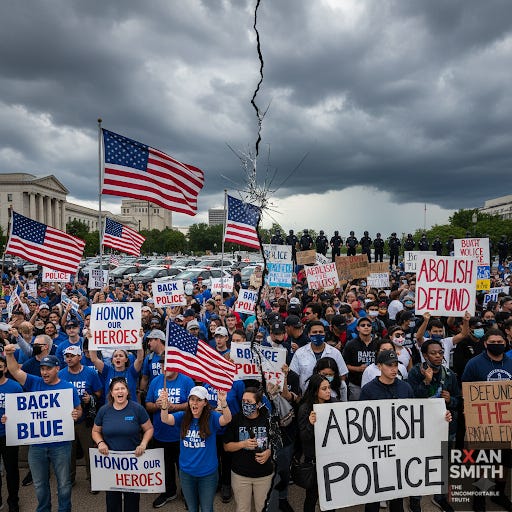
The Fake Choice: “Back the Blue” vs “Abolish the Police”
We’re told there are only two options.
There aren’t.
On the Right:
The Old Guard.
In this telling, the police are the thin blue membrane separating civilization from chaos. Any attempt at accountability is treated like an invitation to anarchy.
Body cameras are an insult.
Civilian oversight is witch-hunting.
Questioning the badge is siding with the mob.
Order must be preserved. Even if that means insulating power from scrutiny.
On the Left:
The Abolitionist Fantasy Camp.
In this narrative, policing is the armed wing of racial capitalism. The only morally serious position is to tear it down.
The awkward question of what happens tomorrow morning when someone calls about a man with a gun gets deferred to “the revolution.”
Both sides are loud.
Both sides are reacting to real harms.
Both sides are useful villains for each other.
And both are allergic to incentives.
The real debate isn’t “more cops vs. fewer cops.”
It’s whether policing remains a crisis-addicted industry
or becomes a profession designed to reduce harm.
The adult answer lives in the space nobody claps for:
Fewer missions
Better incentives
Real accountability
Recruitment and training that resemble a profession, not a paramilitary lottery
Contracts that don’t treat misconduct like a paperwork error
We don’t need untouchable police.
We don’t need no police.
We need policing aligned with public safety instead of political theater.
The Machine That Grows When It Fails
American policing didn’t break; it scaled. It evolved into a system that turns every panic spike into new funding, and absorbs scandals without changing incentives.
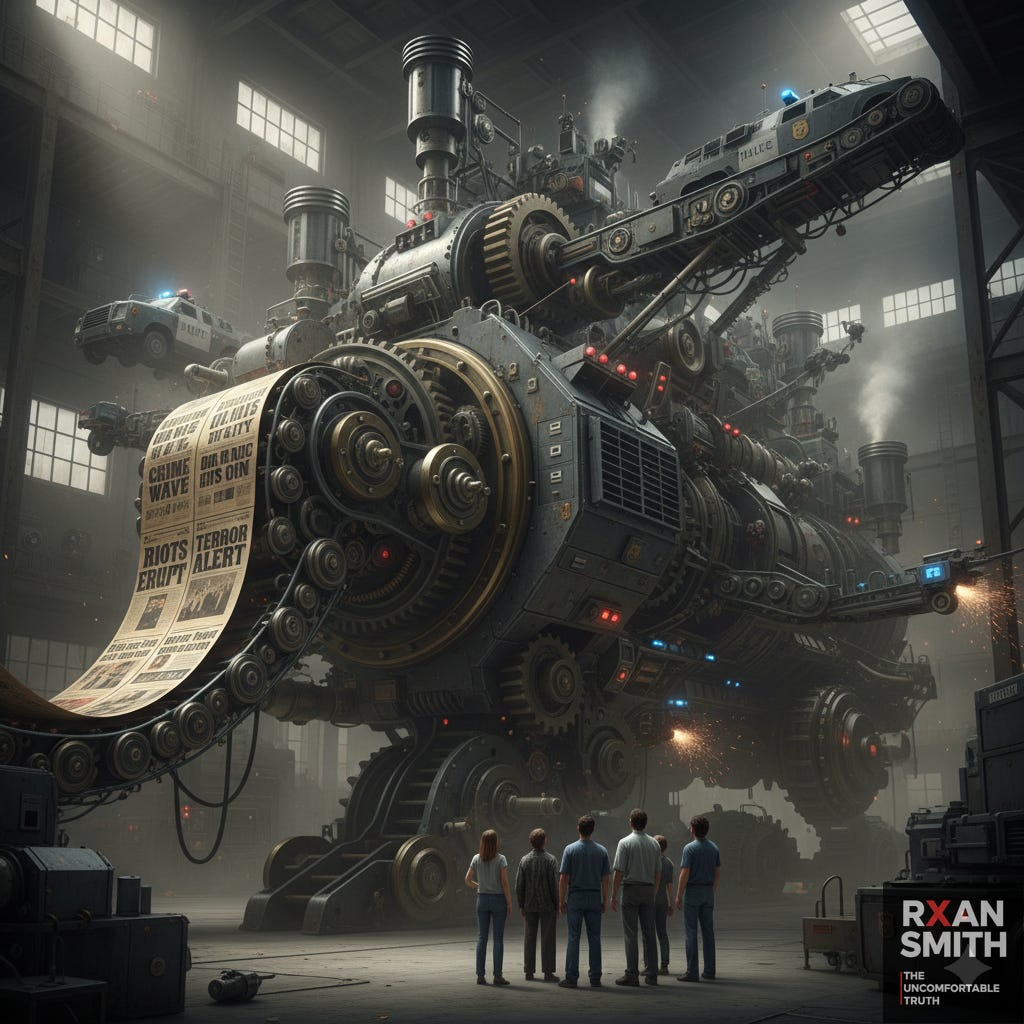
It became a system that treats public fear as a growth opportunity.
Panic spike → Budget increase
Scandal → Commission
Commission → Report
Report → Larger budget and another armored truck
Failure doesn’t shrink the system.
It justifies its expansion.Every scandal leads to a commission. Every commission leads to a report.
Every report leads to… a bigger budget and another armored truck.
The point isn’t that cops are uniquely evil.
The point is structural:
Politics uses policing as the cheapest, loudest response to social breakdown.
Drugs? Police.
Homelessness? Police.
Mental illness? Police.
School discipline? Police.
Border anxiety? Police.
It is always easier to deploy force than fix incentives.
That’s the misalignment.
And it’s why every “reform” feels cosmetic
Pre-Modern Roots: Law for the “Right” People
Panic lever: slavery and labor unrest
Expansion mechanism: private violence and municipal muscle
Before America had “police,” it had:
Slave patrols
Industrial strike-breakers
Pinkertons
Private enforcement hired to protect wealth and racial hierarchy
These were not neutral guardians of public safety.
They enforced a very specific version of order:
White.
Propertied.
On top..
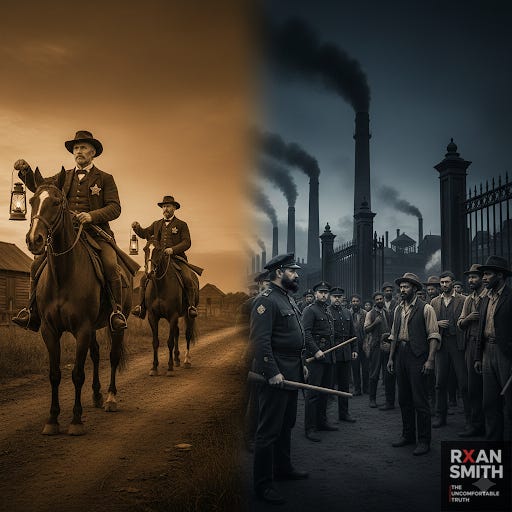
Early municipal forces grew from this soil.
City political machines used police as muscle.
The badge did not mean fairness.
It meant:
These are the people who count.
Those people don’t.
Then came Prohibition.
Overnight, millions of ordinary people became criminals.
Black markets exploded.
Corruption became structural.
Bribes were routine.
Organized crime flourished.
America saw the rot.
It didn’t shrink policing.
It professionalized and expanded it.
Enter the FBI.
Not born as a neutral investigative body, but as a political instrument built on surveillance, leverage, and the idea that dissent itself could threaten stability.
From the beginning, American law enforcement braided three missions together:
Protect property
Police race
Neutralize threats to the existing order
The system was not designed to protect everyone equally.
It was designed to protect power.
Post‑War Expansion: Prosperity with a Panic Button
Panic lever: communism and urban change.
Expansion mechanism: statewide forces, surveillance, and proto‑militarization.
America emerged from World War II with victory parades, a booming economy, and a new addiction: authority. We’d just defeated fascism abroad and immediately began flirting with a softer, friendlier version of it at home — tidy suburbs, highway projects that carved up cities, and the quiet assumption that order and prosperity were the same thing.
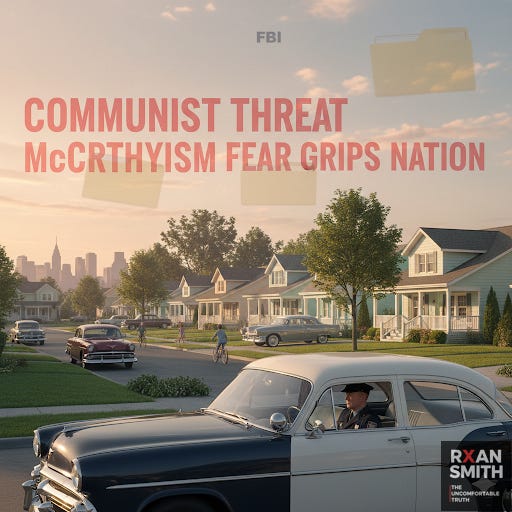
.The Red Scare poured gasoline on that assumption. Suddenly, every school, studio, and union hall was a potential nest of subversives. Local departments, encouraged by federal paranoia, leaned into surveillance. The FBI, already political, became a national nervous system wired for suspicion, monitoring not only criminals but also civil-rights leaders, journalists, and artists who challenged the status quo.
Meanwhile, early SWAT concepts began taking shape in places like Los Angeles. Urban unrest and political violence became the justification for a new idea: that American streets were quasi-battlefields and American citizens were potential combatants. The “militarized mindset” arrived well before the armored vehicle did.
This is the era that hard-right nostalgia mythologizes. In that story, the mid‑century cop isn’t a flawed civil servant; he’s a singular guardian standing between the neighborhood and chaos. The surveillance, political targeting, and racialized enforcement that defined the period are edited out.
The reality isn’t “police good” or “police bad.” The reality is that we built bigger, more centralized forces without building corresponding professional standards, independent oversight, or sane incentives. We gave the machine more reach without giving the public more leverage over how it worked.
Post‑war America didn’t create a policing crisis. It created the conditions for one.
The Civil Rights Era: The Mask Comes Off
Panic lever: Black liberation and urban uprisings.
Expansion mechanism: riot control, “law and order” rhetoric, federal commissions.
If the post‑war era built the machine, the Civil Rights era is when America finally saw what it was for.
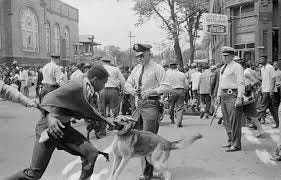
When Black Americans demanded equal rights, Southern police departments didn’t behave like neutral arbiters of law. They behaved like the enforcement arm of a collapsing racial order. Fire hoses, attack dogs, and nightsticks weren’t “aberrations.” They were how the system was designed to respond to challenges from the people it existed to control
.At the federal level, COINTELPRO didn’t target crime rings. It targeted movements. Civil-rights organizers, Black radicals, antiwar activists — anyone who organized outside the narrow bounds of the status quo found themselves wiretapped, smeared, harassed. The badge, again, was a filter. It decided whose rights were non‑negotiable and whose could be trampled in the name of “stability.”
Urban uprisings from Watts to Newark to Detroit weren’t random explosions. They were the inevitable result of segregation, routine brutality, and economic abandonment. When the Kerner Commission finally told the truth — that America was cleaving into two societies, separate and unequal — it handed the country a choice.
Rebuild the system around equal protection. Or double down on enforcement.
We know how that coin landed. The report was praised, skimmed, and quietly shelved. The political class chose a third option: rebrand the crisis.
Instead of treating uprisings as a verdict on segregation and brutality, they increasingly framed them as evidence of “crime.” That semantic pivot set up the next act.
Further Reading:
The War on Crime: Fear as a Business Model
Panic lever: rising crime and urban unrest.
Expansion mechanism: federal money pipelines, SWAT normalization, no‑knock force.
By the late 1960s, America was combustible. Crime was rising, trust was collapsing, and elites were out of ideas that didn’t involve sacrifice from people like them. So they did what politicians do when they’re cornered: they declared war on a noun.
“Crime” became the perfect enemy. It was real enough to terrify voters, vague enough to stretch over whatever the campaign needed it to mean. The Law Enforcement Assistance Administration opened a federal firehose of money straight into local departments. SWAT teams moved from fringe experiments to standard tools. No‑knock raids — the kind that turn living rooms into battlefields — became a normalized tactic.
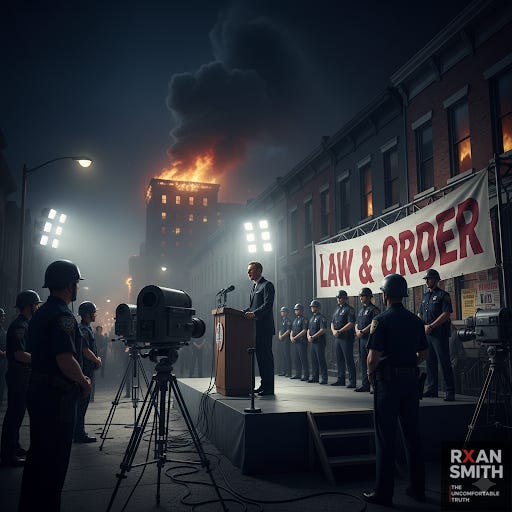
The War on Crime wasn’t a policy. It was a branding exercise.
This era is the spiritual homeland of the “mob rule or civilization” worldview. Society is on the brink; the streets are chaos; only overwhelming force can save you. Every neighborhood becomes a potential combat zone. Every citizen becomes a potential suspect. Policing stops being a profession and starts behaving like domestic counterinsurgency.
The incentive structure followed suit. Federal grants rewarded departments for arrest numbers, not safer neighborhoods. Politicians rewarded chiefs for “crackdowns,” not for fewer complaints or less harm. Media rewarded the most dramatic raids, not the quiet reduction of violence.
The real failure wasn’t the existence of police. It was what we paid and praised them to do.
The War on Crime didn’t fix America. It built the scaffolding for the next disaster.
Further Reading:
📢 Share This with Someone Who Needs to Read It
The War on Drugs: When Crisis Became a Revenue Stream
Panic lever: drugs, especially crack in Black neighborhoods.
Expansion mechanism: mandatory minimums, asset forfeiture, militarized raids.
If the War on Crime built the scaffolding, the War on Drugs poured concrete into it.
The 1980s didn’t just escalate enforcement. They industrialized it. Mandatory minimum sentences helped fill prisons. Asset forfeiture quietly transformed police departments into quasi businesses, able to pad their budgets by seizing cash, cars, and homes without a conviction. Federal and state grants linked funding to drug enforcement metrics.
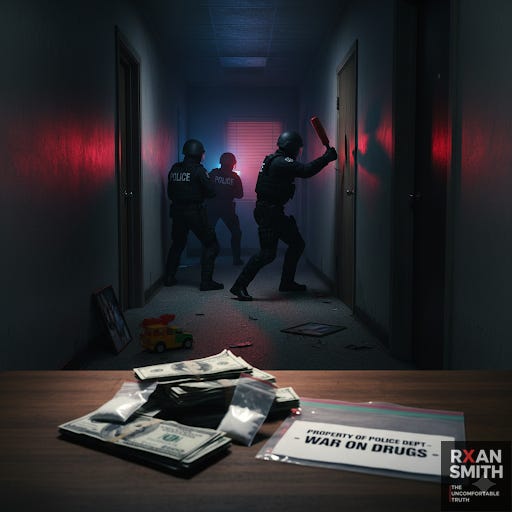
rCrack hit already‑abandoned neighborhoods hard. Instead of treating addiction as a public‑health problem, America treated it like an invasion. SWAT deployments exploded. No‑knock raids became routine. Helicopters, battering rams, and armored vehicles became standard equipment in cities that couldn’t afford functioning schools.
The drug war didn’t end drug use. It did narrow the psychological gap between “police” and “army.”
Hard‑right nostalgists look back at this era as a necessary crusade. They focus on horrific violence in some communities and use it to justify everything that came packaged with it. What they ignore is the long trail of collateral damage: families shattered by low‑level drug prosecutions, neighborhoods shredded by aggressive sweeps, communities losing both their trust in institutions and their young men to cages.
The War on Drugs didn’t just distort policing. It financialized it.. Once departments could directly profit from seizures, the “customer” changed. It wasn’t the public anymore. It was the crisis itself. The worse the panic, the bigger the budgets, the newer the toys, the fewer questions asked.
And once policing becomes a business, it stops optimizing for safety and starts optimizing for revenue and survival.
Further Reading:
Historical Timeline on Policing & Resistance (PD
Police Unions: The Shield Behind the Shield
Panic lever: “anti‑cop” politicians and public scrutiny.
Expansion mechanism: contract immunity, grievance machinery, political leverage.
If the War on Drugs turned policing into a business, police unions turned it into a fortress.
By the 1990s, unions weren’t just bargaining for pay and benefits. They were writing reality. Contracts ballooned into dense legal force fields around officers and departments: short deadlines for filing complaints, automatic record destruction, limits on interrogations, arbitration processes that quietly reinstated fired officers
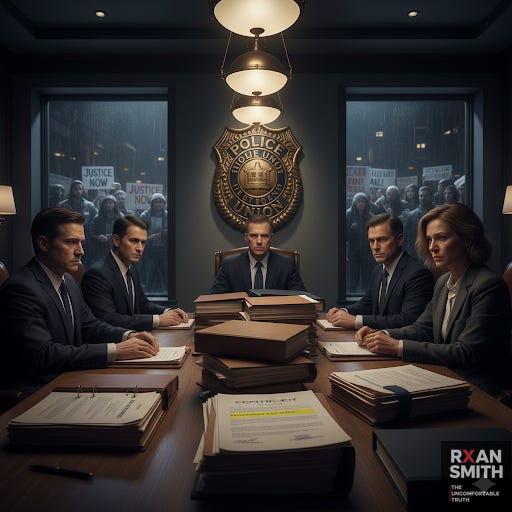
.aPaid administrative leave” became a national punchline. Officers caught on camera brutalizing civilians were suspended, then quietly returned. Civilian oversight boards were created without subpoena power or real teeth, the political equivalent of handing the public a steering wheel attached to nothing.
Unions also became central political players. Any candidate or mayor who even whispered about serious oversight risked being branded “anti‑cop” and hammered in the next election. Fear of that backlash did more to freeze serious reform than any law on the books.
They built a world where misconduct is a paperwork issue, accountability is a negotiation, and the public is told to trust a system that does not trust itself.
The problem isn’t that officers have unions. The problem is the incentive structure those unions built. They reward silence over integrity, aggression over professionalism, and loyalty to the institution over loyalty to the public.
If you want more and better policing — more solved murders, fewer abuses, safer neighborhoods — you can’t get there with contracts designed to protect the worst performers from consequence.
We don’t need fewer officers. We need a profession that can fire and sideline the wrong ones, reward the right ones, and be transparent about the difference.
Further Reading:
🔔 Get Notified When the Next Episode Drops • Subscribe Now
The Camera Era: When the Truth Went Viral — and the Machine Stayed
Panic lever: public outrage over recorded violence.
Expansion mechanism: PR management, “reform” optics, tech without power shifts.
If the War on Drugs financialized policing and unions fortified it, the Camera Era exposed it.
Smartphones turned every bystander into a witness and every traffic stop into potential evidence. Body cameras followed. For the first time in American history, millions of people saw, in excruciating detail, what heavily policed communities had been saying for generations.
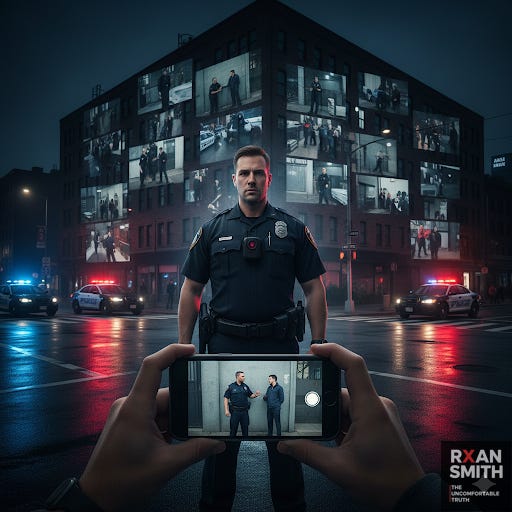
You could no longer wave away certain videos as “allegations.” You saw knees on necks, bullets in backs, no‑knock raids gone lethal in the middle of the night. You saw officers escalate mundane encounters into catastrophic ones and then watched entire institutions go to work explaining why the footage was misleading, incomplete, or unfair.
In theory, this should have been the turning point. The Camera Era could have been the moment when evidence forced incentives to change.
Instead, in many places, departments adapted like any entrenched institution under scrutiny: they developed talking points, emphasized “bad apples,” and offered reforms that changed the optics but not the incentive structure. Cameras without serious penalties for abuse became just another piece of gear, another line item that looked like accountability without rebalancing power.
The pattern repeated: outrage, promises, a task force, a training — budgets intact, authority intact, contracts intact.
The Camera Era didn’t end impunity. It made it impossible to pretend we didn’t know what it looked like.
Further Reading on Cameras & Commissions:
So What Does Real Reform Look Like?
If the problem were simply “too many cops,” the solution would be easy. If it were simply “cops are capitalism’s stormtroopers,” the solution would be easy in a different direction. Neither story survives contact with reality.
Real reform looks less dramatic and more structural:
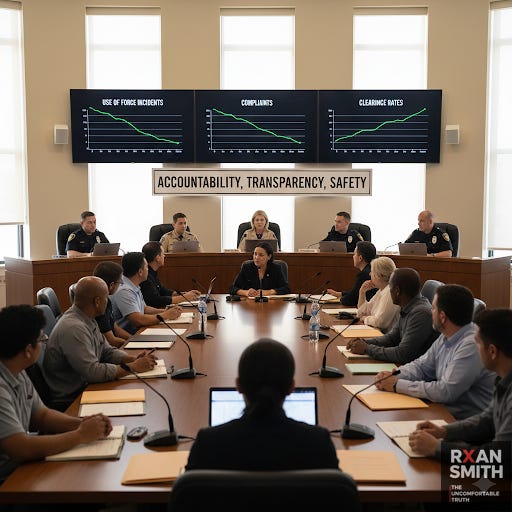
Narrow the mission. Stop asking police to be social workers, mental‑health responders, and revenue agents on top of everything else. Shrink the job to things you actually want armed agents of the state doing.
Change what we reward. Tie promotions and funding to reduced harm, solved serious crimes, and complaints that actually go down — not just arrest counts or “activity.”
Break the contract fortress. Rewrite union agreements so that the worst officers can be fired and kept out of the profession, and so that disciplinary records are transparent to the communities they police.
Shift who has leverage. Give civilian oversight real subpoena power, independent prosecutors for use‑of‑force cases, and public access to the data that matters.
We don’t need a world with no cops, and we definitely don’t need a world where cops exist above the law. We need a world where the people with the legal right to use force are tightly constrained, carefully selected, properly trained, and held accountable — not just when the camera is rolling, but when nobody’s watching.
That requires more than another commission and a new acronym. It requires admitting that the machine we keep “reforming” is doing exactly what history and incentives built it to do — and then rebuilding the incentives from the ground up.
Epilogue
Why Reform Always Fails
Here’s the part where I’m supposed to say something uplifting—how America always finds a way, how we’re just one commission away from fixing this. But let’s be honest: America doesn’t fix systems. America survives them. We don’t solve problems—we outwait them, outshout them, or outsource them to the next generation like a national game of hot potato.
Policing is no different. Every scandal gets a press conference. Every press conference gets a task force. Every task force gets a report filed somewhere between “Infrastructure Week” and “We’ll circle back.” And the system knows this. It’s built on it.
Because in America, failure isn’t punished—it’s funded.
Departments blow multimillion-dollar settlements? Taxpayers cover it.
Officers rack up complaints like loyalty points? They get promoted.
A city erupts after a killing? The budget goes up.
A department melts down? They get new gear.
It’s the only industry where the worse you perform, the more resources you get. Imagine if airlines worked this way. Imagine if hospitals worked this way. You’d call it corruption. In policing, we call it Tuesday.
Real reform doesn’t start with slogans. It starts with subtraction.
Subtract the financial incentives that reward aggression.
Subtract the legal shields that protect misconduct.
Subtract the mythology that safety comes from force instead of trust.
The truth is simple:
We will only get somewhere when the people who benefit from the current system finally have something to lose.
Until then, we’re just rearranging furniture in a burning house—and acting surprised when the smoke keeps getting thicker..
RXan Smith
(if this made you uncomfortable… GOOD.)
That’s where the truth lives.
PayPal.me/phireballsports/5 (send me $5 one time.
Change the five, and send an email amount you’d like)
The $153 Billion Beast (annually)
America doesn’t reform its police. It binge-feeds the monster and calls the indigestion “progress.”
18,000 law enforcement agencies
— more than the 13,300 public school districts we pretend to care about educating kids in.
1.2 million total employees
— roughly the entire population of Dallas, all wearing badges instead of cowboy hats.
$153 billion every single year
— $450 sliced out of every American’s pocket, year after year, forever.
Agencies? Barely budged since 1926.
Spending? Exploded 17 times after inflation.
We have a bigger uniformed workforce than the active-duty Navy + Marines combined.
We spend 6 times more on domestic policing than NASA spends reaching for the stars.
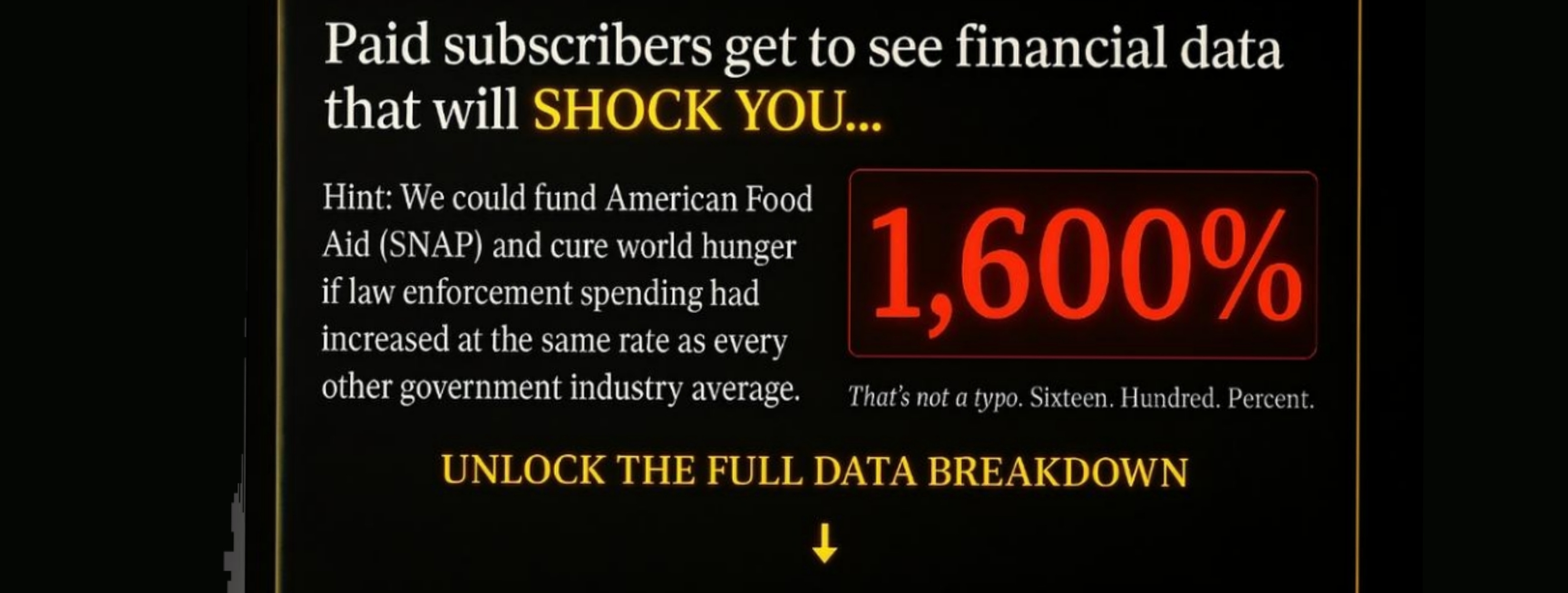
And while we’re feeding this $153 billion fear machine...
Here are 10 other things America spends annually (federal + state/local totals, recent figures):
K-12 public education — about $900 billion (we spend 6× more policing ourselves than NASA, but barely fund schools better than our badges).
Higher education (public colleges/universities) — roughly $300–400 billion (yet student debt crushes generations while police budgets balloon unchecked).
National defense/military — around $850–900 billion federal (we outspend the next 9 countries combined on war toys, but domestic policing gets its own massive slice).
Medicare (federal health for seniors/disabled) — over $900 billion (healthcare for the elderly is huge, yet we prioritize fear over fixing the system killing us slowly).
Medicaid & CHIP (low-income health coverage) — about $600–700 billion federal share (millions uninsured or underinsured, but 18,000 agencies stay fully armored).
Social Security (retirement/disability benefits) — around $1.5 trillion (the biggest single program, yet politicians scream “cuts” while police funding never shrinks).
Highways, roads & infrastructure — roughly $200–300 billion (bridges collapse, roads crumble, but shiny new cruisers roll out every year).
Public welfare / anti-poverty programs (beyond Medicaid) — hundreds of billions (hunger, housing instability rage, but “public safety” means more cops, not more homes).
Interest on the national debt — nearing $1 trillion (we’re borrowing to pay yesterday’s bills, while today’s fear budgets grow fat).
NASA & space/science exploration — about $25–30 billion (we dream of Mars on pocket change compared to the domestic army we maintain at home).
Priorities, right?
We don’t have money for teachers, bridges, mental health, or kids’ futures...
but we always find another $153 billion for the machine that promises to “protect” us from each other.
Uncomfortable?
That’s the subscription bell ringing.
rxansmith.substack.com
youtube.com/@RealRxanSmith
rxansmithmedia.com
This isn’t a safety system.
It’s a fear-laundering machine with 18,000 separate bank accounts.
And we keep writing the checks.
Uncomfortable? Good.
That’s where the truth lives.
PayPal Pledge Support - Independent media survives because readers fund it.
I don’t run ads. I don’t take corporate money. I don’t soften the truth to keep sponsors happy. That means I need you.
One-time support:
$5 | $10 | $20 | $50 | $100
Monthly support:
Subscribe - $5/month | Founding Member - $50/month
Every dollar goes toward research, writing, and exposing the systems that profit from your suffering.
Connect With Rxan Smith Across the Web
📺 YouTube🐦 X (Twitter)📸 Instagram (Main)📸 Instagram (Alt)🧵 Threads (Main)🧵 Threads (Alt)📘 Facebook☕ Buy Me a Coffee💰 PayPal🎭 Patreon
Take Action: This Needs Your Voice
If
If you’re done with the performance art of caring about rural America or left vs. right wars in general, while watching it burn support my work, consider becoming a free or paid subscriber. It takes a village. I only have a pen.
Share this article - Send it to someone who still thinks “market forces” are natural
What’s the biggest scam you’ve seen in rural decline?
PayPal Pledge Support - Independent media survives because readers fund it.
I don’t run ads. I don’t take corporate money. I don’t soften the truth to keep sponsors happy. That means I need you.
One-time support:
$5 | $10 | $20 | $50 | $100
Monthly support:
Subscribe - $5/month | Founding Member - $50/month
Every dollar goes toward research, writing, and exposing the systems that profit from your suffering.
Connect With Rxan Smith Across the Web
📺 YouTube🐦 X (Twitter)📸 Instagram (Main)📸 Instagram (Alt)🧵 Threads (Main)🧵 Threads (Alt)📘 Facebook☕ Buy Me a Coffee💰 PayPal🎭 Patreon
The Complete Series — All 25 Episodes
Ep. 25 — Systemic Poverty Areas ← You Just Finished the Series
rxansmith.substack.com · YouTube: @RealRxanSmith · X: @rxannsmith
— Rxan Smith
Uncomfortable
Making America Grow Again, One Uncomfortable Truth at a Time
Make America Grow Again • Episode 16 of 25
━━━━━━━━━━━━━━━━━━━━
© Rxan Smith. All rights reserved


