


🛑 STOP SCROLLING.🛑
Here’s a question nobody wants to hear:
What do you owe your country?
Not your taxes. You already pay those.
Not your vote. Though statistically, many of you don’t even do that.
I’m talking about something far more uncomfortable:
Your time. Your labor. Your sacrifice.
The kind of contribution that built modern America back when citizens believed in a shared “we” instead of a personalized algorithm feeding a permanent “me first.”
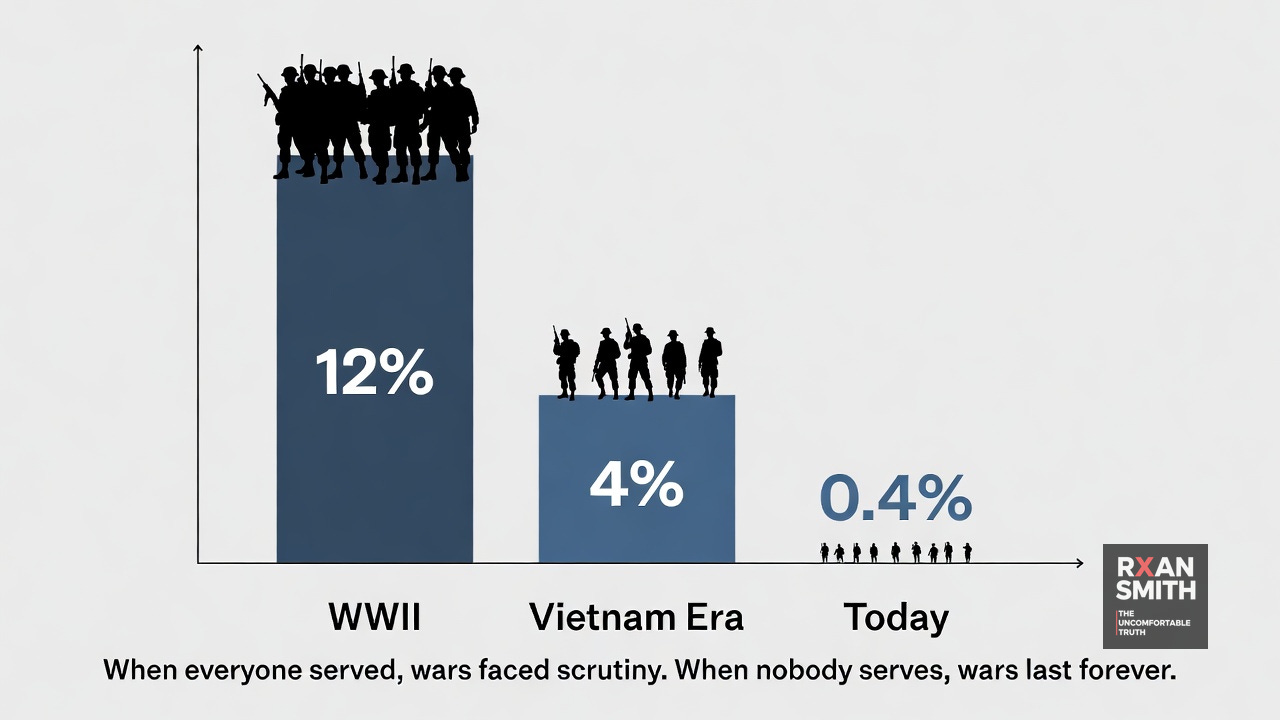
In 2024, only 0.4% of Americans serve in the military. Roughly 1.3 million people defend a country of 335 million.
The rest of us?
We post flag emojis.
We argue online.
We outsource sacrifice.
Wars happen in our name, but not in our lives.
When citizens stop sharing responsibility, democracy quietly begins to fail.
Democracy Requires Shared Sacrifice
Modern America suffers from a problem nobody in politics wants to admit:
Democracy cannot survive on vibes, hashtags, and elections alone.
Self-government requires something deeper:
Shared experience
Cross-class cooperation
Common purpose
Mutual obligation
We used to have an institution that created those things.
It was called national service.
And when we abandoned it, we didn’t just change military policy.
We accidentally dismantled one of the last systems forcing Americans to know each other.
What We Lost When Service Became Optional
1. A Shared American Experience
During World War II, roughly 12% of the entire population served. Rich and poor. Urban and rural. Black and white. College-bound and factory workers.
Service created a national language of experience.
Today, most Americans don’t personally know anyone serving.
The military became a separate social class.
2. A Class-Based Military
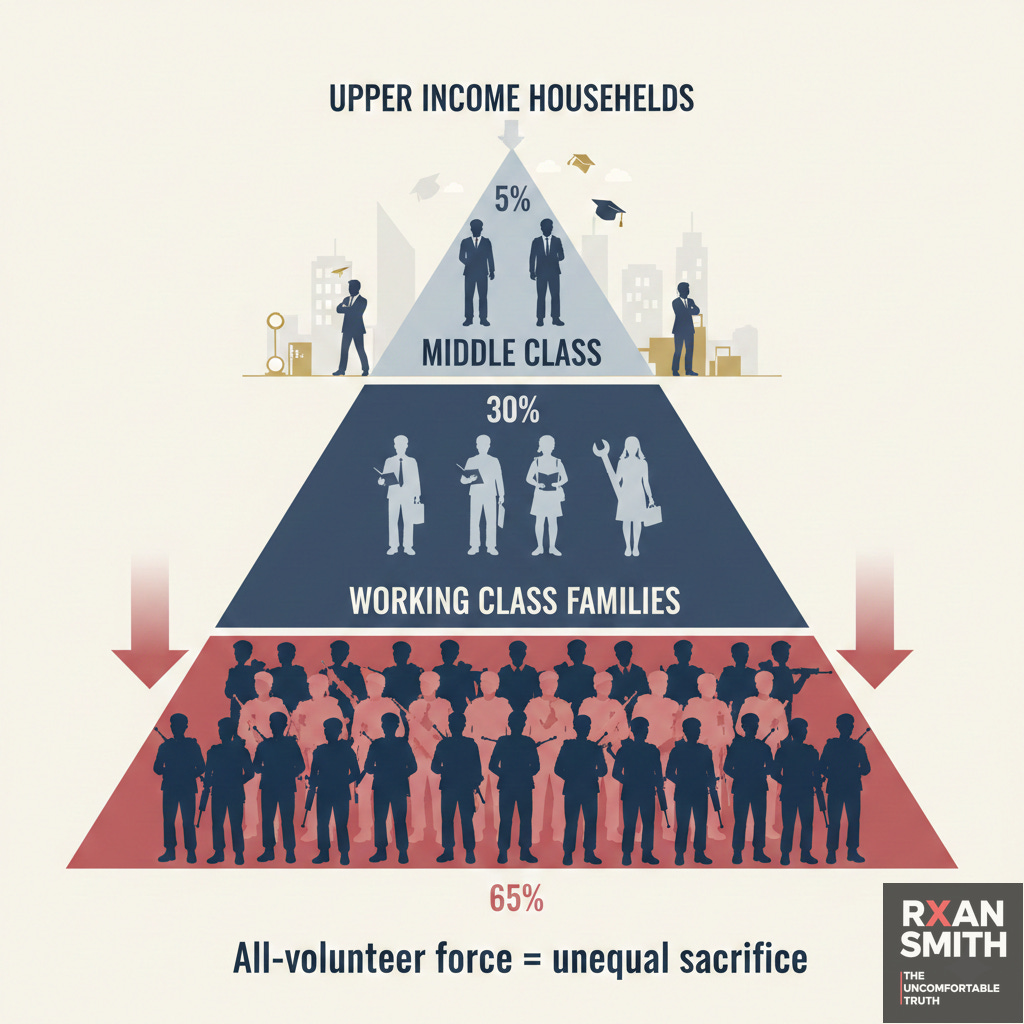
85% of enlisted personnel come from families earning under $85,000.
43% of recruits come from the South, despite only 36% of population.
87% of officers hold bachelor’s degrees; only 7% of enlisted do.
This isn’t coincidence.
It’s economic sorting disguised as volunteerism.
3. Wars Without Consequences
When everyone’s children could be drafted, wars ended faster.
When only a tiny fraction serves, wars become background noise.
Iraq and Afghanistan lasted twenty years largely because most Americans experienced zero personal cost.
Democracy without shared risk produces endless conflict.
The All-Volunteer Myth: How We Outsourced Sacrifice to the Poor
What National Service Could Look Like
Critics imagine forced military conscription.
That’s not the model.
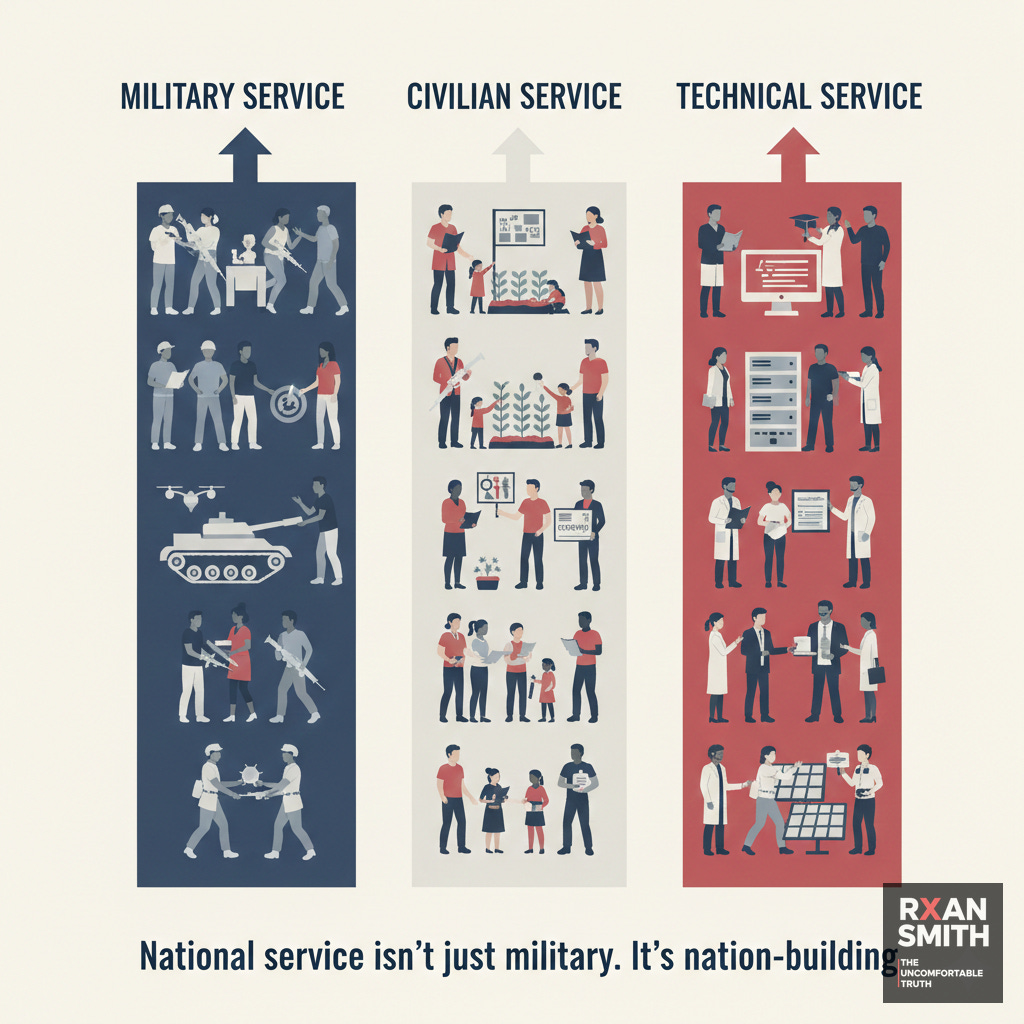
The future is multi-track universal service.
Track 1: Military Service
Army, Navy, Air Force, Marines, Coast Guard, Space Force
1–2 year commitment
Leadership and technical training
Post-service education benefits
Track 2: Civilian Service
Infrastructure repair and broadband expansion
Healthcare and eldercare support
Education tutoring programs
Disaster response teams
Environmental conservation
Track 3: Technical Service
Cybersecurity defense
Public health preparedness
National research labs
Climate technology deployment
Compensation Model
$25k–30k annual stipend
Housing and healthcare provided
$30k–50k education credit after completion
Trade certifications and job placement priority
Enough support to build a future. Not enough to turn service into exploitation.
Why This Fixes More Than You Think
Civic Cohesion
Studies show mandatory service increases civic engagement by 15–20% and raises institutional trust by roughly 30%.
Shared adversity builds social trust faster than political speeches ever will.
Economic Mobility
National service creates a missing middle path between college debt and economic stagnation.
Every young American leaves with skills, credentials, and opportunity.
War Accountability
If every family shares risk, politicians think twice before starting wars.
Democracy regains restraint.
https://youtu.be/5r5LoKRAWXs?si=sbMCSf2U_Y77wGOo
Labor Shortages Solved
Infrastructure rebuilt
Teacher shortages reduced
Healthcare staffing supported
Climate resilience accelerated
Youth Employment
Countries with service programs show youth unemployment rates roughly 40% lower than the United States.
Other Democracies Already Do This
Israel: Universal service builds national cohesion.
South Korea: Mandatory service equalizes class expectations.
Switzerland: Citizen service strengthens civic participation without militarization.
More than 60 democratic nations maintain some form of national service.
This is not radical.
America is the outlier.
The Objections (And Why They Fail)
“It’s authoritarian.”
Taxes aren’t optional. Jury duty isn’t optional. Democracies require obligations.
“It’s just a jobs program.”
Yes. And America desperately needs one that builds skills instead of dependency.
“The military doesn’t want conscripts.”
Most participants would choose civilian tracks. The military still gets motivated volunteers.
“It’s too expensive.”
Estimated cost: $50–70 billion annually. Comparable to existing federal inefficiencies and offset by infrastructure labor and economic gains.
How It Would Actually Happen
Phase 1 (Years 1–3): Voluntary Launch
Create service tracks
Recruit 100,000 volunteers
Build infrastructure and housing
Refine program logistics
Phase 2 (Years 4–6): Gradual Mandate
Lottery-based participation scaling upward
Integration with education system
Public accountability systems
Phase 3 (Year 7+): Universal Implementation
Career pathways
International partnerships
Continuous optimization
The Real Reason America Won’t Do This
National service would force Americans to confront something uncomfortable:
Freedom isn’t just rights. It’s responsibility.
It would mix social classes that currently avoid each other.
It would reconnect citizens to consequences.
It would rebuild a shared national identity.
And that requires cultural change, not just policy.
Democracy Is Not a Spectator Sport
Every previous generation of Americans inherited a country they didn’t build — and understood they had to work like hell to keep it alive. They rolled up their sleeves. They shared the burden. They sacrificed because they believed the experiment only survives if everyone carries a piece of it.
Ours might be the first generation trying to run democracy on pure entitlement and zero shared sacrifice.
We say we want unity, but without proximity. Patriotism-lite. Flag emoji will do… just don’t ask for inconvenience. We demand every right while negotiating every duty. Jury duty gets dodged. Taxes get loopholes. Voting happens only if it doesn’t conflict with brunch reservations.
Then we look around, shocked, clutching our pearls:
Why is trust collapsing?
Why is politics a dumpster fire?
Why do institutions feel broken?
Maybe because we quietly turned “We the People” into “Me the Influencer.”
National service isn’t a miracle cure. It won’t eliminate stupidity, end every war, or fix your dating apps. Humans will still argue. Politics will still be messy. Democracy will still frustrate you.
But it would do something we desperately lack: pull us off the sidelines.
It would force the Malibu trust-fund kid to bunk beside the Iowa farm kid and the Bronx striver. Not online. Not filtered through algorithms. In real life — fixing bridges, tutoring children, responding to disasters, solving problems shoulder to shoulder.
Shared hardship creates understanding. Shared work builds trust. Shared purpose turns strangers back into citizens.
Because democracy isn’t something you watch like a reality show while yelling at the screen. It isn’t a spectator sport you gamble on with tweets and hashtags.
Democracy is something you do.
You participate. You contribute. You give a little time, a little effort, maybe a little discomfort — so the entire system doesn’t collapse under the weight of our collective “me first” mindset.
We used to understand that instinctively.
Maybe the real question isn’t whether national service is radical.
Maybe the radical idea is believing a country can survive forever without asking anything meaningful from the people who live in it.
Maybe it’s time we remembered what citizenship actually means.
The Complete Series — All 25 Episodes
Ep. 25 — Systemic Poverty Areas ← You Just Finished the Series
rxansmith.substack.com · YouTube: @RealRxanSmith · X: @rxannsmith


