

Addiction Nation
Make America Grow Again Episode 14 - The $8 Billion Lie | Everything You Know About Addiction Is Wrong

👆 If you prefer my voice (listen and enjoy free). 👆
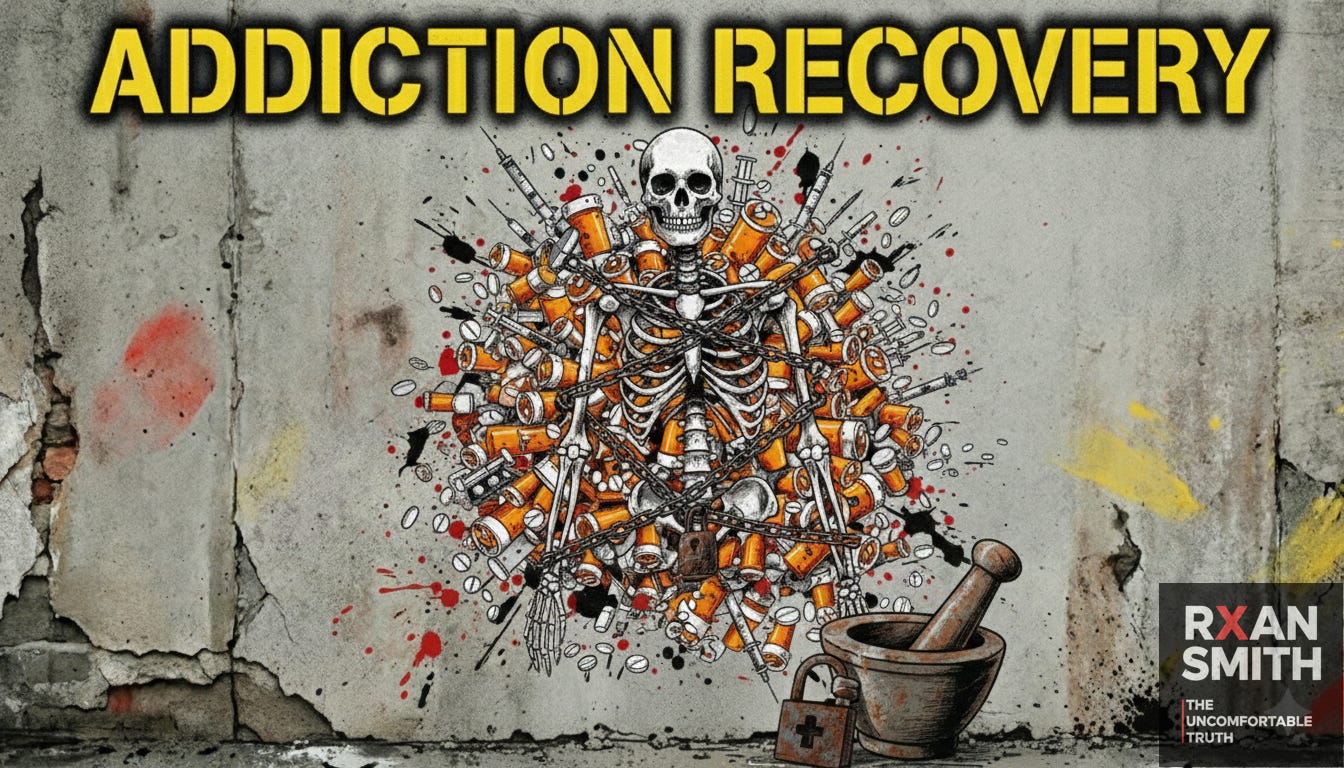
Let’s cut the sh*t, right now: if addiction ONLY nailed rich white kids from the right zip codes, hedge-fund brats, senators’ little angels…. we’d have fixed it faster than you can say “task force.” We’d have ribbon ceremonies, celebrity telethons, emergency billion-dollar bills, and cabinet-level photo ops every time somebody didn’t die. Instead? We got perp walks, three-strikes laws, and a whole industry that sells you the pain pill, then the antidote, then the next pill to fix the antidote. Three separate profit centers. Beautiful symmetry…
That’s not me being edgy. That’s just paying attention. So read on and get enlightened….
Addiction didn’t ambush us like some surprise asteroid. We built it brick by brick. We ignored the warnings, wrote the prescriptions, locked up the users, protected the prescribers, and then blamed the dead guy for lacking “willpower.” Personal responsibility, right? Works great when the game’s rigged.
What I'm Sayin’
Addiction is a man-made public health disaster kept alive by deliberate policy, naked greed, and the kind of moral cowardice that lets politicians sleep at night. Other countries treated it like medicine and watched overdoses crash, crime drop, and taxpayers save money. We treated it like a morality play starring handcuffs and sermons. Result? Packed prisons, repeat customers, and corporations that write fines off like parking tickets. We didn’t fail at solving it. We succeeded at everything except solving it.
For context, the opioid crisis alone has claimed over 500,000 lives since 1999, with overdose deaths hitting a record 93,000 in 2020—a 30% spike amid the pandemic.35 This isn’t just numbers; it’s policy choices that prioritize punishment over prevention, inflating corporate profits while communities collapse.
Criminalization Hammer That Never Learns
We’ve been swinging the same dumb hammer for fifty years: arrest more, sentence longer, scare harder. Guess what? Fear doesn’t cure chemical dependency. It just makes prisons the new asylums and turns neighborhoods into ghost towns.
Portugal in 2001 said screw it. No more jail for personal possession. They put the money into treatment, housing, jobs, actual help. Overdoses tanked. HIV from needles vanished. Kids didn’t suddenly turn into junkies en masse. The only thing that exploded was the excuse that “tough love” works. Turns out tough love is just tough, no love included.
Data backs this up: Portugal’s overdose deaths dropped from 80 per million in 2001 to just 6 by 2021—a 93% plunge—while HIV cases among injectors fell from over 1,000 to fewer than 16 annually. Meanwhile, in the U.S., drug offenses lock up over 360,000 people, fueling a prison boom that’s cost trillions without denting addiction rates.11 One in five U.S. inmates is behind bars for drugs, disproportionately impacting Black and Latino communities despite similar usage rates across races.
For more on global policy failures, check this related piece from my archive: Unlocking Mental Health Access: Government Barriers Exposed and Reforms Needed.
External insight: Dive deeper into Portugal’s model via this report from the Drug Policy Alliance: Drug Decriminalization in Portugal.
Hard Truths series archive – more on policy disasters that keep failing upward
The Drug War: Morality Porn for People Who Hate Results
The whole Drug War is performance art. Politicians get to puff their chests and say “tough on crime.” TV gets gruesome footage. Cops get bigger budgets and toys. When the overdose numbers climb, everyone shrugs and blames the addict’s weak character. Problem solved—until the next funeral.
We watched alcohol prohibition turn into a gangster golden age and learned exactly nothing. Same script, different chemicals, extra hypocrisy. Call it a character flaw and you don’t have to fix the system that fed it.
Since the 1970s “War on Drugs,” U.S. incarceration for drug offenses has soared, with nearly 1 million arrests annually—85% for possession alone.10 Yet, overdose deaths keep climbing, hitting 93,000 in 2020 alone.. Black women and newborns face 1.5 times higher drug testing rates, perpetuating racial disparities in a system that punishes poverty more than it prevents harm.
0
Related reading: Explore healthcare reforms in my series: Healthcare For All | Part 2 in Series of The American Government Fix Tree.
For a historical dive: Mass Incarceration: The Whole Pie 2025.
Crime Pays When You Own the Lobbyists
Purdue Pharma took the fall because they were the easy villain—family name, private company, Sacklers on the cover. Billions in fines? Pocket change. Executives walked. The rest of the industry just tweaked the molecule, slapped on “abuse-deterrent” labels that deterred nobody, and kept the pipeline flowing. Legal. Lucrative. Consequence-free.
Fines are now just the cost of doing business. Like a speeding ticket for a billionaire. Pay it, smile, keep speeding.
Purdue settled for $7.4 billion in 2025, with the Sacklers paying up to $6.5 billion over 15 years—yet no admissions of criminal wrongdoing, and the family walks away barred from opioid sales but still billionaires.24 This follows earlier $600 million fines in 2007 for misleading marketing, where executives pled guilty but avoided jail.26 The pattern? Massive settlements that barely dent profits, while overdose deaths rage on.
3
More on this: DOJ Resolution with Purdue Pharma

MAT: Lifeline, Leash, or Both?
Suboxone and methadone keep people breathing. Anyone who says otherwise is either lying or hasn’t seen the bodies. But let’s not pretend the system is pure charity. Patients get parked on long-term scripts with zero roadmap out, no real talk about tapering, no exit plan. Clinics make money on retention, not recovery. Pharma cashes checks whether you’re hooked on street dope or maintenance meds forever.
This isn’t anti-MAT. It’s anti-bullshit. Give people the truth and a real shot at getting free, not just traded dependencies.
Effectiveness data: Methadone users are 1.8 times more likely to stay in treatment at 12 months than Suboxone users, but both slash illicit opioid use by 8-10 days per month compared to no treatment.3032 Yet only 25% of those needing OUD treatment receive MAT, with 30% getting non-medicated care instead. Relapse risks soar without meds, but long-term dependency trades one chain for another.
2”LARGE”
Deep dive: Buprenorphine/Naloxone vs Methadone Study.31
Education & Harm Reduction: Too Honest for Comfort
We won’t teach kids—or adults—how drugs actually hit the body because god forbid information looks like encouragement. So they learn from street dealers, Reddit threads, and Darwin Award experiments. Brilliant strategy.
Places that did harm reduction—clean needles, fentanyl tests, supervised sites, straight talk—didn’t wave a white flag. They just stopped pretending purity saves lives. Deaths dropped. Survival went up. We keep choosing the fantasy over the body count.
Success stories: Syringe services cut HIV transmission by up to 18% and don’t boost drug use; instead, users are 3x more likely to quit injecting.40 Overdose education via these programs is cost-effective, slashing deaths without increasing crime.41 Yet U.S. adoption lags, with barriers like stigma and funding cuts.
Learn more: CDC Harm Reduction Case Study.41
Recovery: The Relapse Industrial Complex
overy: The Relapse Industrial Complex
Rehab turned into big business before it figured out how to work. Relapse isn’t a bug; it’s the feature. Insurance covers 28 days. Rinse, repeat, bill again. Success is measured in check-ins, not clean years. People bounce between facilities that profit from their chaos while preaching “personal accountability.”
It’s a perfect closed loop: create instability, sell the fix, blame the victim when it breaks again.
Industry stats: U.S. SUD treatment market hit $35 billion in 2021, projected to $60 billion by 2029, with for-profits surging 21% since 2004. Relapse rates hover at 40-60%, fueling repeat revenue in a $42 billion sector where luxury rehabs charge $15k-$75k monthly.


What Real Accountability Would Look Like (Spoiler: Not This)
Real accountability means executives do time, not just pay fines. It means addiction stats become CEO performance reviews. It means rules written to stop the damage, not mop it up later. Above all, it means admitting the system was never built to help the people it chewed up—it was built to manage them.
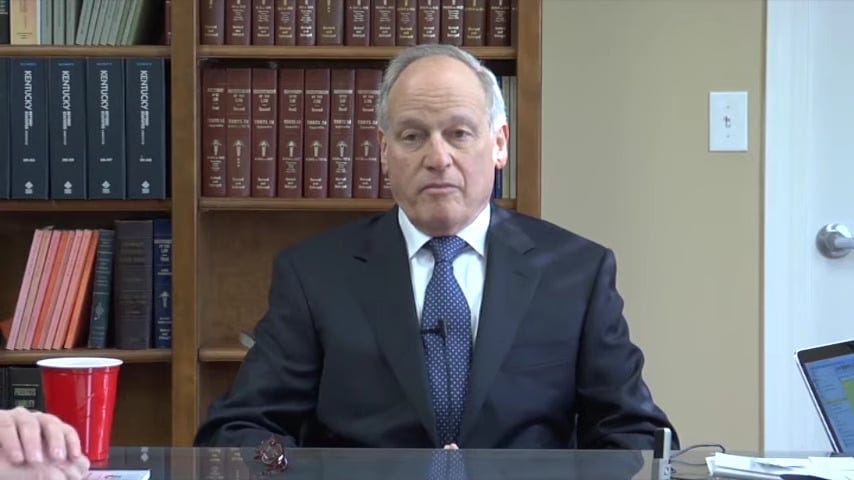
Examples: In 2007, Purdue execs pled guilty to misbranding, paying $34 million but no jail; 2020 saw $8 billion settlements with no personal criminal charges. True liability? Rare, like the Insys case where execs got prison for bribery.
The One Lie We Can’t Quit
Stop calling addiction “complicated.” It’s not. What’s complicated is our endless tap dance around profit versus human life.
We criminalize the suffering, turn treatment into a subscription service, slap wrists of the manufacturers, then point at the corpse and say, “See? Bad choices.” And we have the nerve to act shocked when the numbers keep climbing—even as they finally dip in 2025.
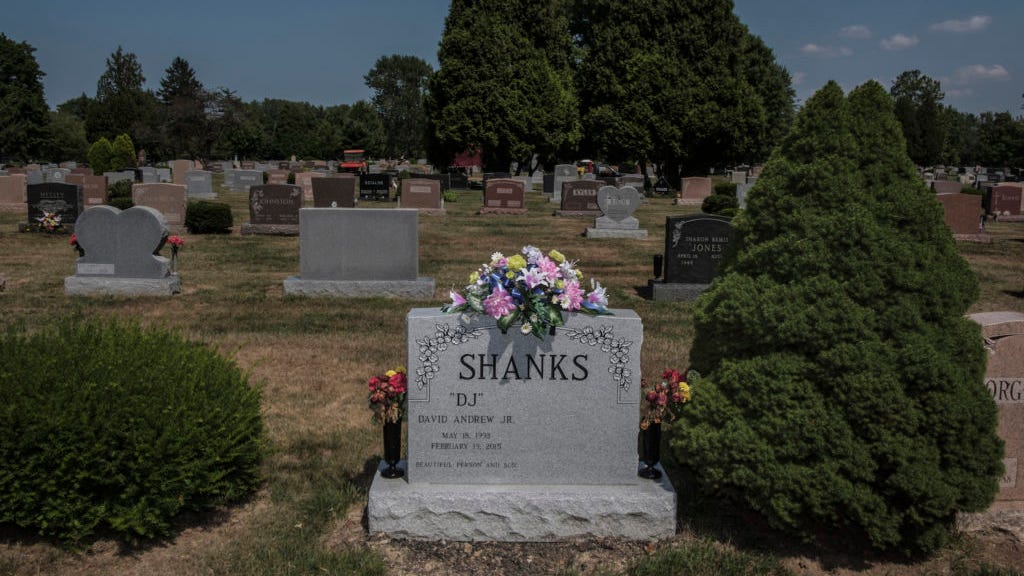
This isn’t some tragic mystery. It’s policy. Plain, ugly, deliberate policy. And until we start treating it that way—until we stop protecting the machine and start protecting the people—we’ll keep filling coffins and calling it character building.
That’s not radical. That’s just reality, twenty years late
-I'm Rxan Smith… believe me on this.. or be wrong. There's no third choice.

📺 YouTube🐦 X (Twitter)📸 Instagram (Main)📸 Instagram (Alt)🧵 Threads (Main)🧵 Threads (Alt)📘 Facebook☕ Buy Me a Coffee💰 PayPal🎭 Patreon
The Complete Series — All 25 Episodes
Ep. 25 — Systemic Poverty Areas ← You Just Finished the Series
rxansmith.substack.com · YouTube: @RealRxanSmith · X: @rxannsmith
— Rxan Smith
Uncomfortable
Making America Grow Again, One Uncomfortable Truth at a Time
Make America Grow Again • Episode 16 of 25
━━━━━━━━━━━━━━━━━━━━
© Rxan Smith. All rights reserved
I appreciate how you pull addiction out of the shadows of shame and place it in the wider context of systems, stories, and unmet needs. It reads like someone gently turning the camera angle so we see people, not just “problems.” It made me rethink how often we confuse moral judgment with understanding.
You are so spot on. As an American living in Portugal I often tell people what Portugal did. Now the town I live in doesn’t have people strung out and living on the street.
I remember the documentary of how they approached others as human beings. It’s sad to see how politicized drug addiction has gotten and the see places like Chicago where I once lived struggle.