

Income Inequality: Raising the Floor - Forget a Glass Ceiling
The Government’s Real Crime Is Keeping You Out of their Club (Because it's ours)! Make America Great Again" Rxan Smith | Part 4 of 25

L
Listen, the game is rigged. There's a big club in this country, and you ain't in it. They own the politicians on both sides, the media, the courts, the whole rigged circus. Red team, blue team—they scream about "freedom" or "fairness," but neither gives a damn about the average person getting squeezed while the top dogs hoard everything. The elites suck up the gains, ship jobs overseas, gut schools and wages, then act shocked when the system produces desperation. Income inequality isn't some accident; it's the design. The government isn't failing us—it's succeeding for the members only.
This isn't just feel-good whining. The data screams it: US Gini coefficient hovers around 0.48-0.49 in recent years (higher means more unequal), one of the worst among developed nations. When the top 1% grabs 40 times what the bottom 90% makes, resentment festers, trust collapses, and society frays. The club dines safely while the rest fight over scraps.
If you can't subscribe or share, just leave a comment and tell me what you think even if it's one word. Any engagement, whether you like it , restock it, share it or leave it comment… it helps tremendously and it usually gets a movement going.
Out of the Club, Stuck on the Floor: Today's Citizenry
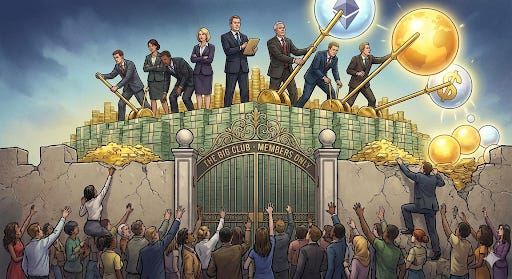
No modern democracy has excluded its citizens from real power as efficiently—or as deliberately—as ours. Voters are trapped in a horizontal war of identity and outrage while power consolidates vertically. The illusion of choice—red team or blue team—masks a deeper truth: both sides serve the same donors, dodge the same accountability, and ignore the same crises.
In 2024, I ranked every major issue by two metrics: how many Americans it affects, and how deeply. The top ten issues were clear.
Yet neither party prioritized them. Democrats didn’t rank cost of living, immigration, or corporate capture in their top ten. Republicans matched the top issue but ignored healthcare, housing, and corruption. Both parties left three of the top ten off their radar entirely—and neither included corporate capture, the root cause of income inequality, anywhere in their top 25.
The most glaring omission? Wages. The federal minimum wage hasn’t budged since 2009. Historically, it’s been raised every 3.2 years. We’ve now missed five cycles. Obama raised it once, then stalled. Trump promised action, then pivoted. Biden didn’t touch it. If we’d followed the historical trend—averaging 4.39% annual growth including inflation and productivity—the minimum wage would be $15.63 today, not $7.25.
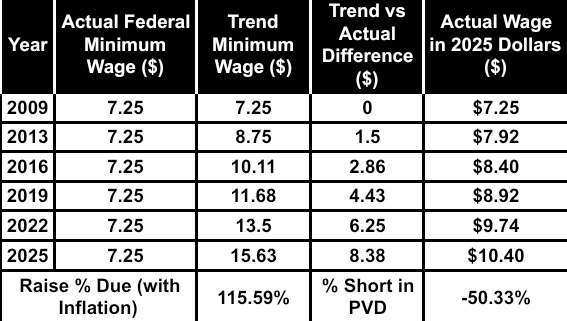
Why does this matter? Because the minimum wage sets the economic floor. When it collapses, corporations like Amazon and Walmart exploit the gap—paying non-union workers less while reporting record profits. Small businesses can’t compete. Workers lose bargaining power. And both parties pretend not to notice.
This isn’t a partisan failure. It’s a bipartisan strategy. Corporate capture ensures that wage stagnation persists, unions weaken, and economic desperation becomes the norm. The parties know to mention it—but not to fix it. They’re too busy debating foreign wars, immigration theatrics, and cultural flashpoints that distract from the economic rot beneath it all.

Income Inequality Is the Connective Tissue of Every Other Crisis
Income inequality is not a standalone issue. It is the connective tissue linking healthcare costs, tax avoidance, infrastructure decay, housing instability, and declining trust in institutions. When the economic floor is too low, every reform above it leaks.
Back to our Gini coefficient of 0.48–0.49 in recent years, placing it among the most unequal developed nations.
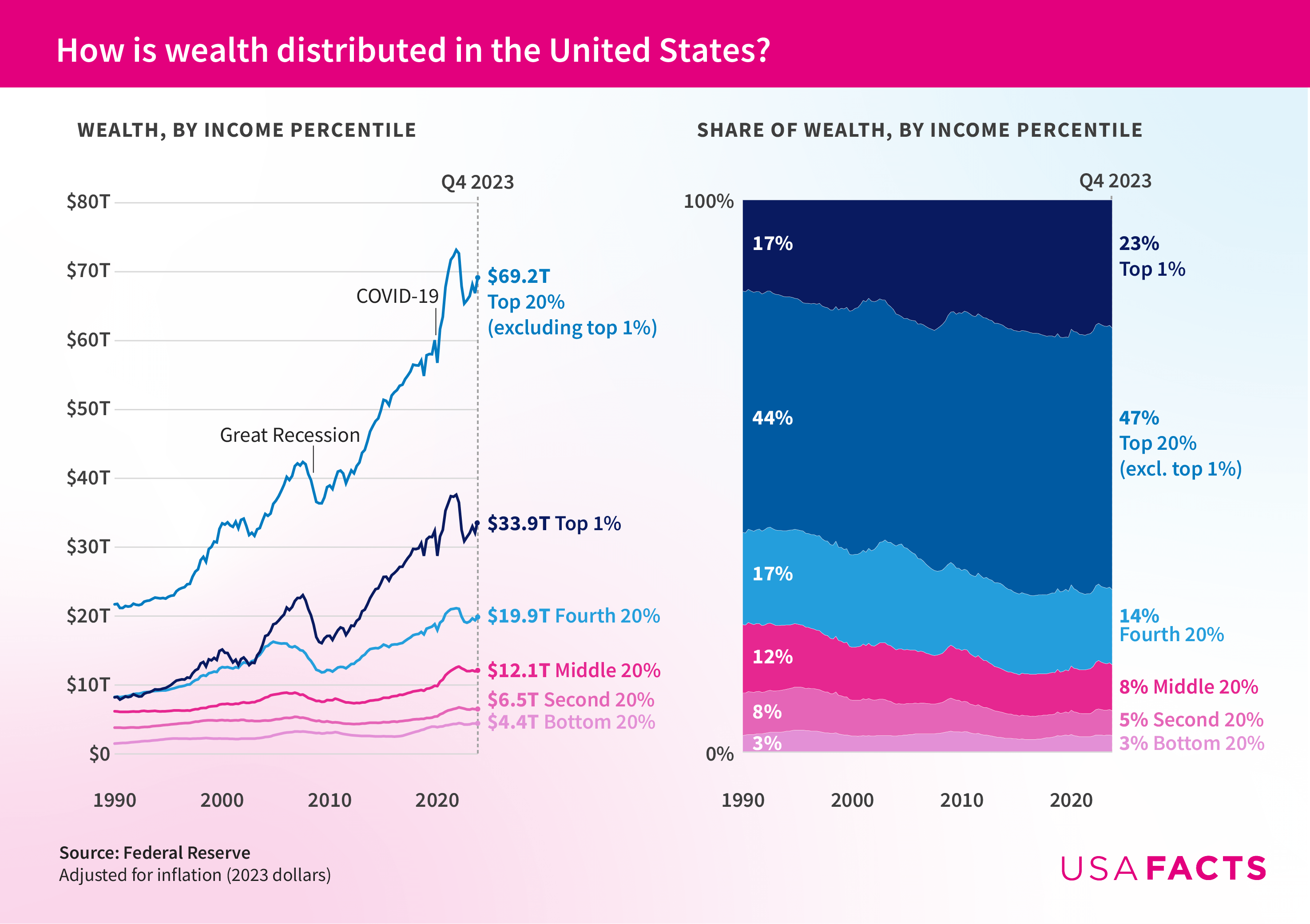
High inequality correlates with lower social mobility, weaker community cohesion, increased mental health strain, and political instability. Economic growth can occur alongside rising inequality, but shared prosperity does not. Sound familiar?
This is why income inequality cannot be treated as a moral debate. It is a structural one. The question is not whether people work hard. The question is whether the system rewards work at all.
How the System Actually Produces Inequality
At a certain level of wealth, money stops behaving like money. Income becomes assets. Assets become collateral. Collateral becomes leverage. Leverage becomes loans. Those loans buy competitors, absorb failing companies, generate accounting losses, and reduce tax exposure. Profits are privatized. Risk is socialized.
This dynamic explains why inequality widens even during strong economic periods. Productivity rises. Corporate profits soar. Stock markets boom. Wages stagnate. Wealth concentrates. The system rewards ownership exponentially more than labor.
This is not innovation failing. It is financial gravity working exactly as designed.
Why Income Inequality Is Not Attacked Head-On
Every serious attempt to confront income inequality directly encounters the same resistance: lobbying pressure, donor backlash, regulatory capture, legal challenges, and coordinated media narratives. These defenses exist because inequality is profitable.
That is why this series treats income inequality as a downstream outcome. Government transparency reveals capture. Healthcare reform removes profit from desperation. Tax reform limits leverage abuse. By the time inequality is addressed directly, the terrain has already shifted.
This is not delay. It is sequencing.
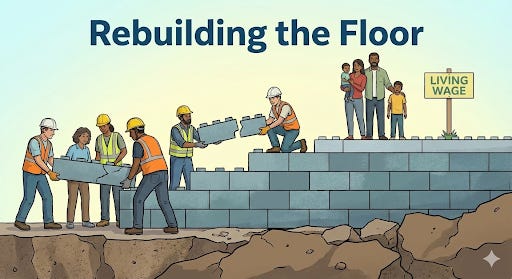
Rebuilding the Floor Instead of Worshipping a Ceiling
The American Dream did not collapse because ambition disappeared. It collapsed because the minimum standard of economic stability eroded. A system that requires constant precarity to function produces fear, burnout, and compliance—not innovation.
Raising the minimum wage to reflect real living costs is not anti-capitalist. It is market correction. When dominant employers are required to pay wages that sustain life, they are forced to compete honestly rather than relying on churn and desperation.
We already accept guaranteed wages, pensions, housing assistance, and education pathways for police, military, and public servants because stability produces competence. Extending that logic to the broader workforce is not radical. It is consistent.
Education, Work, & Mobility Must Function as One
Education access without economic mobility is a dead end. Degrees without outcomes are simply debt with prestige branding.
This framework prioritizes FREE community colleges, associate degrees, with specialist tracks aligned with workforce demand. Two years of general education. Two years of specialization. Skills tied directly to employment. No prestige tax. No lifelong debt burden. University and CC Grads will have a high floor opportunities, which are the leaves that are growing everywhere from the strong branches attached to the strong trunk, that is grown by this fourth root issue. Instead of being sold the dream of a glass ceiling, we're going to make sure that the sturdy floor is there (roots of tree).
Pair this with a government-backed relocation option that allows graduates to choose from revitalized manufacturing and infrastructure regions, and education becomes an on-ramp rather than a toll booth. Skills meet jobs. Communities rebuild. Mobility becomes tangible.
The Union Question That Never Goes Away
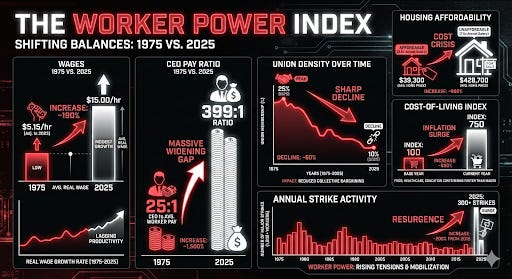
The decline of unions was not cultural drift. It was wage policy. When unions weaken, bargaining power collapses. Productivity gains flow upward. Wages stagnate regardless of output or efficiency.
.
Capital organizes automatically. Labor must fight for permission. This imbalance is not ideological—it is structural. And it is a central driver of income inequality.
The Psychological and Social Cost of Inequality
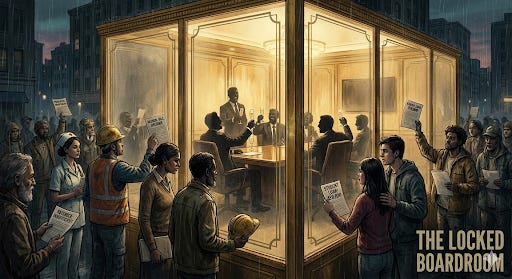
Income inequality imposes a psychological tax. People stop trusting institutions. Effort feels disconnected from outcome. Civic engagement declines. Extremism fills the vacuum left by eroded faith

.
A society with extreme inequality becomes fragile by design. This is not cultural decay. It is structural stress accumulating over time.
Why “Just Grow the Economy” Keeps Failin
The argument is familiar: grow the economy and prosperity will follow. The problem is that growth without distribution concentrates gains, converts them into political influence, and reinforces the very system that produced inequality.
Growth is fuel. Distribution is steering. For decades, the economy has accelerated while the steering wheel remained locked.
What the Opposition Will Argue and Why It Fails
Critics will argue that inequality is about personal responsibility, cultural failure, or individual choices. Others will claim that focusing on inequality distracts from racial, regional, or cultural issues. These arguments contain fragments of truth but miss the structural reality.
Yes, personal responsibility matters.
Yes, effort matters.
Yes, people make bad choices.
But effort without opportunity is just exhaustion.
Responsibility without leverage is a lecture.
You cannot bootstrap your way out of a rigged market with monopoly pricing, credential inflation, and debt traps baked in.
The real barrier is power. Lobbyists, donor networks, corporate consolidation, and political capture preserve inequality because it benefits those already positioned at the top.
Why This Will Take Time
The critical insight is timing. Transparency, healthcare reform, and tax restructuring create pressure from multiple directions. That is how durable change occurs
Short term? 1–3 years to stabilize wages, education access, and healthcare stress.
Long term?1 0–20 years to reverse generational damage.
.We already see the early signals.
Crime dropping. Violence falling. Stability working when it’s allowed to.
Turns out when people can breathe, they don’t burn everything down.
Shocking.
Epilogue
Stop pretending income inequality is some personality flaw, a minor policy oops, or—God forbid—a sign of personal laziness. It’s the goddamn engine driving every toxic thing in this country: distrust, division, rage, the slow-motion collapse of basic decency.
Democrats talk a big game about “corporate capture”—then quietly cash the checks and call it “pragmatism.” Republicans? They straight-up admit they’re in bed with big business; they’ve got their heads so far up the ass of corporate America they think the world is just one giant colon. Both sides benefit from the rigged game. Both keep the ladder pulled up. Everyone else pays the real price—stagnant wages, exploding costs, kids who can’t afford college without selling their future to loan sharks.
Your ideology only works if you’re already winning. The right needs to quit worshipping markets like they’re holy scripture. The left needs to stop thinking slogans are policy. This isn’t envy. It’s math. It’s whether we want a real country or a gated spreadsheet where the top 1% treats the rest like NPCs in their private simulation.
The floor is the problem. Raise it—with living wages hitting $15+ in more states starting 2026, real union power, education that actually moves people up—and the whole damn structure finally has somewhere to stand. Until then, we’re just yelling at shadows while the big club laughs and counts the cash.
Watch the full breakdown on YouTube @RealRxanSmith
Discussion Prompt: When did your faith in the system crack?

Support Independent Media
$5 | $10 | $20 | $50 | $75 | $100
Connect With Rxan Smith
Connect With Rxan Smith Across the Web
📺 YouTube🐦 X (Twitter)📸 Instagram (Main)📸 Instagram (Alt)🧵 Threads (Main)🧵 Threads (Alt)📘 Facebook☕ Buy Me a Coffee💰 PayPal🎭 Patreon
25 Fixes Make America Grow Again
Listen up
I’m done renting rage. I’m done waiting for permission.
I’m here to write truth. Not Left, Right, or Center—because if you still think any of that works, you haven’t been paying attention.
“Make America Great Again” wasn’t magic. It was marketing.
Here’s the uncomfortable part: when Trump said it, he wasn’t wrong.
We haven’t been great in decades. But that’s not on him.
That’s on US—for letting government turn public service into a subscription plan.
I think that there are a number of systems. Some of them i see serious differences between the way they're designed to run and how they're actually running and i support a correction to the ideal. Others were never designed for us