

Corporate Capture | Puppet Show of Democracy
Make America Grow Again | Episode 17 | How Big Business Hijacked America’s Growth Engine

Stop Scrolling: Our Democracy Was Sold While You Were Googling “How to Afford Insulin”
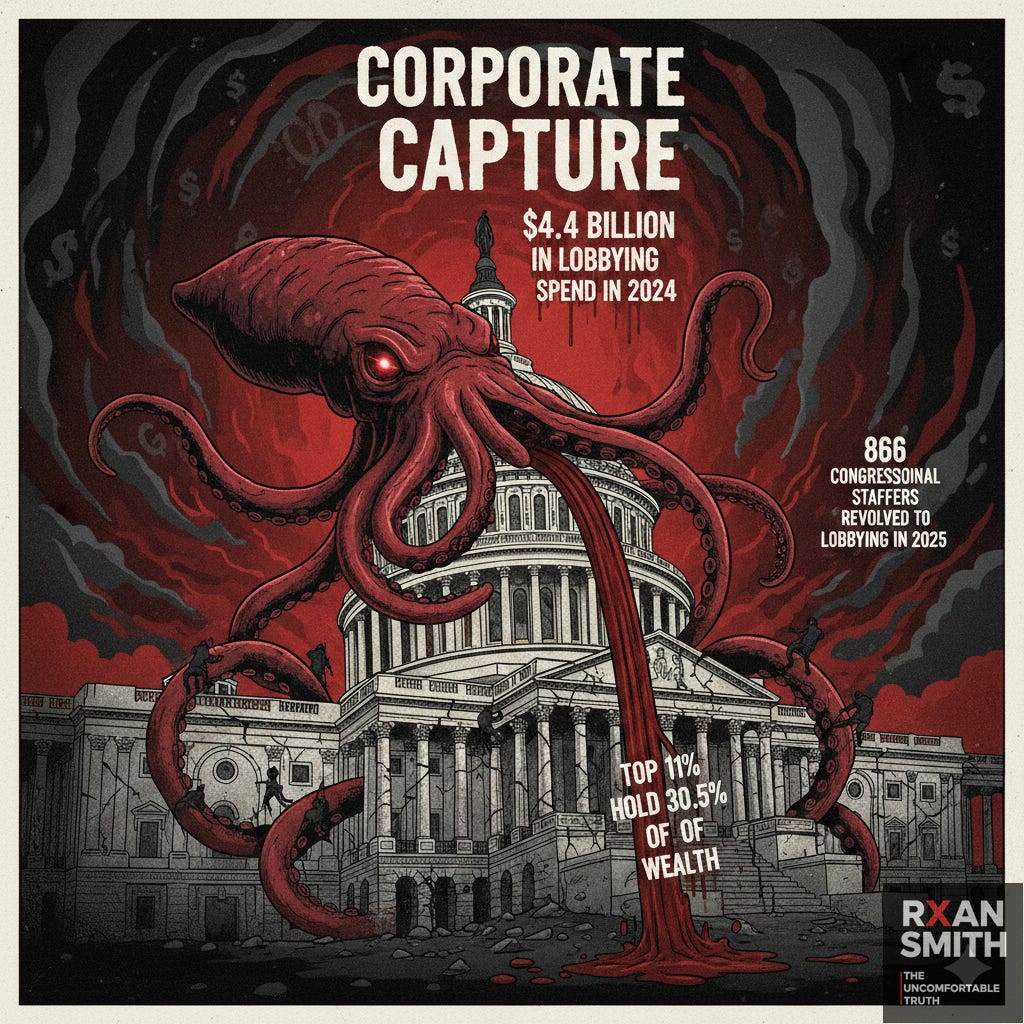
In 2024 alone, corporations and industry groups spent $4.4 billion lobbying the federal government. That number isn't opinion. It's publicly reported data.
Now ask yourself something simpler: when healthcare premiums rise faster than wages, when college costs outpace inflation for decades, when energy companies report record profits during price spikes, is that coincidence? It certainly is not coincidence, and it wasn’t bad luck either… it was purchased policy.
You know what scares me most? It’s not the politicians in Washington—it’s the forces pulling their strings from the luxury boxes. Corporate capture is just a polite way of saying the whole damn government’s been bought out. Remember when democracy meant “of the people, by the people, for the people”? Now it’s “of the lobbyists, by the campaign donors, for the shareholders.”
These suits in boardrooms aren’t content with owning the economy—they’ve gotta own the referees too. They slip millions into politicians’ pockets through perfectly legal channels, and suddenly regulations vanish faster than ethics in an Enron meeting. And us? We’re the ones left holding the bill: poisoned water, unaffordable prescriptions, rigged markets.
Welcome to corporate capture: the silent auction where your democracy gets sold to the highest bidder. We hear the term, corporate capture, from time to time, but… what is it?
Corporate Capture has been transforming democratic institutions into systems increasingly responsive to concentrated economic power rather than public interest.
This is not a conspiracy theory. It is an incentive structure.
Powell warned of threats to the “American free enterprise system” and urged businesses to fight back by aggressively influencing politics, media, academia, and courts. His memo laid the groundwork for the corporate dominance we see today. Business listened. Over the following decades, lobbying infrastructure expanded, campaign finance rules loosened, and regulatory agencies increasingly drew leadership from the industries they oversaw.
Fast-forward to now: In 2024, federal lobbying spending hit that record $4.4 billion, with heavy hitters like the U.S. Chamber of Commerce shelling out $69 million alone. That’s billions funneled to shape policies that favor profits over people. This capture has eroded America’s democratic foundations since the 1970s, turning growth engines into monopolistic sloths and leaving everyday Americans footing the bill for inequality and stagnation.
For perspective, compare the U.S. to Denmark, where strict lobbying bans and transparent governance yield high trust (over 70% trust government) and low corruption. Denmark has 5.9 million people—about the same as Wisconsin. Yet somehow they figured out how to ban lobbying, maintain 70% public trust in government, and deliver healthcare without bankrupting families. Meanwhile, Wisconsin gave us Paul Ryan and dairy farmers who can’t afford to see dentists. The difference? Denmark made bribery illegal. We made it “free speech.”
Examples abound: The opioid crisis, fueled by captured FDA approvals from revolving doors with pharma executives, has cost billions in public health and over 100,000 lives annually. Or consider the 2008 financial crash, where Wall Street’s grip on the SEC led to deregulated risks, bailouts for the rich, and widened wealth gaps—Oxfam reports the top 1% now hold more wealth than the bottom 90%.
These aren’t bugs—they’re features. The system is working perfectly for people who can afford $69 million in lobbying spend. This didn’t happen to us—it was done TO us, invoice by invoice, rider by rider, one corporate-authored bill at a time.
This erosion isn’t inevitable—it’s fixable, if we’re willing to get uncomfortable and act. By understanding the mechanics, harms, history, and solutions, we can reclaim our democracy for growth that benefits all, not just the elite. As we’ll see, nations like Singapore, with meritocratic systems minimizing capture, boost efficiency and prosperity. Time to pull back the curtain on this puppet show.
“The judiciary may be the most important instrument for social, economic and political change.” – Lewis Powell, 1971 Memo
The Mechanics of Capture: How Corporations Pull the Strings
Corporate capture doesn’t happen by accident. It’s a well-oiled machine with interlocking parts. At its core are three pillars: revolving doors, dark money, and media manipulation. These tools allow corporations to infiltrate government, buy influence, and shape public perception, all while dodging accountability.
This is the game where big business writes the rules, refs the match, and owns the scoreboard while charging you admission.
The Revolving Door: Musical Chairs for the Morally Bankrupt
The revolving door describes the movement of officials between government and the industries they regulate. Supporters argue this provides expertise policymakers need. Critics argue it creates incentives to avoid aggressive oversight that could jeopardize future employment.
Both can be true—but the evidence overwhelmingly favors the critics.
This is the merry-go-round where corporate executives slide into government roles, weaken regulations, then spin back to lucrative industry jobs. Take the FDA: Former Monsanto executives have landed key positions, prioritizing biotech approvals over public health concerns. Or Boeing’s cozy relationship with the FAA, where self-certification led to the 737 MAX disasters, killing 346 people. It’s not oversight; it’s an inside job.
In 2025, a total of 866 Members of Congress and congressional staffers moved from Capitol Hill to K Street, a 60% increase over 2024. That’s nearly 900 people who went from supposedly serving you to definitely serving corporate interests. When regulators anticipate lucrative private-sector roles, enforcement decisions may subtly—or not so subtly—shift toward accommodation rather than confrontation.
The issue is rarely explicit corruption. It’s aligned incentives creating structural capture. Compare this to Singapore, where strict ethics rules and meritocratic governance limit such transitions, fostering transparent decision-making and consistently topping global anti-corruption rankings.
Dark Money: Citizens United Opened the Floodgates to Hell
The 2010 Supreme Court decision Citizens United v. FEC expanded protections for political spending as speech, equating corporate money with individual expression. Supporters argued this protected constitutional rights. Critics warned it would amplify wealthy voices disproportionately and unleash unlimited anonymous donations.
The critics were right.
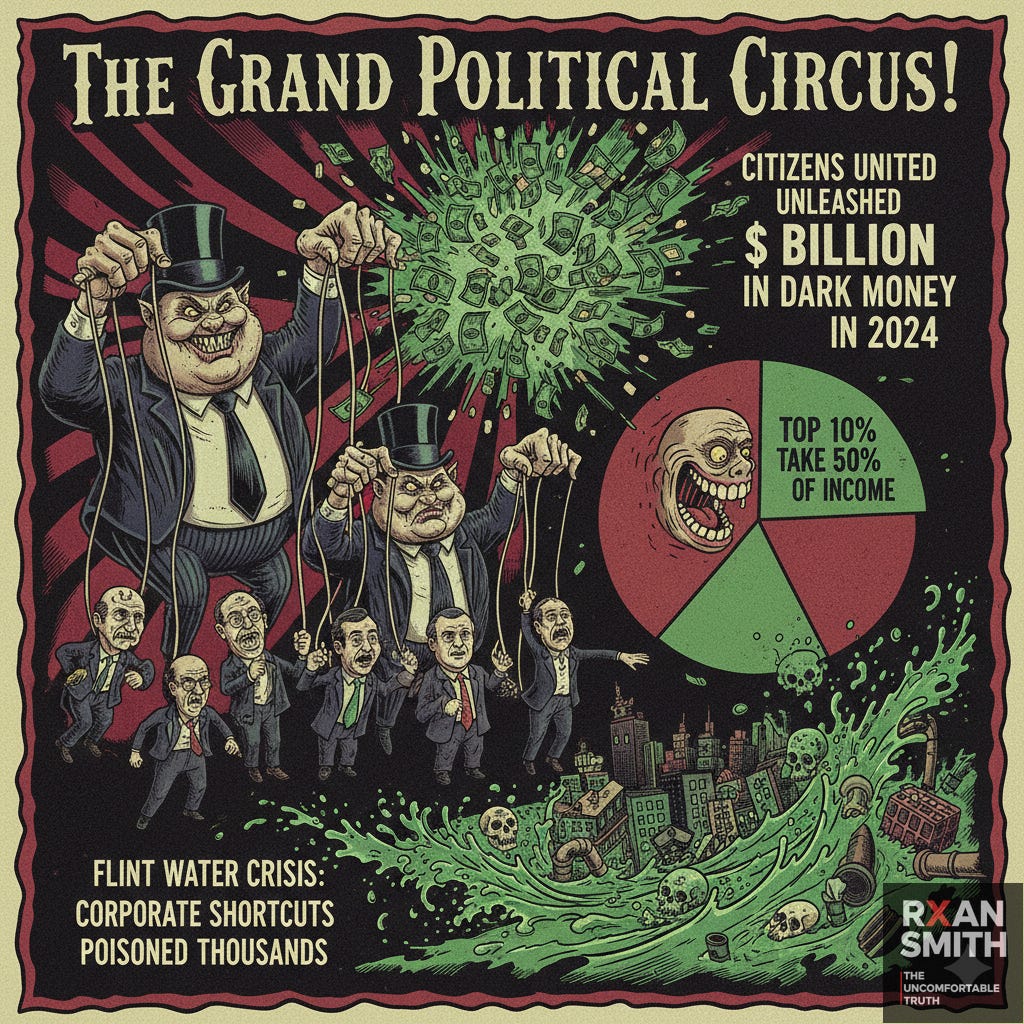
Since then, dark money in elections has exploded, topping $1 billion in 2024 alone, with groups funneling millions to influence outcomes without disclosure. Outside spending has surged into the billions each election cycle. Billionaires and corporations now treat elections like investments, expecting ROI in favorable policies.
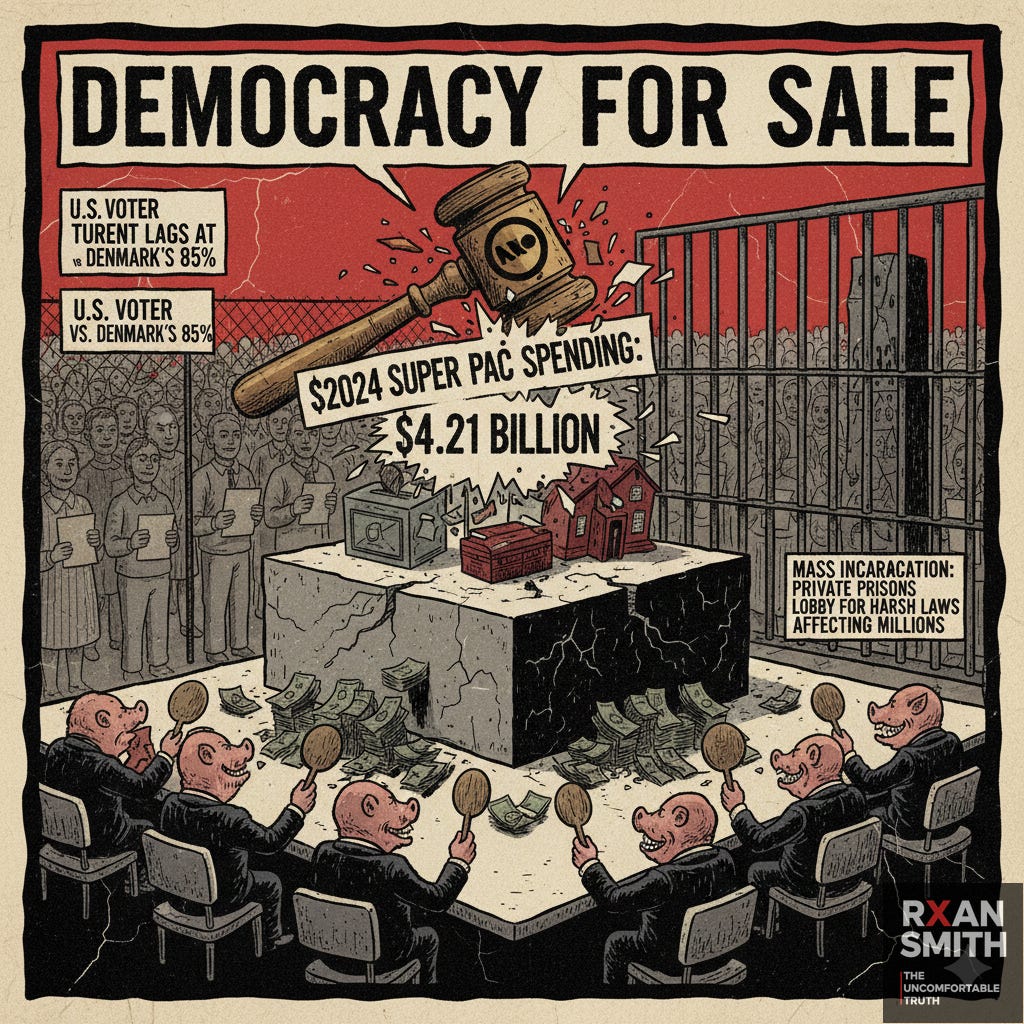
The impact? Post-Citizens United, super PACs spent $4.21 billion in 2024, mostly from the wealthiest donors, reshaping campaigns. Elections increasingly resemble capital markets where influence scales with financial capacity. When a single donation can be larger than your lifetime earnings, we don’t have democracy—we have an oligarchy with better PR.
In contrast, Denmark’s strict lobbying bans keep money out of elections, maintaining high public trust at over 70%. The difference in outcomes is stark.
Media Ownership: Six Corporations Control What You Think
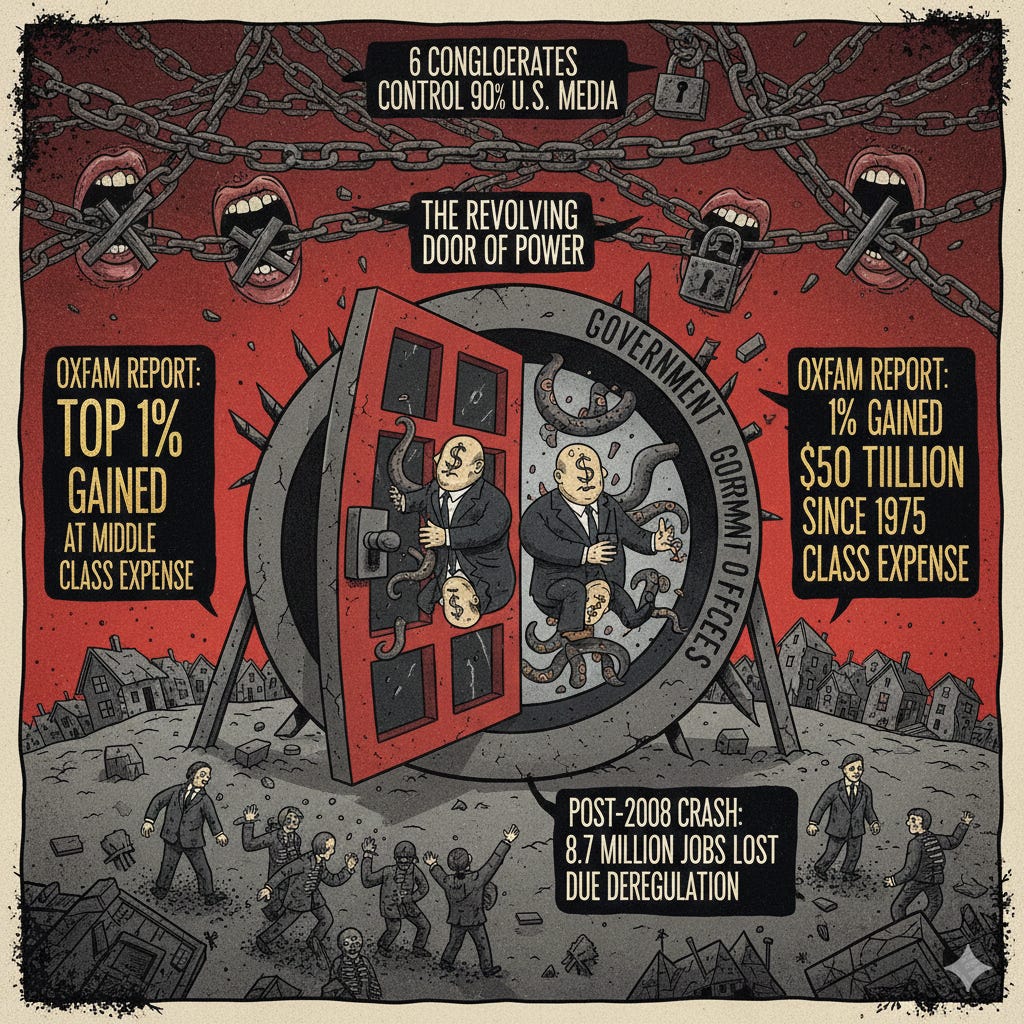
Media consolidation has concentrated ownership among a small number of conglomerates controlling much of American broadcast and cable audiences. Six conglomerates now control 90% of U.S. media. This doesn’t require coordinated censorship to shape discourse—structural incentives alone influence coverage priorities.
Stories threatening major advertisers or parent corporations face higher editorial friction than safe political spectacle. The result: echo chambers that erode public trust and enable misinformation. Add in lobbying—$3.5 billion in 2010, now over $4 billion annually—and you’ve got a system where policy is dictated by the highest bidder.
Examples proliferate: Big Oil’s influence delayed EPA fracking regulations, contributing to environmental disasters like Flint’s water crisis. Wall Street’s grip on the SEC fueled the 2008 crash, with bailouts for banks but crumbs for Main Street. Post-2008, 8.7 million jobs were lost due to deregulation while executives walked away with golden parachutes.
These mechanics don’t just distort policy; they stifle growth by prioritizing short-term profits over long-term innovation and fairness. As discussed in our Antitrust Failures (Fix #9), weak merger enforcement exacerbates this, allowing giants to crush competition.
Globally, nations like Denmark show that minimizing capture leads to equitable growth. U.S. wealth inequality hit peaks in 2024, with the top 1% holding 30.5% of wealth. To break free, we must address these pillars head-o
n
Follow the Money: A Case Study in Purchased Pain
Let’s trace one specific thread from corporate lobby dollar to policy outcome to human suffering. This isn’t theory—it’s forensic accounting of your stolen democracy.
The Opioid Epidemic: A Timeline of Capture
Addiction in this country, specially the opioid epidemic, illustrates how regulatory weakness, aggressive marketing, and policy influence can intersect with devastating results.
2019: PhRMA (Pharmaceutical Research and Manufacturers of America) spends $29.7 million lobbying Congress and federal agencies
2020: Key FDA officials hired directly from Purdue Pharma and other opioid manufacturers; revolving door spins
2021: Opioid approval processes weakened; warning label requirements softened; “abuse-deterrent” claims go unchallenged
2022-2023: Over 100,000 overdose deaths annually; families destroyed; communities hollowed out
2024: Sackler family walks free with $6 billion fortune intact; corporate liability shields hold
Meanwhile: Your medical insurance premiums went up 40% during this exact period
See the direct line? Lobby money → Captured regulators → Weakened oversight → Mass death → Protected wealth → Your increased costs. This isn’t correlation. It’s causation with receipts.
No single factor caused the crisis. Medical culture, patient demand, economic despair, and overprescription all played roles. But lobbying delayed regulatory correction and shaped the policy environment in which the crisis expanded. The tragedy reveals how capture amplifies existing vulnerabilities rather than creating them alone.
And it’s not just pharma. The same pattern appears across sectors:
Finance: Wall Street → SEC → Deregulation → 2008 crash → Bailouts → Your underwater mortgage
Energy: Big Oil → EPA → Delayed fracking rules → Flint water crisis → Your poisoned tap water
Tech: FAANG companies → FTC → Ignored mergers → Monopoly power → Your data sold without consent
Every. Single. Time. The formula is identical: corporate cash buys access, access buys favorable policy, favorable policy extracts wealth from you and funnels it upward.
Economic Consequences: Policy Distortion and Stifled Growth
Corporate capture reshapes economic outcomes through several interconnected channels, creating a rigged economy where growth benefits the few while costs are socialized across everyone else.
Economic Distortions: Widening Gaps and Stifled Innovation
Revolving Doors Undermine Regulatory Integrity: As seen with opioid approvals, leading to epidemics that cost billions in public health. In 2025, 866 staffers revolved to lobbying, up 60%. Boeing’s captured FAA killed 346 people in 737 MAX crashes.
Lobbying Distorts Policy Priorities: Tax structures and subsidies increasingly favor capital over labor. Billions in lobbying skew tax codes, with the ultra-wealthy paying less effective rates than workers. 2024 saw $4.4 billion spent—more than the GDP of 30 countries.
Campaign Finance as Legal Bribery: Citizens United enabled $14B in dark money impacts, eroding trust. Super PACs spent $4.21B in 2024. When a single donation exceeds lifetime earnings for most Americans, democratic responsiveness becomes a fiction.
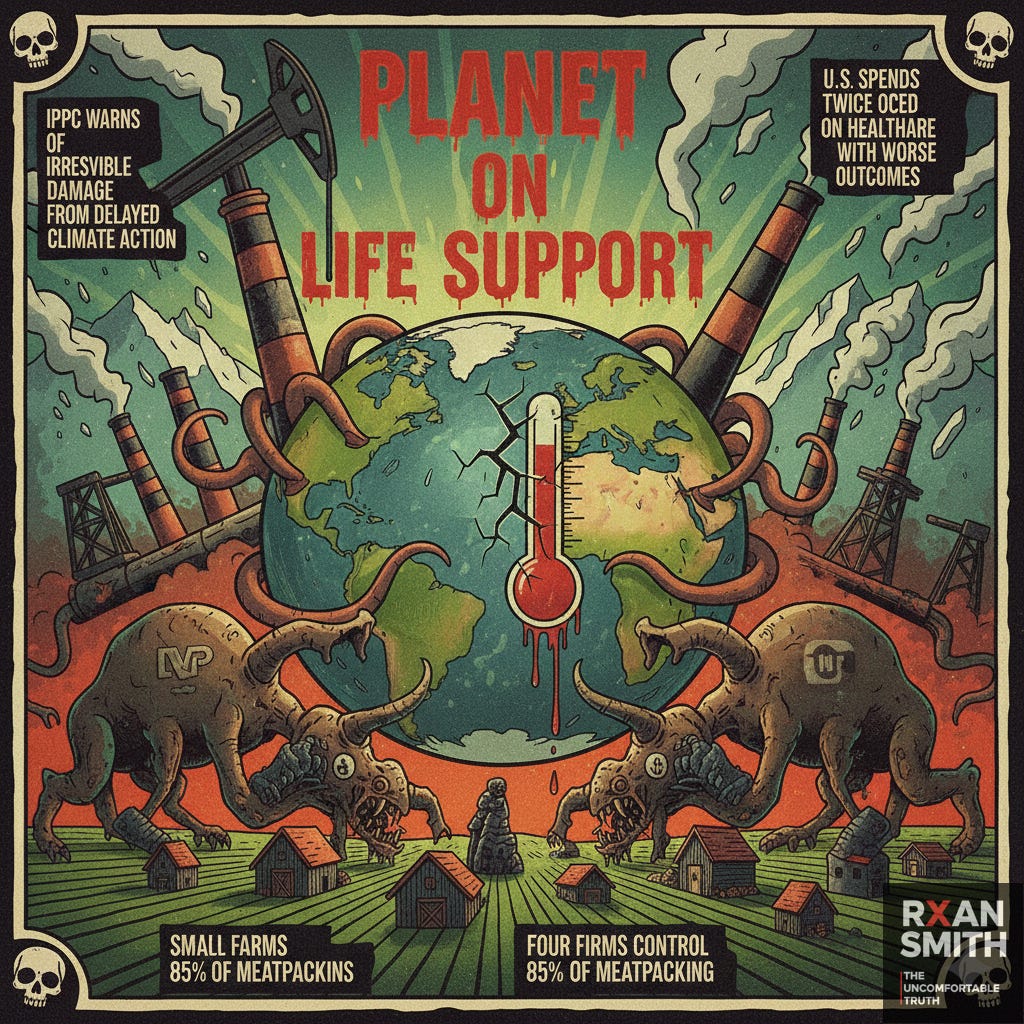
Antitrust Failures Breed Monopolies: Weak antitrust enforcement enables dominant firms to suppress competition. Tech giants like Amazon crush competition, reducing innovation per FTC suits that go nowhere. Four firms now control 85% of meatpacking vs. fragmented markets pre-1980s. Historical breakups like Standard Oil fostered competition; today’s mergers crush it.
Financial Deregulation Fuels Instability: Deregulatory pressures contributed to systemic risk preceding the 2008 crisis. Post-crash, wealth gaps widened catastrophically; Oxfam reports top 1% hold more than bottom 90%. Meanwhile, you’re still paying off that underwater mortgage from a crash they caused and profited from.
Tax Policy Engineered for Evasion: Corporate-written loopholes shift tax burdens to wage earners, underfunding infrastructure by trillions. Amazon paid $0 federal taxes in 2018 while you paid thousands.
Labor Laws Weakened by Corporate Capture: Declining union power correlates with wage stagnation and rising inequality. Right-to-work laws written by corporate lobbyists passed in 27 states, decimating collective bargaining.
Research by political scientists Martin Gilens and Benjamin Page suggests policy outcomes align more closely with elite preferences than median voter preferences, raising uncomfortable questions about democratic responsiveness. Their landmark study showed U.S. policy reflects top 10% preferences 90% of the time and bottom 50% preferences near 0%—that’s not democracy, that’s oligarchy.
U.S. inequality surged post-1980, with top 10% taking 50% of income by 2016, vs. Europe’s steady 35%. As explored in our post on Income Inequality (Fix #4), this links directly to poverty cycles that trap generations.
Environmental and Health Impacts: Poisoning the Well
Regulatory systems shaped by industry influence often prioritize short-term cost reduction over long-term public welfare, with devastating consequences.
Environmental and Health Crises
Environmental Regulations Gutted by Fossil Fuel Capture: Industry lobbying delays climate action; IPCC warns of irreversible damage. Environmental crises such as Flint’s water contamination demonstrate how austerity pressures, privatization incentives, and weak oversight converge with devastating results. Corporate cost-cutting literally poisoned an entire city’s children with lead.
Healthcare System Captured by Big Pharma: Industry blocks reform efforts, inflating costs. Similarly, pharmaceutical patent extensions and regulatory complexity contribute to dramatically higher drug prices in the United States compared with peer nations. U.S. spends twice OECD average per capita with worse health outcomes. Insulin costs $300/vial here vs. $30 in Canada because pharma wrote the rules.
Agricultural Subsidies Favor Corporate Giants: Factory farms dominate via USDA capture, harming small farmers, public health, and the environment. Four companies control 85% of beef processing—and wrote the safety inspection rules.
Energy Policy Locked in Fossil Fuels: Industry capture blocks renewable transition; China leads solar while U.S. subsidizes coal. We give $20 billion annually in fossil fuel subsidies while claiming we can’t afford green energy.
Intellectual Property Weaponized Against Public Health: Pharma-written patent extensions keep drug prices astronomical, limiting healthcare access. Life-saving medications stay expensive decades past development costs because captured regulators extended monopoly protections.
Flint’s crisis exemplifies intersectional harm: Corporate shortcuts poisoned water, hitting poor and minority communities hardest. U.S. environmental harms disproportionately affect minorities, widening racial and economic divides as explored in our Climate Change Action (Fix #6) post.
Social and Democratic Undermining: Eroding Rights and Trust
The Erosion of Democratic Participation
Tech Surveillance Enabled by Captured Regulators: Corporate data harvesting threatens privacy and free speech. Your browsing history is for sale because the people who were supposed to protect you took jobs at the companies doing the selling.
Media Ownership Shapes Public Discourse: Media consolidation doesn’t require coordinated censorship—structural incentives suffice. Six-company media monopoly suppresses inequality stories, manufacturing consent for corporate-friendly policies. They won’t cover corporate capture because they ARE corporate capture.
Military-Industrial Complex Drives Endless Wars: Defense contractor capture of Pentagon and Congress drains trillions, eroding civil liberties. Perpetual war is profitable—but only for Lockheed Martin shareholders, not dead soldiers’ families.
Trade Deals Prioritize Corporate Rights Over Sovereignty: ISDS (Investor-State Dispute Settlement) clauses let corporations sue governments in private tribunals, subordinating democratic will to profit. Your country can be sued for protecting its citizens.
Education Privatization Diverts Public Funds: For-profit schools and charter advocates capture education policy, deepening inequality. Betsy DeVos didn’t happen by accident—she bought her way into destroying public education.
Criminal Justice Captured by Private Prisons: Incarceration-for-profit drives mass imprisonment, disproportionately affecting minorities. Private prisons literally lobby for harsher sentencing to fill their cells and pad their profits.
Infrastructure Neglect from Privatization Push: Corporate toll road schemes replace public investment; bridges collapse while consultants profit. Our infrastructure gets a D+ grade while contractors get billions.
Overall Erosion of Democratic Trust and Participation: Cynicism from visible capture depresses civic engagement and voter turnout. When people see the game is rigged, they stop playing—which is exactly what corporate interests want.
These harms are interconnected: Economic insecurity fuels environmental injustice, which breeds political disengagement. Globally, Denmark’s low capture correlates with high civic engagement (85% voter turnout); U.S. turnout lags at 66% in 2024.
The Economist now ranks us a “flawed democracy”—and corporate capture is why. This systemic damage to civic trust connects directly to our post on Government Transparency (Fix #1).
The Corporate Capture Scorecard: How to Recognize It in Real Time
Is It Corporate Capture? (Check 3+ boxes and you’ve found it)
Use this framework to identify corporate capture as it happens:
☐ Revolving Door Red Flag: Former industry exec now regulating their old company (or planning their return)
☐ Lopsided Benefits: Policy massively benefits one sector while costs are socialized across taxpayers
☐ Opacity Alert: Public can’t see who funded the research, wrote the bill, or lobbied for the rule
☐ Job Creation Theater: “Job creation” mentioned prominently, but worker wages, benefits, and conditions aren’t
☐ Toothless Enforcement: Regulations exist but have no enforcement budget, staff, or meaningful penalties
☐ Media Blackout: Coverage is weirdly muted or nonexistent despite obvious public interest
☐ Complexity as Camouflage: Policy is deliberately convoluted to prevent public understanding
☐ Speed Kills: Major policy changes rushed through without adequate public comment or debate
Three or more checks? Congratulations, you’ve spotted corporate capture in the wild. Now ask: who profits, who pays, and who’s pretending it’s all perfectly normal?
Historical Context and Global Comparisons: It’s Not Inevitable
Corporate capture isn’t baked into America’s DNA; it’s a post-1970s affliction with a clear origin story. The modern political economy did not emerge overnight. It was built deliberately.
Before Reagan’s deregulation era and the Powell Memo’s activation, antitrust enforcement was robust and effective. The 1911 Standard Oil breakup created competition that fueled innovation. The 1982 AT&T divestiture birthed the modern tech industry—imagine if we’d let Ma Bell stay intact.
The Powell Memo shifted gears, mobilizing business against “attacks” from consumer and environmental movements. Post-memo, mergers exploded unchecked, with industry concentration rising dramatically. Today, four firms control 85% of meatpacking vs. fragmented, competitive markets pre-1980s. Tech monopolies now dominate in ways that would have triggered automatic breakups 40 years ago.
Global comparisons prove reform is possible:
Denmark: Strict lobbying bans and transparent governance yield high trust (over 70% trust government) and low corruption. Denmark’s wealth inequality is dramatically lower, with top 10% holding 35% of income vs. U.S. 50%. Their Gini coefficient (measure of inequality) is 0.28 vs. U.S. 0.41—the difference between shared prosperity and extraction.
Singapore’s meritocratic system minimizes capture through high civil service salaries, strict ethics enforcement, and transparency requirements—boosting economic efficiency and growth. Singapore consistently tops EIU business environment rankings.
These nations prove minimizing capture leads to higher prosperity and equity—lessons for America to reclaim its growth potential, as explored in our Government Transparency (Fix #1) post.
Pre-1970s America had stronger unions (35% membership vs. 10% today), progressive taxes that actually captured wealth (top rate 70-91% vs. effective ~23%), and inequality at generational lows in the 1960s. Post-Powell implementation, the top 1% wealth share rose from 22% to 30.5% by 2024—a transfer of $50 trillion from the middle class to the wealthy, per Oxfam calculations.
Reverting to robust antitrust enforcement, like the AT&T breakup that created the conditions for the tech boom, could revive broad-based growth. The difference between then and now isn’t economics—it’s political will crushed by corporate capture. Institutional design matters.
The Revolving Door Hall of Shame: Names, Numbers, Consequences
The Revolving Door Hall of Shame
Real names. Real money. Real consequences. These aren’t theoretical—these are specific people who cashed in on their public service while Americans paid the price.
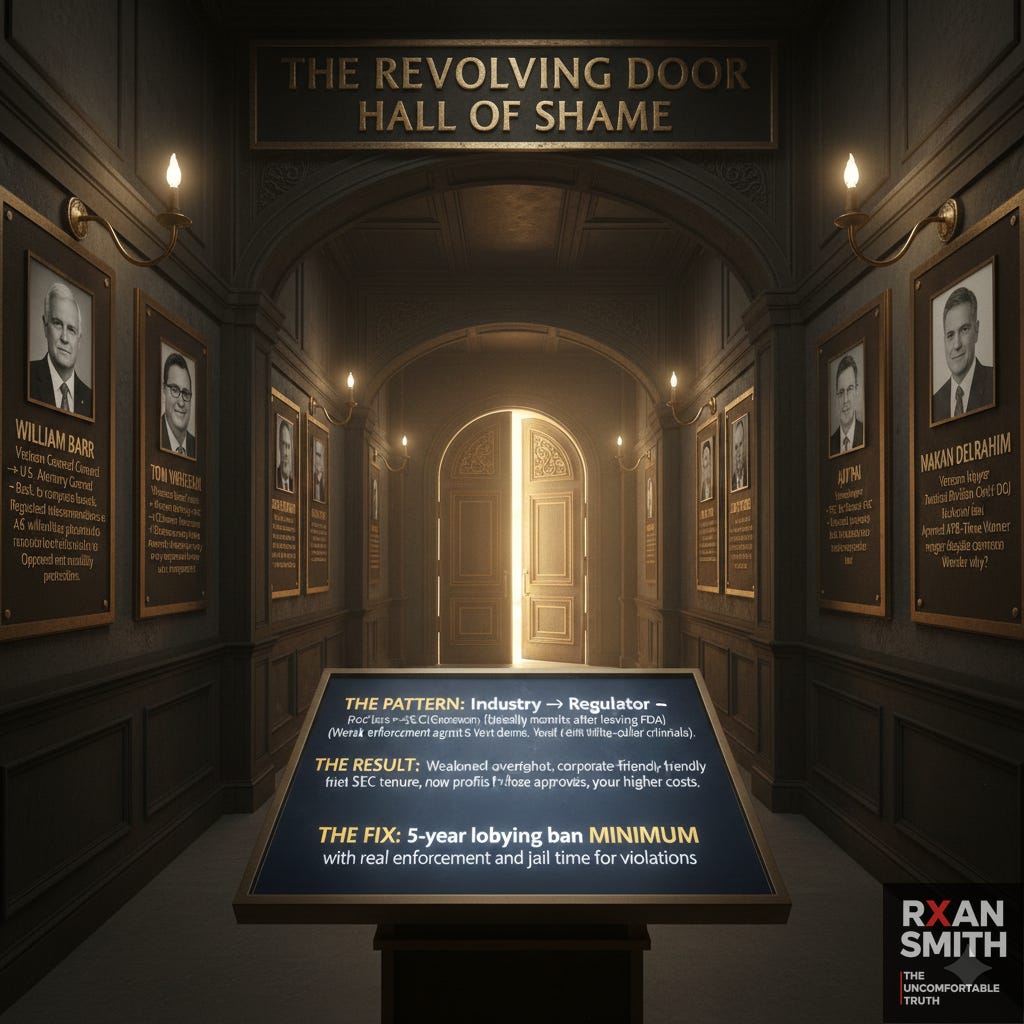
William Barr:
Verizon General Counsel → U.S. Attorney General → Back to corporate boards
Regulated telecommunications as AG while planning return to telco industry. Opposed net neutrality protections.
Tom Wheeler:
Wireless industry’s top lobbyist → FCC Chairman regulating wireless industry
Oversaw merger approvals for the very companies he used to represent.
Robert Khuzami:
Deutsche Bank General Counsel → SEC Enforcement Director → Kirkland & Ellis (defends white-collar criminals)
Weak enforcement against banks during his SEC tenure. Now defends the same firms.
Scott Gottlieb:
FDA Commissioner → Pfizer Board Member (literally months after leaving FDA)
Approved drugs while regulator, now profits from those same approvals.
Ajit Pai:
Verizon lawyer → FCC Chairman → Headed back to industry
Killed net neutrality to benefit his former and future employers.
Makan Delrahim:
Telecom lobbyist → Antitrust Division Chief at DOJ → Back to corporate law
Approved AT&T-Time Warner merger despite concerns. Wonder why?
The Pattern: Industry → Regulator → Back to Industry, Richer
The Result: Weakened oversight, corporate-friendly rules, your higher costs
The Fix: 5-year lobbying ban MINIMUM with real enforcement and jail time for violations
The Counterargument: Isn’t Lobbying Necessary?
Defenders of the current system raise legitimate points worth addressing directly:
Policymakers require technical expertise industries possess
Political spending can represent genuine ideological participation
Regulation can slow innovation if poorly designed
The problem is not participation itself. The problem emerges when participation becomes dominance.
Let’s dismantle the corporate capture apologists’ favorite talking points:
Myth #1: “Lobbying is just free speech protected by the First Amendment”
Reality: It’s amplified speech for the rich that drowns out everyone else. When one side has a $4.4 billion megaphone and the other has a whisper, that’s not free speech—it’s rigged speech. Citizens United didn’t protect speech; it weaponized money against democracy. The Founders never intended “speech” to mean unlimited anonymous corporate cash flooding elections.
Myth #2: “Regulations kill jobs and stifle innovation”
Reality: Evidence shows strong, well-enforced rules foster innovation and stability, not kill it. Deregulated finance led to 2008’s crash, costing 8.7 million jobs. Regulated eras (1940s-1970s) saw steady, broad-based growth and the highest innovation rates in American history. The tech boom followed the AT&T breakup—antitrust enforcement CREATED innovation. Meanwhile, today’s monopolies are innovation graveyards buying up competitors to kill their products.
Myth #3: “Corporate input ensures regulations are practical and workable”
Reality: Data conclusively shows captured input skews policy toward elite preferences. The Gilens and Page study found U.S. policy reflects top 10% preferences 90% of the time and bottom 50% preferences essentially never—near-zero correlation. That’s not “practical input”—that’s oligarchy. Compare to Denmark’s balanced stakeholder consultation process that includes labor, consumers, and environmental groups equally with industry—yielding policies that work for everyone, not just shareholders.
Myth #4: “Revolving door people bring valuable expertise to government”
Reality: They bring conflicts of interest and future employment incentives to go easy on their next employer. The expertise argument crumbles when you see the pattern: lenient regulation during government service, lucrative industry job immediately after. That’s not expertise—it’s an extended job interview paid for with your regulatory protections.
Myth #5: “American free market system is the best and this is just how it works”
Reality: This isn’t free market capitalism—it’s crony capitalism. Actual competitive markets require umpires who can’t be bought. U.S. capture has widened inequality to historic extremes, with the top 1% capturing $50 trillion from the middle class since 1975 (per Oxfam). Meanwhile, Denmark and Singapore prove you can have thriving capitalism WITH strong anti-corruption enforcement and equitable growth. They’re not socialist paradises—they’re capitalist countries that made bribery illegal.
Healthy democracies balance expertise with independence. Capture occurs when regulators depend more on industries than on the public they serve. As explored in our Transparency (Fix #1) post, these defenses always crumble under scrutiny.
The Path Forward: Banning the Revolving Door and Burning Down K Street
Reform does not require abolishing markets or demonizing business. It requires restoring balance between economic power and democratic oversight. Fixing corporate capture demands bold reforms that will make lobbyists squeal. Good. Let them squeal while democracy heals.
Immediate Actions (Year 1)
5-Year Lobbying Ban for All Former Officials: Extended cooling-off periods before officials can lobby former agencies. Close the revolving door with a 5-year minimum. Any violation results in forfeiture of government pension and criminal prosecution. Make the door one-way.
Real-Time Lobbying Disclosure: Real-time lobbying transparency databases showing every meeting, every dollar, every contact—public within 24 hours. Lobbyists hate sunlight? Too bad. Transparency is the price of access.
Public Campaign Financing: Expanded public campaign financing options to level the playing field. If you want to serve the public, let the public fund your campaign—not corporations buying access.
Constitutional Amendment (Years 1-3)
Overturn Citizens United via 28th Amendment: Corporations are not people. Money is not speech. A constitutional amendment is the only permanent fix to this catastrophic decision that legalized bribery. This faces enormous political resistance, but history shows reform waves occur when public awareness aligns with institutional pressure.
Structural Reforms (Years 2-3)
The EXPERTS Act: This legislation proposes key changes including:
Codify Chevron deference to restore agency expertise over corporate interference
Mandatory disclosure of all study funding in rulemaking—no more industry-funded “science”
Create an Office of the Public Advocate with subpoena power and independent funding
Institute meaningful fines for corporations that lie to regulators—make penalties exceed profits from the lie
Independent Oversight Boards: Create truly independent regulatory boards with fixed terms, protected funding, and appointment processes insulated from industry capture. Think Federal Reserve independence, applied to FDA, SEC, EPA, etc.
Streamline OIRA Review Process: The Office of Information and Regulatory Affairs has become a black hole where corporate interests kill regulations in secret. Require public justification for any rule changes or delays with strict timelines.
Antitrust Enforcement Renaissance: Strengthened antitrust enforcement to restore pre-1980s merger scrutiny standards. Break up existing monopolies. Staff and fund the FTC properly. As explored in our Tech Regulation (Fix #9) post, this is urgent for innovation.
Criminalize Regulatory Capture: Make provable regulatory capture a federal crime with mandatory prison time. When regulators are caught serving industry over public interest, they should serve time, not collect golden parachutes.
Timeline and Difficulty
Timeline: 12-24 months for initial legislation; 2-4 years for constitutional amendment
Difficulty: 4.5/5—entrenched corporate interests will fight like hell. They’ll spend billions to protect their billion-dollar investments in captured government.
How We Win: Public pressure via sustained boycotts, coordinated strikes, mass voter mobilization, and primarying every captured politician. Examples: Denmark’s lobbying bans reduced corruption to near-zero; Singapore’s ethics enforcement made it the world’s least corrupt country.
What You Can Do Right Now
Track Your Representatives: Use OpenSecrets.org to see who’s buying your congressperson. Then vote accordingly.
Support Reform Candidates: Primary challenges break capture. Fund them.
Join or Start Local Transparency Campaigns: Municipal and state capture is often worse than federal. Start there.
Boycott Captured Industries: Hit them in the quarterly earnings. Money talks.
Share This Post: Corporate media won’t cover corporate capture. You have to.
With U.S. inequality at historic peaks (bottom 50% hold just 2.5% of wealth in 2024 while top 1% hold 30.5%), these fixes could trigger the largest wealth redistribution in modern history—from extraction back to shared prosperity. Global models prove it’s possible. Singapore and Denmark aren’t magical unicorn countries—they just made bribery illegal and enforced it. We can too.
The time for action is NOW. As linked to our broader Transparency (Fix #1) and Inequality (Fix #4) reforms, corporate capture is the keystone—fix this, and dozens of other problems become solvable.
Conclusion: The System Works-But Not for Us
Corporate capture does not mean democracy has failed. It means democracy is being competed over—and one side is winning because they can afford to play the game at scale.
If you’re still pretending corporate capture is just “business lobbying,” wake up and smell the crony capitalism—it’s the reason your democracy fits in a corporate briefcase.
We’ve let these boardroom bandits turn Capitol Hill into their personal ATM, and now we’re all paying overdraft fees in the form of poisoned rivers, skyrocketing drug prices, and politicians who couldn’t find their spine with a GPS and a search warrant. The opioid epidemic wasn’t an accident—it was purchased. The 2008 crash wasn’t an accident—it was deregulation by design. Your insulin costs weren’t an accident—they were negotiated by the very companies setting the prices.
But here’s the twist: We don’t have to keep playing their game.
The question facing Americans is not whether business should influence government. It always will. The question is whether citizens retain equal influence in return.
So here’s your homework: Next time a politician talks about “job creators,” ask them to name ONE billionaire who got rich creating jobs instead of eliminating them. When they cite “economic freedom,” ask which freedom costs $4.4 billion in lobbying to maintain. When they say “regulations hurt business,” ask them why Denmark’s heavily regulated economy has higher GDP per capita, better health outcomes, and happier citizens than ours.
Corporate capture isn’t a policy failure—it’s a business model. And business is booming—just not for you.
The revolving door isn’t broken. It’s working exactly as designed—just not for you. Ban the revolving doors. Cap the cash floods. Overturn Citizens United. Create independent oversight with actual teeth. Criminalize regulatory capture with prison time for violators. Remind these suits that America isn’t their private playground—it’s OUR country, and we’re taking it back.
If growth is to benefit the many rather than the few, the rules shaping markets must once again be accountable to the public that lives under them.
Because if we don’t, the next hard truth won’t be uncomfortable—it’ll be unlivable.
The choice is yours: Keep pretending the system isn’t rigged while it picks your pocket, or get uncomfortable enough to demand change. Democracy wasn’t handed to us—it was fought for. Now it’s being sold off piece by piece. Time to fight again.
The puppet show continues only as long as the audience believes it cannot leave the theater.
Goodnight, everybody. And remember—they’re counting on you to stay quiet, stay divided, and stay broke. Don’t give them the satisfaction.
.Continue the Make America Grow Again Journey
The Complete Series — All 25 Episodes
Ep. 25 — Systemic Poverty Areas ← You Just Finished the Series
rxansmith.substack.com · YouTube: @RealRxanSmith · X: @rxannsmith