




The largest bloc is neither party
Here's a quick introduction video if you need to be convinced with audio visual… but then… you got to read…
For years, Americans have been told they have two choices.
Pick a side… Choose a team… Wear the jersey… Defend the tribe.
But almost half the country looked at both teams and quietly checked the box marked: Neither.
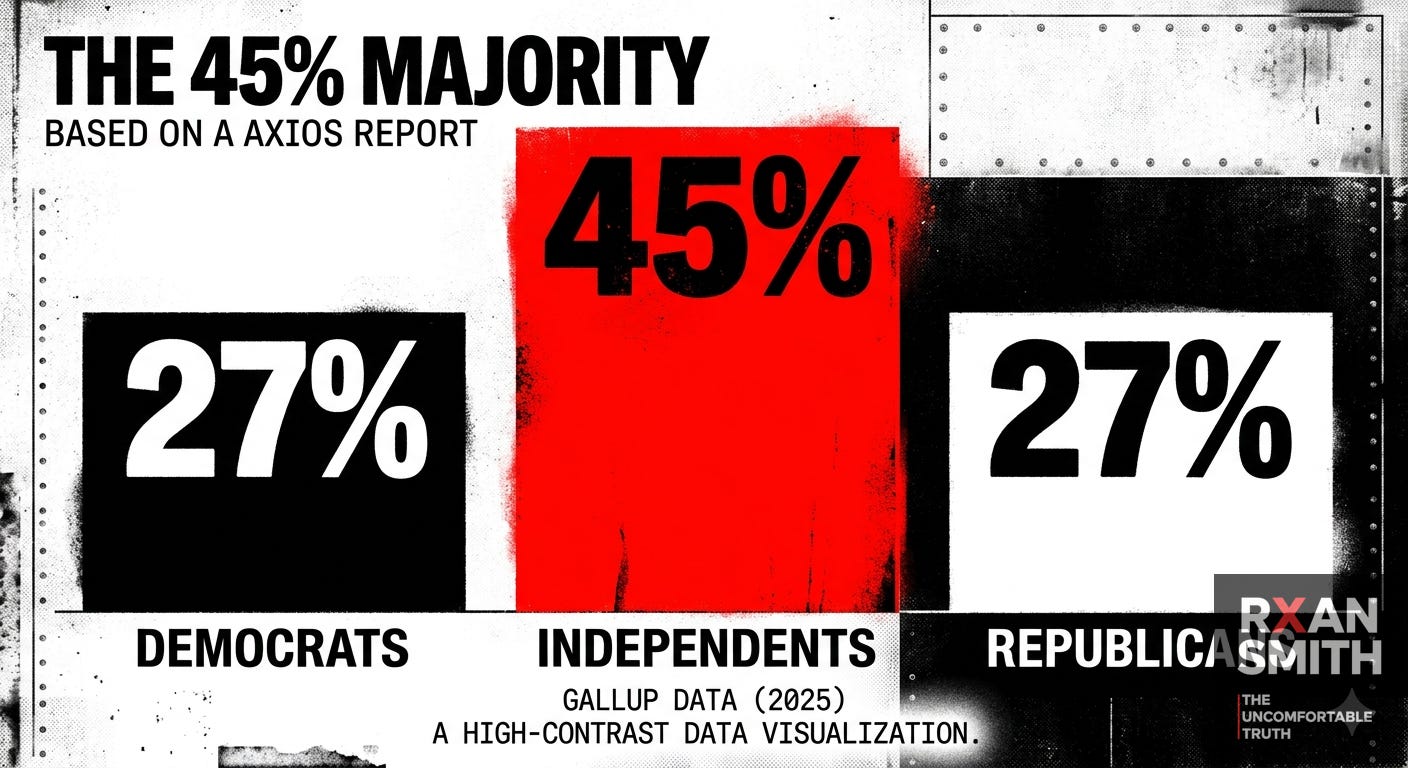
Forty-five percent of Americans now identify as political independents.
That's the biggest political story in the country, not a footnote.
Yet almost every political conversation in America still begins with the same assumption: There are two tribes. Pick one.
The problem is that nearly half the country already declined the offer. The largest political bloc in America is neither party. But our media ecosystem keeps acting as though everyone must eventually be sorted into one of two approved categories.
That’s the mismatch.
The country changed.
The script didn’t.
When politics is presented as a permanent red-versus-blue cage match, the public isn’t being described. It’s being managed
Trust in institutions is collapsing
The tragedy isn’t that Americans disagree.
It’s that millions of people no longer know who to trust enough to find out who’s right.
You can see it everywhere.
The friend who used to watch cable news and now refuses to.
The relative who dismisses every headline before reading it.
The person who checks three different sources because they assume somebody is leaving something out.
Trust didn’t disappear in a poll.
It disappeared in millions of individual decisions.
found that trust in the mass media fell to just 28% in 2025, a new low, with fewer than three in ten Americans saying they trust newspapers, television, and radio to report the news fully, accurately, and fairly. Gallup: Trust in Media at New Low of 28% in U.S.
The Reuters Institute’s Digital News Report 2025 reached a similar conclusion from another angle, finding that traditional news media is struggling to connect with much of the public, with declining engagement, low trust, and stagnating digital subscriptions. Reuters Institute: Digital News Report 2025
If you are worried about oligarchy, corporate power, democratic backsliding, or institutional decay, this should set off alarms. A country where the largest political bloc is independent and trust in the press is at historic lows is not just having a messaging problem. It is suffering from a broken information system.
What the Left Gets Right
Before getting to the critique, let’s acknowledge something important: the left is right about many of the country’s biggest problems.
Wealth inequality is real. Corporate influence is real. Healthcare costs are absurd. Housing affordability is collapsing. Billionaires exercise outsized influence in public life. Citizens United damaged public trust in democratic institutions.
These are not fantasies cooked up in a campus seminar.
They are structural realities.
On many core issues, the public is already closer to left-populist economics than elite political discourse wants to admit.
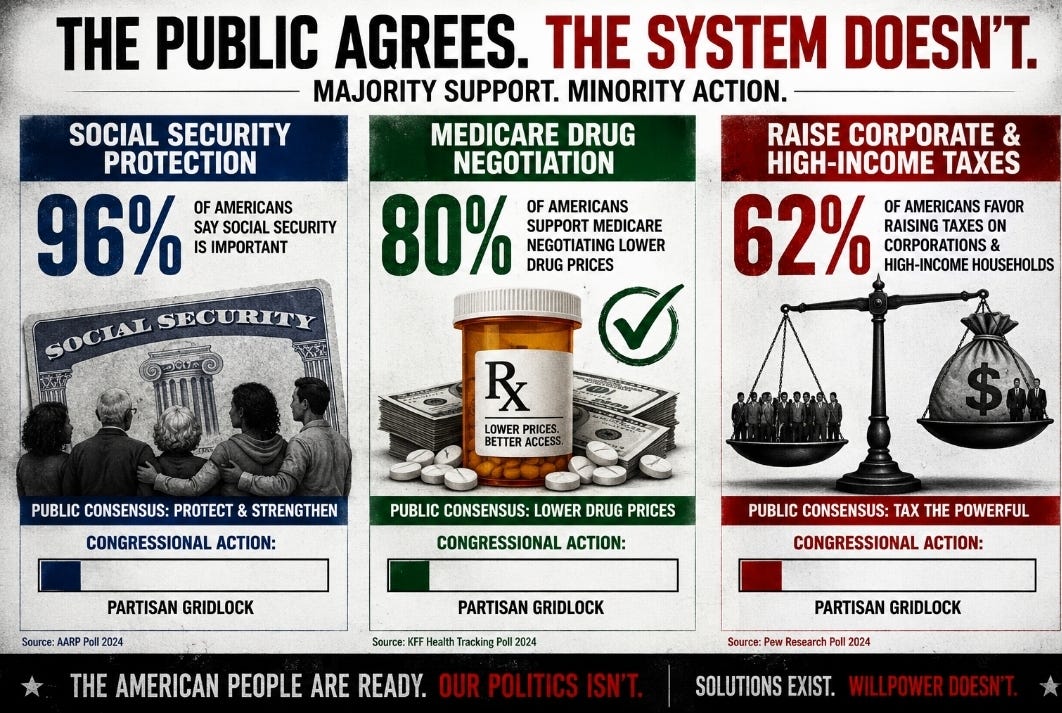
AARP polling found that 96% of Americans say Social Security is important. KFF polling shows broad support for allowing Medicare to negotiate prescription drug prices. Pew found that most Americans continue to favor raising taxes on large corporations and higher-income households. AARP Poll: Social Security Support High, Confidence Lags; KFF: 3 Charts About Medicare Drug Price Negotiations; Pew: Most Americans Continue to Favor Raising Taxes on Corporations, Higher-Income Household
The problem is not that the left sees the wrong problems.
The problem is that too many of those arguments are delivered through a media ecosystem that rewards outrage more than persuasion, posture more than clarity, and moral performance more than public understanding.
The result is a strange paradox:
The public often agrees with the diagnosis while tuning out the messenger.
That’s not a policy failure.
It’s a credibility failure..
How Media Failure Sabotages Those Arguments
If you are concerned about corporate capture, then media capture should concern you. If you are concerned about oligarchy, then information oligarchies should concern you. If you are concerned about democracy, then a system in which seven in ten Americans do not trust the mass media should concern you. Gallup: Trust in Media at New Low of 28% in U.S..
And trust did not collapse for no reason.
It collapsed after repeated institutional failures: the press amplifying Iraq WMD claims beyond the available evidence and failing to seriously interrogate the structures that led to the 2008 financial crisis until after the damage was done.
Those examples matter because they are not partisan mistakes.
They are institutional mistakes.
That distinction is important. Many younger progressives correctly distrust explicit right-wing propaganda but are often less likely to question the broader information ecosystem. If you want people to examine the structure itself, you have to show how credibility is lost not only through partisan media, but through failures inside prestige institutions as well.
Not with conspiracy theories.
With examples.
Audience Capture Is Replacing Corporate Capture
For years, we worried that corporate media was captured by advertisers. Then social media and subscription media changed the plumbing.
Now we face a newer problem: audience capture.
The New Capture
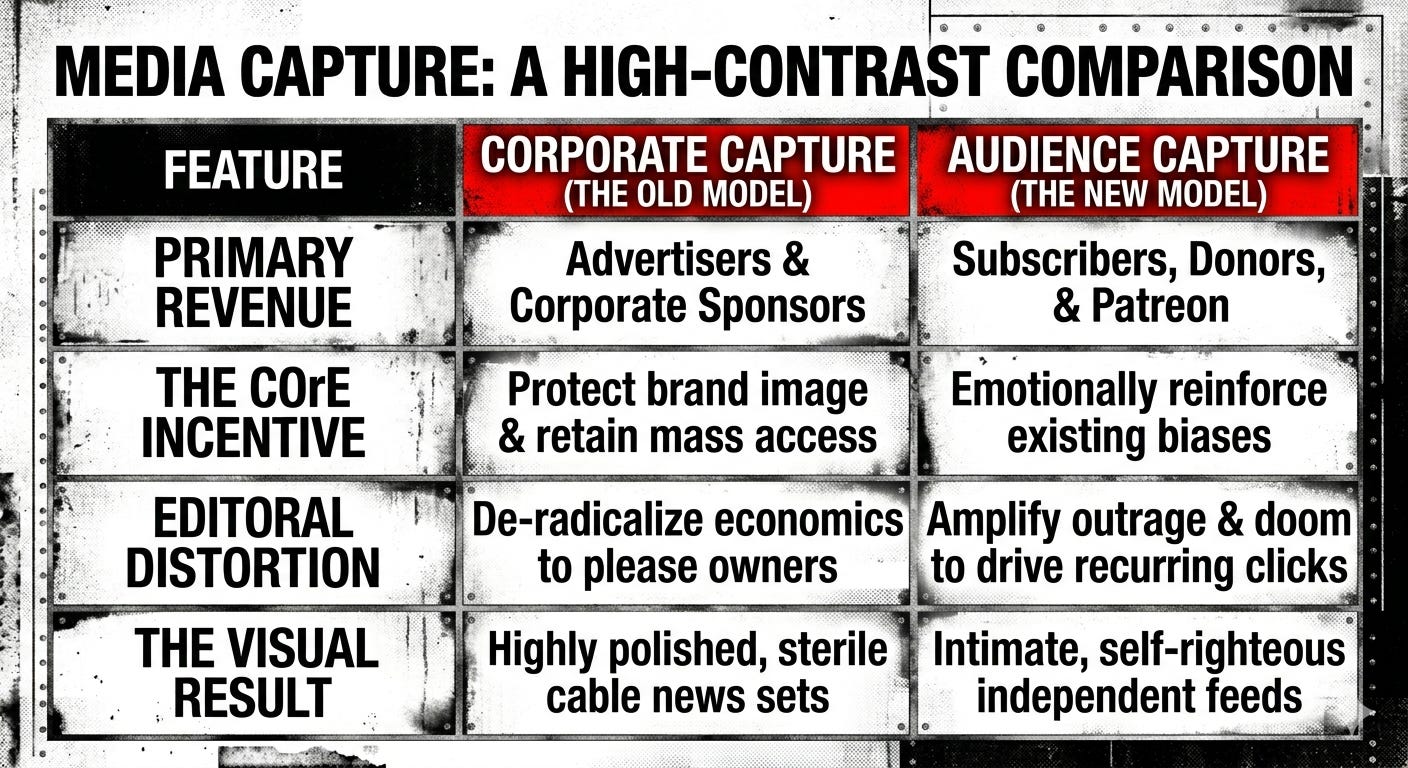
Corporate media tells audiences what advertisers want.
Audience-captured media tells audiences what audiences want.
Different masters.
Same temptation.
The old model bent coverage toward what owners, sponsors, and political insiders could tolerate.
The new model often bends coverage toward what subscribers most want emotionally reinforced.
If doom drives clicks, doom multiplies.
If flattering a tribe drives subscriptions, tribal reinforcement becomes editorial strategy.
If audiences want a nightly sermon confirming that everybody else is the problem, too many outlets will serve exactly that, complete with a self-righteous grin and a donation link.
That is audience capture.
And it is dangerous because it feels democratic while producing the same distortion.
Corporate capture edits reality to please advertisers.
Audience capture edits reality to please subscribers.
Either way, the facts get sanded down to fit the revenue model.
The left’s opportunity - and how it’s being squandered
Here is the maddening part: the left is not losing because its core economic arguments are universally unpopular. On several major issues, the public is already on its side or nearby. The problem is that the media environment often prevents those arguments from being heard clearly, consistently, and persuasively. AARP; KFF; Pew
Instead of calmly and relentlessly connecting those dots, too much of the broader left media space drifts into the same bad habits it claims to oppose: outrage cycles instead of explanation, cultural dunk contests instead of structural analysis, and endless warnings of catastrophe with very little practical sense of what would actually move people. That does not build durable persuasion. It builds a mood.
If your central fear is authoritarianism, you cannot afford a left that only talks to itself. If your central fear is oligarchy, you cannot afford a left media ecosystem that behaves like an emotional vending machine for people who already agree. If your central fear is corporate power, you cannot afford to reproduce the same incentive structures under a different logo.
5 rules for independent media that deserve the name
If independent media is going to matter, it has to be more than cable news with softer lighting and a Patreon page. It has to be structurally different.
Evidence before ideology. Start with what can be shown — polling, outcomes, budgets, historical context — then build your argument from there. Gallup on independents; Gallup on media trust
Critique allies first. It is easy to attack the other side. The test of independence is whether you can say, “our side got this wrong,” without collapsing into partisan panic.
Show your sources. If you want people to trust you more than institutions that already burned them, then transparency is not optional. Link the reports. Show the receipts. Reuters Institute; KFF; Pew
Separate reporting from opinion. Even highly opinionated outlets can distinguish between what happened and what they think it means. Blurring those lines is one of the diseases we are supposedly trying to cure.
Measure outcomes, not intentions. The question is not whether an outlet means well. The question is whether it leaves people better informed, more capable of acting, and less dependent on a constant emotional drip feed.
Rxan Smith Closing Editorial
This is not an argument against journalism. A functioning democracy needs journalism the same way a functioning body needs a nervous system. If the signals stop moving, the whole thing starts walking into walls.
The problem is that somewhere along the way, journalism stopped being treated as a public service and started being treated as a product. Politics stopped being a civic responsibility and became a team sport. Then social media arrived and turned both into a 24-hour casino where the currency is attention.
And now everyone is confused about why nobody trusts anything.
The right thinks the media is a Democratic Party super PAC with better lighting.
The left thinks the media is failing because it isn’t aggressive enough toward the right.
The media thinks the public is becoming misinformed.
And all intelligent members of the public know that all of them are full of shit.
The uncomfortable possibility is that the public sees something the experts are missing.
Not because the public is always right. Millions of people thought NFTs were a brilliant idea five minutes ago.
But because people can sense incentives.
They know when they’re being marketed to.
They know when they’re being manipulated.
They know when every story somehow arrives exactly where the audience was expected to arrive before it began.
That’s why trust isn’t collapsing only in media. It’s collapsing in political parties, Congress, corporations, universities, churches, and nearly every institution wondering why people keep leaving.
Trust is not lost when people disagree with you. It’s lost when people believe you’re no longer telling them the whole truth.
And the greatest danger facing independent media right now isn’t censorship, algorithms, or corporate pressure.
It’s audience capture.
The temptation to stop informing people and start feeding them.
To tell subscribers what they already believe.
To build communities around certainty instead of curiosity.
The tragedy is that this is happening at the exact moment the country is desperate for something better.
Half the country doesn’t identify with either major party.
Trust in media is scraping historic lows.
Most Americans agree on more economic issues than politics would ever lead them to believe.
The opening exists.
The audience exists.
The demand exists.
What doesn’t exist yet are enough institutions willing to value truth more than tribe.
Because that’s the choice.
Not left versus right.
Not mainstream versus independent.
Truth versus audience capture.
Reality versus performance.
Citizens versus customers.
The future of independent media won’t be decided by how many subscribers it gains.
It will be decided by whether it can occasionally look at its own audience and say:
“No. You’re wrong about that.”
That’s the moment honesty becomes expensive.
The moment truth risks upsetting the people paying the bills.
That’s when you find out whether you’re building journalism or a more personalized form of propaganda.
The country doesn’t need more content.
It doesn’t need more outrage.
It needs people willing to tell the truth when it’s inconvenient, unpopular, unprofitable, and occasionally directed at their own side.
Because if independent media can’t do that, then it isn’t the cure.
It’s just the next stage of the disease.
📚 Continue Reading: My Most Popular Essays
If this article resonated with you, these are six of the best places to continue exploring the ideas behind Rxan Smith: Uncomfortable.
🇺🇸 United We Stand Is a Mathematical Certainty
Unity isn’t a moral argument. It’s a mathematical one. Why America’s future depends less on ideology than on incentives.

📜 The Common Republic: Declaration of Citizenship
What if America had a new founding document for the 21st century? A vision of citizenship built around shared responsibility instead of partisan identity.

🧭 The Left vs. Right Axis Has Always Been Broken
The political spectrum we’ve inherited explains less and less about how people actually think. Here’s a better framework.

⚙️ 💲 The Price of Survival
Why millions of Americans feel like they’re working harder than ever just to stay in place, and what that reveals about the system we’ve built.

✍️ You’re Writing America’s Next Chapter
History isn’t written by politicians alone. It’s written by ordinary people deciding they refuse to accept the script they’ve been handed.

It’s Not Capitalism vs. Socialism
The debate we’ve been having for decades asks the wrong question. The real battle isn’t economic labels. It’s whether power serves the public or captures it.


