Let’s start with something so obvious it apparently needs to be screamed from a burning building: people can die when gas gets too expensive. People can die when insulin costs four hundred dollars. People can die when the electricity shuts off in a heat wave, when the grocery bill doubles overnight, when the deductible is higher than the rent.
These are not market failures in some abstract policy-paper sense. They are body counts. Slow, quiet, spreadsheet-invisible body counts that we have decided, as a civilization, to treat as the price of freedom.
Freedom from what, exactly? From the indignity of a stable life?
Right about now, someone is preparing to call this socialist. Fine. Let’s hear the speech about the miracle of markets. I’ll wait.
Competition built miracles. Nobody serious is arguing otherwise. The issue is not markets. The issue is that we have decided, as deliberate policy, not to draw a line between what you want and what you need to not die.
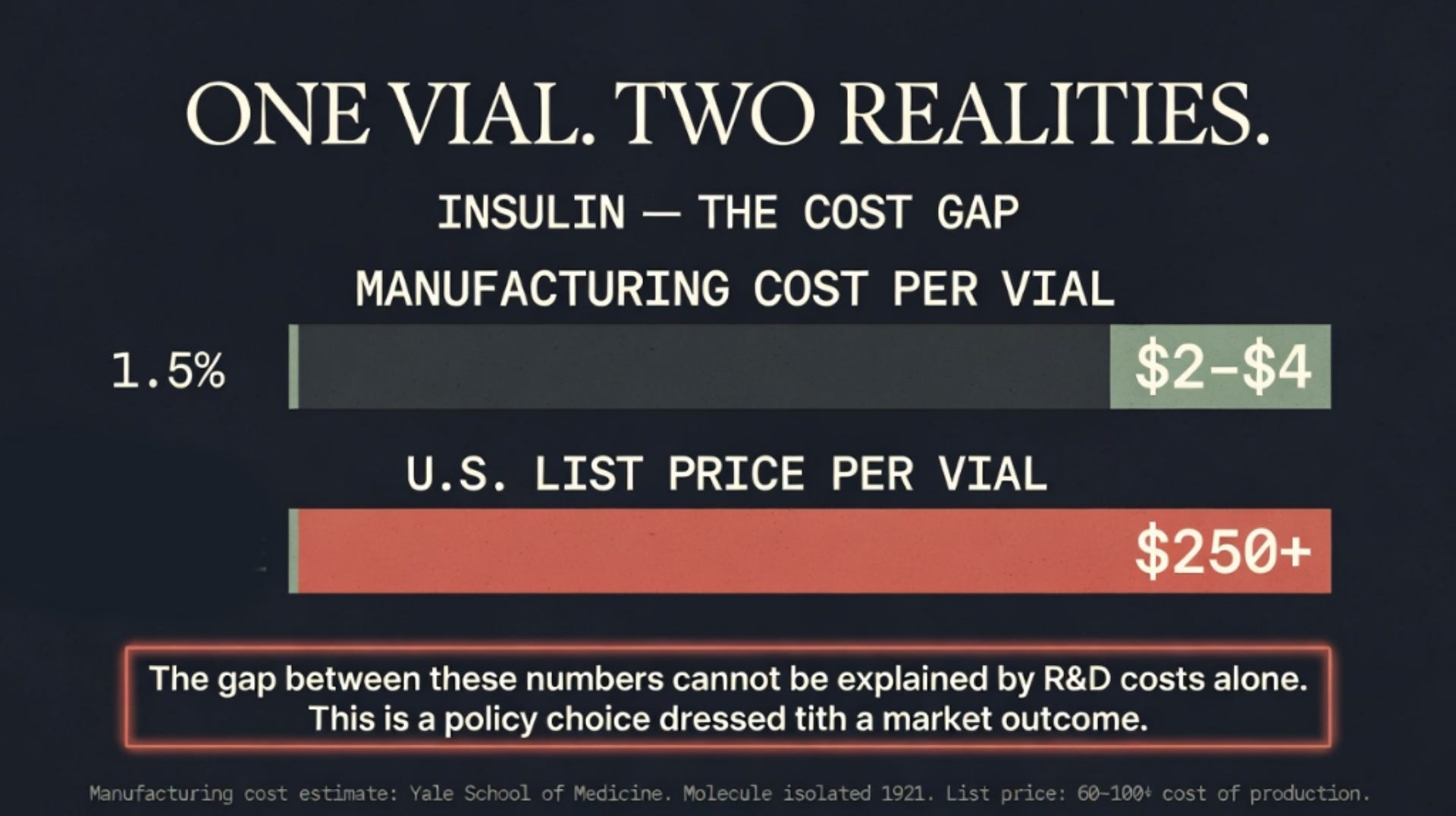
We regulate streaming services and lawn darts, but we let the pricing of insulin — a molecule discovered in 1921 — float freely because that’s somehow the defensible position in the year 2026.
And the money… the trillions… didn’t go into reserves. It didn’t go into domestic supply chain hardening, or energy buffers, or healthcare infrastructure. It went into the economy like gasoline on a bonfire. Peloton bikes flew off shelves. Stocks soared. Corporations reported record profits while families ate the volatility on the basics.
We turned a national emergency into a luxury stimulus and congratulated ourselves for the GDP numbers while the bill kept compounding.
We waited for the crisis. Then we improvised. Then we called it a success and forgot about it.
We spent more per capita on healthcare than any country on earth and still have people rationing pills, terrified of getting sick, chained to jobs they hate because quitting means losing their insurance..
Thanks for reading Rxan Smith Uncomfortable! This post is public so feel free to share it
France built a state-owned nuclear fleet that generates roughly 75% of its electricity, then structured a regulatory mechanism that caps the price at which that power reaches consumers and taxes windfall profits above set thresholds to redistribute them back to households. Singapore stockpiles food reserves like a country that has actually thought about what happens when the supply chain breaks. The Nordic countries and South Korea have figured out how to keep a cancer diagnosis from liquefying a family’s finances.
These are not communist hellscapes. These are functioning, often fiscally conservative democracies that decided to draw a line between necessities and everything else.
None of these countries are perfect. They pay costs elsewhere — higher taxes, slower growth in some sectors, demographic challenges, regulatory burdens. But they made a different calculation about what happens when the basics become unaffordable. They decided the instability of not drawing that line costs more than the tax line to draw it.
The Stress Test We Failed In Public
Then COVID happened. And COVID was not just a pandemic — it was an audit. It was a full, open-book examination of what your system actually is versus what you tell yourself it is. What it revealed about this country should haunt every person who makes decisions in Washington.
Our system was so brittle, so exposed, so structurally reliant on everything working perfectly all the time, that we literally had to pay people to survive. Not transition them. Not absorb the shock with pre-built resilience. Pay them. Immediately. In cash. To not die Resilience.
And the money… the trillions… didn’t go into reserves. It didn’t go into domestic supply chain hardening, or energy buffers, or healthcare infrastructure. It went into the economy like gasoline on a bonfire. Peloton bikes flew off shelves. Stocks soared. Corporations reported record profits while families ate the volatility on the basics. We turned a national emergency into a luxury stimulus and congratulated ourselves for the GDP numbers while the bill kept compounding.
We waited for the crisis. Then we improvised. Then we called it a success and forgot about it.
We spent more per capita on healthcare than any country on earth and still have people rationing pills, terrified of getting sick, chained to jobs they hate because quitting means losing their insurance
The Bat Country Diagnosis
There is something genuinely deranged about this arrangement. According to 2024 data from the Stockholm International Peace Research Institute, the United States spent nearly a trillion dollars on defense — more than the next nine countries combined. Aircraft carriers. Hypersonic missile programs. Special operations forces on every continent. We are, by every military metric, the most formidable security apparatus in human history.
And then we turn around and leave the soft underbelly — the part of national security that’s about whether ordinary people can survive ordinary chaos — completely, philosophically, proudly exposed.
That is not a market. That is not freedom. That is a country that has decided to build the world’s greatest fortress and leave the water supply outside the walls.
This used to be a conservative argument. Eisenhower warned about the military-industrial complex consuming resources that could build national strength from the inside. Reagan ran on energy independence as a security imperative. The original national security hawks understood that resilience wasn’t just aircraft carriers — it was the stability of its domestic population.
Somewhere between then and now, “national security” got reduced to procurement contracts and forward bases, while the home front was handed to the quarterly earnings cycle.
A few months of real inflation. A health scare with a bad deductible. A fuel spike right when you stretched to make rent. Years of progress get erased overnight.
And we are living in an era where those shocks are not going to get rarer. Wars. Cyberattacks. Climate catastrophes. Geopolitical actors who have decided that chaos is the strategy. This is the permanent condition now. And we have engineered a population with zero insulation against it.
That is not a political opinion. That is a national security threat.
What This Actually Requires
If your country can spend $2 trillion on a war in Afghanistan and come home with little to show for it but a slightly more experienced Taliban, then we’re allowed to spend money making sure a family in Ohio doesn’t have to choose between insulin and the electric bill.
That’s not redistribution. That’s just not being stupid on purpose.
There is no canceling insulin.
There is no budget version of chemotherapy.
There is no “switching providers” when every provider raises prices together.
There is no life hack for eviction.
For years, we’ve had a furious national argument about whether a drag show at a library is a threat to the republic. Meanwhile, the actual foundation of national stability — the ability of ordinary people to absorb ordinary shocks without their lives detonating — has been dismissed as some fringe political fantasy.
The countries that didn’t dismiss it are now outperforming us in measures that actually matter: resilience, stability, trust, health, and long-term economic security.
And rage is easily redirected toward whoever is most convenient. Every election season we act surprised by the outcome, as if cause and effect are somehow unrelated. The people profiting from that chaos understand it perfectly.
The chaos isn’t a bug. It’s the product.
The Verdict
This isn’t a call for central planning.
It’s a call for a government that remembers what it’s for.
Different rules for necessities doesn’t mean government runs everything. It means necessities are judged by a different standard than luxury goods. It means resilience, redundancy, strategic reserves. Competition where possible, regulation where necessary, and public intervention when markets demonstrably fail to provide basic stability.
That’s not socialism. That’s engineering a system that doesn’t collapse the first time something goes wrong.
Not GDP worship. Not military theater. Not culture-war content designed to keep everyone screaming at each other while the foundation quietly hollows out.
The actual job: making sure the people who live here can survive long enough to participate in the experiment.
Because in an era of permanent turbulence — and let’s be honest, this is the era of permanent turbulence — treating survival as a commodity may be one of the greatest strategic mistakes this nation ever makes.
Uncomfortable truths, systemic analysis, and no‑spin political commentary for listeners tired of echo chambers and late outrage. New episodes cut through noise with cinematic, confrontational clarity.
Uncomfortable truths, systemic analysis, and no‑spin political commentary for listeners tired of echo chambers and late outrage. New episodes cut through noise with cinematic, confrontational clarity.