
Every presidential post creates the same argument.
Did he lie? Was he right? Is he crazy? Is he brilliant?
That’s usually where the conversation ends. Which is unfortunate. Because it’s probably the least interesting question you can ask.
We treat presidential social media like it’s a diary. It isn’t.
It’s a press conference disguised as insomnia.
Presidents don’t have diaries anymore. They have comment sections.
Every presidential post has an intended audience. The question was never what he’s saying. It’s who he’s saying it to.
The Five Parts
Watch a poker game with your eyes locked on the cards and you’ll miss the whole game.
The cards aren’t where the information lives. The chips are. Where they move. Who’s pushing them. Who just folded without saying a word.
Presidential statements work the same way.
Every public statement, from any president, in any era, breaks into five parts. The message. The messenger. The audience. The objective. The omission.
Cable news spends most of its airtime on the first two. Fact-checkers have built entire careers on them.
The other three are the ones that actually explain what’s happening.
The omission is the sneaky one. Every statement is defined as much by what’s left out on purpose as by what’s said out loud. Keep it in your back pocket. It gets its own section soon.
So let’s use two posts. Same account, same morning, about ninety minutes apart. Not because Trump is uniquely guilty of doing this. Because he’s uniquely public about it. There’s no press secretary translating the instinct into diplomatic language first. You get the raw feed.
Think of this less as a case against a president and more as a dissection kit. Learn to use it here, and you can point it at any president who’s ever lived, including the next one.
Fifty Percent Of A Snub
Post one, stripped to its skeleton.
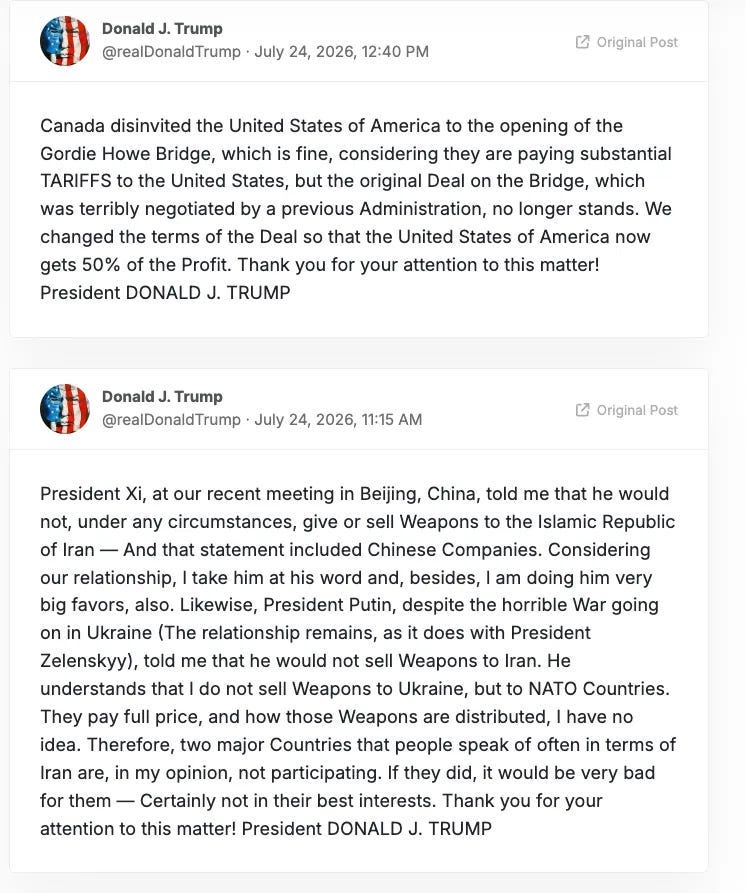
Canada uninvited the United States from a bridge-opening ceremony. Trump responds that it’s fine, actually, since Canada is paying substantial tariffs. Then he adds that the original deal on the bridge, negotiated by a previous administration, no longer stands. The terms were rewritten. The U.S. now takes fifty percent of the profit.
Read that as a diary entry and it sounds like venting. A guy got snubbed and he’s mad about it.
Read it as a press conference and a different picture forms.
Ask who benefits from hearing this.
Not Canada. Canada already knows what happened at that ceremony. This post isn’t informing Canada of anything.
The audience is everyone else in the room. American voters who’ve been told tariffs are leverage, not just a tax on groceries at the register, get a data point: see, it worked, we’re getting fifty percent. Markets watching trade policy get a signal that no deal is ever fully final, everything stays open for another round. And any country currently sitting across a table from this administration gets the quiet version of a warning: this is what happens to a deal we decide we don’t like anymore, whether or not you’re the one who did the snubbing.
A diplomatic embarrassment becomes a financial win in three sentences.
That’s not a diary entry. That’s the fastest reframe in the building.
Xi, Putin, And The Weapons Nobody’s Selling
Post two is denser, so slow down.
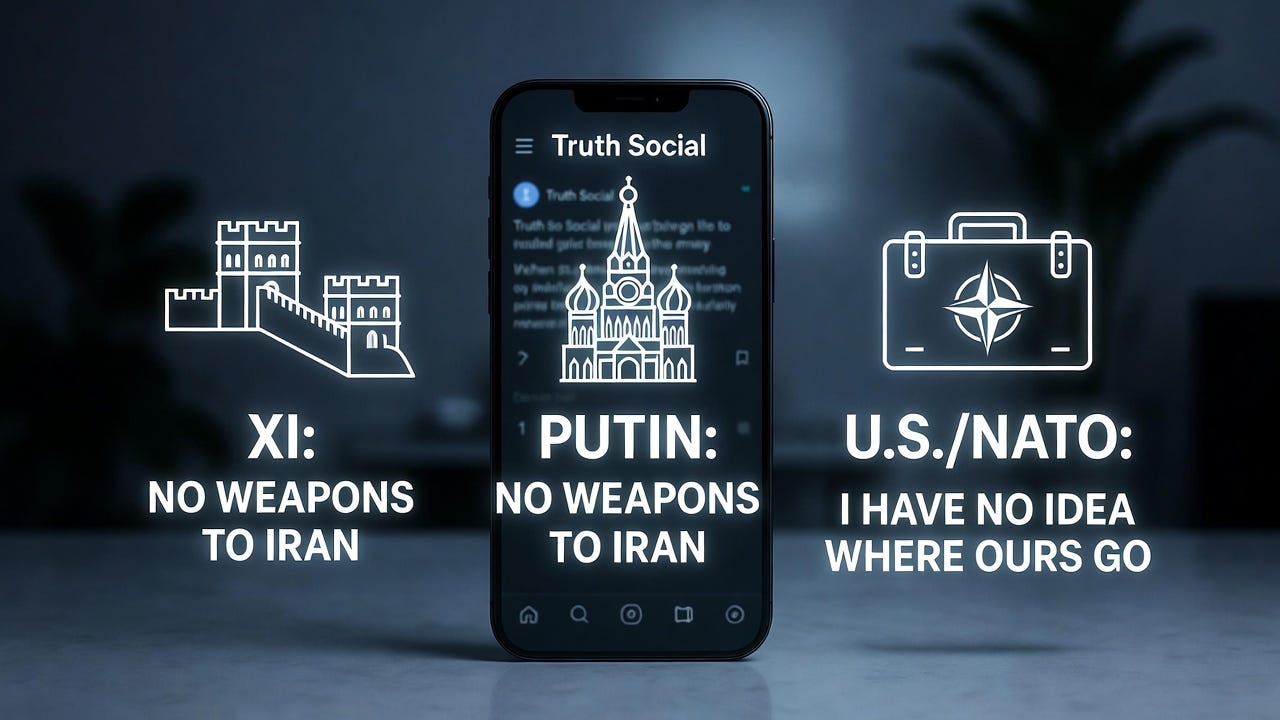
Trump says Xi personally told him, in Beijing, that China, and Chinese companies, will not sell weapons to Iran. He says he takes Xi at his word, partly because of the relationship, partly because he’s doing Xi very big favors of his own.
Then Putin. Same assurance, different war attached to his name. Putin tells him Russia won’t sell weapons to Iran either. Trump notes, in parentheses, that the relationship with Zelenskyy remains, like a footnote nobody asked for.
Then comes the pivot that does the real work. Trump says he doesn’t sell weapons to Ukraine. He sells them to NATO countries, who pay full price, and what NATO does with those weapons after that isn’t something he’s tracking. I have no idea.
Conclusion: the two major countries people usually worry about arming Iran are, in his telling, not participating. Certainly not in their own best interests.
Now run the questions.
The messenger matters as much as the message here. This isn’t “intelligence assesses.” It’s “a guy personally told me, and I believe him, because we have a relationship.” That’s not a policy claim. That’s a trust claim, dressed up as one.
The audience isn’t really Xi or Putin. They already know what they told him, if they told him anything at all. The audience is everyone watching from outside that room: Americans anxious about Iran’s access to weapons, allies wondering whether the warmth with Beijing and Moscow is cover for something looser than they’d like, and critics who’ve spent months asking exactly this question out loud. This post answers it before anyone has to ask. I’m not being played. I’m the one calling in favors.
Then there’s the line doing the most work while sounding the most casual. I have no idea.
It reads less like an admission of ignorance than a liability shield, filed in advance.
If a NATO-supplied weapon ever surfaces somewhere embarrassing, that sentence is already on the record. Not my sale. Not my tracking. Not my problem.
Compare that posture to the total confidence in what two foreign leaders privately told him, against the total detachment from where his own country’s weapons end up once they leave the warehouse.
That contrast is the actual content of the post. Everything else is scaffolding.
The Dog That Didn’t Bark
Most people read statements. Detectives read omissions.
Sherlock Holmes solves a case by noticing a dog that stayed silent when it should have barked. The silence was the clue, not the noise.
Same move works here.
The bridge post never mentions Mexico, also under the tariff regime, also part of the same hemispheric trade picture. It never mentions the price consumers pay for tariffs, only the check the U.S. supposedly gets to cash. It blames “a previous administration” by function, not by name, generic enough that no specific opponent has to be elevated into a rival.
The Xi and Putin post is louder in its silence. Israel is the country with the most immediate stake in whether Iran gets weapons. Israel isn’t mentioned once. Taiwan, the subject most likely to test whether “the relationship” with Xi means anything in practice, isn’t mentioned either. And nowhere in either paragraph is there a verification mechanism, an inspection, a consequence if either promise turns out to be false. Just trust, stated as fact.
That’s the fifth category earning its keep. The omission. What’s left out of a statement is chosen as deliberately as what’s left in. Read for what’s missing and the post stops sounding like reassurance. It starts looking like a hole with confident language poured over it.
The Indispensable Middleman
Zoom out further and neither post is really about Canada, or Xi, or Putin.
They’re about Trump positioning himself as the indispensable middleman between America and everyone it deals with.
Read the verbs, not the nouns.
I negotiated.
I talked.
I was told.
I believe.
I got.
I decided.
I warned.
Every sentence eventually collapses back into the first person, no matter which country started it. The bridge deal isn’t described as a policy outcome, it’s described as something he personally rewrote. Xi’s assurance isn’t intelligence, it’s something Xi told him, specifically, because of a relationship only he has. Putin’s promise isn’t verified anywhere except inside a conversation only he was part of.
That’s not a policy pattern. That’s a communication pattern. And it’s the most consistent thing in both posts. The world happened, and then he handled it.
One Post, Twenty Posts, A Hundred Posts
Two posts aren’t evidence. They’re a hypothesis. Twenty posts become a pattern. A hundred become a strategy.
Run this same five-part read across that volume and you stop seeing isolated reactions. You start seeing a hierarchy: who gets named repeatedly, who gets named once and dropped, who never gets named at all, and what keeps getting quietly omitted no matter the subject. That hierarchy becomes a map of what a presidency actually prioritizes, regardless of what any press release claims the priorities are.
That’s the real exercise. Not this piece. The next fifty times you read one of these posts.
Read The Room, Not The Diary
Zoom out.
A president’s feed isn’t a diary, and it isn’t entertainment either, no matter how many people scroll it like it is. It’s one of the clearest windows available into how a White House wants the world to interpret reality, in real time, before the professionals get a chance to launder it into a press release.
Every president does this. Every president has always done this. The tool changed. The instinct didn’t.
That includes the ones you already like. Especially those.
Try it tomorrow on someone whose politics you actually agree with. Read a Biden speech, an Obama interview, an AOC thread, a JD Vance post, a Gavin Newsom press conference, the same way. Five parts. Message, messenger, audience, objective, omission. The framework doesn’t care who you vote for. Good frameworks never do.
Politicians have spent centuries convincing us to listen to what they say.
The better trick is watching who they’re trying to convince.
That’s where power hides. Not in the speech. In the audience.
The next time a president posts something that sends cable news into cardiac arrest, don’t ask whether you agree.
Ask a different question.
Who was this actually for?
Presidents aren’t shouting into the void. They’re talking to someone. Figure out who, and you’ve already understood more than most of the people arguing about it
🎤 💧
R❌AN SMITH