




America’s economy isn’t breaking because of capitalism or socialism. It’s breaking because we spent forty years dismantling the rules that kept concentrated power in check. One president already proved what fixing it looks like. We just stopped doing it.
The debate isn’t capitalism versus socialism. It’s whether we’re willing to enforce the rules of the system we already have.
Let’s start with what nobody on either side of this argument wants to say out loud.
America is not a capitalist country. It is not a socialist country. It is a mixed economy with a capitalist mythology layered on top — and much of the political debate assumes we must either replace the system or defend it, and neither side spends much time asking how the system stopped working the way it was supposed to. The gap between the mythology and the reality has become so wide that we can no longer have a coherent conversation about how to fix anything. And the rest of the country is just trying to pay rent.
So before we talk about what socialism costs, let’s talk about what we already bought.
Rxan Smith Uncomfortable is a reader-supported publication. To receive new posts and support my work, consider becoming a free or paid subscriber.
WE ARE ALREADY DOING THIS
Pick any line item in the federal budget and explain to me why it doesn’t complicate the story right-wing media tells every time someone proposes expanding Medicaid.
$886B
FY2024 Defense Dept. budget — the world’s largest jobs program
$1.06T
Annual interest on national debt — borrowed money, paid to bond holders
$1.3T
Medicare + Medicaid annual spend — government-run healthcare
$1.5T
Social Security annual spend — government retirement program
The Department of Defense employs approximately 2.87 million people directly, making it the largest employer in the United States. Add contractors and the number climbs well past four million. Social Security is a mandatory government retirement fund. Medicare is a single-payer insurance program for seniors. The mortgage interest deduction is a government subsidy for homeowners. Agricultural subsidies are direct government payments to farmers. The highway system is public infrastructure. Pell Grants are government-funded higher education assistance.
America already operates a mixed economy containing markets, public infrastructure, public insurance programs, subsidies, regulations, and government services. The question was never whether government should exist inside the economy. The question was where its role should begin and end — and who gets to decide when the line moves.
The debate was never capitalism versus socialism. It was always about where to draw the line — which industries get guardrails, which ones get to operate without them, and who decides. The problem isn’t the label. The problem isn’t that we stopped drawing the line. It’s that we kept moving it in one direction.
THE SEQUENCING PROBLEM
Take any activist platform — healthcare, housing, labor rights, climate action, college affordability, criminal justice reform, wealth redistribution. These are not radical goals in the abstract. Many of them poll reasonably well in survey form. The problem is not the ideology. The problem is the sequencing — and the fundamental mismatch between activist priorities and voter priorities.
Activists prioritize by moral urgency: what injustice demands immediate action. Voters prioritize by daily pain: what problem is making my life harder this week. These lists are not the same. Climate justice and police abolition rank near the top for one group. Grocery bills, housing costs, and healthcare premiums rank near the top for the other. Running on the first list while the second list is what’s killing people has a documented electoral track record, and it is not a good one.
Franklin Roosevelt did not win four terms by leading with social transformation. He led with economic security — jobs, banking stability, wages, mortgage relief — and built the political capital from that foundation to do everything else. The New Deal was radical by the standards of its time. But it was radical in the direction of the median American’s most urgent problems. That is the difference between durable coalition-building and moral grandstanding that loses elections and accomplishes nothing.
THE COST PROBLEM
The honest version of the Medicare for All debate is not “can we afford universal healthcare.” The honest version is: why does healthcare cost this much in the first place?
America already spends approximately $4.8 to $5 trillion per year on healthcare from all sources combined — employers, individuals, state and federal governments, private insurers. That is more per capita than any country on Earth. It is not producing proportional results. We rank eighteenth globally in life expectancy. Medical bankruptcy is a uniquely American phenomenon. The system is not underfunded. It is structurally designed to extract.
$4.9T
What America already spends on healthcare annually
2–4x
More than peer nations for the same drugs from same manufacturers
$50T+
Projected 10-year total healthcare spend under current system
#18
U.S. life expectancy ranking globally, despite highest per-capita spend
The pharmaceutical industry’s ability to charge Americans two to four times what Canadians pay for the same drug made by the same manufacturer is not a law of nature. It is a policy choice — a series of deliberate decisions made by legislators and regulators over three decades about what Medicare could negotiate, what patent protections would look like, and what happened when drug companies funded the campaigns of the people writing those rules.
The hospital consolidation that turned regional healthcare into a monopoly billing system happened because the FTC declined to block merger after merger for twenty-five years. That is not a coverage architecture problem. It is a monopoly and regulatory capture problem — and it will persist under any coverage architecture until someone addresses the underlying structure. You do not insure your way out of a monopoly problem.
The Question Nobody Asks
Why does the same insulin that costs $98 in Canada cost $326 in the USA? Not because American patients are sicker. Because American patients have no negotiating power, American hospitals have consolidated into regional monopolies, and the regulatory apparatus that was supposed to prevent this spent the last forty years being staffed by the people it was supposed to regulate.
THE TEARDOWN
The title of this piece is “The Guardrails We Tore Down.” That requires an accounting of the tearing down — not as history for its own sake, but because the mechanism matters. These were not accidents. Each was a choice, made by identifiable people, for identifiable reasons, with identifiable beneficiaries. Understanding that is what separates a structural diagnosis from a complaint.
None of these decisions, taken individually, seemed revolutionary. No politician campaigned on creating a more monopolized economy. No voter was told they were voting to weaken competition. The guardrails disappeared the same way most institutions decay: gradually, technically, and largely out of public view until the consequences became impossible to ignore.
Not every change on this list was inherently wrong, and reasonable people can debate many of them. What matters is the cumulative effect.
1980s
Antitrust philosophy shifts. The Reagan administration adopts the Chicago School framework, which holds that market concentration is only harmful if it raises consumer prices in the short term. Corporate mergers that would have been blocked under prior standards sail through. The DOJ and FTC begin the decade-long project of redefining “competitive harm” in ways that exclude most of what had previously been considered harmful.
Regulatory agencies defunded and restaffed. The FTC loses roughly 40% of its staff between 1980 and 1984. The NLRB becomes a venue for management-side enforcement. The SEC’s budget is held flat while the financial sector grows. The pattern is consistent: the agencies are not abolished. They are hollowed out and pointed in the wrong direction.
Union density begins its long decline. The signal moment is PATCO — Reagan fires 11,000 air traffic controllers for striking. The message to every employer negotiating with organized labor is received. Union membership, which had been approximately 35% of the workforce in the mid-1950s and still sat near 20% in 1980, begins a decline that will take it below 10% by 2023.
1990s
Glass-Steagall repealed. The Gramm-Leach-Bliley Act of 1999 removes the Depression-era firewall between commercial banking and investment banking. Banks that take federally insured deposits can now also make leveraged bets. The financial sector grows from roughly 4% of GDP in 1980 to over 8% by 2006. When those bets go wrong, the insured deposits are backstopped by the public. The profits, during the good years, are private.
Telecommunications consolidation accelerates. The Telecommunications Act of 1996, sold as pro-competition legislation, produces the opposite. Within a decade, the number of major media companies falls from roughly fifty to six. Local news begins its structural collapse. The information infrastructure that a functioning democracy depends on is consolidated into a small number of nationally owned properties optimized for engagement over accuracy.
Healthcare mergers begin in earnest. Hospitals start merging regionally. The FTC, operating under the new permissive merger framework, largely waves them through. By the mid-2000s, most metropolitan areas will have one or two dominant hospital systems with effectively no competition — and pricing power to match.
2000s
Financial leverage reaches systemic levels. Investment banks achieve leverage ratios of 30:1 or higher in the mid-2000s. The SEC, in a 2004 rule change, exempts the five largest investment banks from leverage limits that had applied to the rest of the industry. The rule is adopted after a single 55-minute meeting. None of the commissioners vote against it. When the leverage unwinds in 2008, the public absorbs the losses through TARP and the Federal Reserve’s emergency programs. The executives who built the leverage keep most of their compensation.
Private equity begins its roll-up era. Leveraged buyout activity, using historically low interest rates and minimal regulatory scrutiny, accelerates. Private equity acquires hospital systems, nursing homes, dental practices, veterinary chains, newspapers, apartment buildings, and retail chains — stripping assets, loading debt, and extracting fees regardless of whether the underlying business survives. The NLRB and FTC, still operating with reduced staffing and permissive frameworks, do not meaningfully intervene.
2010
Citizens United v. FEC. The Supreme Court rules that corporations have First Amendment rights to spend unlimited money in elections. The decision does not create political money — it eliminates the last meaningful constraint on it. Dark money organizations, SuperPACs, and industry-funded advocacy groups scale immediately. The campaign finance infrastructure that allows regulated industries to fund the campaigns of their regulators is now constitutionally protected. The revolving door between regulatory agencies and the industries they oversee becomes a superhighway.
2010s
Tech concentration goes unaddressed. Google acquires DoubleClick in 2007 and dominates online advertising. Facebook acquires Instagram in 2012 and WhatsApp in 2014. Amazon builds a cloud infrastructure business that underlies a substantial fraction of the internet while also competing directly with the businesses that depend on its retail platform. The FTC and DOJ review most of these acquisitions and approve them. The argument, consistent with the Chicago School framework, is that consumer prices are not rising — therefore no competitive harm exists. That framework has no concept of data monopoly, platform dependency, or the elimination of potential competitors before they can threaten incumbents.
Pharmaceutical pricing reaches its current structure. The Medicare Modernization Act of 2003 explicitly prohibits Medicare from negotiating drug prices — a provision inserted at the insistence of the pharmaceutical lobby and passed in a 220–215 House vote at 3 a.m. For twenty years, the largest healthcare purchaser in the United States is legally barred from doing what every other developed country’s healthcare system does as a matter of course. The resulting pricing structure — in which Americans effectively subsidize below-market drug prices for the rest of the world — is protected by the same campaign finance infrastructure that Citizens United subsequently entrenched.
2020s
Concentration reaches Gilded Age levels. By most measures of corporate concentration — revenue share of top four firms by sector, markup over marginal cost, profit share of GDP — the American economy in 2025 resembles the economy Teddy Roosevelt inherited more than it resembles the economy of 1970. In sector after sector, a small number of dominant players have pricing power, regulatory influence, and political cover that their predecessors in the Standard Oil era would have recognized immediately.
The CFPB begins a new cycle of gutting. The Consumer Financial Protection Bureau, created after 2008 specifically to prevent the regulatory capture that enabled the financial crisis, has now been targeted for reduction twice in fifteen years — first in the Trump I era, and again in the Trump II era. The pattern remains consistent: institutions built to constrain concentrated economic power are themselves targeted by the concentrated economic power they were built to constrain.
That is the teardown. Not a conspiracy — a series of decisions made by people who understood exactly what they were doing, funded by people who understood exactly why. The guardrails were not swept away in a moment of ideological revolution. They were removed piece by piece, agency by agency, rule by rule, over forty years, by a political class that was paid to remove them and told the public it was doing something else.
T
HE TEDDY OPTION
Here is the thing nobody on the activist left and nobody on the libertarian right wants to acknowledge simultaneously: most of what is broken about the American economy is not a product of too much capitalism or too little socialism. It is a product of regulatory capture, monopoly consolidation, and the systematic removal of guardrails that American governance installed deliberately over the better part of a century — and then quietly dismantled starting in the 1980s.
Historical Precedent
“The old parties are husks, with no real soul within either, divided on artificial lines, boss-ridden and privilege-controlled, each a jumble of incongruous elements, and neither daring to speak out wisely and fearlessly what should be said on the vital issues of the day.”
Theodore Roosevelt, 1912
Theodore Roosevelt did not come into office arguing for socialism. He came into office arguing that capitalism needed to be saved from itself. He busted forty-four monopolies. He created the FDA, the Forest Service, and the national park system. He pushed through the Pure Food and Drug Act and the Meat Inspection Act. He did not do any of this by expanding the size of government indefinitely. He did it by demanding that the participants in the economy play by rules that already existed or should have existed.
What he understood — and what both parties have since forgotten for different reasons — is that a market without enforceable rules is not capitalism. It is organized extraction. And the people doing the extracting will always have more resources to capture the regulatory process than the people being extracted from have to fight back. That is not a left-wing critique. It is a structural observation about power.
The model he demonstrated was specific. You don’t wait for a new ideology. You enforce the laws already on the books. The Sherman Antitrust Act had existed since 1890 when Roosevelt took office in 1901. It had been used six times in eleven years, largely to break up labor unions. Roosevelt turned it on the corporations it was written to constrain. He did not invent new authority. He used existing authority the way it was designed to be used, against people who had spent a decade assuming it wouldn’t be.
The Federal Trade Commission exists. The Department of Justice Antitrust Division exists. The National Labor Relations Board exists. The Securities and Exchange Commission exists. The Food and Drug Administration exists. The Consumer Financial Protection Bureau exists and has already been gutted once and partially rebuilt. These are not new institutions requiring new appropriations. They are existing institutions that have been systematically underfunded, understaffed, and in several cases deliberately sabotaged by appointing people to run them who do not believe in the mission they were hired to execute.
What Guardrails Actually Look Like
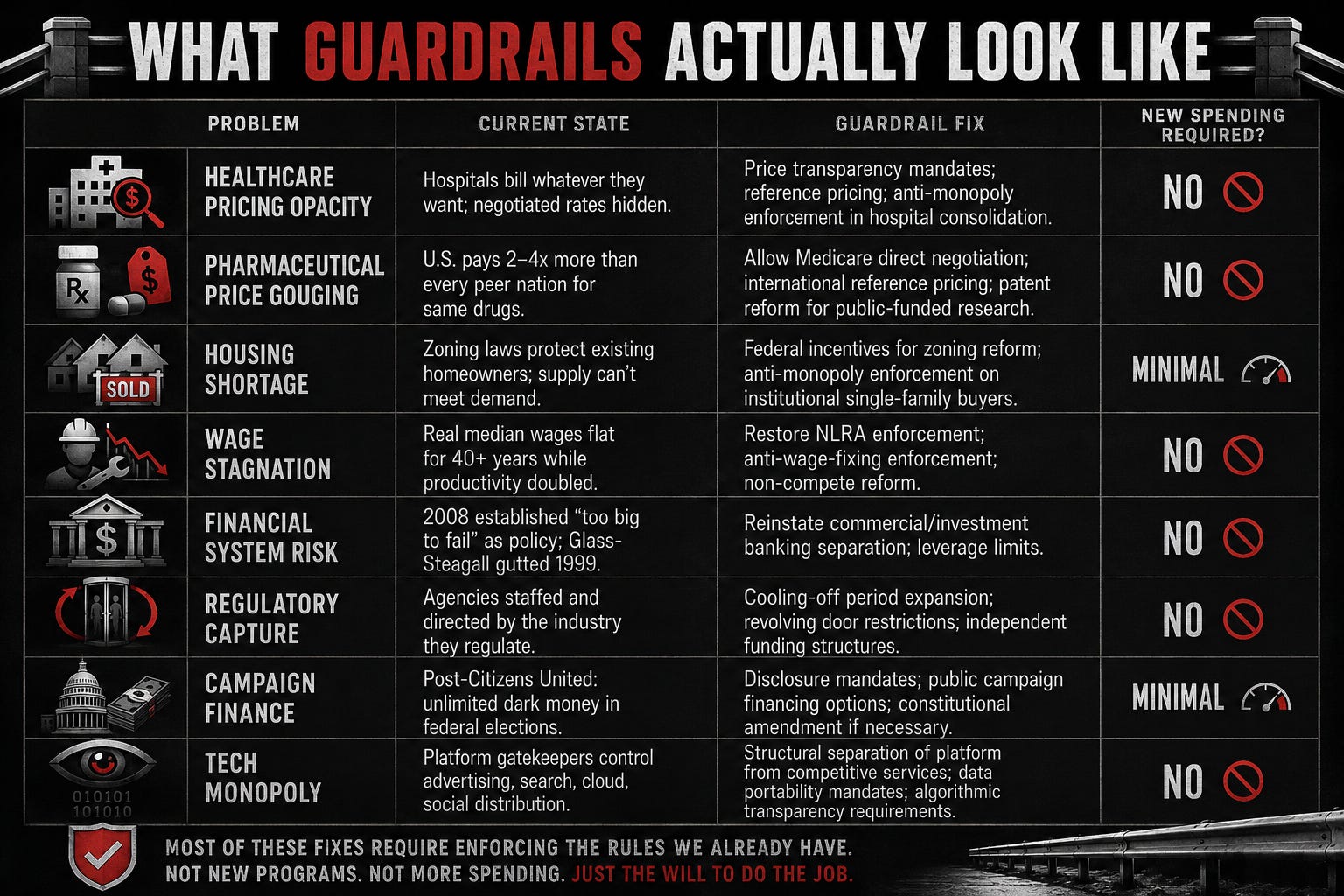
None of those fixes require the kind of multi-trillion-dollar expenditure that dominates the current policy debate. Most of them require the government to do what it is already theoretically authorized to do — enforce existing law, break up illegal monopolies, fund regulatory agencies at the level they need to function, and require transparency. The machinery for most of this already exists. What it costs to run these agencies properly is an order of magnitude less than what it costs to insure the population against the consequences of not running them.
What doesn’t exist is the political will to use the machinery. Because the people who benefit from the current arrangement fund the campaigns of the people who would have to enforce the rules. That is not a capitalism problem. That is a corruption problem with a capitalism costume on.
THE NEW TRUSTS
If Teddy Roosevelt were alive today, he wouldn’t be talking about socialism. He wouldn’t be talking about abolishing capitalism. He’d be asking why a handful of companies control online advertising, cloud computing, prescription drug distribution, hospital networks, meat processing, banking assets, and telecommunications infrastructure. Then he’d ask why the agencies created to police those industries stopped doing their jobs.
The trusts Roosevelt busted were railroad companies and oil companies — entities that controlled the physical infrastructure of the economy so completely that no competitor could enter, no supplier could negotiate, and no customer could escape. The digital equivalent is not a metaphor. Google controls approximately 90% of the search advertising market. Amazon controls roughly 40% of American e-commerce and a commanding share of cloud infrastructure — while simultaneously competing directly against the businesses that depend on that infrastructure to reach customers. Meta acquired its two largest potential competitors, Instagram and WhatsApp, at the moment they became threatening, with explicit internal communications describing the acquisitions as a strategy to neutralize competitive threats. Apple controls both the hardware and the software distribution platform for one of the two dominant smartphone operating systems, taking a 30% cut of every transaction that passes through it.
These are not new companies that need room to grow. They are mature monopolies with market capitalizations larger than most countries’ GDP, operating with the same structural advantages that Standard Oil had in 1900: control of a critical infrastructure layer, the ability to squeeze competitors who depend on access to that layer, and sufficient political spending to ensure the agencies that might intervene remain understaffed, under-resourced, and philosophically hesitant
The Chicago School framework that has guided antitrust enforcement for forty years has no language for this. If a platform gives you a service for free while harvesting your behavioral data to sell to advertisers, consumer prices have not risen — therefore, by the framework’s logic, no harm has occurred. The fact that this arrangement has produced a surveillance capitalism infrastructure that shapes political information, distorts public discourse, and eliminates the possibility of competition in any market the platform chooses to enter is simply outside the analytical vocabulary the framework provides.
Roosevelt did not need a new theory of economics. He needed people willing to use the tools already available. We are in the same position. The Sherman Act applies to digital gatekeepers the same way it applied to railroad trusts. The question is whether anyone in government is willing to say so out loud and act accordingly.
The socialists are right that the game has become rigged. Conservatives are right that wealth creation matters. Both are wrong about the cure.
WHAT THIS ACTUALLY IS
Let’s be direct about the thing both sides are dancing around.
The left correctly identifies many of the symptoms. Wages have been stagnant relative to productivity for four decades. Healthcare costs are destroying household finances. Housing is unaffordable in every major metro. The pharmaceutical industry charges Americans two to four times what peer nations pay for identical drugs. Corporate consolidation has reduced competition across sector after sector. The gap between the top decile and everyone else has widened at a rate not seen since the Gilded Age. These are not debatable points. They are documented facts.
The right correctly identifies that wealth creation matters, that markets generate prosperity that central planning historically has not, and that government programs tend to calcify into bureaucracies that serve themselves. Those are also not debatable points. They are documented facts.
Both sides are wrong about the cure. Because neither set of symptoms is caused by too much capitalism or too little socialism. They are caused by the removal of the mechanisms that were always supposed to keep capitalism honest.
America became prosperous not because it chose capitalism over regulation, but because it paired capitalism with rules that prevented economic power from becoming political power. The crisis we face today isn’t a failure of markets. It’s a failure to police them.
The right’s diagnosis is largely incorrect. The answer to failed regulatory enforcement is not less regulation. The answer to a captured FDA is not no FDA. The answer to a postal service starved of funding is not to prove government can’t run anything by starving it further. The idea that the market would solve drug pricing if we just got government out of the way is contradicted by the fact that the drug pricing problem is worst in the one developed country that most closely follows that prescription.
The real argument is not between capitalism and socialism. It is between a system with functioning guardrails and a system without them. Teddy Roosevelt understood this in 1901. We are still arguing about it in 2025 because a significant number of very wealthy people have found it useful for us to keep arguing about it, and they have funded the infrastructure — political, media, and academic — to make sure we do.
The Uncomfortable Summary
We have been debating the wrong question for forty years. The question is not how much socialism to add. The question is whether we are willing to enforce the rules of the system we already have. Most of what is broken can be addressed at a fraction of the cost of the multi-trillion-dollar proposals that currently dominate the debate. It requires only that the people we elect stop taking money from the industries they are supposed to regulate. That turns out to be the hardest thing in American politics. Considerably harder than arguing about socialism.
THE BOTTOM LINE
America is not suffering from too little socialism. It is suffering from too much regulatory capture, too much monopoly consolidation, too much campaign finance corruption, and too little honest governance of the mixed economy it already operates.
Teddy Roosevelt busted the trusts and proved that concentrated economic power can be confronted without abandoning capitalism. He did not solve it permanently — he slowed it, rebalanced it, bought the country a generation of breathing room before the forces of consolidation regrouped. The monopolies never disappear. They adapt. Which is why we are back here a century later, having the same argument with a different cast, about different industries, using different vocabulary to describe the same structural problem.
The blueprint is still on the shelf. Enforce the rules. Break up illegal concentrations of market power. Fund the institutions built to do that work. Insist that economic strength does not automatically purchase political immunity.
It requires no new ideology, no new bureaucracy, and no new debt. It requires only that we elect people willing to actually do the job — and stop pretending that the word socialism is the real problem when the word corruption is sitting right there, plain as day, in every campaign finance disclosure and every industry-written regulatory comment and every revolving door appointment.
That’s the uncomfortable part.
🎤 💧 - Rxan Smith

Sources & Further Reading
Data, historical records, and policy analysis cited or referenced in this article. Primary government sources are listed first within each category.
Government Spending & Federal Programs
Congressional Budget Office (CBO) — Budget and Economic Outlook
Office of Management and Budget (OMB) — Historical Tables
U.S. Department of Defense — FY2024 Budget Materials
Social Security Administration — Annual Trustees Reports
Centers for Medicare & Medicaid Services (CMS) — National Health Expenditure Data
Healthcare Costs & Pricing
Centers for Medicare & Medicaid Services (CMS) — National Health Expenditure Accounts
Kaiser Family Foundation (KFF) — U.S. Health System Tracker
Commonwealth Fund — International Health System Comparisons
RAND Corporation — Hospital Price Transparency Studies
Congressional Research Service (CRS) — Medicare Drug Price Negotiation Reports
Antitrust & Market Concentration
Federal Trade Commission (FTC) — Historical Merger Enforcement Reports
Lina Khan, “Amazon’s Antitrust Paradox” (Yale Law Journal, 2017)
Thomas Philippon, The Great Reversal (2019)
Barry Lynn, Cornered (2010)
Tim Wu, The Curse of Bigness (2018)
Labor, Wages & Unionization
Bureau of Labor Statistics (BLS) — Union Membership Reports
Economic Policy Institute (EPI) — Productivity-Pay Gap Research
Congressional Research Service — PATCO Strike Historical Analysis
National Labor Relations Board (NLRB) — Historical Data
Financial Deregulation & Banking
Gramm-Leach-Bliley Act (1999)
Brookings Institution — Glass-Steagall Retrospectives
Federal Reserve — Historical Data (FRED)
Telecommunications & Media Consolidation
Columbia Journalism Review — Local News Decline Research
Pew Research Center — State of Local News
Campaign Finance & Political Influence
Citizens United v. FEC (2010)
Big Tech & Platform Dominance
House Judiciary Committee Report: Investigation of Competition in Digital Markets (2020)
Federal Trade Commission — Merger Reviews
Theodore Roosevelt & Progressive Era Reform
National Park Service — Theodore Roosevelt and Trust-Busting
Edmund Morris, Theodore Rex
Doris Kearns Goodwin, The Bully Pulpit
U.S. Department of Justice — Historical Antitrust Cases
Additional Data Sources
UNCOMFORTABLE


