


For generations we have asked what government can do for us.
We’ve also been advised to ask what we can do for our government.
Today we ask a different question:
What kind of country are we willing to build without waiting for permission?
Article the First
On the Nature of This Crisis
We hold these truths to be self-evident: that no government exists for its own preservation. That no party exists for its own enrichment. That no corporation exists without obligation to the society that made its success possible. And that every institution derives its legitimacy from its ability to improve the lives of the people it serves.
The crisis of our age is not ideological.
The crisis of our age is representational.
The Republic is not suffering from a conflict of values. It is suffering from a failure of incentives. And that failure was not an accident. It was a design. The current system does not malfunction when money buys policy. The incentives reward it.
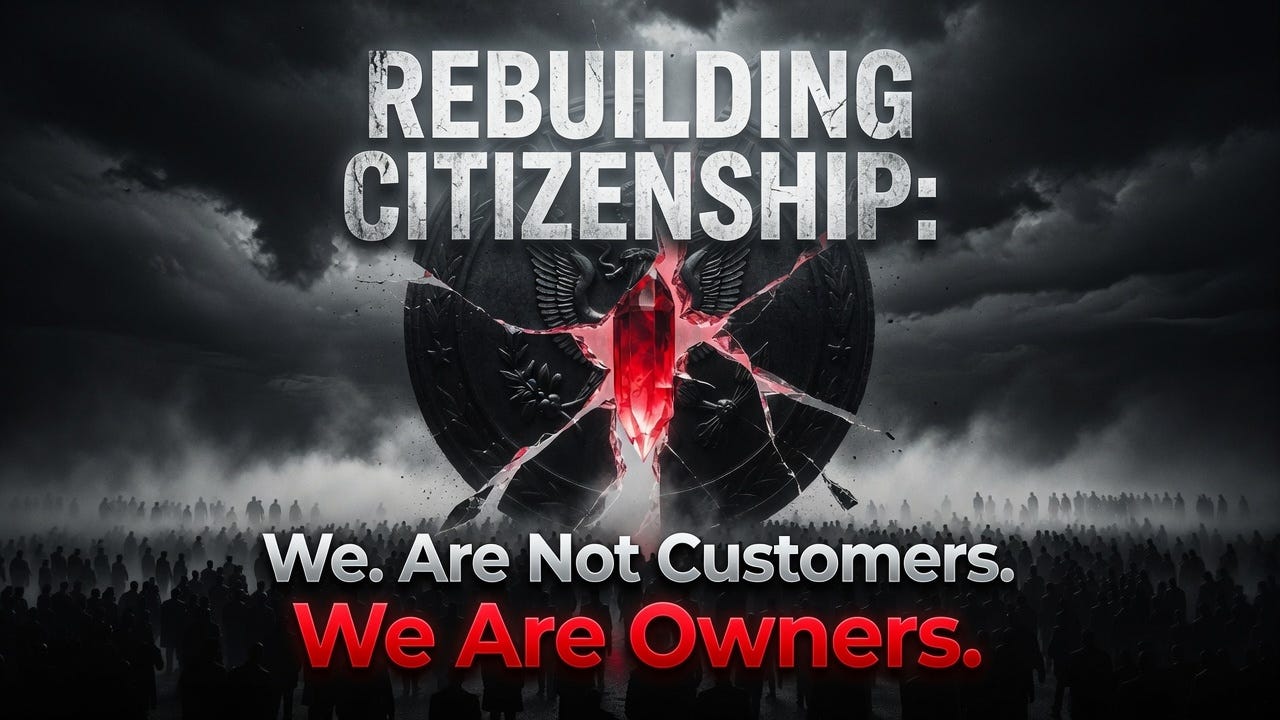
The citizen is not a customer.
The citizen is an owner.
And for fifty years, the incentives have rewarded those who treat the owner as a spectator.
We have mistaken disagreement for division. We have mistaken parties for principles. We have mistaken participation for representation. And we have mistaken noise for self-government.
The measure of a nation is not the power of its government. It is the power of its people to shape the government that serves them.
And where institutions repeatedly fail to serve the public interest, citizens possess not merely the right, but the responsibility, to peacefully reform, replace, or render them irrelevant.
Article the Second
On the False-Choice Machine
They told us our choices were red or blue. Left or right. Coke or Pepsi. As though citizenship were nothing more than selecting a brand.
Meanwhile the foundations of the Republic cracked beneath us and both brands watched it happen, because the cracking was profitable.
Every election became a debate about labels instead of outcomes. About personalities instead of policy. About who to hate instead of what to build.
The machine was not broken.
The machine was built to produce exactly this: a citizenry too exhausted by culture war to notice the bill.
A campaign finance system that rewards access over representation.
A regulatory revolving door that converts public authority into private advantage.
A defense procurement process where cost overruns are not failures. They are the business model.
A pharmaceutical pricing structure that has nothing to do with research costs and everything to do with market capture.
You were not given a choice.
You were given a performance.
And the media that was supposed to expose this performance became a cast member in it.
Every cable network found that outrage was more profitable than information. That division drove clicks. That the citizens most consumed by the culture war were the citizens least likely to notice the bipartisan consensus quietly transferring wealth upward.
Americans agree far more on the ends than they do on the means.
The institutions that profit from division have spent decades making sure we never notice.
Americans across race, religion, geography, age, and party registration desire the same fundamental things:
Safe communities and equal justice under law
Meaningful work and an economy that rewards honest labor
Affordable homes and reliable healthcare
Quality education and opportunity for every child
Honest government and accountable institutions
Strong families and freedom of expression
A future worth building and a past worth reckoning with
We reject the notion that citizenship consists of choosing between two competing brands of power.
We reject the notion that loyalty to a party is more important than loyalty to the nation.
We reject the notion that labels are substitutes for results.
Article the Third
On Rights and Responsibility
Government was never intended to make people equal in outcome, identical in belief, or uniform in character.
Its purpose is to create the conditions under which free people may build meaningful lives.
Every person deserves opportunity.
Every person owes responsibility.
Every success carries with it an obligation to widen the path for those who follow.
Rights without responsibility become entitlement.
Responsibility without rights becomes oppression.
A healthy republic requires both.
But a republic that has allowed its wealthiest citizens to extract generational wealth, offshore their taxes, purchase legislation, and then leave, physically relocate to avoid the consequences of the society they strip-mined, has abandoned the responsibility half of that compact.
You do not get to profit from a nation and then defect from it when the bill comes due.
This applies equally to the billionaire who renounces citizenship when tax policy becomes inconvenient, and to the hedge fund that treats a pension as a liquidation target.
Extraction without obligation is not capitalism.
It is parasitism wearing a business suit.
Article the Fourth
On the Standard of Institutions
We are not searching for perfection.
We are searching for progress.
We do not demand a world without corruption, bias, error, greed, or failure. Such a world has never existed and never will.
What we demand is a system in which corruption is punished more often than rewarded and we mean punished with specificity, not rhetoric.
Name the mechanism:
The revolving door between regulatory agencies and the industries they regulate.
The legal bribery of campaign finance.
The insider trading that is technically permissible for members of Congress.
The pharmaceutical companies that raise prices on life-sustaining drugs not because development costs rose, but because they can.
The defense contractors that fail audits, exceed budgets, miss deadlines, and still receive contracts.
These are not bugs in the system.
These are the system.
And no speech, no election, no hashtag movement will fix them without structural reform that the current beneficiaries of these systems will spend billions to prevent.
We therefore declare that institutions shall be judged not by their promises, but by their outcomes.
Not by their rhetoric, but by their results.
Not by their intentions, but by their impact.
Human beings will never be perfect.
But our institutions can become better.
And when they stop becoming better, they begin to decay
.
Article the Fifth
On the Tribes That Mistook Themselves for Nations
This manifesto would be dishonest if it indicted only one side of the political divide.
The failures of the Republic belong to all of us, and the habits that sustain those failures are distributed more widely than either tribe cares to admit.
The Left’s Failure
The left’s failure has often been one of culture.
A movement that spends more energy policing language than building coalitions eventually mistakes moral performance for political power.
A movement that treats every disagreement as a moral emergency and every imperfect ally as a potential enemy finds itself increasingly pure and increasingly powerless.
Righteous defeat is still defeat.
The people who need relief do not benefit from your principles if your principles never govern.
The Right’s Failure
The right’s failure has often been one of nostalgia.
A movement that promises to restore a past that no longer exists eventually mistakes memory for policy.
A movement that elevates loyalty above accountability and personality above principle finds itself defending behavior it would condemn in its opponents.
Patriotism is not the same thing as partisanship.
A flag is not a substitute for a plan.
The left increasingly struggles to persuade people who disagree with it.
The right increasingly struggles to question people who agree with it.
One confuses criticism with betrayal.
The other confuses disagreement with bigotry.
Neither produces effective self-government.
Both tribes have become addicted to a comforting fiction:
The country’s problems would largely disappear if only the other side would lose.
But a republic cannot function when half the nation sees its opponents as villains and the other half sees itself as victims.
The purpose of politics is not to defeat fellow citizens.
It is to solve collective problems.
And any movement that values ideological satisfaction more than practical results will eventually discover that reality does not care how pure its intentions were.
Article the Sixth
On What the Mirror Shows
We have talked enough about what government has failed to do.
It is time to talk about what we have failed to do.
Because the citizens reading this declaration are not innocent bystanders.
We are participants.
And in a democracy, that means we are partially responsible for the outcomes we refuse to acknowledge.
The country borrowed $36 trillion in your name.
You voted for the people who spent it, or for the people who promised to reduce it and then spent it faster.
You voted for candidates who promised not to touch the programs you didn’t want touched and then complained about the debt.
You demanded accountability from the other party’s representatives and made excuses for your own.
If you voted in every election and never contacted an elected official, attended a public meeting, or read a piece of legislation:
You participated in the ritual without engaging in the work.
This manifesto is not about them.
It is about us.
We do not get to demand a republic worthy of our values while outsourcing civic responsibility to a tribe, a network, a feed, and a vote cast once every four years.
Self-government is not a spectator sport.
It was never supposed to be.
The most dangerous voter is not the one who votes for the wrong party.
It is the one who votes, feels virtuous, and goes home.
Article the Eighth
On What We Intend to Do
We are done asking what our leaders intend to do.
We are here to declare what we intend to do.
Not as a tribe.
Not as a party.
As citizens who have read the ledger and refuse to pretend the numbers balance.
We Intend:
To build communities stronger than the divisions sold to us.
To demand institutions worthy of public trust and name the specific mechanisms that corrupt them.
To reward service over spectacle, across party lines, without exception.
To measure success by outcomes, not slogans, and change our votes when the outcomes do not follow.
To hold the powerful accountable regardless of the flag they fly, including the flags we have carried.
To do the actual work of citizenship, not just the ceremonial parts.
To pass on a republic more honest than the one we inherited, which will require being honest about the one we have.
If government wishes to help, let it help.
If it refuses, let it stand aside.
If media wishes to inform, let it inform.
If it insists on performing, let it perform to an emptying room.
Let future generations say this of us:
That when division was profitable, we chose clarity.
That when cynicism was fashionable, we chose specificity.
That when institutions failed, we named exactly which ones, exactly which mechanisms, and then rebuilt them.
That we did not mistake voting for governing, or governing for citizenship.
That when power forgot whom it served, the people reminded it. Not with violence. Not with vengeance. But with sustained, specific, unglamorous, uncomfortable work done by people who understood that the republic was not a gift that could be received.
It was a practice that had to be maintained.
We are asking you to show up when it is inconvenient.
To be persuaded by evidence.
To hold your own side to the standard you demand of theirs.
To attend the meeting nobody else attends.
To call the office everyone assumes is already being called.
The republic we were promised was never going to be delivered.
It was always going to have to be built.
The people who told you otherwise were selling something.
And you bought it long enough.
That’s on them.
What happens next is on you.
Enough is enough.
🎤 💧
- R❌AN Smith
If this lit something: spread it — not to your echo chamber,
but to the person on the other side of the aisle who needs to read
the half that confirms what they already suspected.
Subscribe so the algorithm does not bury this before it reaches the people who need it.
Every dollar goes to getting this further, faster. Nothing else. Make sure to engage below, and check out these three posts I’ve pasted at the bottom (below the six bottoms)
Who is Rxan Smith (me)?
Rxan Smith Uncomfortable is a reader-supported publication. To receive new posts and support my work, consider becoming a free or paid subscriber.

Join Rxan Smith’s subscriber chat
Available in the Substack app and on web
IF f THIS POST MOTIVATED YOU…
The History Behind Negative Partisanship
When opposition becomes identity, accountability dies first. The real damage isn’t the arguments — it’s what the division protects.
Managed democracy in action. Gerrymandering, primary filters, and structural rules that shape outcomes long before voters show up — and both parties benefit.
American voting is less Democratic than any democracy.
The House Always Wins: You Do Not Vote; You Participate in a Ritual of Optics

“The real game is played long before your finger reaches the ballot.”
The Democrat Guide on How to Regain Respect of the Majority.
Why machine keeps winning no matter who holds the office. Redistricting, backlash cycles, and the structural incentives that survive every election. structural incentives that survive every election.


