


Every election cycle we’re told the same thing.
This election is the most important election of our lifetime.
Democracy is on the ballot.
The other side is an existential threat.
The stakes have never been higher.
And then the election ends.
And somehow… the pharmaceutical companies are still winning.
The defense contractors are still winning.
The biggest lobbyists are still winning.
The wealthiest donors are still winning.
And ordinary Americans are still wondering why housing costs too much, healthcare costs too much, education costs too much, and trust in every institution keeps collapsing.
So tonight I want to ask a question.
What if we’ve been looking at politics through the wrong lens?
Rxan Smith Uncomfortable is a reader-supported publication. To receive new posts and support my work, consider becoming a free or paid subscriber.
What if the most important divide in America isn’t Republican versus Democrat?
What if it isn’t conservative versus liberal?
What if it isn’t left versus right?
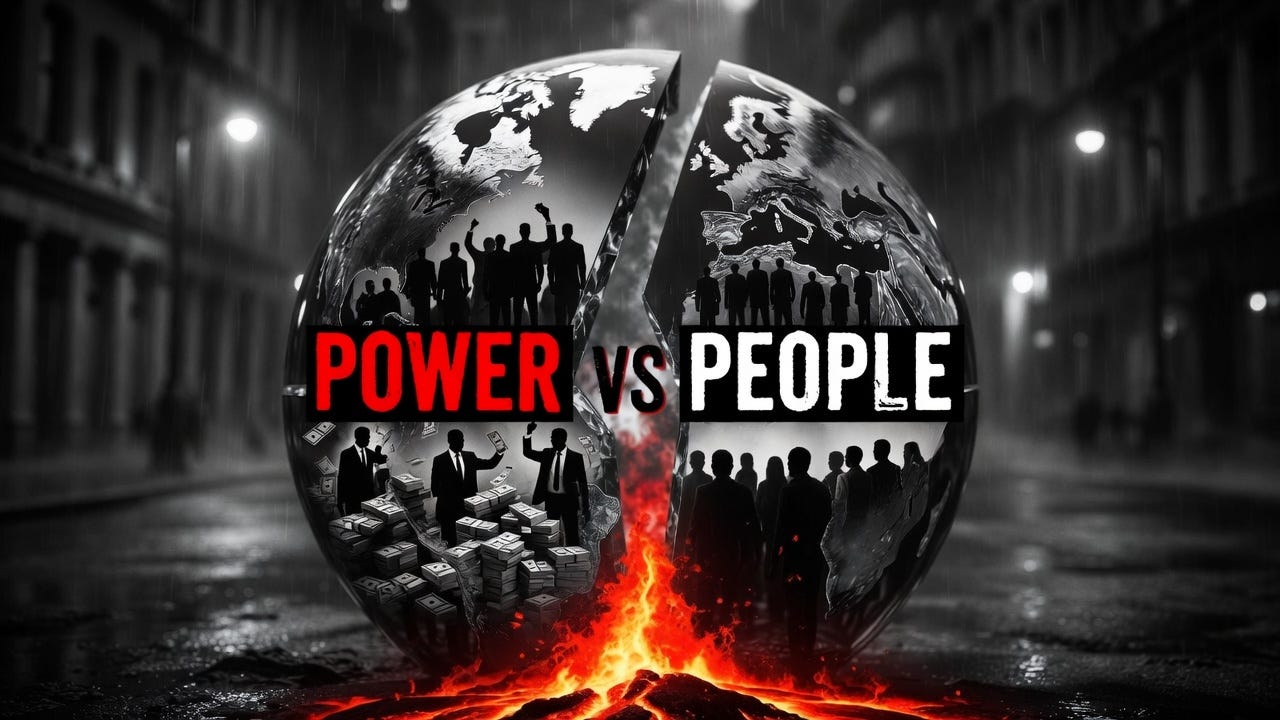
What if the real divide is something much older, much simpler, and much more important?
POWER
VS
PEOPLE
THE REAL DIVIDE IN AMERICA
Now before anyone starts typing angry comments, let’s get something out of the way.
This is not a “both parties are exactly the same” argument.
They aren’t.
There are real differences on abortion, guns, regulation, culture, courts, taxation, and a hundred other issues.
Those differences matter. They affect real lives.
But that’s not what tonight is about.
Tonight is about asking a different question.
A bigger question.
A question that cuts underneath the labels.
Who actually wins? Who actually benefits? Who actually has power?
Because once you start asking those questions, modern politics begins to look very different.
The Spectrum They Sold You
Let’s start with something most people never think about.
When you say you’re on the left or the right, what exactly does that mean?
Do you believe workers should have more power in the workplace? Traditionally left.
Do you believe government should stay out of your private life, your bedroom, your medical decisions? Traditionally right.
Do you believe local communities should have more say over federal mandates? Traditionally right.
Do you believe corporate monopolies are destroying small businesses and rural economies? Traditionally left.
Except here’s the problem.
Most Americans believe some combination of all those things.
Most Americans are not ideological robots.
Most Americans are mixtures. They always have been.
The average citizen doesn’t fit neatly into a partisan box.
The average citizen has a scrambled basket of views.
And that’s where the traditional political map starts breaking down.
◀ FAR LEFT
CENTER
FAR RIGHT ▶
The Axis That Actually Matters
◀ THE PEOPLE POWER ▶
Because the idea that America consists of two perfectly coherent tribes locked in eternal combat isn’t reality.
It’s marketing. It’s branding. It’s a product.
And somebody is making a lot of money selling it.
Study after study shows that somewhere between 60 and 70 percent of Americans hold views that don’t map cleanly onto either party platform.
They want universal healthcare and secure borders.
Police reform and safe streets.
Skeptical of Wall Street and skeptical of government overreach.
They want the government to leave their guns alone and to do something about their insulin costs.
These aren’t contradictions. These are just normal people.
Yet we’re constantly told we must choose one team or the other.
Why?
Who benefits from that?
Because when I look around, I notice something.
The people at the bottom are fighting each other.
The people at the top are cashing checks.
And that brings us to something fascinating.
The original left-right political spectrum wasn’t even created around today’s issues.
It came from the French Revolution.
People literally sat on opposite sides of a room in the National Assembly.
Those on the left supported the revolution, the redistribution of aristocratic power, the rights of the commons.
Those on the right supported the monarchy, the Church, the existing order.
The question wasn’t identity.
The question wasn’t culture.
The question wasn’t social media outrage.
The question was simple: Who holds power? Who should hold power? And what are they allowed to do with it?
That’s it. That’s the original argument.
Fast forward a couple hundred years and we’ve buried that question under mountains of tribalism, outrage, and distraction.
But the question never disappeared.
We just stopped asking it.
And maybe that’s exactly what powerful people wanted.
Because once you start following power instead of labels, some uncomfortable patterns emerge.
Consider this:
Less than one percent of Americans make large political donations.
Yet research has repeatedly found that when the preferences of average voters conflict with the preferences of economic elites, elite preferences are more likely to become policy.
The people have votes.
The powerful have access.
The people have opinions.
The powerful have influence.
The people have election years.
The powerful have lobbyists every day of every year.
And lobbying isn’t a small side business.
It’s a multibillion-dollar industry.
Pharmaceutical companies. Financial institutions. Defense contractors. Technology giants. Energy companies. Healthcare systems. Insurance companies. Private equity firms.
All spending enormous amounts of money influencing the rules under which they operate.
Again, ask the question.
Who benefits?
Concrete Examples
Drug Pricing & Insulin
People’s interest: Lower out-of-pocket costs. Same drug, same factory, same price as in peer nations. Chronic illness should not be a profit center.
Power’s interest: Maximized margins via patent evergreening, direct-to-consumer advertising, and blocking importation or price negotiation. Recurring revenue from lifelong patients.
Status quo alignment: Power
Both parties have taken pharma money for decades while costs remain outliers globally.
Immigration Enforcement
People’s interest: Secure borders that actually work plus legal pathways that don’t flood low-skill labor markets and suppress wages for citizens without college degrees.
Power’s interest: Reliable supply of cheap, compliant labor for agriculture, meatpacking, construction, and hospitality. Enforcement theater that never quite solves the supply.
Status quo alignment: Power
Decades of bipartisan inaction while key industries quietly depend on the current flow.
Healthcare System Design
People’s interest: Access decoupled from employment. Predictable costs. No medical bankruptcy for insured people. Prevention over endless billing cycles.
Power’s interest: Employer-based system that ties workers to jobs. Multiple layers of administration and profit-taking. Complexity that defeats reform.
Status quo alignment: Power
The U.S. pays far more per capita than peers while delivering worse population outcomes on many metrics.
Corporate Taxes & Bailouts
People’s interest: Profitable corporations pay a meaningful share. Losses are not socialized while gains stay private. No permanent “too big to fail” safety net.
Power’s interest: Lower effective rates through lobbying and complexity. Access to emergency public capital when markets turn. Tax code written by the people it taxes least.
Status quo alignment: Power
Effective corporate rates remain far below statutory. Bailout infrastructure is now permanent.
In the 1970s, CEOs made roughly twenty-five times what typical workers made.
Today that number is more than two hundred and eighty times.
The top one percent owns a dramatically larger share of wealth than it did a generation ago.
Federal lobbying spending has exploded.
Concentrated wealth has increased. Concentrated influence has increased. Concentrated access has increased.
And yet somehow we’re still arguing like the biggest story in America is which party won the last election.
Maybe we’re debating the symptoms while ignoring the disease.
Maybe we’re arguing about teams while someone else owns the stadium.
For years I bought the frame like everyone else.
I argued left versus right.
I picked my team and defended it.
Then I started noticing something that didn’t fit the script.
Every time ordinary people got angry enough to fight each other over the latest outrage...
somebody else quietly got richer.
The pharmaceutical companies. The defense contractors. The private equity firms. The people writing the rules.
And I realized the fight itself might be the product.
Now here’s where this gets uncomfortable.
I’m not asking you to switch teams.
I’m asking you to take off the jersey.
Rxan Smith Uncomfortable is a reader-supported publication. To receive new posts and support my work, consider becoming a free or paid subscriber.
The Partisan Test
One of the easiest ways to know whether you’ve become a partisan instead of a citizen is simple:
Can you criticize your own side?
Not the other side.
Your side.
Because power doesn’t care what jersey you’re wearing.
Power corrupts Republicans.
Power corrupts Democrats.
Power corrupts corporations.
Power corrupts bureaucracies.
Power corrupts movements.
The moment accountability becomes something that only applies to your opponents, you’ve stopped defending principles and started defending a tribe.
Ask yourself some simple questions.
Should people who work full-time be able to afford a decent life?
Should corporations write the regulations that govern themselves?
Should elected officials be financially dependent on the industries they’re supposed to oversee?
Should healthcare bankrupt families?
Should government spy on citizens without meaningful oversight?
Don’t ask what Republicans think.
Don’t ask what Democrats think.
Ask what you think.
Because I’d wager that on many of those questions, you have more in common with your supposed political enemies than you realize.
And that’s dangerous.
Not dangerous for you.
Dangerous for the people who profit from keeping you divided.
What Nobody Talks About
Here’s what nobody talks about.
If the Republican Party disappeared tomorrow...
The pharmaceutical lobby would still exist.
If the Democratic Party disappeared tomorrow...
The pharmaceutical lobby would still exist.
If Fox News disappeared tomorrow...
The lobbying industry would still exist.
If MSNBC disappeared tomorrow...
The lobbying industry would still exist.
If every culture war argument vanished overnight...
The concentration of wealth would still exist.
The revolving door would still exist.
Regulatory capture would still exist.
The incentives would still exist.
Which means maybe the problem isn’t the argument.
Maybe the problem is the thing the argument distracts us from.
Power loves certainty.
People need results.
That’s why so much of modern politics has become performance.
The goal isn’t solving problems.
The goal is proving loyalty.
The goal is demonstrating that you’re on the correct team.
But ordinary Americans don’t wake up asking whether their neighbors are sufficiently enlightened.
They want affordable housing.
Affordable healthcare.
Safe communities.
Good jobs.
Functional institutions.
If your movement can’t deliver those things, eventually voters stop listening no matter how morally convinced you are that you’re right.
Reality always gets the final vote.
Rxan’s Final RX
Stop saying you’re “not political.”
You live in a society.
Your rent.
Your insulin.
Your kid’s school lunch.
The water coming out of your tap.
Every one of those exists inside a system shaped by political decisions made by people you’ve probably never met.
Mostly without your input.
Being “not political” isn’t a personality trait.
It’s an abdication.
And the people who benefit most from your absence are counting on you to keep it up.
At the same time, stop pretending the other party is single-handedly destroying America.
Both parties have held power repeatedly during my lifetime.
Yet somehow the same winners keep winning.
Pharmaceutical companies keep getting their prices.
Defense contractors keep getting their wars.
Banks keep getting their bailouts.
And ordinary Americans keep getting the bill.
If your team keeps losing to the same opponent no matter who’s in charge, maybe the problem isn’t just the referee.
Maybe the game itself is fixed.
That’s why political identity deserves far more skepticism than pride.
Most political identities aren’t assembled through careful reasoning. They’re built through repetition, emotion, tribal loyalty, and social reward. The outrage is often genuine.
The analysis beneath it is frequently manufactured.
There’s a difference between having convictions and being conditioned.
Too many people confuse the two.
And if you can name every scandal involving the other party but can’t name a single one involving your own, you’re not informed.
You’re curated.
You’re consuming a media diet engineered to confirm your assumptions, reinforce your biases, and monetize your anger.
A healthy democracy requires citizens willing to challenge their own side.
What we have right now are fans.
Fans don’t hold anyone accountable.
Fans make excuses.
The most radical political act in 2026 isn’t voting red.
It isn’t voting blue.
It’s refusing to let either party define the terms of the conversation.
It’s recognizing that the most important political axis isn’t necessarily left versus right.
It’s power versus people.
And then honestly asking where the policies you support actually fall.
Not symbolically.
Not rhetorically.
Actually.
Ask better questions.
Who benefits from this?
Who paid for it?
Who wrote it?
Who profits from it?
What problem does it actually solve?
Not the marketing.
Not the slogan.
Not the campaign ad.
The reality.
Because when you start asking those questions, you stop being a voter in someone else’s game.
You start becoming a citizen in your own country.
And that’s deeply threatening to exactly the people who should feel threatened.
That’s the point.
And that’s what makes people uncomfortable.
If this made you uncomfortable , you’re exactly who I write for.
Free to read. Paid for the deeper cuts, early access, community, and support. Revolution Leader Membership Helps Grow Our Movement Directly
All Support is Appreciated and I am humbled to be able to write for you.
The Uncomfortable Truth • Rxan Smith • Making us uncomfortable since 2025
Rxan Smith Uncomfortable is a reader-supported publication. To receive new posts and support my work, consider becoming a free or paid subscriber.
Enough is enough.
🎤 💧
- R❌AN Smith
If this lit something: spread it — not to your echo chamber,
but to the person on the other side of the aisle who needs to read
the half that confirms what they already suspected.
Subscribe so the algorithm does not bury this before it reaches the people who need it.
Every dollar goes to getting this further, faster. Nothing else. Make sure to engage below, and check out these three posts I’ve pasted at the bottom (below the six bottoms)
Who is Rxan Smith (me)?
Rxan Smith Uncomfortable is a reader-supported publication. To receive new posts and support my work, consider becoming a free or paid subscriber.
Join Rxan Smith’s subscriber chat
Available in the Substack app and on web
IF f THIS POST MOTIVATED YOU…
The History Behind Negative Partisanship
When opposition becomes identity, accountability dies first. The real damage isn’t the arguments — it’s what the division protects.
Managed democracy in action. Gerrymandering, primary filters, and structural rules that shape outcomes long before voters show up — and both parties benefit.
American voting is less Democratic than any democracy.
The House Always Wins: You Do Not Vote; You Participate in a Ritual of Optics

“The real game is played long before your finger reaches the ballot.”
The Democrat Guide on How to Regain Respect of the Majority.
Why machine keeps winning no matter who holds the office. Redistricting, backlash cycles, and the structural incentives that survive every election.


