I want to write something epic. Not the kind of post that scores well for a day and disappears by Thursday. Something for the people my strongest work has already reached, the ones who still believe this country can change.
Underneath every argument, every headline, every campaign ad, there’s one feeling almost every American carries whether they say it out loud or not.
This country needs to change.
We’ve heard that promise a thousand times. Nobody’s offered a plan simpler than trusting one more system, one more politician, one more party.
I’m not asking you to trust any of those things. I’m asking you to trust four things that already exist, whether either party notices them or not.
Rxan Smith Uncomfortable is a reader-supported publication. To receive new posts and support my work, consider becoming a free or paid subscriber.
Four Things That Still Exist
History.
Pride of country.
The desire for the American Dream.
And the common good that still lives in ordinary people, underneath all the noise we’ve been trained to mistake for disagreement.
Unite those four things and you don’t need consensus on what they mean. You need enough shared rules for pursuing them together. That’s not idealism. That’s arithmetic. It’s what democracy has always actually meant: the will of citizens, not the will of a brand.
Here’s the part nobody wants to say plainly.
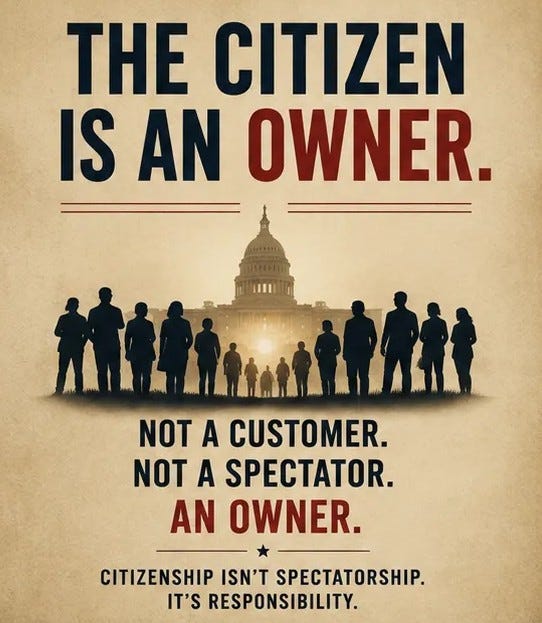
The citizen was never supposed to be a customer. The citizen is an owner.
For fifty years the incentives have rewarded whoever could make the owner behave like a spectator instead. Sit down. Pick a side. Watch the show. Pay the bill quietly at the end. You weren’t given a choice between two ideas. You were given a performance, and the reviews were rigged from the start.
The Deposit
Here’s the actual argument, so I don’t bury it.
America has a habit. We rediscover the common good, but usually only after catastrophe forces our hand. Pearl Harbor. The year after September 11th. A handful of other mornings where the bill came due all at once and the tribalism evaporated because it had to.
History already answered whether we’re capable of unity. The real question is whether we can find the common good before the catastrophe, instead of after it.
The real question is whether we can find the common good before the catastrophe, instead of after it.
This isn’t a prediction of violence, and it isn’t a threat of it.
it’s an argument against waiting for tragedy, war, or collapse to remember that we’re countrymen. We’ve done that before. We shouldn’t need to do it again.
I’m not selling you a better system with more charisma. I don’t claim to know every answer the next decade is going to demand. What I’m offering is more modest and more durable: get there early, and we’re standing together before the bill arrives instead of after.
The common good is not a policy.
It’s the deposit everything else gets built on.
Whatever ideology comes next has to come after that deposit is made, not instead of it. Without it there is no left and no right. There’s only forward and backward, and right now we’re being sold backward dressed up as revolution on both ends of the aisle at once.
The Mirror
We’ve spent enough time talking about what government has failed to do. It’s time to talk about what we’ve failed to do.
Voting is the minimum admission price for citizenship. It was never meant to be the whole membership.
Somewhere along the way we started treating politics like content. Post. Rage. Vote. Disappear. Repeat. Meanwhile the people who actually move outcomes are the ones showing up to the meetings nobody livestreams: zoning boards, primaries, school boards, county party committees, regulatory hearings. They have disproportionate power for one simple reason. Everyone else is busy arguing with strangers under a video.
That’s what “the citizen is an owner” actually costs. Not a slogan. A Tuesday night in a folding chair.
Not a slogan. A Tuesday night in a folding chair.
You voted for the people who spent the money, or for the people who promised to cut it and spent it faster anyway. You demanded accountability from the other party’s representatives and made excuses for your own. If you’ve voted in every election and never once called an office, attended a meeting, or read a bill, you participated in the ritual without doing the work.
This isn’t about them anymore.
It’s about us.
It’s time to look at the person across the aisle and say something simpler than a slogan.
It’s nice to be back, neighbor.
We Have Done This Before
This isn’t a hope. It’s a track record, if you’re honest about what’s actually in it.
In 1941, this country was still arguing about whether to enter a war that was already killing people. Then came Pearl Harbor. Twenty-four hundred Americans dead before eight in the morning on a Sunday, and within twenty-four hours a deeply divided country became remarkably unified. Factories converted overnight. The prosperity that followed came from a dozen forces working together: wartime mobilization, industrial dominance, unionization, the GI Bill, decades of infrastructure investment. It wasn’t distributed evenly. Black Americans in particular were locked out of large parts of it by policy, not accident. But the speed of the mobilization, the willingness to move as one country, is the part worth remembering.
By 1998, the federal government started running actual surpluses, four years straight through 2001. The peak came in 2000: $236 billion in a single year, the largest surplus on record. Not utopia. Divided government, tax changes, a tech boom, and defense drawdowns after the Cold War all played a part. But for a stretch of years, the country paid its bills instead of arguing about who should have to.
Then came September 11th. Twenty-nine hundred seventy-seven lives lost, and for one brief window the country was one again. What happened to that window afterward, trillions funneled into contracts, a surplus spent down while the flags were still out on people’s porches, was a choice. A documented one, made by people whose names are on the record. The grief was real. The choices are traceable.
And somewhere in the neighborhood of several million Americans who voted for Obama went on to vote for Trump. The exact number depends on which study you trust. What doesn’t depend on anything is the plain fact itself: millions of the same voters were willing to cross an enormous ideological and stylistic gulf, twice, looking for change nobody else was offering them. That alone is enough to end every lazy theory about a simple left/right electorate.
Different election. Different decade. Same disease.
Same Disease, Different Vocabulary
I understand the instinct to vote for Trump. I understand the instinct to align with the DSA, especially among younger people watching both parties fail them in real time. Everything they’ve seen from the establishment has stopped working, and they are correctly desperate for something that does.
I’m not arguing the two are the same movement. They aren’t equivalent in ideology, size, leadership, or history. I’m arguing they’re the same kind of answer to the same kind of question: what do you reach for once you’ve concluded the existing settlement has already failed you?
The conservative who’s furious about endless wars and a political class that hasn’t served working people in thirty years, and the progressive who’s furious about corporate capture and a healthcare system that bankrupts people who did everything right, are pointing at the same broken machinery in two different accents. They don’t agree on the diagnosis or the cure. They agree the patient is sick.
The left’s failure has often been one of purity. A movement that spends more energy policing language than building coalitions eventually mistakes moral performance for actual power. Righteous defeat is still defeat.
The right’s failure has often been one of nostalgia. A movement that promises to restore a past that no longer exists eventually mistakes memory for a plan.
The two failures aren’t identical. One drives away allies with a purity test. The other drives away accountability with a loyalty test. Different mechanisms, same result: neither side can build the kind of durable, cross-partisan coalition that structural reform actually requires, so both settle for being right instead of being effective.
Both tribes have gotten addicted to the same comforting fiction: that the country’s problems would mostly disappear if the other side would just lose. But a republic can’t function when half the nation treats its neighbors as villains and the other half treats itself as the victim.
Rxan Smith Uncomfortable is a reader-supported publication. To receive new posts and support my work, consider becoming a free or paid subscriber.
The Declaration
If I’m going to call this a declaration, it should actually declare something.
The common good isn’t a mood, and it isn’t “everyone compromise.” It’s the minimum set of conditions under which Americans who disagree about almost everything else can still govern themselves together: equal citizenship, institutions that answer to the public instead of donors, rules that apply the same way regardless of who’s breaking them, real economic opportunity, basic security, and power that changes hands peacefully every time.
That’s the foundation. Here’s what standing on it actually requires.
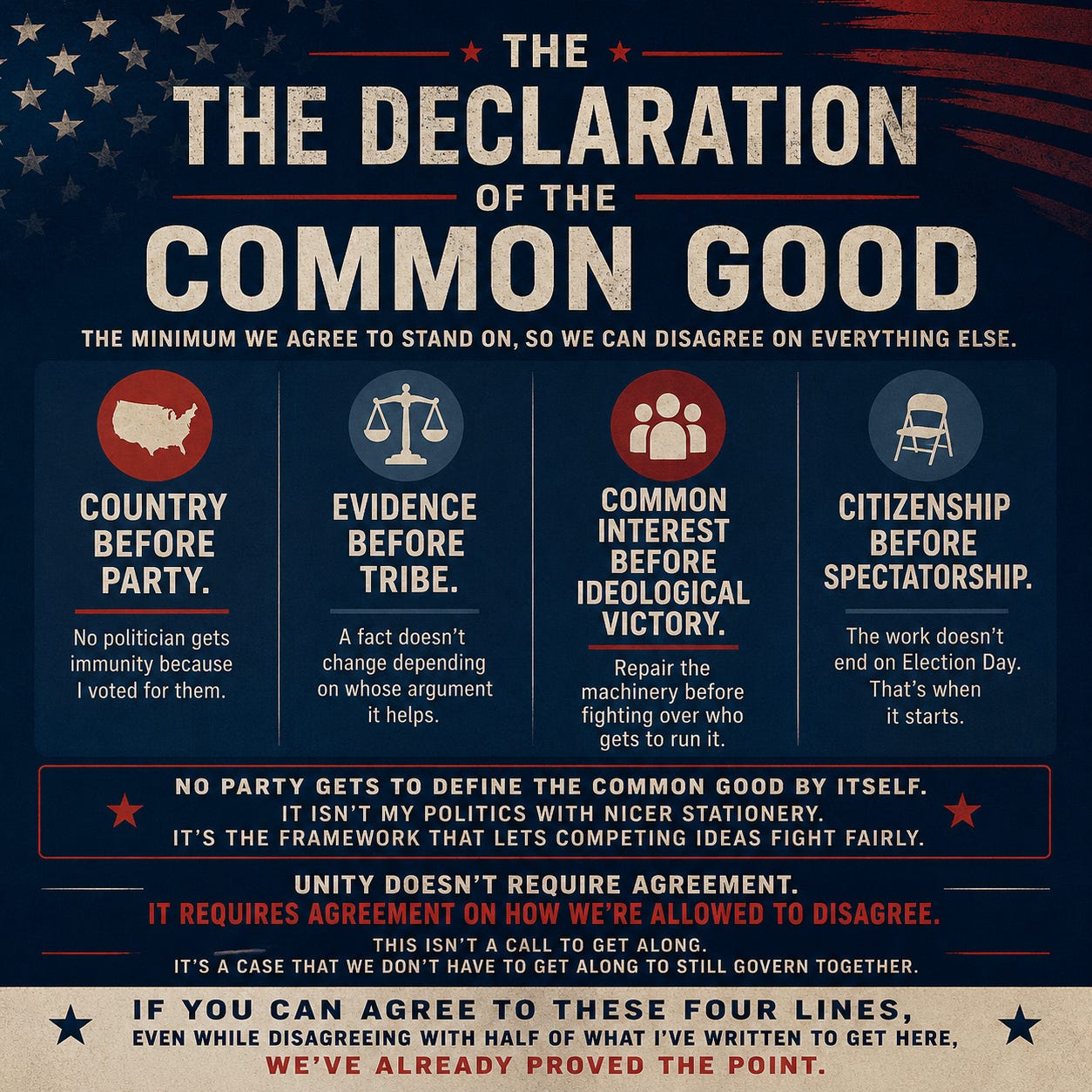
Country before party. No politician gets immunity because I voted for them.
Evidence before tribe. A fact doesn’t change depending on whose argument it helps.
Common interest before ideological victory. Repair the machinery before fighting over who gets to run it.
Citizenship before spectatorship. The work doesn’t end on Election Day. That’s when it starts.
No party gets to define the common good by itself. It isn’t my politics with nicer stationery. It’s the framework that lets competing ideas fight fairly over everything that comes after it.
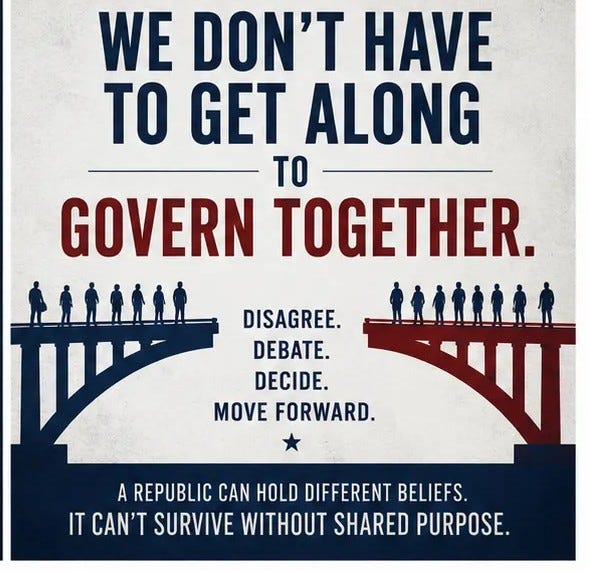
Unity doesn’t require agreement. It requires agreement on how we’re allowed to disagree. That’s not a call to get along. It’s a case that we don’t have to get along to still govern together.
The ‘Four Olds’ Democracy Never Forgets - They Don’t Require Radical Social or Economic Policy… Just a declaration to support humanity and the common good. No ideology owns mortality or livbety.
If you can agree to these four lines, even while disagreeing with half of what I’ve written to get to this point, WE have already proved the point. This is the first priority to heal.
The Path
Here’s where it stops being a feeling and starts being a plan, because a feeling without a plan is just content. This isn’t the whole operating manual, that’s its own piece. This is the direction.
Participate. Show up locally before the national fights: primaries, town halls, school boards, the meetings nobody livestreams. Don’t start by building a national third party, America’s electoral structure is built to punish them. Build outward from the room where you can actually be heard.
Expose. Follow the money. Document the conflicts. Make the incentives visible instead of invisible, because most of what’s broken here survives on nobody bothering to look.
Pressure. Votes, calls, organized constituencies, and when institutions still refuse to respond, sustained economic pressure like boycotts. Documented tools with documented records. They work when they’re broad and disciplined, they fail when they’re narrow and performative.
Reform. Attack the incentives directly: end gerrymandering, require full disclosure of political money, close the lobbyist revolving door with real cooling-off periods and real enforcement, not a blanket punishment for anyone who ever worked in government and then didn’t. Other democracies have adopted versions of these. We haven’t, because the people writing the rules have never had an incentive to change them.
Agree to disagree on everything else. The conservative who agrees lobbying has captured this government is your ally in fixing it, even if you disagree with him on almost everything downstream of that. Park the rest of the argument until the machine blocking all of it is repaired.
Sharing this is step one, not the whole plan. If everyone who agrees with the four lines above makes sure it reaches five more people, the idea moves. But it only matters if it moves toward the work above, not just toward another share count.
Before the Blood
For a quarter-century, the people profiting from our division have been betting on our exhaustion. On our tribalism. On our willingness to claw at the person next to us instead of the people actually running the machine.
Here’s what they got wrong. They mistook our patience for surrender.
We are the people who have reorganized an entire economy around a common purpose when circumstances demanded it. We are the people who balanced a budget within living memory. We are the people who, more than once, became one country again inside of twenty-four hours when the stakes were finally undeniable.
The only real question left is whether we do that again before the cost gets higher, or after.
I don’t know exactly what comes next. Neither does anyone else, no matter how confidently they say it on television. That’s the point. We don’t need agreement about the destination before we agree the vehicle belongs to us.
Stand with the idea that the citizen is an owner, not a spectator.
Stand with the Declaration of the Common Good.
Stand with the plain fact that united, we still stand, and that it has never once been sentiment. It’s arithmetic.
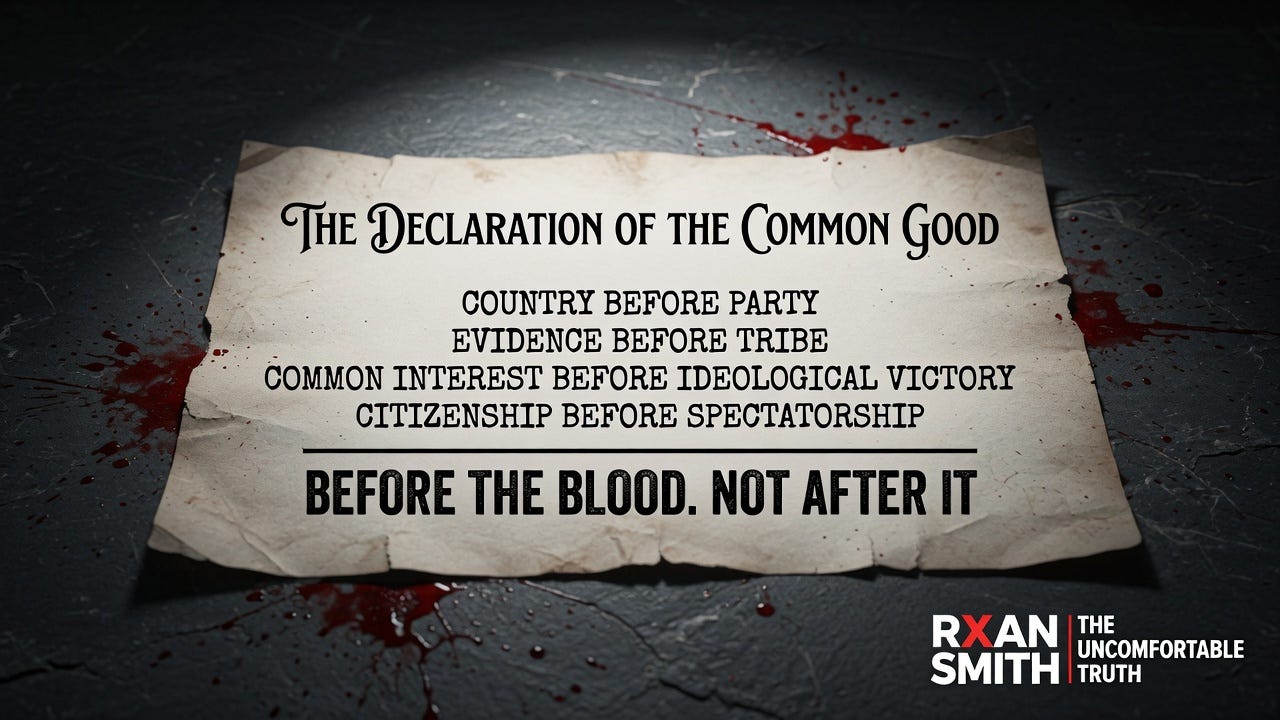
Before the blood... Not after it.
I am R❌️an Smith, and if his made you uncomfortable, good! That's the point.
Rxan Smith Uncomfortable is a reader-supported publication. To receive new posts and support my work, consider becoming a free or paid subscriber.
Thanks for reading Rxan Smith Uncomfortable! This post is public so feel free to share it.
Uncomfortable truths, systemic analysis, and no‑spin political commentary for listeners tired of echo chambers and late outrage. New episodes cut through noise with cinematic, confrontational clarity.
Uncomfortable truths, systemic analysis, and no‑spin political commentary for listeners tired of echo chambers and late outrage. New episodes cut through noise with cinematic, confrontational clarity.