A transcript unlocks clips, previews, and editing.
Nine Robes, No Shame: The United States Supreme Court
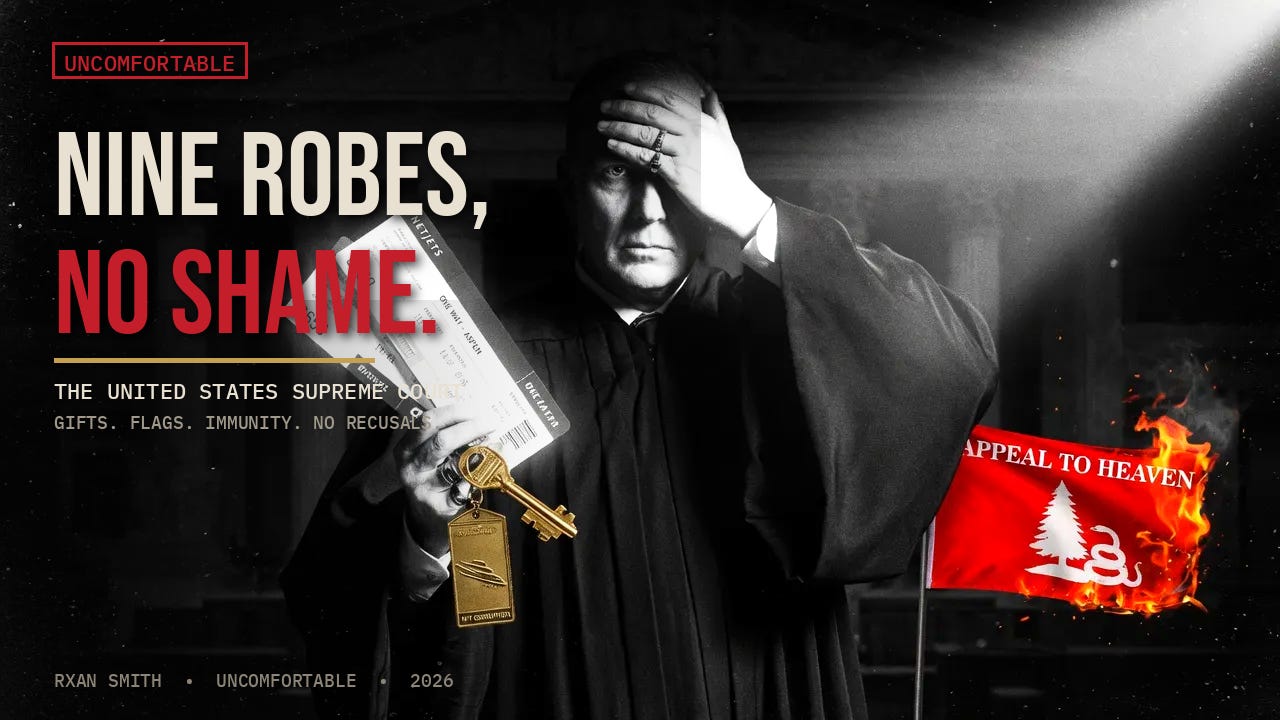
SCOTUS was designed to protect the law from power. When did it become THE PLACE where power goes to protect itself w/ a gavel, a lifetime appointment, and a luxury fishing trip on someone else's jet.
The Supreme Court was designed to protect the law from power.
Increasingly, it looks like the place where power goes to protect itself… with a gavel stamp, a lifetime appointment, and a luxury fishing trip on somebody else’s jet. - Rxan Smith The Uncomfortable Truth
Let me be direct. Choosing between two permanent political tribes has never made sense to me… not when both sides treat loyalty like morality and disagreement like betrayal..
So I say this…
Not as a Democrat.
Not as a Republican.
As an American who still believes there should exist one institution that operates above the treeline of partisan warfare. Give me one that pretends well.
And before anyone pretends independent media itself is neutral.. everybody has a lens. The difference is whether you disclose it honestly or smuggle ideology through the side door in the costume of objectivity. What’s wrong with this country is bad for both sides. If it isn’t, it goes to the back of the line.
We were told the Supreme Court was that institution. The place where politics stopped at the door. For a meaningful stretch of history, enough people believed it to make it function.
We don’t believe it anymore.
The remarkable thing isn’t that the Court has drifted. Institutions drift. It’s that the people on it have stopped pretending to care that you noticed.
If this court is going to rule straight down party lines, we need to be honest about what it is. And if we’re honest about what it is, we need a serious talk about why we still need it.
Built for people who can handle it. Subscribe to Rxan Smith Uncomfortable to support my work,
If you are already a subscriber, please consider upgrading here subscription to make sure this publication survives. If a paid subscription isn’t in the cards right now, you can still keep this work independent. Please consider supporting me on Buy Me a Coffee or PayPal. Every contribution goes directly into keeping me free of sponsors, ads, and anyone who’d want a say in what gets written. An informed public is nearly impossible to manipulate: our goal.
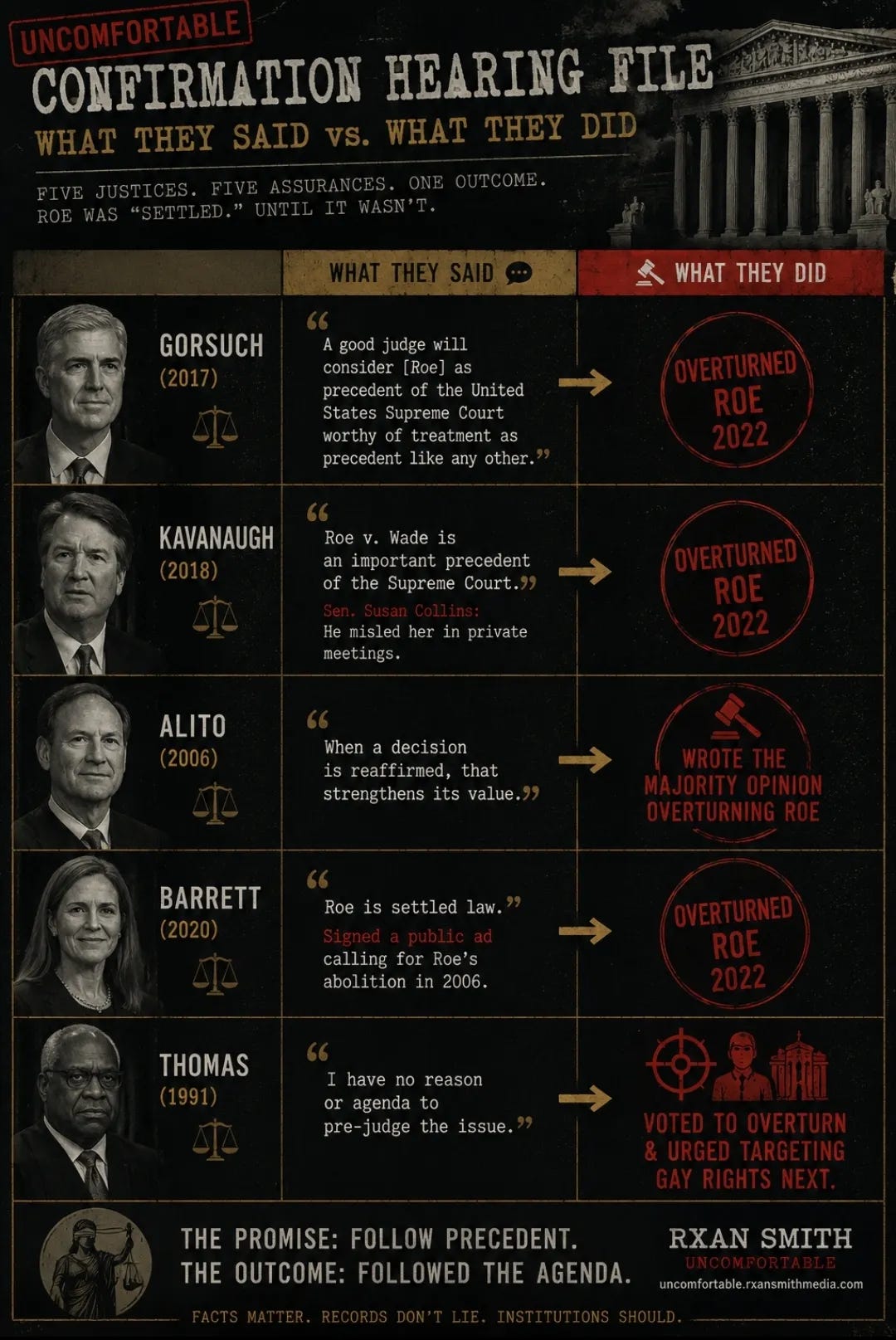
You want a seat on the highest court in the land. You testify, under oath, about your judicial philosophy. This is where you perform your sincerity… assuring serious senators that you respect precedent. That stare decisis is sacred to you.
They nod. They vote. You get the robe.
Gorsuch told the committee in 2017 a good judge would treat Roe as precedent like any other. Kavanaugh called it “an important precedent.” Alito said reaffirming a decision “strengthens its value.” Barrett called it “settled law”… after signing a public ad calling for its abolition.
In 2022, all four voted to overturn Roe in Dobbs, eliminating a constitutional right fifty years of Americans had structured their lives around. A right reaffirmed… their word… repeatedly. Senator Susan Collins, who confirmed two of them, said the ruling contradicted what they told her.
Reasonable people can argue the merits of Dobbs. What’s not debatable: the issue isn’t whether they technically lied under oath. It’s whether they deliberately cultivated ambiguity to secure confirmation for outcomes they already intended. Because that sounds exactly like what happened.
These weren’t judges discovering a new argument on the bench. These were people who knew what they intended, but said whatever got them confirmed.
Know someone who’d rather be right than comfortable? Send them this.
Nothing clarifies an institution’s values like money.
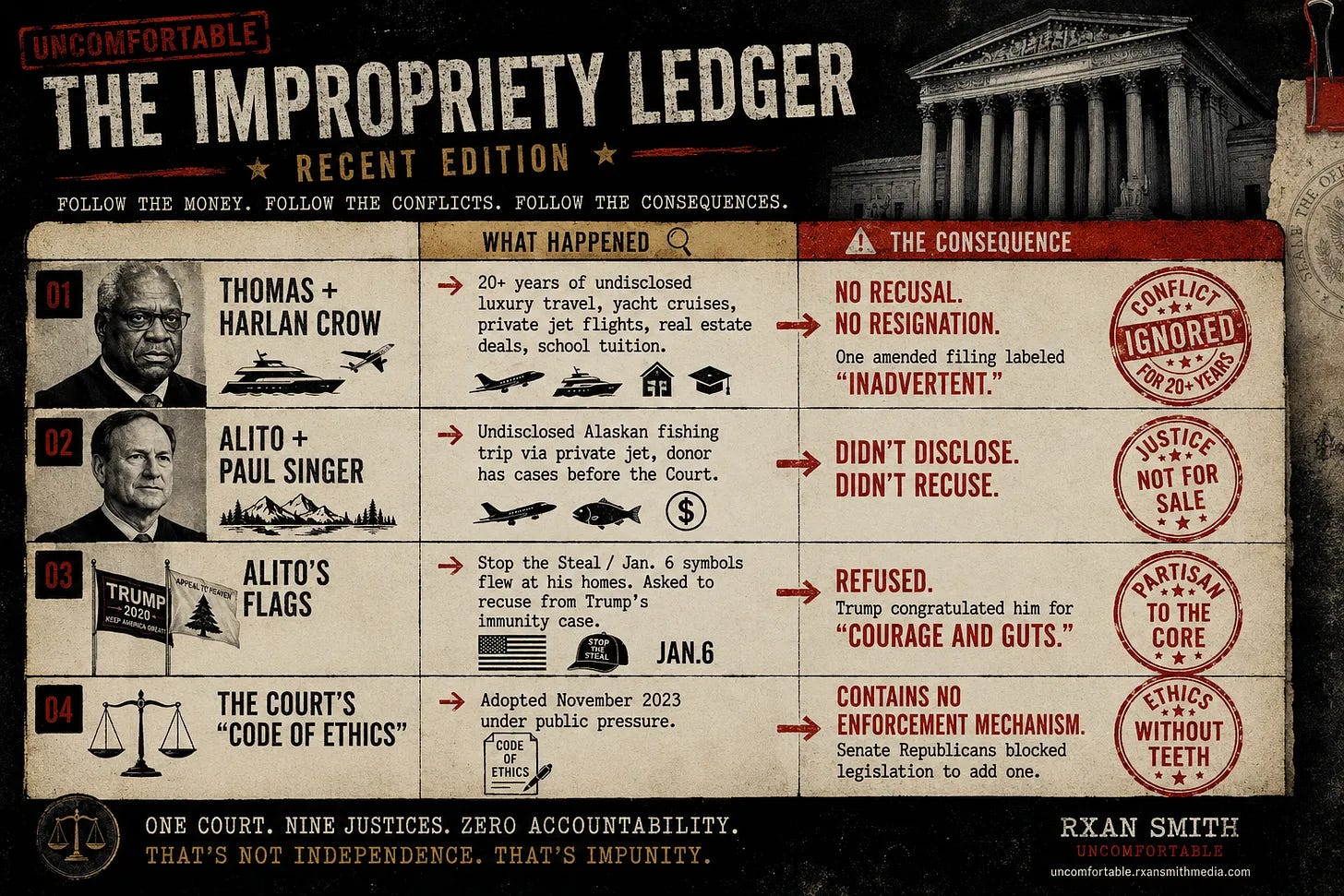
Clarence Thomas accepted luxury travel, private jets, yacht cruises, and undisclosed gifts from Republican billionaire Harlan Crow for more than two decades. Not once. Virtually every year. ProPublica’s 2023 investigation revealed Crow also bought Thomas’s mother’s house and covered a relative’s private school tuition. Ethics experts said the nondisclosure appeared to violate federal law.
Thomas’s defense: colleagues told him “personal hospitality from close personal friends” wasn’t reportable. He amended his disclosures, calling the omissions inadvertent. The Senate Judiciary Committee then found at least three more undisclosed jet flights. Twenty-plus years. Hundreds of thousands of dollars. The defense: I forgot.
Alito wasn’t about to let Thomas have all the fun. He accepted a private-jet Alaskan fishing trip from hedge fund billionaire Paul Singer… who has donated over $80 million to Republican organizations and had business before the Court. Alito didn’t disclose. Didn’t recuse.
Then came the flags. An upside-down American flag (a Stop the Steal symbol) flew outside Alito’s Virginia home in January 2021. An “Appeal to Heaven” flag, also carried by Capitol rioters, flew at his beach house in 2023. Asked to recuse from Trump’s immunity case, his response was elegant in its audacity: my wife is fond of flying flags; I am not. He was “therefore required to reject” the request.
Trump praised him for it. That should tell you something.
The King’s New Clothes: Presidential Immunity
In July 2024, the Court ruled 6–3 in Trump v. United States that former presidents get absolute immunity for “core constitutional powers” and presumptive immunity for other official acts. Six Republican appointees. Three Democratic. Straight down the line.
Issued on the term’s last day, the ruling guaranteed Trump’s federal election-subversion trial couldn’t proceed before November. Sotomayor’s dissent: it makes a mockery of the principle that no man is above the law, creating a law-free zone around the president.
Let’s be uncomfortable about this. The Founders… the people originalists claim to channel… fought a revolution against a monarch who couldn’t be held accountable. They never wrote “immunity” into the Constitution. Six justices looked at two centuries of that principle and decided the man who appointed three of them deserved special protection.
If you’re on the right and cheering, a hypothetical: a Democratic president commits a real federal crime using the powers of the office. Are you comfortable handing every future president a legal force field? Or did you only want the immunity to apply to your guy?
The law was never supposed to bend for a name. The moment it does, it isn’t law anymore. It’s a loyalty test with a marble facade.
The 14th Amendment Had a Good Run…
(But it Barely Kept Running)
In June 2025, in Trump v. CASA, the Court limited nationwide in junctions… meaning an executive order restricting birthright citizenship, which every lower court found likely unconstitutional, could take effect against people who hadn’t personally sued. Then, last week, the Court struck the order down in Trump v. Barbara. Roberts and Barrett crossed over. Three justices… Thomas, Alito, Gorsuch… were ready to reread 160 years of settled constitutional text.
Credit where it’s earned: the line broke. But notice what it took… the plainest text in the Constitution, unanimous lower courts, and a 160-year precedent… to get two conservative votes. And the same week, the Court overturned Humphrey’s Executor, handing the presidency its biggest power expansion in decades.
Trump called that one the real win. He wasn’t wrong.
A court is not independent because it occasionally rules against its patron. It’s independent when you don’t have to hold your breath to find out.
But look closer at the exchange rate. The same week Trump lost on birthright citizenship… a case so textually indefensible that no honest reading of the 14th Amendment could save it… he won Slaughter, overturning ninety years of precedent and handing the presidency its largest power expansion in decades. He called that one the real victory. Publicly. Immediately.
That’s the pattern worth watching: lose the case you were never going to win, the one whose loss makes the Court look independent… and collect the structural wins that actually move power. A symbolic defeat is cheap. Control of the executive branch is not. You don’t need a backroom deal for this to work. You just need a Court that needs to look balanced more than it needs to be accountable… and a president who’s figured out that its reputation is a currency he can spend.
So here’s the question: if losing the indefensible case is what buys legitimacy for everything else… who really won last week?
Justices are appointed by presidents running on ideological platforms. Confirmed by senators answering to partisan bases. They serve for life with no accountability, no binding ethics enforcement, and no removal short of impeachment… which has never once succeeded against a sitting justice.
The system does not punish partisan behavior. It rewards it. A justice who rules with their appointing party’s agenda faces no consequence. One who breaks ranks becomes the next attack cycle. This is not a court anymore. It’s a third legislative chamber in black robes, staffed by unelected politicians who never face you at a ballot box.
The Scoreboard Both Sides Need to See
This isn’t a liberal or conservative argument. It’s an American one, and I’m making it to anyone with functioning eyes.
To the right: you used to care about judicial restraint. You wrote books about activist judges inventing law from the bench. What do you call a court that rewrites presidential immunity, invents a framework no founding document contemplated, and times the ruling so one specific president never faces a jury before his election? If that’s restraint, I have a yacht trip to sell you.
To the left: you’re not off the hook. When you talk about court-packing, when you celebrate rulings because you liked the outcome rather than the reasoning, when you treat justices as political allies, guess what… you’re feeding the same machine.
The answer to a partisan court is not a more partisan court.
The answer is an ethical, enforceable, accountable one.
In the 2006–07 term, nineteen of twenty-four 5–4 decisions broke on ideological lines. Alarming then. The baseline now. Abortion, guns, immunity, voting rights, affirmative action, environmental regulation… every genuinely contested case decided predictably, by a 6–3 supermajority, in the direction of whoever appointed them.
That’s not justice. It’s a scoreboard. And we’re all losing.
What Actually Fixes This
I’m not interested in burning down the institution. I’m interested in repairing it. Anyone who dismisses that distinction is more invested in the argument than the outcome. The solutions exist. They’re not radical:
Staggered 18-year term limits. Lifetime appointments made sense when life expectancy was 55… not when a 48-year-old nominee can reshape American law for four more decades. Staggered terms give every president two appointments per term and end death-watch politics. It takes a constitutional amendment… difficult, not impossible, worth the conversation.
Binding, enforceable ethics standards. Every federal judge below the Supreme Court is bound by a Code of Conduct. The nine most powerful aren’t. The Court’s voluntary 2023 code has no enforcement mechanism, and Senate Republicans blocked legislation to add one. That tells you who benefits. An independent ethics body with real authority to investigate and mandate recusal is the minimum requirement.
Automatic recusal standards. If your flags fly a movement’s symbols, if its billionaire funders paid for your vacations, if the man who appointed you is the named defendant… you don’t get to grade your own conflict. Justices currently do. That’s a punchline, not independence.
Transparency in appointments. No more strategic ambiguity dressed as judicial temperament. If you hold the seat for life, the American people are owed real answers… not a rehearsed performance of careful nothing.
None of this is about ideology.
A liberal court with no ethics enforcement is just as dangerous as a conservative one. The goal isn’t filling seats with people you agree with. It’s a system where the people in them answer to something other than the party that put them there.
The Purpose Problem
The question to sit with isn't which party wins the next appointment... Ask yourself this:
If the Supreme Court rules on party lines in every major contested case… justices appointed on ideological criteria, confirmed by partisan votes, taking undisclosed gifts from partisan donors, refusing to recuse from cases involving the men who appointed them… what exactly are we maintaining the fiction of judicial independence for?
The Court was designed to be the place where the law meant something independent of whoever held power. That is literally its purpose. If it won’t do that, it has ceased to be a court and become a caucus. And a caucus doesn’t get lifetime appointments, marble columns, and the last word on the Constitution.
The little guy is still waiting… in the same room where Exxon made forty billion in a year and took nineteen years after the Valdez spill to compensate the people it destroyed. The court was supposed to stand up for that person. That was the bargain. The justification for the robes, the tenure, the reverence. Break the bargain, and what’s left?
I’m not asking you to hate the Supreme Court. I’m asking you to stop pretending it’s something it isn’t. Institutions earn legitimacy through every act of courage required to rule against the people who put you there. This court hasn’t been earning it. It’s been spending it. The account is nearly empty.
Every time you cheer a partisan ruling that breaks your way, you’re building the machine that will be turned against you the next time the other side fills the seats.
That’s not a partisan warning. It’s a law of physics.
Uncomfortable truths, systemic analysis, and no‑spin political commentary for listeners tired of echo chambers and late outrage. New episodes cut through noise with cinematic, confrontational clarity.
Uncomfortable truths, systemic analysis, and no‑spin political commentary for listeners tired of echo chambers and late outrage. New episodes cut through noise with cinematic, confrontational clarity.