


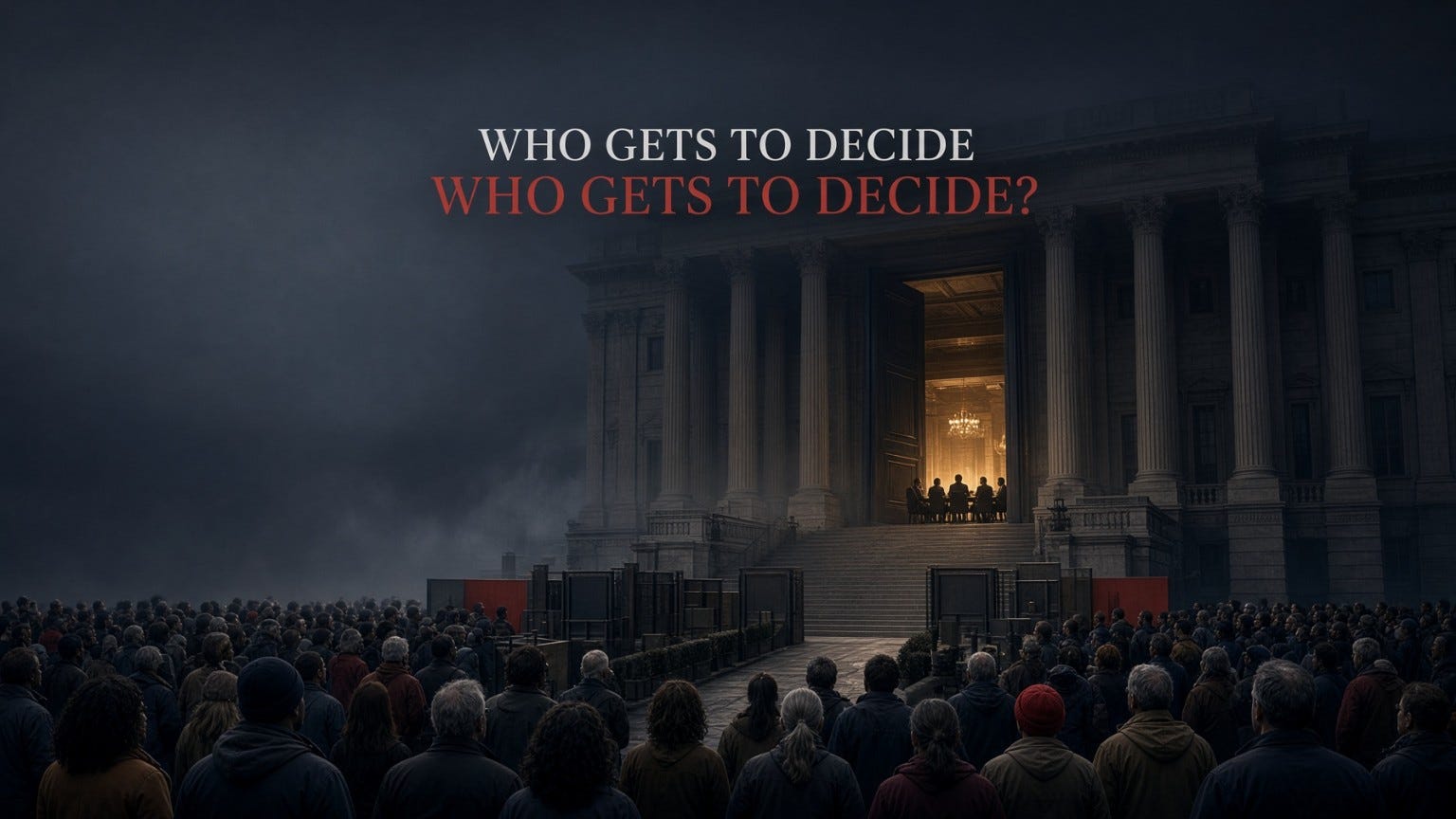
In 2020, roughly 10 percent of eligible voters participated in primaries that effectively decided the winners in 83 percent of U.S. House districts. Not the general election in November. The primary, months earlier, in a low-turnout race most of the country wasn’t paying attention to. In a district drawn safe enough, the primary is the election. Most of the country still shows up in the fall to vote in something that was already decided.
That’s not a conspiracy. Nobody sat down and designed that outcome on purpose. It’s what’s left over after decades of small, locally defensible decisions, about how districts get drawn, how campaigns get funded, who owns the news, that each made sense on their own and add up to something nobody actually designed: a system explicitly built to prevent minority rule that keeps producing it anyway.
A reader asked me a version of this question recently, more or less: why do the few keep “leading” the many, even inside a system that’s supposed to prevent that by design? Fair question. Here’s my actual answer, mechanism by mechanism, not mascot by mascot.
The Primary Trapdoor
Most House seats aren’t genuinely competitive by the time November rolls around. They were decided in a primary that maybe one in five eligible voters bothered to show up for, often fewer. That 10 percent, 83 percent split from 2020 wasn’t a fluke. The same basic pattern showed up again in 2022, when Unite America calculated that just 8 percent of voters effectively determined 83 percent of House seats. It’s what happens by default once a district is drawn safe enough that the primary is the only real contest left.
Picture the district. Drawn lopsided enough that whoever wins the primary is functionally mayor for life. A relatively small slice of the electorate picks a nominee in a low turnout primary. That nominee wins in November by thirty points against a challenger nobody bothered to fund, because nobody needed to. The general election was already decorative.
Whoever survives that room doesn’t need to appeal to the middle of the country. They need to appeal to the middle of a much smaller room, the sliver of the electorate motivated enough, plugged in enough, or angry enough to show up to a primary nobody else notices. That’s not a Republican problem or a Democratic problem. Both parties draw themselves safe seats. Both parties get represented by whoever wins the smaller room.

The Reelection Machine
Once someone’s in, they basically don’t leave. In 2020, 373 of the 394 House incumbents who ran for reelection won, nearly 95 percent, and that’s a normal year, not an outlier. Congress is consistently one of the least popular institutions in the country. The same people keep winning anyway.
Money is a big part of the answer, but not the whole answer. Incumbents raise more and pull in donors who already have a good read on how the vote’s likely to go, but they also carry name recognition, constituent services, party infrastructure, and the plain advantage of experience. Some research even suggests gerrymandering isn’t doing as much of this work as people assume, and that legal limits on redistricting have occasionally cut into incumbent advantage rather than growing it. The machine doesn’t run on one cause. It runs on several that happen to reinforce each other.
The Price of a Seat at the Table
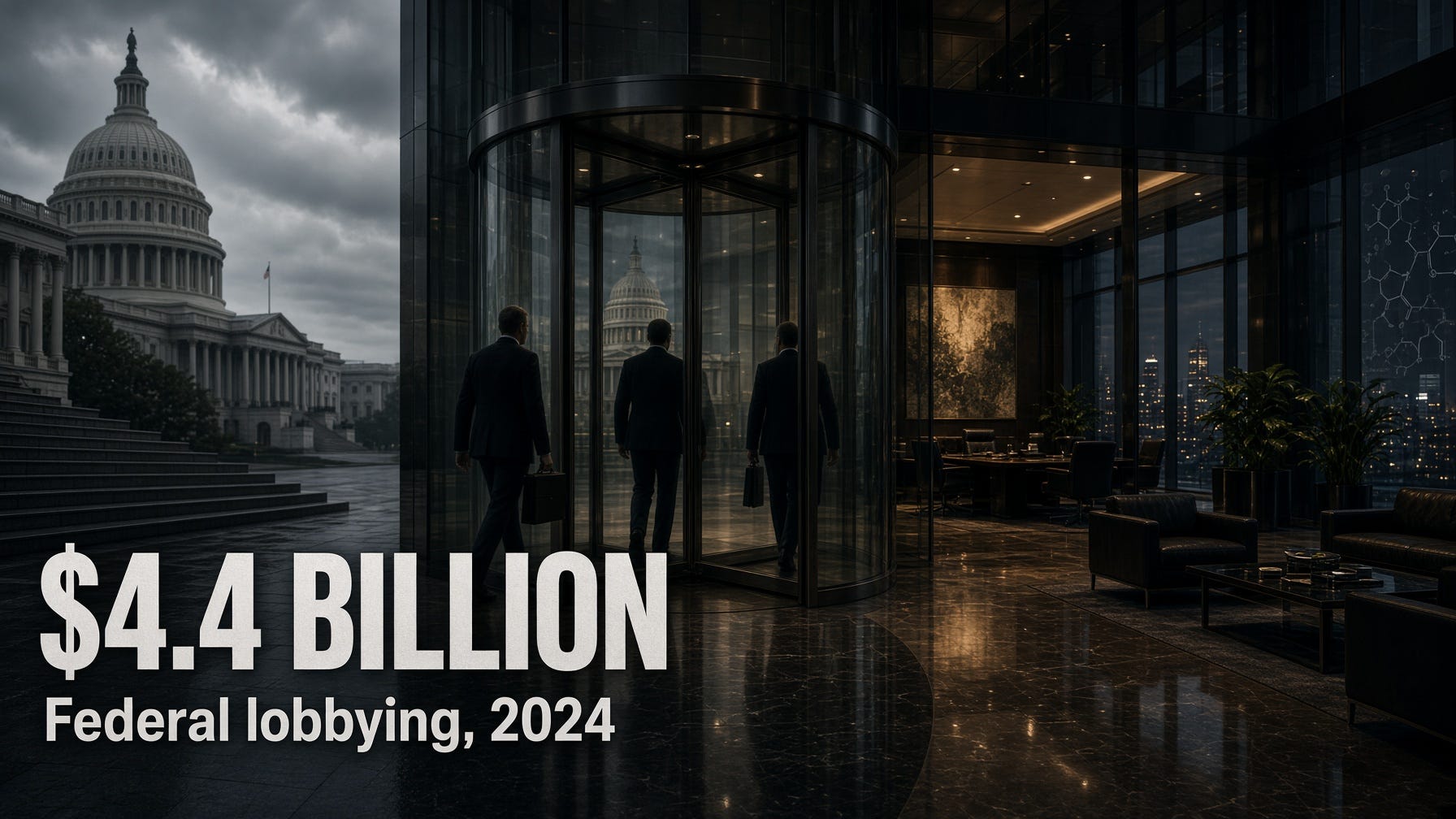
Federal lobbying hit a record $4.4 billion in 2024. Almost none of that is illegal, most of it isn’t even hidden. It’s just the going rate for a seat at the table when decisions get made.
A meaningful share of the people at that table used to be the ones casting the votes. Of members of Congress who left office between 1998 and 2004, 43 percent went on to register as lobbyists. That’s not a fringe pattern, that’s closer to half.
The revolving door has a name people actually remember. Congressman Billy Tauzin helped negotiate the 2003 Medicare prescription drug legislation, a bill the pharmaceutical industry liked very much. Shortly afterward, he left Congress to become PhRMA’s chief lobbyist for a reported two million dollars a year. No law was broken and no crime was charged. That’s exactly what makes it worth asking whether the incentive structure itself is the problem.
Six Rooms
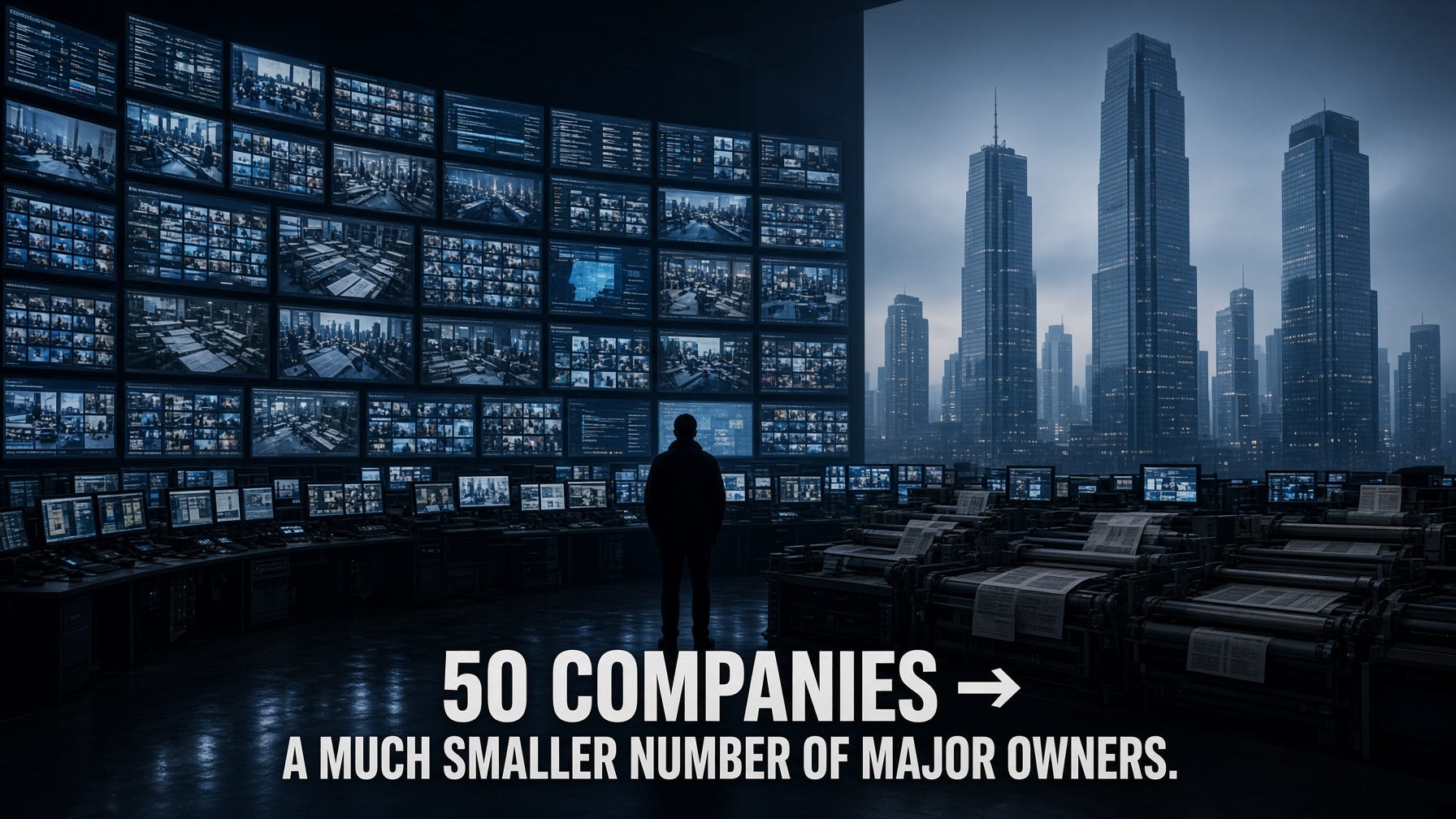
In 1983, roughly 50 companies controlled about 90 percent of American media. Today ownership is dramatically more concentrated, though exactly how many companies dominate depends on which slice of the media ecosystem you’re measuring, broadcast, cable, streaming, and the algorithms deciding what shows up in a feed are all consolidating at different speeds.
That’s the mechanism behind something a reader flagged to me recently, that the chains holding people in place these days aren’t physical anymore, they’re in what gets shown to you and what quietly doesn’t. And here’s the part worth sitting with: none of this requires a handful of executives in a room deciding how to manage the public. Market incentives, ad revenue, algorithmic curation, and plain consolidation can narrow the information environment without anybody coordinating it on purpose. That’s less cinematic than a conspiracy. It’s also more believable, and harder to fix, because there’s no room to storm.
Step back and look at what these mechanisms add up to together. None of them, on its own, means a handful of people rule the country. What they mean, together, is that a handful of gateways control who gets to compete at all. The primary decides who gets a viable nomination. Money decides who can seriously compete once they have one. Incumbency decides who starts every race already ahead. Lobbying decides who gets sustained access after they win. Concentrated media decides a good deal of what the country even hears about the choice in front of it. None of that individually adds up to “the few rule America.” Stacked on top of each other, it adds up to the few deciding who gets into the room in the first place.
Here’s the uncomfortable part, though. None of this requires a villain. Every mechanism on this list exists because it solved some real problem once. Incumbents build seniority because Congress genuinely runs better with people who know how it works. Lobbying exists because government needs technical expertise it doesn’t have in house. Media consolidated because local newspapers were genuinely dying and somebody had to buy them. Safe districts exist partly because Americans increasingly choose to live near people who already agree with them.
Nobody designed this concentration of political power on purpose. It’s what you get when a hundred locally reasonable decisions compound for decades without anyone checking whether the sum still resembles what the system promised.
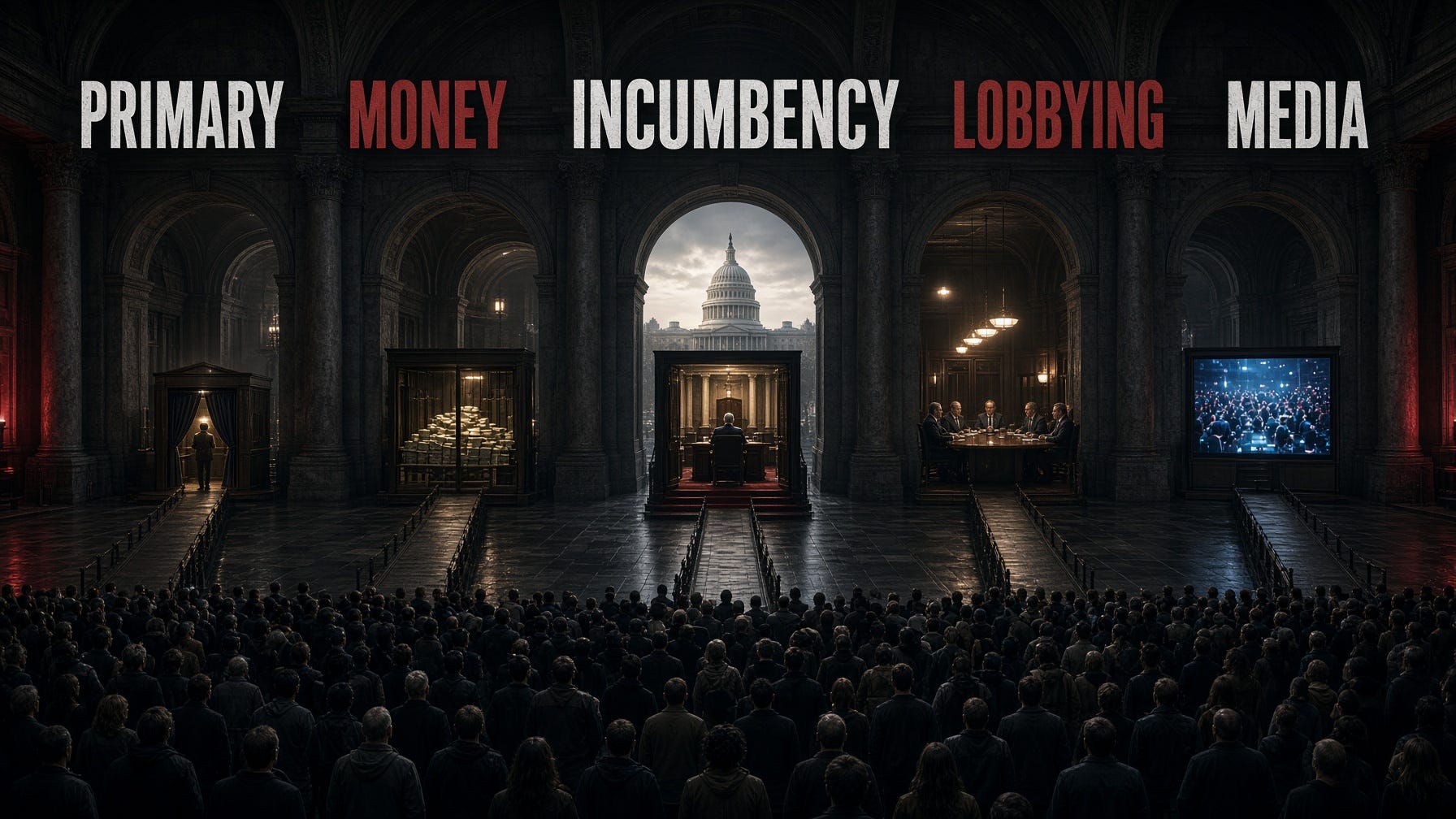
What Prevention Was Supposed to Look Like
The system was built around safeguards intended to make concentrated political power harder. Frequent elections so power couldn’t calcify. A free press so information couldn’t be cornered. Checks and balances so no single institution could hold too much at once. Every one of those safeguards still technically exists. Frequent elections became uncompetitive elections. A free press became a much smaller number of very large media companies. Checks and balances still exist, but they were never designed to solve a system in which both parties operate inside the same fundraising and lobbying ecosystem.
What Would Actually Change This
None of this gets fixed by picking a side harder. But a few structural interventions are worth putting on the table, not as guaranteed fixes, just as places where the incentives could actually shift. Independent redistricting commissions instead of legislatures drawing their own districts. Open or nonpartisan primaries, so the deciding vote isn’t cast by the most motivated sliver of one party. Tighter, better enforced limits on lobbying by former members, a lifetime ban raises its own constitutional and practical questions, but the current restriction, one year for former House members, two for former senators, still leaves plenty of room for former officials to work in consulting, strategy, and other influence-adjacent roles that don’t technically count as prohibited lobbying. Some real conversation about media ownership concentration, complicated as that’s gotten now that the internet has multiplied the number of voices while consolidating who actually controls distribution and ad revenue.
None of that asks you to trust the other team more. It just makes it structurally harder for a small room to keep deciding things for a big country, which is a lower bar than fixing democracy, and a more honest one.
Democracy doesn’t fail because the few seize power in one dramatic moment. It fails a percentage point at a time, in low turnout primaries and safe districts and revolving doors and boardrooms nobody’s watching, until the country notices the decisions keep getting made somewhere it was never invited. Nobody has to coordinate any of it. That’s not a defense of the system. It’s the actual diagnosis, and it’s worse than a conspiracy, because there’s no room to storm and no villain to vote out.
The chains were never going to be physical. Nobody needs to lock you up if they can just make sure you never see the room where it happens.
I’m R❌️AN SMITH… And if this made you uncomfortable, good… That's the point. Don't forget to 💛Like, 🔂 Restack, and SUBSCRIBE! Scroll to bottom for companion piece on voting.

“The chains were never going to be physical. Nobody needs to lock you up if they can just make sure you never see the room where it happens.”

Related Article:
You Do Not Vote; You Participate in a Ritual of Optics.

“The real game is played long before your finger reaches the ballot.”


