


🛑 STOP ✋. Before we argue about who caused the divide, ask the more uncomfortable question:
What if the division isn’t the real problem?
What if the real problem is what that division is doing under the surface, to the part of democracy that’s supposed to stop leaders from running the country into the ground?
Something deeper has shifted. And most people, left, right, and everyone exhausted in between, haven’t fully processed it yet.
The Shift Nobody Talks About
For most of American history, politics was at least nominally driven by belief. Policy mattered. Results mattered. Governing mattered.
Today, millions of Americans are motivated less by what they believe and more by what they oppose.
Political scientists call this negative partisanship and it’s now the dominant operating system of American politics.
A democracy running on fear of the other side isn’t making decisions. It’s in a permanent defensive crouch. And a country in a permanent defensive crouch cannot govern. It can only perform.
When performance replaces governance, politics becomes theater. And theater has a different set of incentives than governing does.
Conflict is the product.
Outrage is the revenue model.
And the audience never has to ask whether anything actually got fixed, because the show never ends.
When Loyalty Replaces Accountability
When voters treat politics like a team sport, everything changes.
Winning becomes more important than governing.
Loyalty becomes more important than results.
Accountability becomes optional because if the goal is defeating the other side, almost anything can be justified.
Bad policy? “At least it’s not them.”
Corruption? “They’re worse.”
Incompetence? “Wrong time to criticize our side.”
This isn’t a left problem or a right problem.
The mechanism operates identically on both sides.
Many media ecosystems are rewarded for keeping audiences emotionally engaged through conflict because attention drives clicks, subscriptions, ratings, and advertising.
The incentive isn’t to inform. It’s to inflame.
And once tribal loyalty sets in, accountability doesn’t just weaken. It gets replaced by a feedback loop that insulates power from consequence.
Leaders underperform or act corruptly → supporters defend them to own the other side → leaders face no meaningful consequences → performance degrades further → the cycle repeats at a lower floor
.
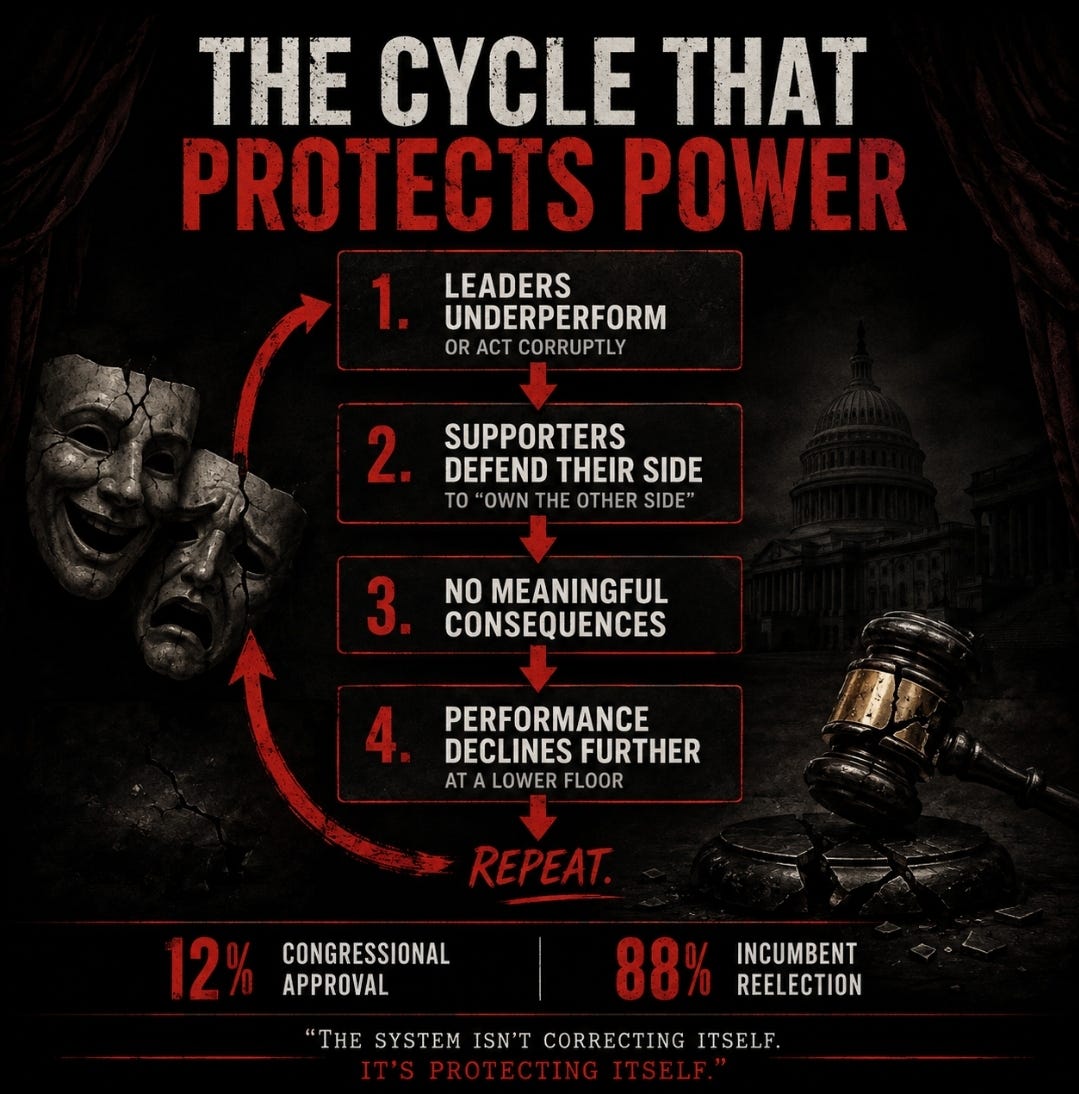
The system isn’t correcting itself.
It’s protecting itself.
Every turn of that loop further weakens the one thing democracy requires to function: the willingness of citizens to hold their own side accountable.
Without that pressure, failure stops having consequences.
And when failure has no consequences, the system doesn’t collapse dramatically.
It just quietly stops working.
What That Looks Like in Practice
The consequences are no longer theoretical. They’re measurable.
FIVE NUMBERS THAT SHOULD MAKE EVERY AMERICAN UNCOMFORTABLE
🔥 88%
Incumbent Reelection
⚠️ 12%
Congressional Approval
💰 $39 Trillion
National Debt
🏥 2040
Medicare Insolvency
💳 40%
Can’t Cover a $400 Emergency
That’s not contradiction. That’s loyalty replacing accountability..
Those aren’t isolated statistics. They’re symptoms of the same accountability failure.
Americans say they distrust government.
Then they re-elect the same people running it.
That’s not contradiction. That’s loyalty replacing accountability.
Both parties win symbolic battles.
Both parties avoid the structural crises.
And an electorate focused on the arena, the performance, the outrage, the daily score, is less likely to demand structural reform than one focused on results.
That’s not a conspiracy.
It’s simply what happens when the incentives are never challenged.
History Has Seen This Before
Two examples.
Neither requires a history degree.
1856 • The Senate Floor
Congressman Preston Brooks walked onto the Senate floor and beat Senator Charles Sumner nearly to death with a metal-tipped cane over a political speech.
Brooks received souvenir canes from supporters back home.
Sumner’s empty chair sat for three years as a symbol of Northern martyrdom.
Congress didn’t just stop functioning.
It became physically dangerous.
The accountability mechanism, the one that was supposed to impose consequences on bad behavior, had been completely replaced by factional loyalty.
The system didn’t course-correct.
It escalated.
Until somewhere between 620,000 and 750,000 Americans were dead.
1974 • The Resignation
When Nixon’s crimes became undeniable, Republican senators went to the White House and told their own president to go.
Howard Baker, a Republican serving on a committee investigating a Republican president, asked the question that broke everything open.
“What did the president know, and when did he know it?”
Party loyalty subordinated to constitutional principle.
That’s what made the system survive.
The difference between 1856 and 1974 isn’t that one era had better people.
It’s that in 1974, the accountability mechanism still had enough structural support to function, barely.
Senators faced enough pressure from constituents and institutions that crossing party lines was possible without being politically fatal.
It is nearly impossible to imagine either party doing that today.
Not because the people are worse.
Because the incentive structure punishes it.
The Part Nobody Wants to Say Out Loud
Americans still believe they’re holding their leaders accountable.
The data says otherwise.
What we’re actually doing is defending our side, attacking the other, and calling that engagement.
It isn’t.
It’s theater.
And it serves everyone currently holding power because conflict is entertaining, and an electorate focused on symbolic battles is less likely to demand answers about the structural problems that never get solved.
The system doesn’t send a notification when it stops working.
Congressional approval hits 12%.
Incumbents still win.
The debt compounds.
Infrastructure crumbles.
Retirement security erodes.
The dysfunction becomes the weather.
Background noise everyone complains about and nobody connects to their own voting behavior.
History suggests these problems rarely get fixed voluntarily.
Not through better arguments.
Not through fact-checks.
Not through one viral video.
They get fixed when the consequences become impossible to spin, excuse, or blame on the other side.
That’s the uncomfortable pattern across almost every major episode of political fracture in modern history.
Unity doesn’t come from people becoming more reasonable.
It comes from circumstances making the cost of continued division impossible to ignore.
America’s political tribes aren’t just dividing the country.
They’re dismantling the accountability systems that make self-governance possible.
Negative partisanship isn’t the cause of every problem on that list.
But it has become one of the biggest obstacles to solving them, because fixing them requires the one thing the current incentive structure makes increasingly difficult:
Holding your own side accountable for failure.
So the question isn’t whether this gets fixed.
History says it probably will.
Do we fix it before the bill comes due... or because it comes due?
Support the work:
☕ Buy Me a Coffee
https://buymeacoffee.com/rxansmith
💙 PayPal
https://paypal.me/phireballsports
📚 Subscribe on Substack


