


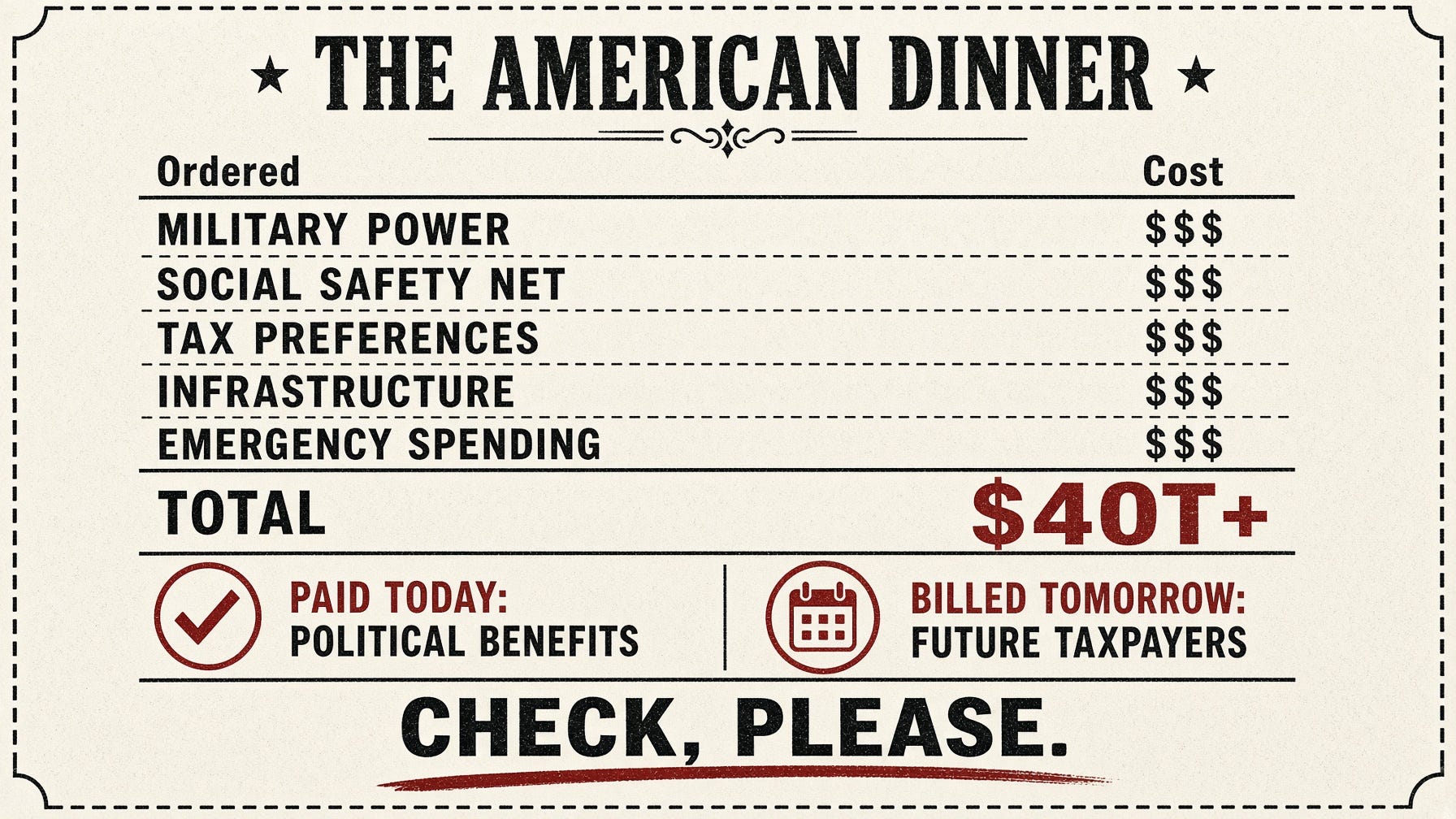
We want the empire, the safety net, AND the Cayman Islands tax code. And we’ve decided our grandchildren will pick up the check. Welcome to $40 trillion of bipartisan denial.
The $40 Trillion Illusion
There’s a sign in Midtown Manhattan that flips digits fast enough to give a finance major a panic attack. Politicians pose in front of it, cable news treats it like a countdown to Armageddon, and everyone else stares at it the way a dog stares at a ceiling fan: vaguely threatened, deeply confused, unsure what to do about it.
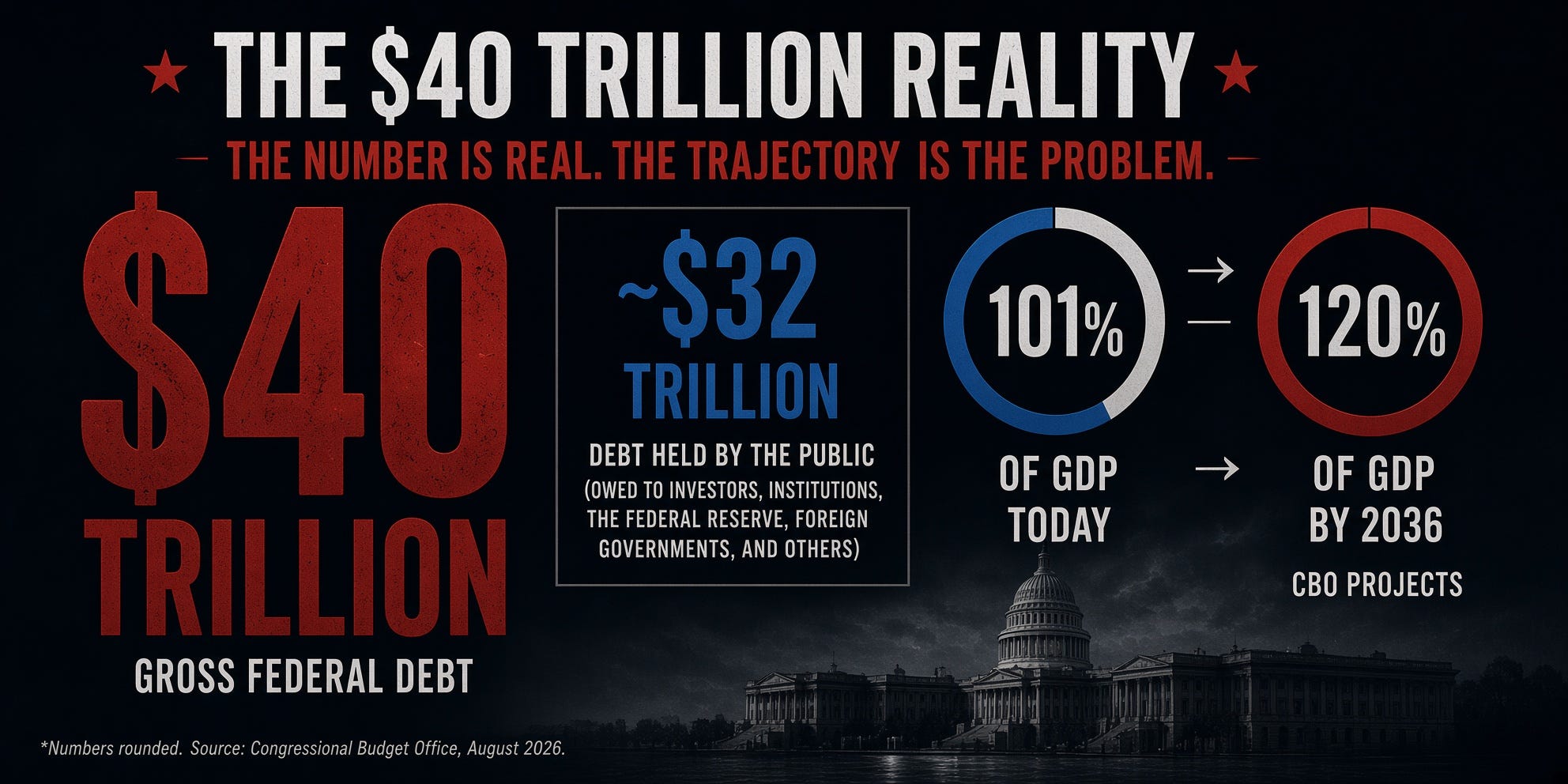
On August 18, 2026, the national debt crossed $40 trillion.
That $40 trillion is gross federal debt: everything Washington owes, including what it owes itself. The number economists often focus on is debt held by the public, roughly $32 trillion owed to investors, institutions, foreign governments, the Federal Reserve, and others outside the federal government. It’s now roughly equal to the size of the entire U.S. economy. CBO projects it will reach 120 percent of GDP by 2036, surpassing the previous postwar record of 106 percent.
The headline number gets the attention. The trajectory is what should scare you.
The math isn’t complicated. The politics are. What we have is a structural bypass of the American social contract, a system where politicians deliver benefits today, send the bill to the future, and run for reelection before it arrives.
You don’t need a conspiracy to produce this outcome. You only need incentives: politicians get rewarded for handing out benefits today and punished for naming the costs today. That’s not corruption. That’s the machine working as built, and the only people not in on the joke are the ones expected to pay for it.
America Isn’t Broke, It’s Addicted
Let’s drop the polite fiction: there’s no reasonable middle ground being blocked by partisan dysfunction, no secret compromise waiting in a committee room somewhere.
The truth is simpler, and worse. We want European-style social protections, Roman-level military power, and Cayman-level resistance to taxation. We’ve spent decades pretending those three things can coexist without somebody eventually receiving the check. For sixty years we’ve tried anyway, charging the difference to a credit card that doesn’t belong to us.
The debt isn’t government malpractice. It’s a receipt: the accumulated total of political decisions we’ve repeatedly accepted without wanting to pay for them. Breaking that habit requires pain, and in a democracy, pain is political suicide.
Translated into something less abstract: divide $40 trillion across roughly 160 million individual taxpayers and you get a theoretical share of about $250,000 apiece. That’s not a bill headed to your mailbox, just a way to make an incomprehensible number concrete. Annual net interest has already reached roughly $1 trillion. CBO projects it will more than double, reaching $2.1 trillion by 2036, and we’re still pretending this is sustainable.
Republicans call it freedom when they cut revenue. Democrats call it compassion when they expand spending. Both are allergic to the one tool that actually works: pain, real, shared, politically survivable pain.
The Silent Cosigner
That $40 trillion isn’t abstract “government debt,” like the city having a pothole problem. It’s your liability: a second mortgage on a house you don’t own, for renovations you didn’t approve, taken out by people who won’t be around when the foundation cracks. You didn’t sign the paperwork. Doesn’t matter. You’re still on the hook.
We love to romanticize the Founders, selectively, but there’s one thing they were absolutely unhinged about: taxation without representation. It was worth a revolution. What we’ve built is arguably worse: liability without representation, binding the labor and future productivity of people who cannot vote, cannot object, and may not even be born yet.
“This is taxation without representation for the 21st century. Instead of tea in a harbor, it’s $40 trillion in compounding interest, owed by people who weren’t born when the balance started.”
Rxan Smith, Uncomfortable
This isn’t partisan, and that’s what makes it dangerous. The debt expanded under Reagan, accelerated under Bush, continued through Obama, surged under Trump’s tax cuts, exploded during COVID under both parties, and hasn’t meaningfully slowed since.
America doesn’t have a $40 trillion debt because one party wrecked everything. We have it because both parties found the same political business model: give voters the benefits now, borrow the money, and let someone else explain the bill later
The Interest Trap
This is where it stops being theoretical. Not “think tank report” ugly. Actually ugly. The kind of ugly where, if you explain it at a dinner table, people stop eating.
We paid $970 billion in net interest in 2025, more than the entire defense budget, roughly 19 percent of federal revenue and 3.2 percent of GDP. Not on defense. Not on infrastructure. Not on education. Just interest. That’s up from $375 billion in 2019, two and a half times the pre-pandemic baseline.
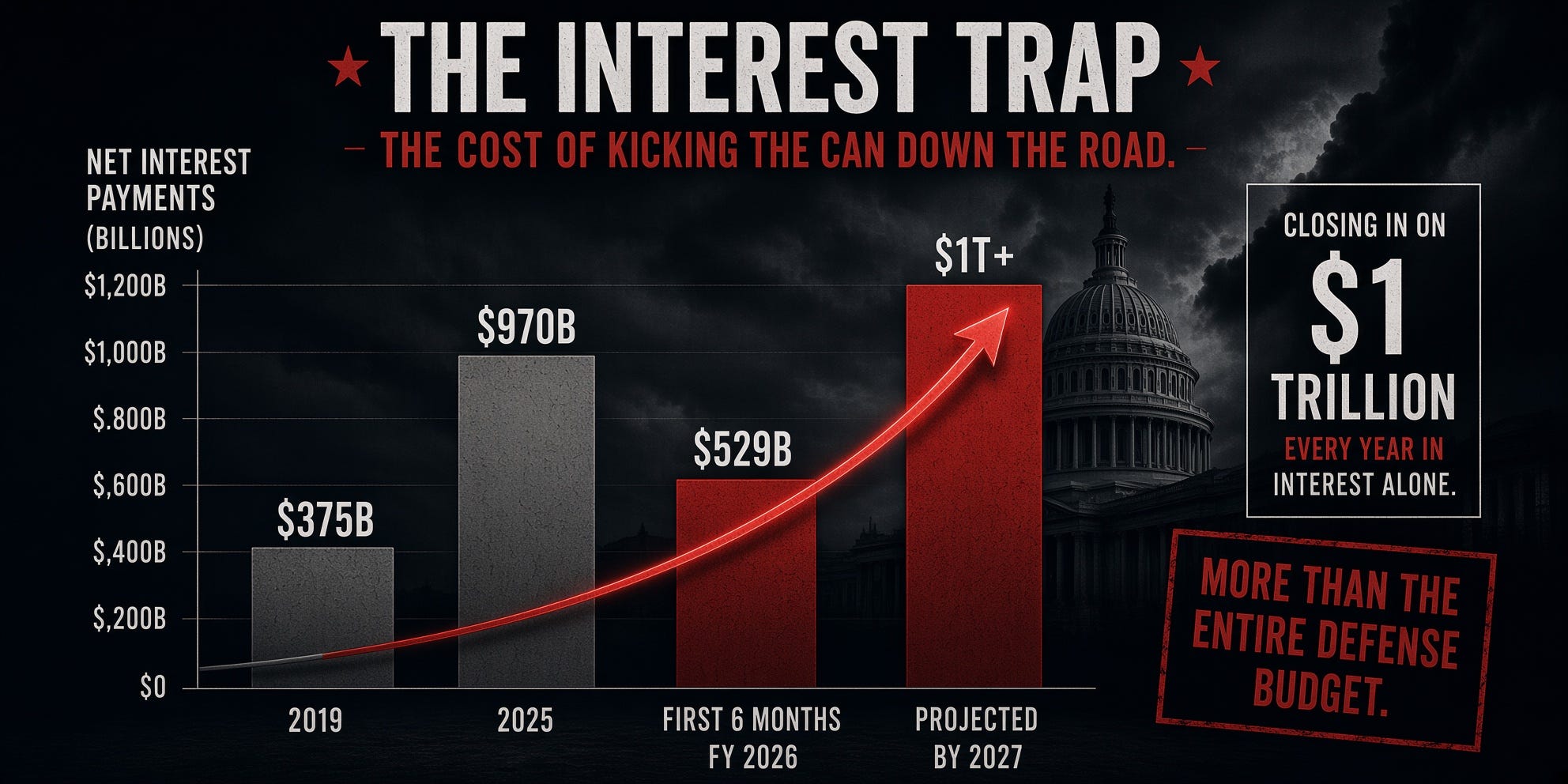
Translated into something less polite: we’re paying more to not pay our bills than we’re paying to fund the core functions of the country. We’re financing one credit card with another, betting future growth will outrun compounding reality. That’s not strategy. That’s dependency.
Interest doesn’t negotiate. It doesn’t care about elections, messaging, or bipartisan consensus. It compounds, relentlessly. Interest is the part of the bill you don’t get to argue about.
Not Greece. Something Worse.
Before someone reaches for the household-budget analogy: no, the United States isn’t a family with a checking account. It issues the world’s dominant reserve currency, borrows in its own currency, and has tools no household has. Treasuries remain among the world’s most important safe-haven assets. America has the deepest capital markets and the largest economy on Earth.
That doesn’t mean debt doesn’t matter. It means the mechanism of failure is different. America doesn’t need to run out of dollars to run out of fiscal room. Rising interest costs can crowd out other priorities, constrain future responses to crises, and force increasingly painful choices between taxes, spending, and borrowing.
That’s precisely why the argument isn’t that America is about to go broke. It’s that debt has a carrying cost, one that increasingly constrains what the government can do with every dollar it collects.
The real threat was never sudden collapse. It’s postponement. America is strong enough to keep borrowing long after the bill should have forced a conversation, and every year we don’t have it, the eventual one gets more expensive. Strength isn’t the cure here. It’s the reason we’ve avoided treatment for sixty years.
Deficits, Delusion, and Denial
So why doesn’t anyone fix this? Because fixing it requires a politician to stand in front of voters and say: “We need to raise your taxes and cut the programs you like.” That sentence is political suicide. Not metaphorically. Historically.
There is no version of fiscal responsibility that wins applause in real time. The actual solution is simple: take more in, spend less out, or both. Fiscal responsibility is the broccoli of public policy: everyone agrees it’s good for you, no one orders it voluntarily, and any politician who builds a menu around it gets voted out before dessert
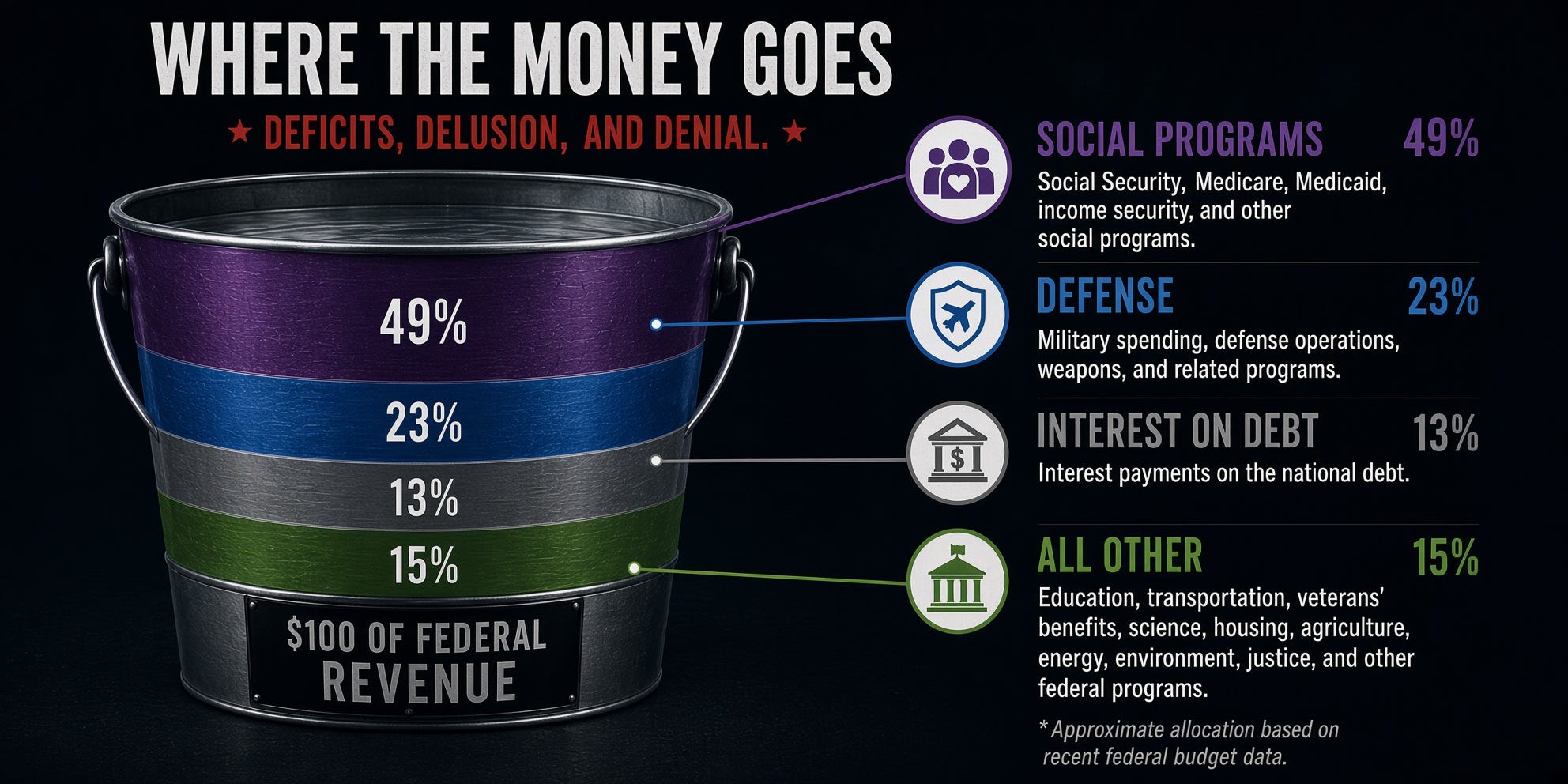
So instead of solving the problem, we perform concern about it: debt ceiling standoffs that end exactly the same way every time, and “fiscal hawks” who appear on schedule and disappear on impact. It’s not dysfunction. It’s choreography.
Because the part everyone leaves out is the only part that matters: someone has to pay for it. And the person who tells voters that directly doesn’t stay in office.
This is the uncomfortable reality. The system isn’t broken. It’s optimized: for short-term reward, long-term avoidance, maximum political survival. It’s politically toxic to fix, because fixing it requires something the system doesn’t reward: honesty about tradeoffs.
The Great American Dine and Dash
Stop calling it the “National Debt.” That name is doing a lot of public relations work: it sounds civic, shared, almost patriotic. Call it what it actually is: the Great American Dine and Dash.
We ordered everything. The world-class military. The full social safety net. The tax structure that pretends neither has to be paid for. We ate the appetizers, the entrées, dessert. And now we’re slipping out the back, assigning the bill to a table that hasn’t even sat down yet.
I get it, debt is boring, and that boredom isn’t accidental, it’s functional. We stopped paying attention decades ago. Politicians noticed. They had every incentive to keep the show running.
We’ve built a system where every path leads to the same ending: borrow more, delay consequences, repeat. That’s not a superpower. That’s a guy juggling credit cards in a dark basement, hoping the repo man knocks on someone else’s door first.
Republicans blame Democrats. Democrats blame Republicans. Everyone blames Washington.
Washington is us. Politicians didn’t invent the incentive. We rewarded it. We elected the people who gave us the meal. We applauded when they ordered it. We complained when anyone suggested paying for it.
We didn’t accidentally accumulate $40 trillion. We made $40 trillion worth of choices, took the benefits today, and pushed the bill into tomorrow. Tomorrow doesn’t get a vote.
If we’re not going to fix it, and statistically, we’re not, then at least stop pretending it’s an accident: cut things we like, tax things that should be taxed, build automatic constraints so this can’t keep happening, and admit we’re taxing future labor to fund present comfort.
That’s the Great American Dine and Dash. We ordered everything. We ate everything. We left someone else with the check.
Change the motto on the dollar bill. From “In God We Trust” to: “Check, Please.”
I’m Rxan Smith. And if this made you uncomfortable… good. That's the point.


