



Rxan Smith: The Uncomfortable Truth | Rxan Smith | Rxan Smith Media
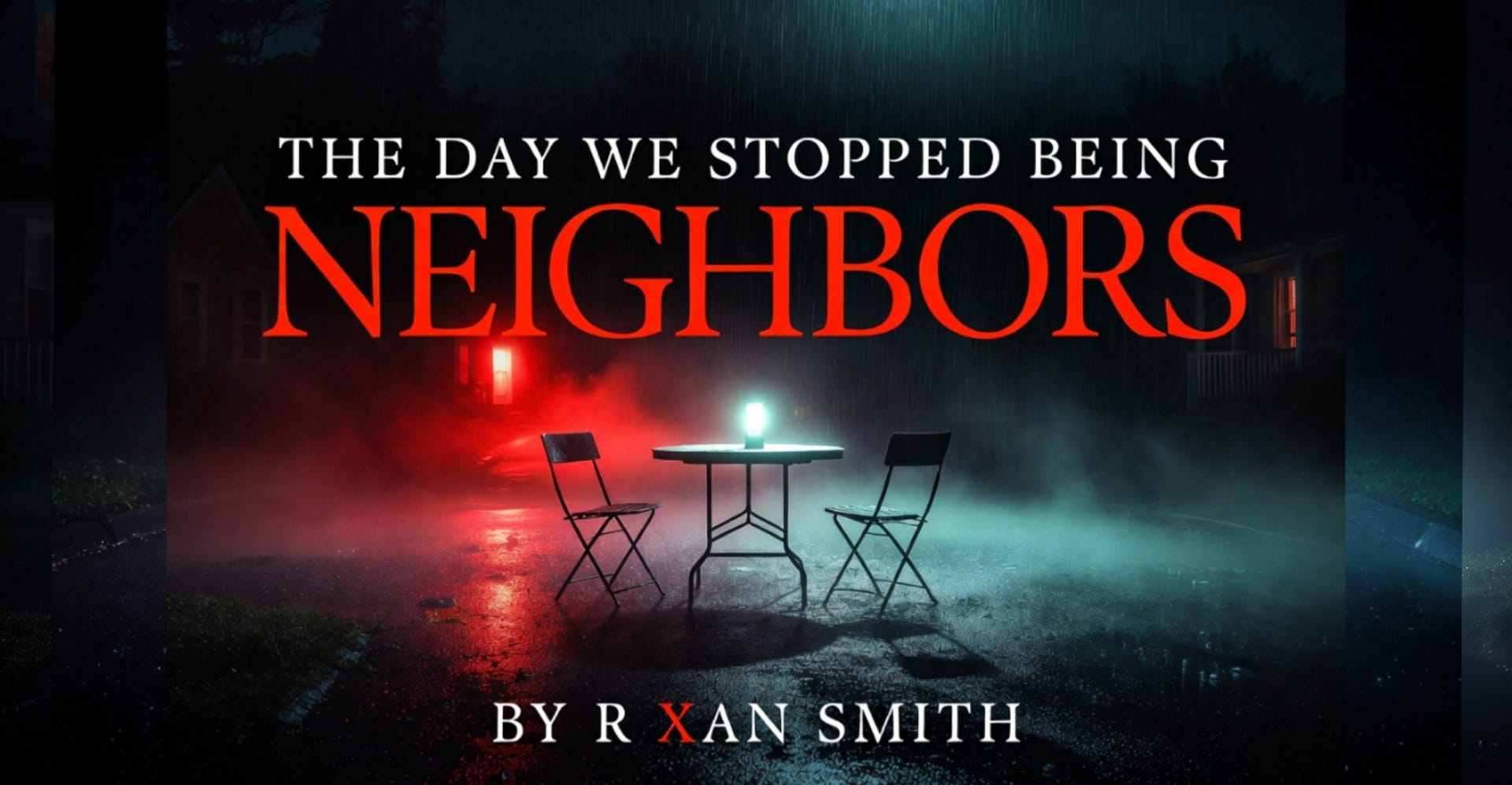
There’s a specific kind of loneliness that nobody talks about because it doesn’t look like loneliness.
It looks like having 800 friends online and nobody to call at 2am. It looks like knowing exactly what your coworker thinks about immigration and having no idea if their mom is sick. It looks like a neighborhood where everyone has an opinion about the country and nobody knows the person next door.
We are more connected than any humans in history.
We have never been more alone.
And somehow, we’ve decided this is fine
I grew up on a street where the adults disagreed about everything. I know this because I could hear them. Through screen doors, across driveways, at the edge of lawns where conversations happened without appointments.
They voted differently. They went to different churches. One guy had a Ronald Reagan decal on rear windshield and another had a union card on his dashboard… they both showed up when Maria’s furnace broke in January.
That’s not nostalgia. That’s a description of a functional social contract that we have, without much debate, decided to abandon.
Here’s what replaced it.
Somewhere in the last twenty years, we stopped sorting people by street and started sorting them by signal. What you watch. Who you follow. What you share. Whether you said Happy Holidays or Merry Christmas. Whether you own a gun or think other people shouldn’t.
Every interaction became an audition. Every opinion became a credential. Every conversation became a loyalty test before it became a conversation.
We didn’t just become polarized. We became legible. Perfectly, permanently, algorithmically legible. And once you’re legible, you stop being a person and start being a category.
Your neighbor isn’t your neighbor anymore. They’re a data point with a lawn.
We optimized for the comfort of certainty over the discomfort of contact.
The media didn’t create this alone. Neither did the politicians. Neither did Silicon Valley — though all three made it worse and all three made money doing it.
What created it is something more embarrassing to admit: we chose it.
Not consciously. Not in a single moment. But in ten thousand small choices to stay in feeds that confirmed what we already believed, to share the thing that made our tribe feel smart and the other tribe feel stupid, to mistake the feeling of being right for the experience of understanding something.
And contact — actual, friction-generating, occasionally maddening contact with people who are not like us — is the only thing that has ever built a functioning society.
Nobody did this to us. We are not victims of polarization the way you are a victim of weather. We participate in it every single day, in choices so small they feel like nothing — the unfollow, the block, the eye-roll, the assumption before the conversation, the decision to never find out.
The people who want us divided are counting on us to believe that the division is natural. That the other side is genuinely incomprehensible. That there is nothing on the other end of that difference worth reaching for.
They need us to believe that.
Because the one thing that threatens every concentrated power structure in American history is the moment ordinary people — across every line of difference — looked at each other and said: wait, we have the same problem.
You can’t love an abstraction. You can’t trust a category.
You can’t grieve with a political position.
You can only do those things with a person
And persons require proximity. Proximity requires tolerance of difference. Tolerance of difference requires the slow, inconvenient, occasionally terrible work of staying in the room.
We have been very efficiently relieved of that obligation.
The algorithm sorted us so we didn’t have to do it ourselves. The media gave us permission to write off half the country as irredeemable. The politicians figured out that our anger was more reliable than our hope, and built their entire industry on keeping us separated and furious.
They didn’t invent the division. They just found out how to monetize it.
You don’t have to agree with your neighbor to need them.
That’s not a bumper sticker. That’s the entire premise of civilization.
Maybe the country isn’t falling apart because we disagree. Maybe it’s falling apart because disagreement used to be the beginning of a relationship and now it’s the reason we never start one.
A functioning society isn’t built when everyone thinks alike. That’s never happened anywhere. It’s built when people decide that the person across from them is more important than the argument between them.
The hardest thing in modern America isn’t changing someone’s mind.
It’s remembering they have one.
And maybe the first step back isn’t political at all. Maybe it’s learning to become neighbors again.
Every day that someone chooses contact over comfort, curiosity over contempt, the hard conversation over the clean exit — they are refusing to be sorted.
And that refusal is the only thing that has ever, in the whole of human history, made anything better.
UNCOMFORTABLE
Rxan Smith Media · The truth that makes everyone uneasy
Refuse to be sorted.
Every week, Uncomfortable delivers sharp, evidence-driven essays that cut through the noise — without tribal loyalty or algorithmic rage.
Subscribe to UncomfortableRead the archive free
No spam. Unsubscribe anytime. Join readers who value clarity over comfort.
© Rxan Smith Media 2026
Rxan Smith: The Uncomfortable Truth Substack Homepage
Thanks for Reading

Thanks for Reading
If you value independent, evidence-driven journalism, please consider supporting my work.
Subscribe or upgrade to a paid membership.
Explore the Rxan Smith Universe
Every subscription, share, comment, and contribution helps keep the research, writing, and conversations going.


