



“The real game is played long before your finger reaches the ballot.”
Listen, you poor, sleepwalking, cockeyed optimists. You wake up on Election Day, slap on your little red-white-and-blue hat, and stand in a line that snakes around the block like a dying python, clutching a plastic flag and a lukewarm hope.. staring at a touchscreen like a gambler who doesn’t realize the machine was unplugged in 1994.
By the time your finger hovers over that touchscreen or fills in that little oval, the real game has already been played… the board tilted, the dice loaded, and the house has already won.
Managed democracy does not eliminate elections; it shapes incentives, access, visibility, competition, and influence long before voters participate. America is constitutionally a democratic republic, but many structural mechanisms systematically dilute, shape, or restrict meaningful participation. These are legal, normalized, bipartisan incentive structures that have calcified over decadez, producing predictable outcomes through entrenched incentives rather than any grand conspiracy.
Below is a detailed system-by-system walkthrough of the major filters, complete with mechanics, historical evolution, hard numbers, human consequences, international comparisons, and the incentives that keep them locked in place.
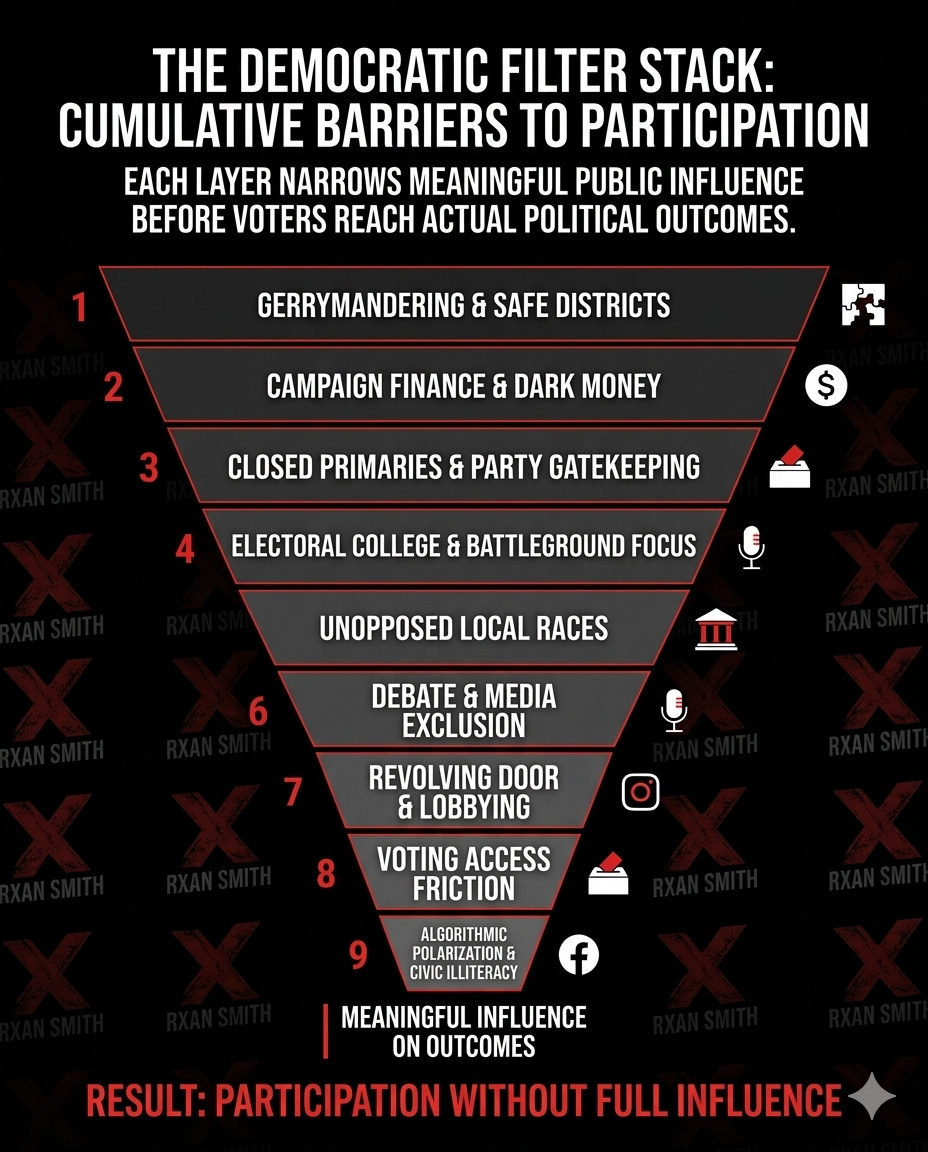
Each filter alone seems survivable. Together they form a democratic filter stack.
How America Drifted Here
Campaign costs exploded with the television era. Buckley v. Valeo (1976) equated money with speech. Media consolidation accelerated in the 1990s. Citizens United (2010) removed limits on independent expenditures. The Voting Rights Act was gutted in Shelby County (2013). The 2016 primaries shattered institutional trust. Internet outrage economics nationalized every race while local journalism collapsed. Layer by layer, upstream filtering became the default operating system.
"And this is where the average voter quietly disappears from the equation."
Gerrymandering: Politicians Choosing Voters
The mechanism is brutally simple. Every decade, state legislatures redraw congressional and state legislative maps using sophisticated computer software.
The twin tactics are:
“packing” - cramming as many of the opposing party’s voters as possible into a handful of districts they win by huge margins
“cracking” - dispersing the rest across many districts so they lose narrowly everywhere else.
Post-2010 census, Republicans executed the REDMAP strategy, pouring resources into state legislative races to control redistricting and net dozens of congressional seats. Democrats responded in kind in states they controlled, such as Illinois and Maryland.
The Brennan Center estimates that current maps delivered Republicans a net advantage of around 16 House seats in the 2024 cycle compared to neutral maps.
Only about 1 in 10 congressional districts are truly competitive. Incumbency reelection rates hover near 95%.
Safe districts turn the real contest into the primary… a digital landfill of algorithm-optimized bile where the only way your ‘representative’ loses their job is if they’re caught in a seedy motel with a dead girl or a live boy. These are grizzled, tax-funded parasites carved out of wet limestone, grinning with the confidence of a man who knows he’s the only one at the table with an extra ace. The result: the House popular vote can diverge dramatically from seat totals, insulating one party from public opinion shifts for a full decade.
A moderate voter trapped in a permanently one-party district.. say, a suburban Atlanta Republican in a heavily packed Democratic seat… watches their preferences neutralized el”. The result: the House popular vote can diverge dramatically from seat totals, insulating one party from public opinion shifts for a full decade.
A moderate voter trapped in a permanently one-party district… say, a suburban Atlanta Republican in a heavily packed Democratic seat… watches their preferences neutralized el”. The result: the House popular vote can diverge dramatically from seat totals, insulating one party from public opinion shifts for a full decade.
A moderate voter trapped in a permanently one-party district… say, a suburban Atlanta Republican in a heavily packed Democratic seat…. watches their preferences neutralized election after election. The Supreme Court has refused to police partisan gerrymandering as a federal matter.
Internationally, countries like Canada, Australia, and the UK use independent redistricting commissions that produce far more competitive maps.
Gerrymandering creates safe seats. Safe seats change the incentives for fundraising, media strategy, and candidate recruitment. The next filter builds directly on this foundation.
Citizens United & Campaign Finance: The Billionaire Casino
The 1976 Buckley v. Valeo decision began equating money with speech. Citizens United (2010) and follow-on rulings removed limits on independent expenditures. Super PACs can raise and spend unlimited sums (as long as they don’t coordinate directly with candidates). Dark money flows through 501(c)(4) nonprofits that never disclose donors.
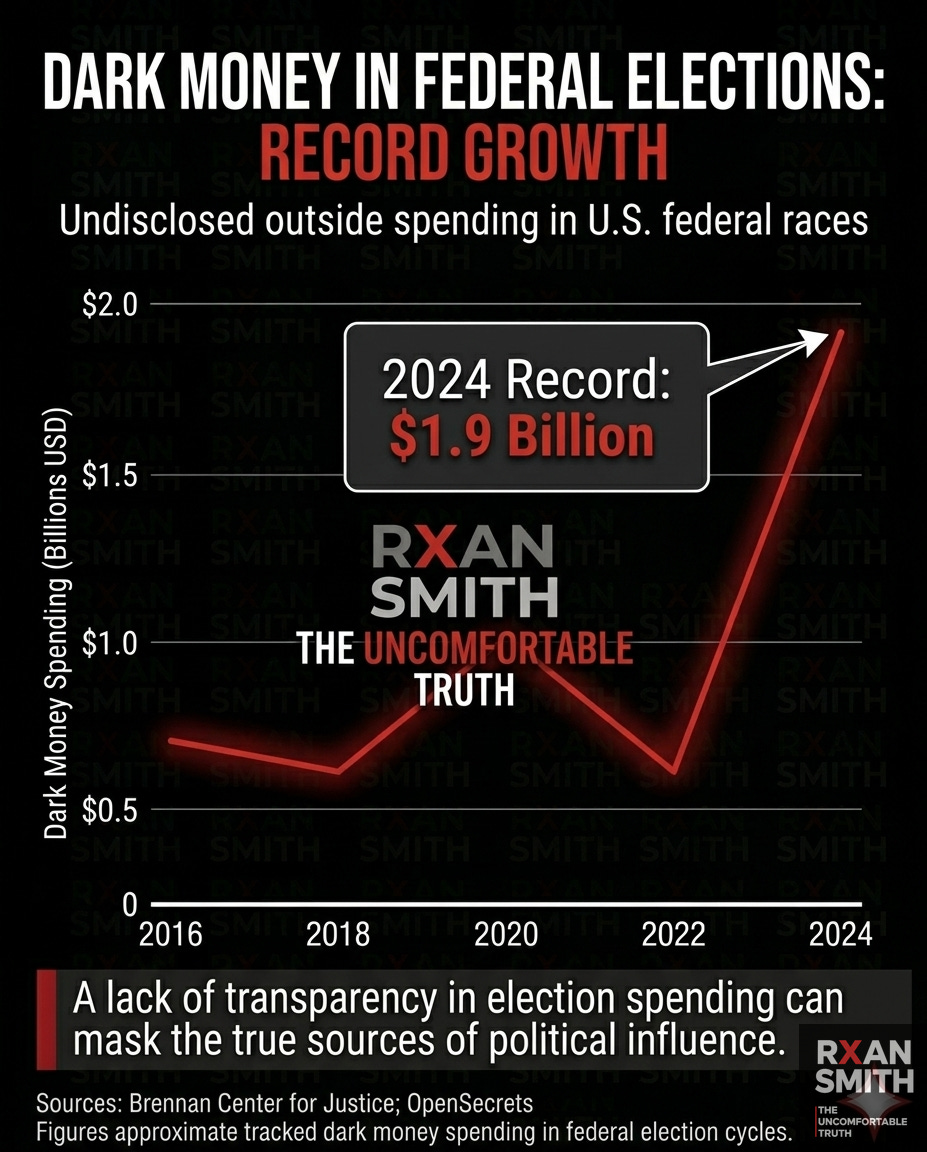
Typical House races now cost millions; Senate races routinely top $20–50 million. Lawmakers spend hours every day fundraising. Small-dollar donations have grown, but outrage still drives virality and megadonor bundling. Wealth concentration means a tiny slice of ultra-wealthy donors accounts for a wildly disproportionate share of total money.
Money shapes candidate viability. Candidate viability shapes media exposure. Media exposure shapes debate access. Debate access shapes voter awareness. By the time citizens vote, much of the filtering has already occurred upstream.
Both parties benefit, though often through different donor ecosystems. While European peer democracies pretend to have rules, America operates a neon-lit billionaire’s casino where the floor is slick with dark money and the ‘house’ is a bipartisan cartel of lobbyists who would sell their own mothers for a three-point bump in an internal poll. You get one vote; they get a nuclear-powered information machine.
The Illusion of Primary Democracy
Political parties are technically private organizations that write their own rules. Closed primaries exclude independents… which are which are now the largest voting bloc in many states. Superdelegates, debate qualification thresholds, fundraising minimums, media gatekeeping, endorsement pipelines, and the front-loaded calendar (Iowa and New Hampshire first) all favor establishment candidates.
Low-turnout primaries are dominated by high-information, highly ideological activists. The 2016 DNC controversies, superdelegate optics, and similar dynamics with RFK Jr. in 2024 illustrated the institutional tilt.
An independent voter in Texas who spends hours researching candidates discovers the real contest was filtered months earlier through closed primaries and debate rules. The incentive is party control: the duopoly protects itself from outsiders.
Electoral College & Battleground Domination
Winner-take-all rules in 48 states mean that once a state is safely blue or red, it is effectively ignored. In 2024, 94% of all presidential campaign events occurred in just seven swing states representing less than 20% of the U.S. population. Thirty-two states received zero candidate visits.
National Popular Vote / FairVote tracking
A voter in Wyoming has vastly more per-capita electoral influence than one in California. Safe-state voters feel their turnout is meaningless because policy, advertising, and ground game flow overwhelmingly to battlegrounds. Faithless electors and small-state overrepresentation in the Senate compound the distortion.
Most peer democracies use direct popular vote systems that avoid this geographic lottery.
Unopposed Elections & Competitive Scarcity
Ballotpedia tracked 76,902 races in 2024: roughly 70% were uncontested — the highest rate since tracking began.
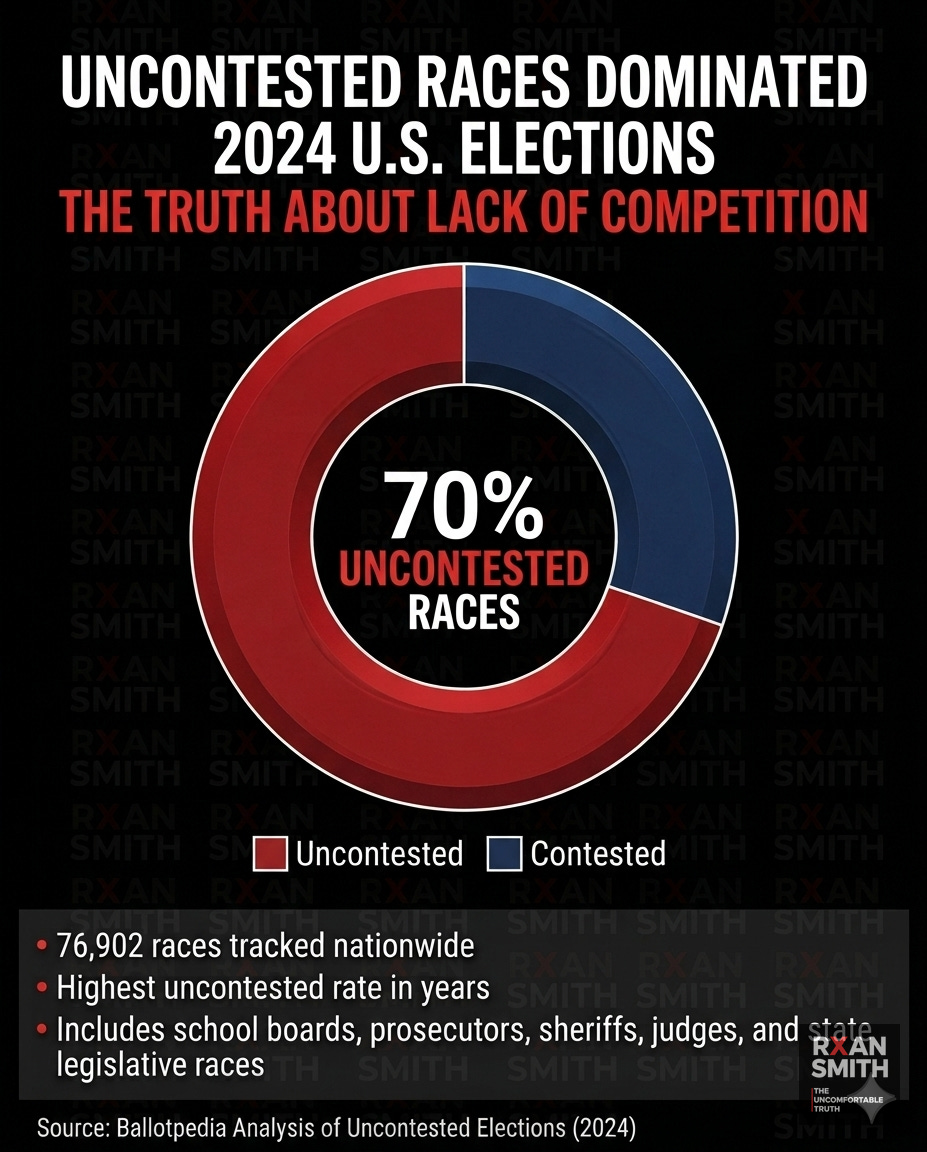
This includes congressional seats, state legislative races, school boards, county commissions, prosecutors, sheriffs, and judges. Local turnout is microscopic. Collapsed local journalism, high entry costs, and incumbency protection networks deter challengers. An entire county or school board can be decided by default, often captured by organized activist minorities.
The consequences are tangible and immediate:
Prosecutors decide who gets charged, what pleas are offered, and how aggressively to pursue cases. When 95% of incumbent district attorneys win reelection with little or no opposition, criminal justice policy is shaped with minimal democratic accountability.
School boards control curricula, book selections, teacher contracts, and local tax levies. Uncontested races mean parents and communities often have no real voice in what children learn.
Sheriffs set policing priorities, jail conditions, and cooperation with federal immigration authorities. These are powerful local offices that frequently go unchallenged.
Judges (especially at the state and local level) run effectively unopposed in many jurisdictions, shaping sentencing, civil rights enforcement, and access to justice for years.
Congressional reelection rates remain near 95% while approval ratings often sit below 20%. The psychological effect is inevitability: voters learn that competition has already disappeared long before they reach the ballot.
Internationally, many democracies have lower barriers and more proportional systems that encourage broader competition at every level of government.
Debate Exclusion, Media Gatekeeping & the Information Machine
The Commission on Presidential Debates remains a bipartisan cartel. Cable news profits from outrage. America has lost one-third of its newspapers since 2005. Over half of Americans now get news primarily from social media. Third-party candidates face high polling thresholds (Ross Perot was a rare exception).
Cable news profits from polarization: MSNBC, Fox, and CNN optimize for spectacle and outrage because it drives ratings. The U.S. has lost roughly one-third of its newspapers since 2005, creating news deserts for tens of millions. Over half of Americans now get political news primarily or sometimes from social media. Algorithms reward rage engagement.
Hyper-polarization is no accident; it’s a 24-hour strobe light of synthetic panic. It’s designed to keep your eyes dilated and your brain soft enough to be spoon-fed whatever flavor of ‘crisis’ the sponsors are moving this week. It’s an outrage industry run by smooth-talking vultures in tailored navy suits, orbiting D.C. like high-end undertakers looking for a fresh narrative to skin and stuff.
Democratic systems built for long-form deliberation now operate inside platforms optimized for emotional immediacy. Attention spans compress. Soundbites replace policy. Trust in media has collapsed across the board — Gallup’s most recent reading hit a new low of just 28% expressing a “great deal” or “fair amount” of trust.
Most peer democracies maintain stronger public broadcasters with explicit civic mandates.
Revolving Door, Lobbying & the Parallel Government
Hundreds of former members of Congress and senior staffers spin through the revolving door into lobbying each year. The K Street ecosystem in Washington sees the industry spend over $4.4 billion annually.
Former regulators routinely join the industries they once oversaw. Industry groups literally draft legislation. Think tanks receive corporate funding that shapes research. Congressional staff are chronically underpaid, creating a natural pipeline to higher-paying lobbying jobs.
A regulator approving an industry-friendly rule one month can be on that industry’s payroll months later. Public service becomes a temp job on the way to private-sector riches. This creates a parallel government far more responsive to concentrated interests than to voters.
This is not cartoon villainy. Most actors inside the system believe they are operating legitimately. Soft corruption is the gradual normalization of behavior that weakens democratic responsiveness through perfectly legal incentives
Voting Accessibility & the Filter Stack
Most OECD countries treat Election Day as a national holiday, offer automatic registration (often exceeding 90%), same-day registration, and simpler ballot access. Many use ranked-choice voting.
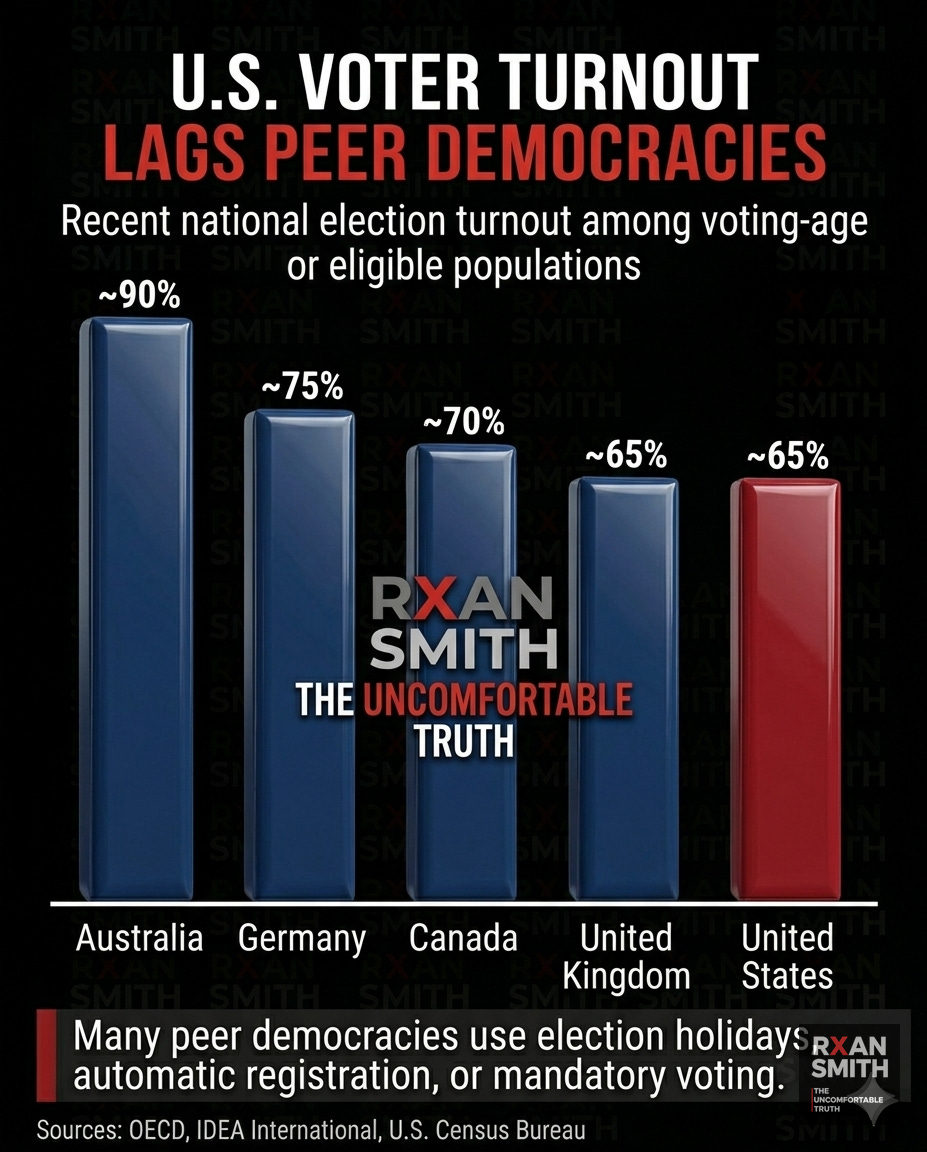
The U.S. has long lines (with documented disparities by race and income), polling place closures, voter purges, strict registration deadlines, mail-in restrictions, signature matching, and felon disenfranchisement laws that vary wildly by state. Working-class voters, disabled voters, and rural residents face disproportionate obstacles.
Closed primaries further exclude tens of millions of independents. The cumulative friction lowers turnout… about 65.3% of voting-age citizens in 2024 versus 75–90% in many peer nations with mandatory voting (Australia) or election holidays.
U.S. Census Bureau, April 2025
The system teaches voters they are structurally irrelevant.
Complexity itself becomes a filter. Highly educated observers often underestimate how intimidating the bureaucracy feels to ordinary citizens trying to navigate registration, deadlines, and compliance rules.
The Self-Reinforcing Loop
These filters do not operate in isolation. They form a closed feedback loop that entrenches the status quo:
Safe districts reduce competition
→ Reduced competition lowers turnout
Low turnout empowers activist extremes
→ Extremes increase polarization
Polarization boosts media profits
→ Media outrage boosts fundraising
Fundraising entrenches incumbents
→ Incumbents resist reform
The loop is self-sustaining. Each element reinforces the next. Breaking any single link requires confronting the entire architecture of incentives.
Why Americans Don’t Notice
Systems become invisible when you grow up inside them. Complexity fatigue sets in. Hyper-partisanship turns every issue into a team sport. Media incentives reward spectacle over institutional analysis. Learned helplessness does the rest. Most citizens sense something is off… turnout lags, trust collapses, outcomes feel disconnected… but the machinery is too diffuse, too normalized, and too technical to see clearly in daily life.
Why Reform Rarely Happens
The system persists because the incentives persist. Reform threatens the beneficiaries at every level:
Incumbents benefit from safe seats and name recognition.
Donors and dark money networks benefit from unlimited spending and access.
Media companies profit from outrage and polarization.
Political consultants and fundraisers thrive on high-cost, low-competition races.
Parties maintain duopoly control over primaries, debates, and ballot access.
Activist bases on both sides benefit from the outrage equilibrium that keeps their voters mobilized and donations flowing.
When everyone who matters inside the system benefits from the current arrangement, structural change faces an uphill battle that goes far beyond public opinion.
Algorithmic Reality, Civic Illiteracy & Psychological Consequences
Civics education has atrophied; large percentages of Americans cannot name the three branches of government. Social media algorithms amplify echo chambers and outrage because rage metrics drive engagement. AI misinformation risks compound the problem.
News deserts and attention fragmentation leave voters exhausted. The result is learned helplessness, deep cynicism, political tribalism, exhaustion, apathy, and distrust. Doomscrolling replaces civic engagement.
A teenager learning politics entirely from 15-second TikTok clips internalizes a distorted, hyper-polarized view of the system. The psychological toll is real: participation without influence breeds the very apathy that sustains the filters.
Congress vs. Public Opinion: Participation Without Influence
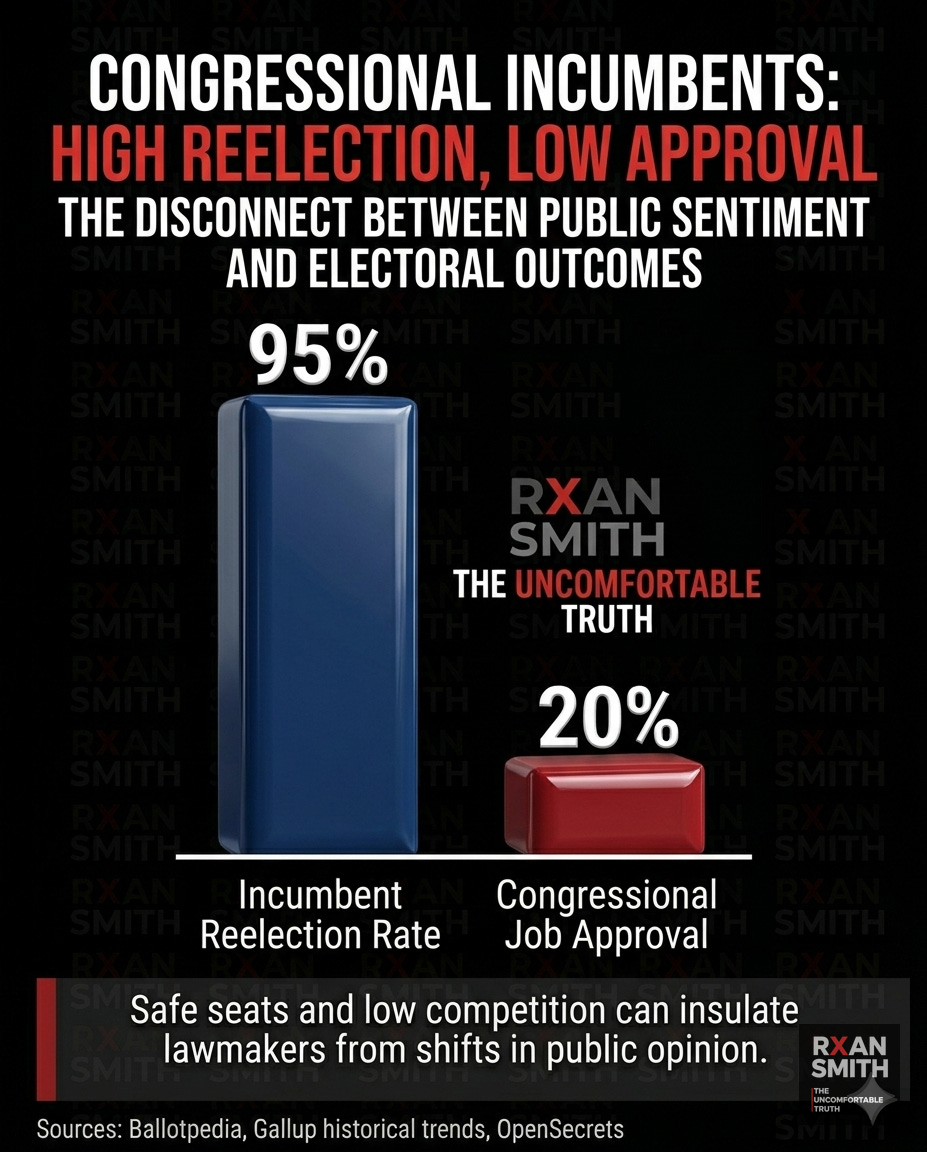
Congressional approval ratings often hover below 20%. Yet incumbent reelection rates routinely exceed 95%.
Broad, bipartisan public support exists for multiple popular policies that repeatedly stall or get watered down:
Universal background checks for gun purchases… consistently 70–90%+ support in Gallup and Pew polling over many years.
Medicare negotiation for prescription drug prices… 83% overall support in West Health-Gallup polling, with strong majorities across parties; recent polls show 67%+ support for expansion.
Congressional term limits… 87% favor in Pew Research (2023), with overwhelming support in both parties.
Campaign finance reform and anti-corruption measures… consistently high support in multiple national surveys.
Sources: Gallup, West Health-Gallup, Pew Research Center
Broad support vs. legislative stagnation is the clearest evidence of managed democracy in action: the ritual of voting continues while real power and outcomes remain disconnected from majority preferences.
Why Third Parties Fail Structurally
Winner-take-all elections and Duverger’s Law mathematically favor two dominant parties. Spoiler effects punish challengers. Debate exclusion, onerous ballot access barriers (often requiring hundreds of thousands of signatures), funding disadvantages, and media blackouts compound the problem.
The system is self-reinforcing: third parties rarely break through, further narrowing the menu of realistic choices for voters.
The Case Against This Thesis (And Why It Doesn’t Fully Land)
“America still holds free elections and incumbents sometimes lose.” True.
“Other democracies have flaws too.” Also true.
“Money doesn’t always win.” Correct.
But the filters don’t need to rig every single outcome. They narrow the realistic menu of choices upstream, long before Election Day. Most races remain uncompetitive. Turnout lags peers. Voters feel ignored. The system produces participation without full influence.. exactly what the entrenched incentives reward.
Historical Perspective
Many political systems throughout history maintained formal elections while narrowing meaningful public influence through elite gatekeeping, restricted competition, or concentrated power. Managed democracy is not a uniquely American invention… it is a recurring pattern when incentives favor insiders over broad responsiveness.
Reforms That Could Matter
Before we leave you with the rage, here’s the part most doom-scroll pieces skip: actual fixes that have worked elsewhere and could work here.
Independent redistricting commissions - already in several states and proven to produce more competitive maps.
Ranked-choice voting and open primaries - used successfully in Maine, Alaska, and dozens of cities; reduces spoiler effects and gives independents a voice.
Automatic voter registration and Election Day holiday - standard in peer democracies that get higher turnout.
Public campaign financing and strict disclosure - to counter dark money.
Reform or replace the Commission on Presidential Debates with nonpartisan criteria.
Lobbying bans and revolving-door restrictions - real cooling-off periods.
None of this is utopian. Most of it exists somewhere in America or abroad already. The obstacle isn’t feasibility - it’s the very incentives these reforms would disrupt.
Epilogue: The Human Cost of Managed Democracy
Most Americans are not political extremists. They are exhausted citizens trying to raise families, pay rent, survive healthcare costs, and navigate systems they increasingly do not trust.
Managed democracy survives not because people are stupid, but because they are fragmented, overwhelmed, and structurally disconnected from meaningful influence.
The final tally isn’t an election; it’s a receipt from a transaction that happened six months ago in a windowless room. You’ve been huffing the exhaust of this machine so long you think the smog is fresh air. This isn’t a healthy democracy - it’s a calcified theater of the absurd where we polish the deck chairs on a sinking ship and charge the passengers for the privilege of drowning
Once you see the machine operating according to these entrenched incentives, you can’t unsee it. Structural awareness is the first step. Structural reform is the only real path forward.

.
Data drawn from Brennan Center (gerrymandering & dark money), Ballotpedia (uncontested races), FairVote & National Popular Vote (campaign events), OpenSecrets (lobbying & money), Pew Research Center, Gallup, OECD, U.S. Census Bureau, and official election records. This is the system, working according to entrenched incentives - and it can be redesigned if enough people demand it.
Visual assets generated for Substack embedding via Google Gemini Pro


