


Rxan Smith Media / uncomfortable.rxansmithmedia.com
There is a specific kind of progressive… and I know this person, I have been this person… who will accept absolutely no victory. Hand them the moon and they will immediately begin composing a thread about how we should have gotten there sooner, how the astronauts were problematic, and how celebrating the moon landing is a distraction from the fact that we still haven’t fixed the sidewalk outside the launchpad. You could cure cancer and they would demand a vigil for the people who died of cancer before the cure existed. You could end hunger and they would remind you, correctly, that we should have done it forty years ago… and then log off without once saying that hunger ending is, on balance, good.
I became a progressive because I believed things could get better. That’s it. That’s the whole thesis. And somewhere between the early 2000s and now, that movement… my movement… quietly replaced “things can get better” with “nothing is ever good enough,” and then celebrated that reframe as a sign of moral seriousness. I didn’t sign up for that. I didn’t sign up to flog myself before bed every night as proof that I care. That’s not progressivism. That’s a hair shirt with a podcast.
Uncomfortable
Let’s get uncomfortable for a second. Not cable-news uncomfortable. Actually uncomfortable. Because here’s the thing about 2026 that nobody in my ideological zip code wants to say out loud: on a significant number of the issues that defined the progressive project for the last half century — civil rights, environmental protection, healthcare access, LGBTQ equality, public health — we have made real, measurable, documented progress. Not on every front. Not finished. Not enough. But enough that a person sitting in 1976 looking at 2026 would recognize a different country on these specific questions, and not recognize it as worse.
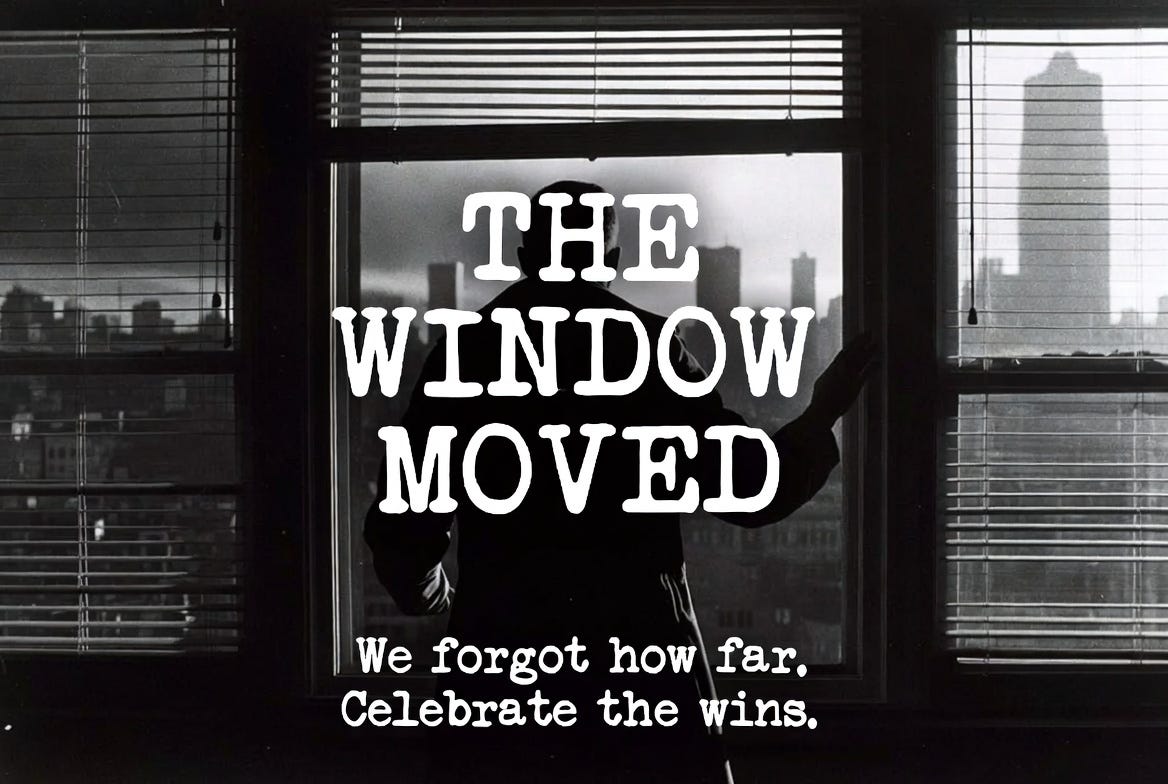
Fifty years ago, you could be fired for being gay in almost every state in this country — no recourse, no cause needed, just gone. Today gay marriage is the law of the land, has been for over a decade, and the polling majority defending it is wider than the polling majority for apple pie. The conversation we are now having — about gender identity, about trans rights — would not have been a political debate in 1976. It wouldn’t have been a college seminar. It would have been a confused silence, a shrug, a “what are you talking about.” The fact that it IS a debate, loud and ugly as it is, means the Overton window moved. The window moving IS the progress. We forgot to look at how far it moved because we were too busy screaming about how far it still needs to go.
“The Overton window moving is the progress. We forgot to look at how far it moved because we were too busy screaming about how far it still needs to go.”
Twenty-five years ago, the Clean Air Act had barely been renovated. Los Angeles — Los Angeles — had days you couldn’t see the Hollywood Hills from downtown. Today, by essentially every air quality metric, American cities breathe better than they did in 2000. EPA air quality trend data shows nationwide particulate pollution down more than 40% since 1990. The ozone layer, which the previous generation genuinely thought we might destroy entirely, is healing — the UN confirmed in 2023 the Antarctic hole is on track to fully recover by mid-century. There’s a hole, yes. It’s smaller than it was. That’s not a talking point. That’s atmospheric chemistry. It counts.
Twenty-five years ago, 36 million people in this country had no health insurance and the political will to change that was, at best, theoretical. Then a flawed, compromised, messy piece of legislation called the Affordable Care Act got passed, got signed, got challenged fourteen times in court, survived, and today the uninsured rate hit an all-time low in 2024 — roughly 20 million people covered who weren’t before. That’s not enough. That’s not single-payer. That’s not Medicare for All. It’s also not nothing. It is, by any honest accounting, one of the most significant expansions of health access in American history since Medicare itself. You are allowed to want more AND acknowledge that something happened. These are not mutually exclusive conditions. This isn’t a logic puzzle. You can hold both.
What 50 Years of Progress Actually Looks Like
Marriage equality: illegal in all 50 states in 1976. Legal in all 50 since Obergefell, 2015.
Interracial marriage: still controversial in living memory. 94% approval in 2021 Gallup polling. Now unremarkable. That’s the goal.
Urban air quality: EPA data shows nationwide particulate pollution down 40%+ since 1990.
The ozone layer: we found the hole, we banned the CFCs, the UN confirmed recovery is on track. International cooperation worked.
Workplace sexual harassment: in 1976 it didn’t have a legal name. #MeToo prosecuted people. Some of them stayed prosecuted.
Tobacco: 42% of adults smoked in 1965. Under 12% today. Public health campaigning worked.
ACA coverage: Uninsured rate hit an all-time low in 2024. Flawed law. Real result. Both.
LGBTQ workplace protections: Supreme Court ruled in Bostock, 2020. Not enough. But a ruling exists.
None of this is to say things are fine. Things are not fine. The list of what remains broken, unfair, dangerous, and unjust is long and I can write it from memory and so can you. But here’s the problem with never acknowledging the scoreboard: younger people — people who are new to the fight, who have the energy and the numbers and the moral clarity — are entering a movement that tells them, on day one, that everything is catastrophic and nothing has ever worked and the whole system is irredeemably rotten. And then we wonder why they oscillate between revolutionary fervor and crushing hopelessness with almost nothing in between. We did that. We trained them to feel that way. We handed them a movement with no memory of its own wins.
There is a specific and catastrophic mistake that the contemporary left has perfected, and it predates social media but the internet turned it into an art form: we ban the ninety percent because we can’t stand the ten. Someone says something that is ninety percent correct and ten percent aggravating, and instead of taking the ninety percent and arguing about the ten, we write the funeral notice, update the blacklist, and retreat to a media diet of people who say only what we want to hear, wrapped in language that is grammatically correct and politically useless. That’s not a coalition. That’s a terrarium.
Bill Maher is a useful example — not because he’s especially important, but because he’s the example the left loves to make. The show was called Politically Incorrect. He put it in the title. He has spent thirty-plus years saying things that approximately ninety percent of self-described progressives privately agree with and publicly won’t say, because the ten percent makes enough noise to make you feel excommunicated if you admit it. And so we’ve made him radioactive, and the coalition gets a little smaller, and we tell ourselves that’s a sign of seriousness.
But Maher is just one name on a long list. The list also includes comedians, economists, academics, former allies, moderates, and occasionally just people who used the wrong word in 2011 and have been informationally frozen at that moment ever since. What these people have in common is not that they’re right about everything. What they have in common is that they talk to audiences who are not already convinced. And you cannot build a majority by only talking to the converted. This should be obvious. The fact that it needs to be said is itself a symptom of the disease being diagnosed.
Here is what I actually believe about where we are and where we’re going, and I recognize this makes me sound like a naïve optimist who still thinks the arc of the moral universe bends toward justice, and I can live with that: when human beings are not performing politics for the internet, we are mostly okay. Not great. Mostly okay and quietly improving. I have watched suburban neighborhoods that voted hard right in 2004 put Black Lives Matter signs in their yards by 2020. Not because they became revolutionaries. Because they got to know people. Because their kids went to school with people. Because reality does its slow, unglamorous, offline work and it generally trends in the right direction if you let it breathe.
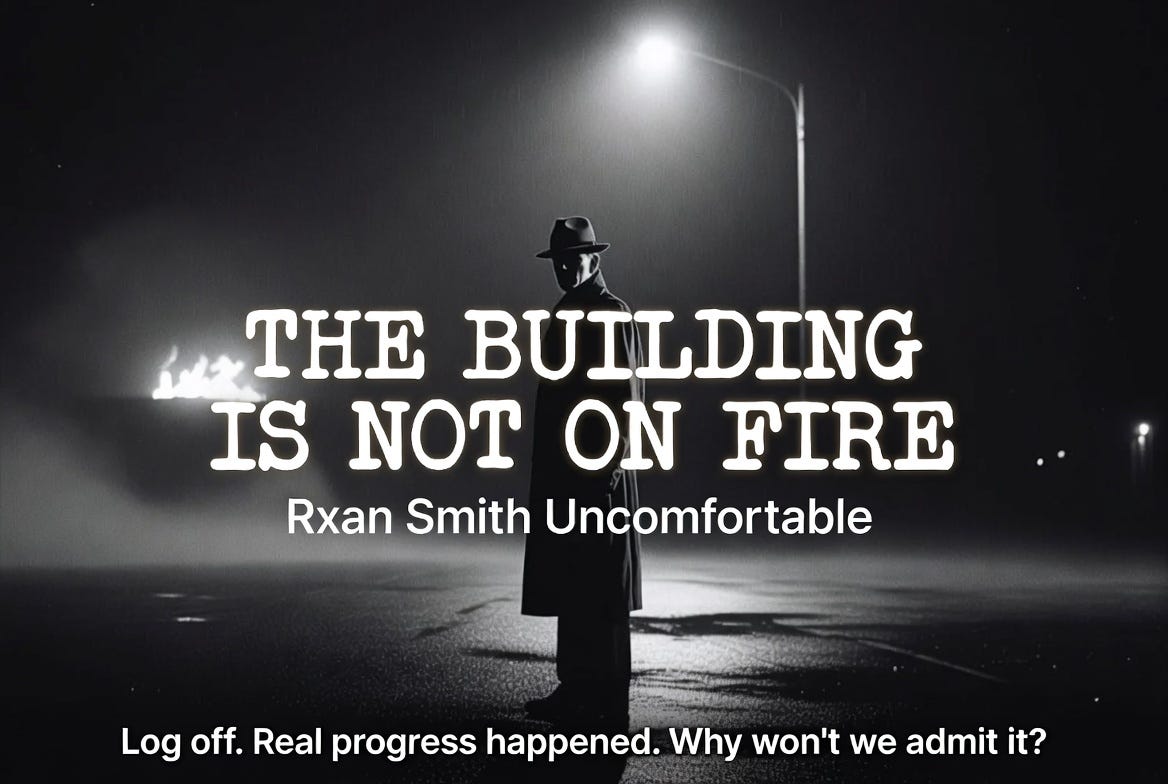
The internet doesn’t let it breathe. The internet finds the worst moment of every day and pins it to the top. It is an outrage delivery machine masquerading as a discourse platform, and we — all of us, left right and center — have handed it our identities and our judgment and our capacity to feel like anything is working. When the algorithm rewards the most extreme statement, the most extreme statement gets made, by everyone, until that’s all we can hear. And then we look at the feed and we think: this is where we are. But it isn’t. The feed is not where we are. The feed is a funhouse mirror mounted in a burning building. Log off and walk outside and most of the time the building is not on fire.
“The algorithm rewards the most extreme statement until that’s all we can hear. And then we mistake the feed for the world. Log off. Walk outside. Most of the time the building is not on fire.”— The Uncomfortable
I want to be precise about something, because the argument I’m making can be misread as optimism-bias if I’m not careful. There are domains where things have genuinely gotten worse and the data supports the pessimism. Housing affordability is a real crisis — the median home price relative to median income is at a generational low for accessibility, and it is not improving. Institutional trust — in government, media, medicine, higher education — has collapsed in ways that have downstream consequences we haven’t finished paying. Loneliness and social isolation, especially among young men, are at epidemic levels by clinical measures. The cost of building a middle-class life in this country has risen faster than wages for two consecutive decades. These are not internet panics. These are documented, measurable declines in specific areas of American life, and anyone arguing “things are generally fine” without acknowledging them deserves to get laughed out of the room.
“A movement that can’t distinguish between a win and a loss can’t replicate wins or diagnose losses. It’s just noise.”— The Uncomfortable
I am not arguing things are generally fine. I am arguing that we have made real progress on some things, and pretending we haven’t makes us less equipped to fix the things that genuinely aren’t working — because a movement that can’t distinguish between a win and a loss can’t replicate wins or diagnose losses. It’s just noise.
Stop Treating Progress Like a Confession of Failure
If you call yourself a progressive, you have to actually acknowledge it when something progresses. I’m not asking for a parade. I’m asking for a moment — thirty seconds, a single sentence, a nodded recognition — that the thing we fought for happened. That it worked. That the world is, in this specific measurable way, less terrible than it was. Because if we can’t do that, then we’re not a movement with a direction. We’re a permanent grievance operation. And permanent grievance operations do not win. They recruit, they rage, they fracture, and eventually they hand the narrative to people who are very happy to tell everyone else that the left is impossible to please, always angry, never satisfied, contemptuous of normal people. You know why that message lands? Because we keep validating it.
To the younger generation — and I mean this as an invitation, not a lecture — you inherited a fight that is real and urgent, and your energy is exactly what it needs. But you also inherited it without the context of what was already won, because the people who won it felt guilty celebrating. That guilt was misplaced. The wins were real. Marriage equality was a win. The ACA was a win. The ozone treaty was a win. Clean air standards were a win. None of them are finished. All of them are real. You are standing on ground that was hard-fought, and knowing that doesn’t make you complacent — it makes you informed. Complacency is the enemy. But so is the lie that nothing has ever worked. Point the revolutionary energy somewhere. It’ll do more damage with GPS.
On the excommunication habit: Maher will say something next week that makes you want to throw the television. Fine. But the broader point survives whatever he says next week. The left has built a culture of political eviction — where being wrong ten percent of the time disqualifies you from the ninety percent where you were right, where the worst thing someone said five years ago is the only thing they are now, where the coalition shrinks by design and then the coalition wonders why it keeps losing. That is not ideological rigor. That’s a firing squad arranged in a circle. And the exits it creates lead directly to the other side, which is very happy to take them.
I became a progressive because I thought we could make things better. I still think that. But I also think that a movement which refuses to see that it already has — that can’t stop, take a breath, and say that actually worked, we did that — is a movement that has confused the map for the territory, the fight for the purpose, and the permanent revolution for the actual goal. The goal was always a better world. Not a perfected one. A better one. We’re making it. Slowly, badly, imperfectly, with constant backsliding and spectacular failures mixed in. But the line, taken over decades, over generations, bends. It bends because people showed up and made it bend. That’s not inspiration-poster stuff. That’s history. You can look it up.
Celebrate the wins. Raise the bar. Keep going. In that order.
And maybe… maybe… don’t excommunicate everyone who makes you slightly uncomfortable. That used to be kind of the whole point.
© 2026 Rxan Smith Media · uncomfortable.rxansmithmedia.com


