

College = Success

Narrative vs Reality | Episode #004
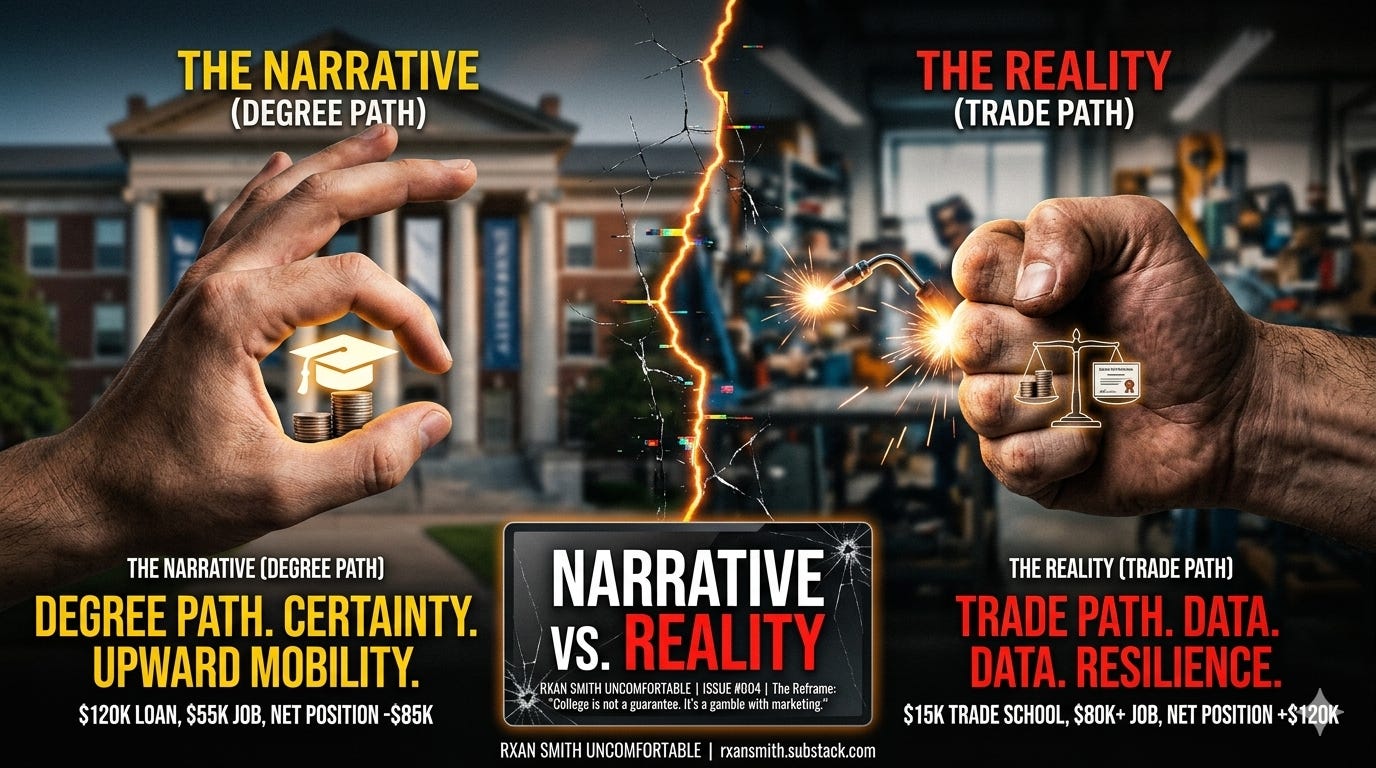
4“We told an entire generation: go into debt now, it’ll pay off later.
College = Success: the promise that sold a generation into debt. The math they did not show you. And what the trades already figured out.
The Narrative
The story was airtight. Get the degree. Land the job. Earn the salary. Justify the loan. In that order, without deviation.
College was not presented as one option among several. It was the default. The fallback question was not “what will you do instead?” It was “which school?” The people who asked about trade programs got evil looks. You know the look
White-collar > blue-collar was not just economic advice… it was a status hierarchy masquerading as career counseling. A degree means you're serious. It means upward mobility in motion. It meant you were playing the long game.
What nobody paused to run… OdOddly enough.. was the actual math.
The Reality
The student debt crisis is not a side effect of the system. It is a feature of it. Tuition at four-year universities increased over 1,200% between 1980 and 2020, roughly eight times the rate of inflation. Federal loan availability expanded to meet that price increase, which allowed universities to keep raising prices, which required more loans. A perfect loop. Except students were the ones spinning inside it.
By the numbers
Total U.S. student debt: $1.7 trillion+
Graduates working in jobs not requiring their degree: ~43%
Average plumber salary (U.S.): $65K–$100K+
Average English/communications graduate starting salary: ~$42K
Median trade school cost vs. four-year degree: $33K vs $120K+
Underemployment is the part of the narrative that never made it into the brochure. The assumption was that a degree opened doors. What it actually did, for a significant share of graduates, was add a credential requirement to jobs that did not need one while attaching a six-figure debt load to people starting their working lives.
Meanwhile, the trades spent decades being quietly embarrassed out of career fairs. HVAC technicians. Electricians. Plumbers. Welders. Roles that are recession-resistant, cannot be offshored, and in many markets pay more than the degrees that replaced them in the cultural hierarchy.
The Collision
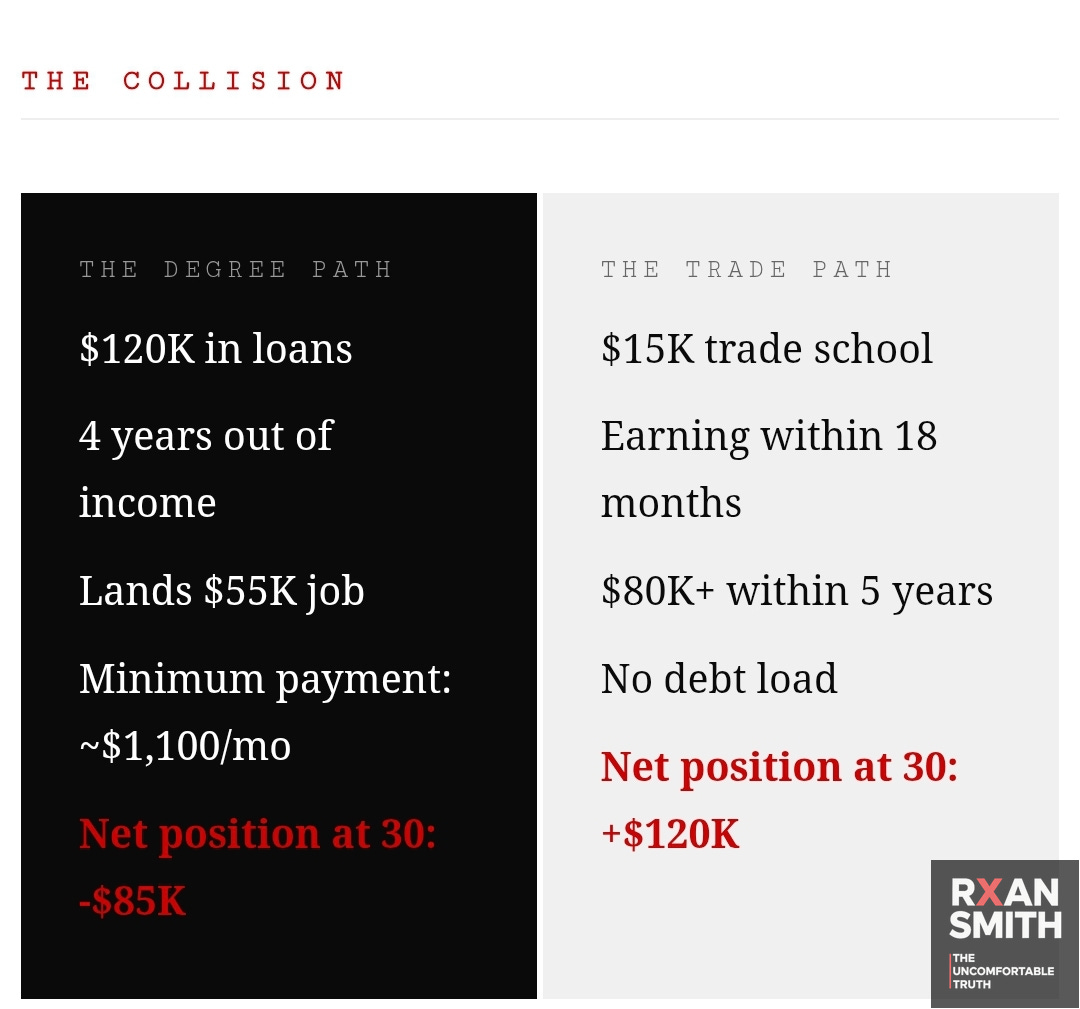
That gap is not a rounding error. It is a $200,000 difference in financial starting position before either person hits 35. The degree path is not inherently wrong. But it was sold as the only path, which is where the damage happened.

The Reframe
College is not a guarantee. It’s a gamble with marketing.”
Some degrees produce strong returns. Medicine, engineering, accounting, computer science — fields where the credential gates an income that justifies the cost. Other degrees are expensive credentials for jobs that do not require them, attached to debt that follows you for 20 years.
The problem was never education. The problem was the conflation of education with one specific delivery mechanism sold at a price that only made sense in a completely different economy.
And the institutions that benefited from that conflation — universities, federal lending programs, the employers who added degree requirements to positions they did not need — had no incentive to correct it. So they did not.
The Uncomfortable Honest Part
A lot of people reading this spent real money and real years on degrees that did not deliver the return they were promised. That is not stupidity. That is responding rationally to bad information from trusted sources.
The anger belongs pointed at the institutions that sold the guarantee, not at the people who believed it. Including the parents who pushed it. They believed the same story.
The Close
“Education matters. The type matters more.”
Not all education is created equal and not all debt is created equal. A $200K loan for a degree with a 6% employment rate in field is a worse financial decision than a $15K trade certificate with a 95% placement rate. The prestige attached to the first one does not change the math.
Learning is never wasted. Paying $120K for learning when $15K gets you to the same income destination — that is worth questioning before you sign.
Narrative vs Reality Series
← Ep 3: The American Dream | Next: Episode 4 — Free Market Capitalis
m
Support the work 💰 💸 💳
Independent. No advertisers. No donors with agendas. Just the numbers and where they point.
☕ buymeacoffee.com/rxansmith 💸 paypal.me/phireballsports
RXAN SMITH: UNCOMFORTABLE | rxansmith.substack.com
This Substack is reader-supported. To receive new posts and support my work, consider becoming a free or paid subscriber.
Thanks for reading! This post is public so feel free to share it.

The Iran Crisis Everyone’s Misreading Subtitle

Narrative vs Reality| Rxan Smith | · Issue #002 (Every Monday)
The 2026 “Blue Wave” Narrative Is Breaking: Here’s What the Data Actually Says

■ Narrative vs. Reality - Issue #001 (Mondays)