
The American Dream
What they sold you. What actually runs the economy. And why working harder will not close the gap
Narrative vs Reality Episode #003
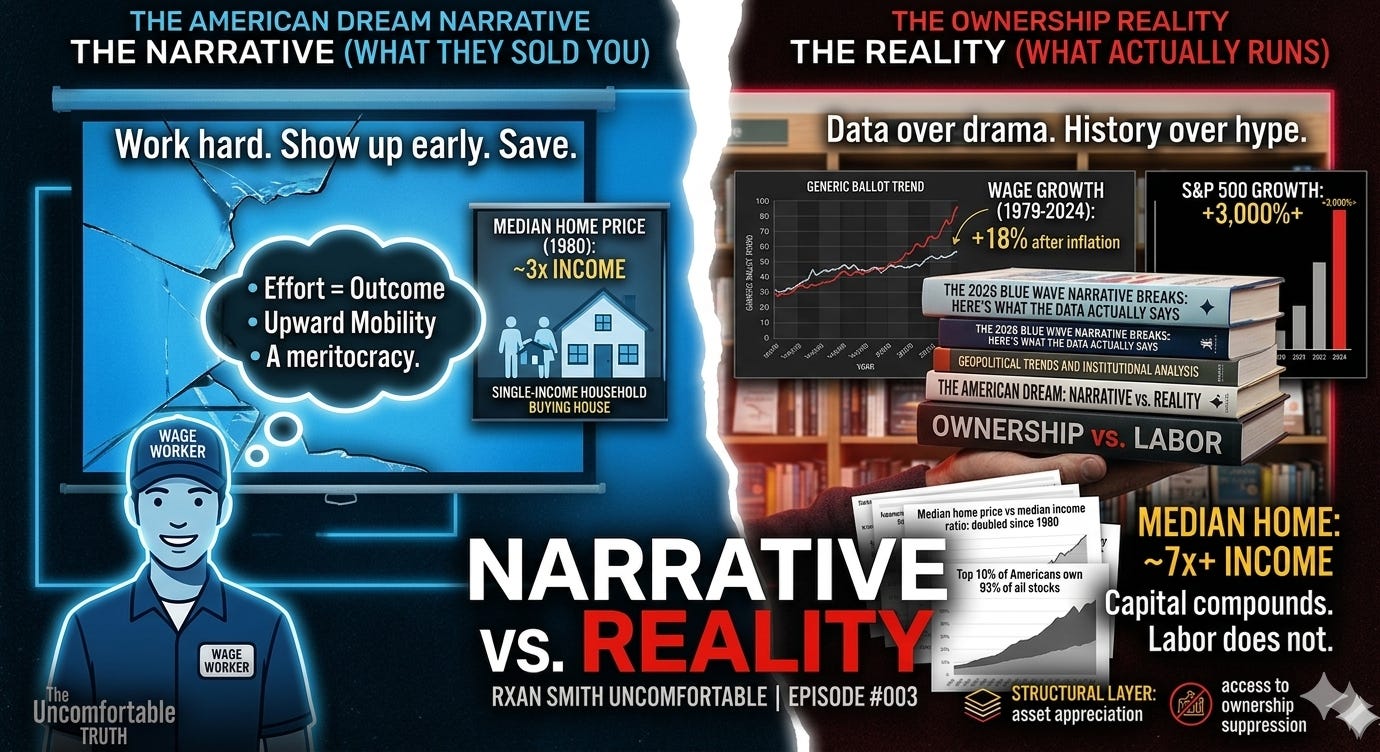
“If hard work guarantees success... why are the hardest workers usually the furthest behind?”
The Narrative
You know the story. You grew up inside it.
Work hard. Show up early. Save what you can. Buy a house. Keep your head down, pay your dues, and eventually the system rewards you. That was the deal. That was what your parents believed, what their parents believed, what got hammered into every guidance counselor speech and graduation address and motivational poster in every break room in America.
The narrative is elegant in its simplicity: effort equals outcome. Character plus consistency equals upward mobility. The American Dream is not a lottery. It is a meritocracy. Anyone can make it if they are willing to earn it.
It is a beautiful story. It is also about 50 years out of date.
The Reality
Here is what has happened to wages versus everything else while the narrative stayed the same.
By the numbers
→ Median wage growth (1979–2024): +18% after inflation
→ S&P 500 (same period): +3,000%+
→ Median home price vs median income ratio: doubled since 1980
→ Top 10% of Americans own 93% of all stocks
That is a structural gap, not a problem with wage. And it has been widening for decades while we told the people falling behind to wake up earlier and work harder.
Housing used to be something a single income could buy. In 1980, the median home cost about 3x the median household income. Today that ratio is over 7x in most markets and double digits in major cities. You are not priced out because you did not save enough. You are priced out because the asset class you were told to save toward was purchased by the people who were already in it.
The same dynamic runs through every wealth-building vehicle: stocks, real estate, private equity, small business ownership. The mechanism that produces wealth is not labor. It is asset ownership. And asset ownership requires prior capital, which is the one thing the Dream narrative never accounts for.
The Collision
Two people. Same year. Same city.
Person A
Earns $80,000/year
Saves 10% religiously
Rents while saving for down payment
Net worth after 10 years: ~$85K
Person B
Inherits a $200K house in 2014
Does nothing unusual
Holds asset while it appreciates
Net worth after 10 years: ~$380K+
Person A did everything right. Person B did almost nothing. The difference is not character. The difference is not discipline. The difference is ownership.
That is not a moral failure. That is a structural one. And we have been blaming individuals for a structural problem for a long time now.
The Reframe
“It’s not a work economy. It’s an ownership economy.”
That is not a cynical statement. It is a descriptive one. The mechanism that generates wealth in this country is not wages. It is asset appreciation. Capital compounds. Labor does not.
Once you understand that, two things become clear. First, the advice to work harder is not wrong so much as incomplete. Second, the systems that restrict access to ownership — housing policy, wage suppression, student debt — are not peripheral issues. They are the entire game.
The Dream was never a lie exactly. It was a description of how the economy worked for about 30 years after World War II, when wages and productivity moved together, housing was genuinely accessible, and college was cheap enough to be a reasonable investment. That era ended somewhere around 1973. The story kept going.
The Uncomfortable Honest Part
The Dream narrative is not maintained by accident. It is politically useful to tell people that their poverty is a personal failure. It keeps them looking inward instead of upward. It turns structural critique into self-help demand.
The people who benefit from the current ownership structure have every incentive to keep selling the labor narrative. And they do. On both sides of the aisle.
The Close
“You’re not failing the system. You’re playing the wrong game.”
The rules of the game you were sold: work hard, save money, be patient. The rules of the game that actually runs: own things that other people need, compound returns over time, pass it down.
Knowing the difference does not automatically change your situation. But it does mean you stop blaming yourself for losing a game that was never designed for the kind of player you are.
And it means you start asking different questions. Not “how do I work harder?” but “how do I get into the ownership game?” Not “what am I doing wrong?” but “what is the system actually rewarding?”
Narrative vs Reality Series
Support the work
If this made you uncomfortable in a useful way, consider supporting independent media that does not answer to advertisers or party donors.
☕ buymeacoffee.com/rxansmith 💸 paypal.me/phireballsports
RXAN SMITH: UNCOMFORTABLE | rxansmith.substack.com


Smarter, band together, share resources (walkable housing)save $10k in <5y. Invest it, dbl it in 5y, buy property. WRR
Sounds easy, its hard! Its doable, I did it on a Wmt hourly.