


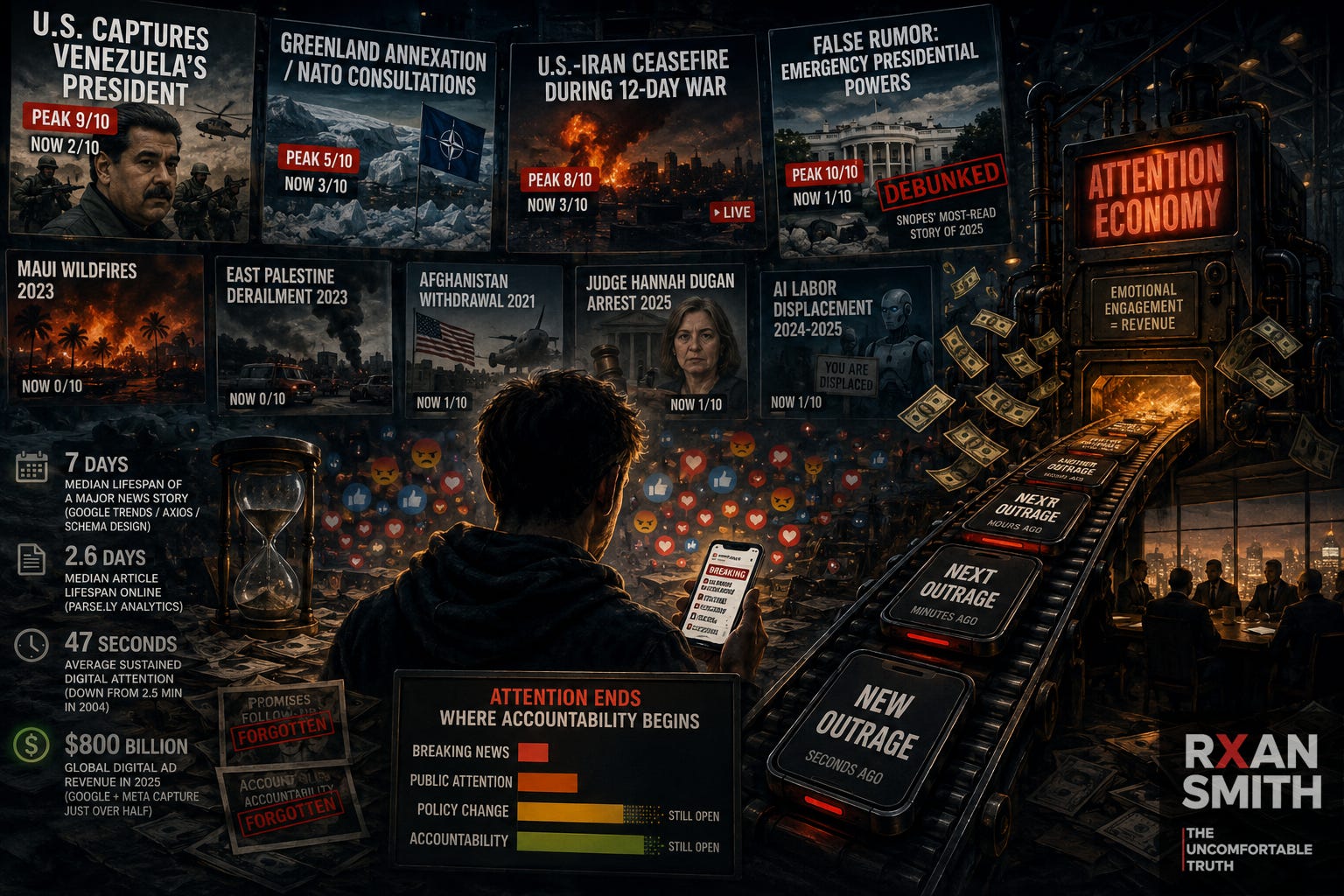
Yesterday the Iran ceasefire collapsed again. New strikes, new retaliation, oil already climbing. Before that it was a Supreme Court ruling on birthright citizenship. Before that it was Venezuela.
Quick question. Can you remember what actually happened with any of them? Not your opinion of it. The facts. The promises made. The follow-up that never came.
Most people can’t. That isn’t because you’re stupid. It’s because forgetting has become one of the most profitable industries on Earth.
And that’s a bigger story than whatever’s leading your feed this morning.
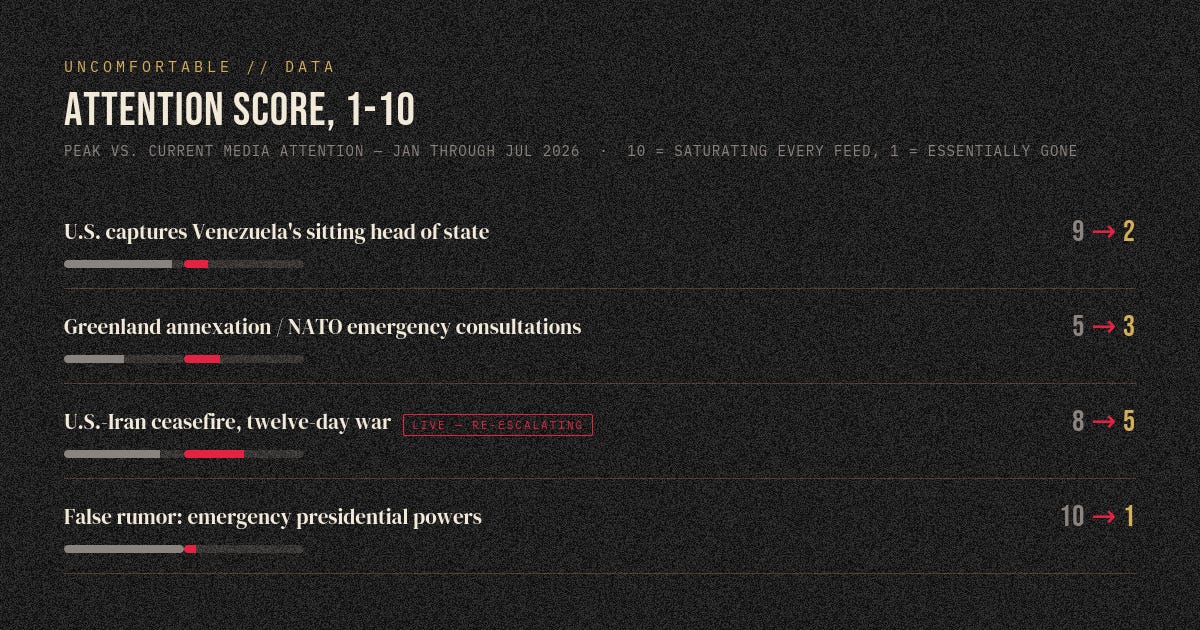
Nothing resolved. Attention rotated. This morning the U.S. struck Iran again and Iran hit back at Bahrain, Kuwait, and Qatar. The ceasefire is over, and it’s already competing with a NATO summit and a Senate scandal in Maine for headline space. The last row is the one that should bother you most: a debunked rumor about emergency presidential powers hit a higher peak attention score than any real crisis on this list, including the capture of a sitting head of state. Then it vanished too.
The Argument
This is not about bias. It is about structure.
That distinction between a crisis concluding and a crisis being abandoned is the thing modern media is engineered to prevent you from noticing.
This is not a conspiracy. It is an argument about architecture, the architecture of an outrage cycle governed by algorithmic amplification and the psychology of an attention economy that has no financial interest in your long-term understanding of anything.
The structure is working exactly as designed.
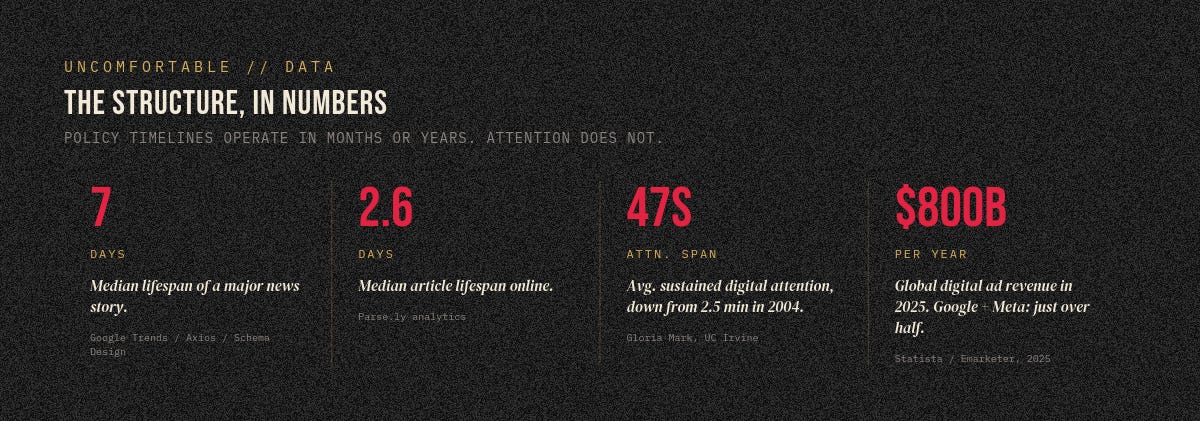
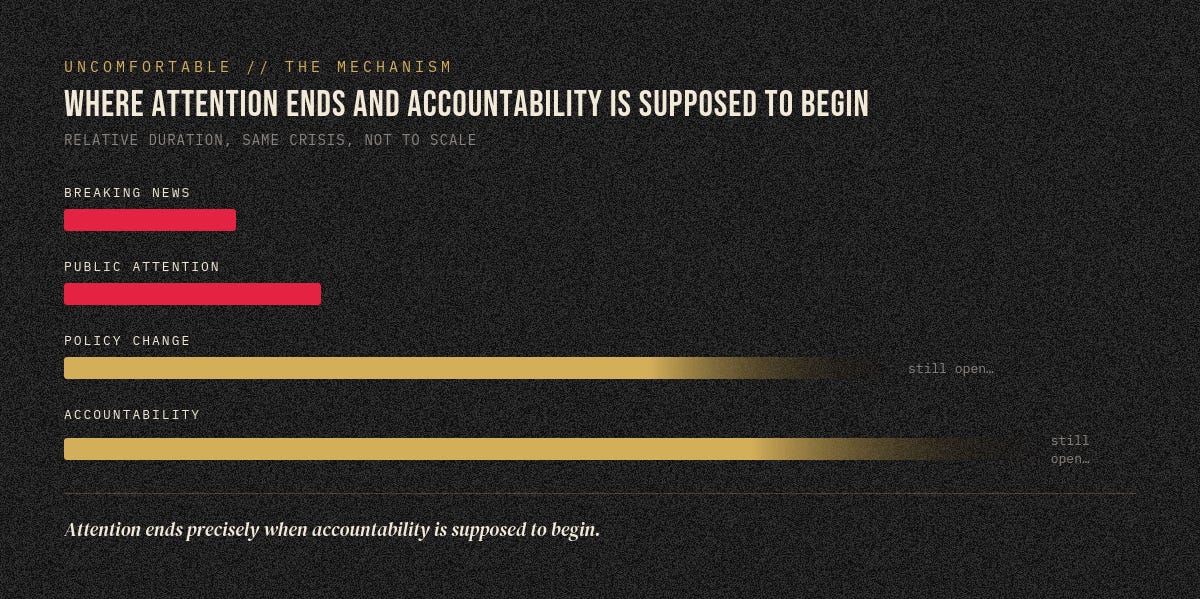
Policy timelines operate in months or years. Attention expires before accountability can begin. This is not prioritization. This is interruption.
The Pattern
It is not one story. It is every story.
The Venezuela story has carried too much weight in this argument. One example is an anecdote. Five examples across different administrations, different parties, different news cycles, that is a pattern. Here is the pattern.
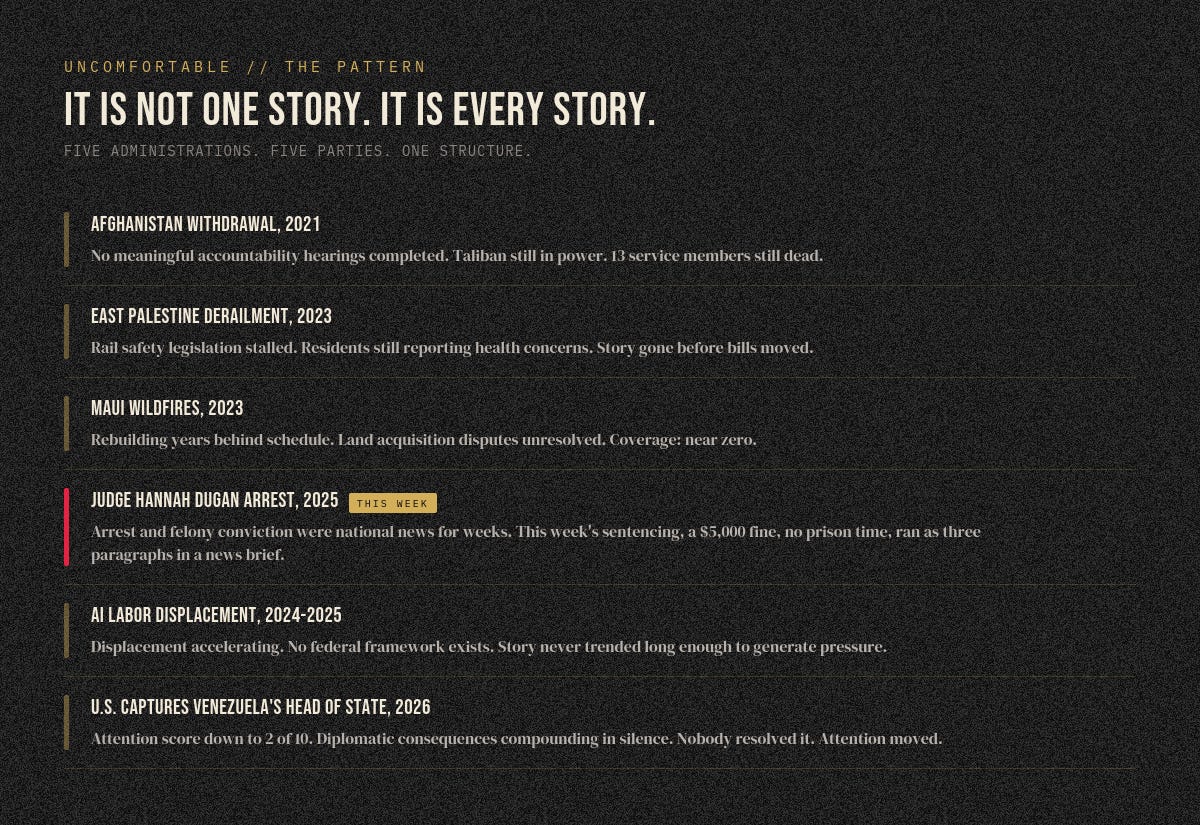
Notice how fast each one gets replaced. The Iran ceasefire is hours old and it’s already sharing space with a NATO summit and a Senate scandal. Give it a week and something newer will bury it completely, the same way every story on this list buried the one before it.
The specific stories change. The structure doesn’t. Crisis arrives. Urgency peaks. Coverage rotates. Consequences compound in the dark. If this pattern only happened once, it would be a news failure. Happening across every major story for twenty years, it is a system design.
The Hidden Mechanism
Emotional front-loading
Research into attention economy psychology shows negative news fades faster than positive news because emotional intensity is front-loaded. The brain experiences urgency first and processing later. Modern platforms never allow the later phase.
The audience did not demand shorter news cycles. The environment trained shorter attention. You are not informed sequentially. You are stimulated continuously.
Internal Meta research disclosed by whistleblower Frances Haugen confirmed that anger and fear outperform positive emotions in engagement metrics by a significant margin. Outrage is not collateral damage from a broken system. It is the product the system was designed to sell.
Nobody had to conspire. The math did the conspiring. Nobody needed a smoke-filled room. Nobody needed to coordinate. Nobody needed to hate democracy. Every platform optimized for engagement because engagement paid more. Every politician adapted because attention rewarded spectacle over follow-through. Every publisher chased the algorithm because visibility paid the bills. The outcome looks coordinated because incentives keep producing the same destination without anyone sharing a map. Eight hundred billion dollars in annual digital advertising revenue requires your sustained emotional activation, and a perfectly legal system of incentives has been optimizing toward that number for two decades.
Devil’s Advocate
Attention has always been short.
The reasonable objection: People forgot stories in the 1950s too. Humans cannot care about everything indefinitely. Maybe this is natural prioritization. Maybe attention has always moved before consequences arrived.
That objection is partially correct and entirely beside the point.
The issue is not that humans forget. The issue is that for the first time in history, forgetting has been monetized at industrial scale. Humans have never before carried a machine in their pocket specifically engineered to interrupt that attention every few seconds, then sell the interruption to advertisers.
That is not a continuity with the 1950s. That is a phase change. The forgetting was always human. The acceleration is new.
Yes, media companies optimize for engagement because engagement works. Users click urgency, share outrage, and reward novelty over follow-up. A false rumor about emergency presidential powers became Snopes’ most-read story of 2025, outperforming every verified global crisis on the list.
The infrastructure exploits psychology. Participation remains voluntary. The machine runs on audience behavior as much as algorithms. Which makes you both the victim and the primary investor.
Every time you screenshot the outrage of the day and send it to your group chat. Every time you refresh for the update on the story you were enraged about four hours ago and have already half-forgotten. Every time you feel genuinely, righteously informed for forty-seven seconds before the next thing lands, you are not resisting the machine. You are the machine.
The Real Cost
What gets crowded out
The greatest damage is not misinformation. It is displacement. Every degree of public attention devoted to the spectacular is a degree withheld from the structural.
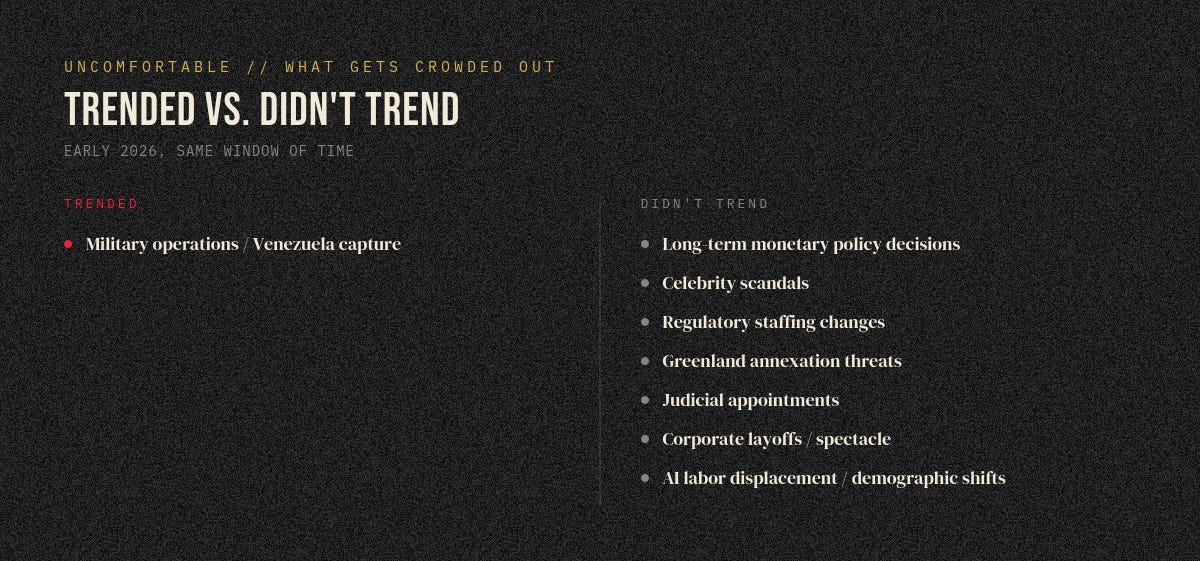
These stories lack spectacle. Therefore they lack trend velocity. Therefore they lack attention. Therefore they lack democratic pressure. That is not an accident of the news cycle. That is a feature of it.
The Beneficiaries
Who benefits from the forgetting?
This is the point where people start looking for villains. There doesn’t need to be one.
When public attention expires before consequences arrive, every institution gains breathing room. Politicians make promises that outlive the news cycle. Corporations survive scandals that disappear before reforms materialize. Bureaucracies implement decisions long after the public stopped watching. Interest groups quietly win battles that never become trends.
The benefit is not immunity from criticism. The benefit is immunity from sustained criticism.
A scandal can survive a week of outrage. Few institutions can survive a year of scrutiny.
That distinction matters because accountability is not an event. It is a process. It requires memory. It requires repetition. It requires citizens willing to ask the same question in July that they asked in January.
The modern attention economy excels at many things. Maintaining pressure is not one of them.
When attention moves faster than consequences, power doesn’t need to defeat accountability.
It only needs to outlast it.
The Uncomfortable Conclusion
You are not going to like this part.
You think you are a victim of this system. You are also its primary investor. Your engagement is not a byproduct of the attention economy. It is the economy.
What the math produced is a civilization that is simultaneously the most informed and the most amnesiac in human history. You know more about what is happening in the world than any citizen in any prior era. And you will remember almost none of it.
The attention economy isn’t selling you information. It’s renting your memory back to you, one outrage at a time. And every time it convinces you to forget yesterday for today’s headline, the people who needed one more week without scrutiny just got it.
The consequences of these stories don’t trend. They compound. They show up in your foreign policy, your fuel prices, your grandchildren’s geography. They show up everywhere except the place where democratic accountability is supposed to live, which is your sustained attention.
The question worth asking in 2026 is not whether these crises are real. They are. It is not whether the media is biased. It is. The question, the one that indicts all of us and that none of us want to answer honestly, is whether a democratic system can survive being governed by citizens whose attention expires faster than any policy can mature.
The press did not lose its memory. We stopped paying it to have one.
The most subversive thing you can do right now is remember something from last month. Not the feeling of it. The facts of it. What happened, what was promised, what was never followed up on, what quietly became permanent while you were watching the next fire.
Memory is not nostalgia. In this environment, memory is a threat to the business model.
Which is exactly why they’re betting you don’t have any left.
Based on every number we’ve got so far,
we f**king do not.
And that’s not a glitch.
That’s the business model.
Sleep tight.
🎤💧
- R❌AN SMITH

Hungary for More
Sources & Data: Attention scores, editorial estimate based on relative coverage volume, top trending U.S. media stories, Jan-Jul 2026. Google Trends / Axios / Schema Design (median story lifespan). Parse.ly analytics (median article lifespan). Gloria Mark, UC Irvine (attention span research, 47s avg. / 40s median). Frances Haugen / Meta (internal engagement research disclosures). Statista / Emarketer (2025 digital ad revenue). NPR, AP (U.S.-Iran ceasefire collapse, July 8-9, 2026). NYT (Judge Hannah Dugan sentencing, July 2026). Snopes (most-read story data, 2025).
Once again, the culprit is human nature. It is an ancient political maxim that people have short memories. That’s why newly elected incumbents do the stuff that will anger their constituents early so that by the time elections come around, people have forgotten.
The powers that be that you mention simply exploit this human availability
So, unless and until we can change your nature, which is controversial in and of itself, this and other things you lament will continue to be the case.
When print newspapers were a thing, there used to be a comic strip in the funny papers called Pogo, which was political satire; in one famous strip, Pogo famously said “we have met the enemy, and it is us”; that remains the case and perhaps shall always be the case.
There’s nothing new under the sun, the same was the case in the print era. The culprit is human nature.