

Thank you for tuning in! We begin this week, as we so often do now… in the middle of the wreckage.
The Week’s Wreckage
Five Stories. Five headlines. Five arguments.
Five reasons half the country is yelling at the other half.
And beneath all of them...
the same story.
🌍 Middle East: The Matchbox Gets Shaken Again
Early Monday, Israel struck Iranian radar sites and a petrochemical plant in Mahshahr.
Iran responded with waves of missiles targeting Israeli military bases under the banner of Operation Nasr.
Israel also hit Beirut’s southern suburbs on Sunday, defying American requests and further straining the April ceasefire that was already hanging by a thread.
Explosions lit up multiple Iranian cities.
Sirens screamed across Israel.
President Trump made it clear he “calls the shots,” urged Iran back to negotiations, expressed displeasure with Israel’s Beirut operation, and reportedly convinced Netanyahu to hold off on immediate further retaliation.
Meanwhile, diplomats from multiple countries are scrambling to salvage what remains of the fragile ceasefire as it approaches roughly its hundredth day.
The risks remain the familiar ones:
A wider regional war through Houthi involvement
Fresh disruptions to Red Sea shipping lanes
Escalation around the Strait of Hormuz, the narrow oil chokepoint the global economy still depends on far more than most people realize.
Resources are finite.
Priorities matter.
And eventually, every bill comes due.
It’s the foreign policy version of letting the kids play with matches in the garage while the adults argue over who gets to hold the fire extinguisher. The people who keep telling us they have everything under control are the same ones who benefit every time the situation stays just unstable enough to justify the next round of spending and the next bump in energy prices that lands on your kitchen table..
Every foreign commitment comes with a domestic opportunity cost.
Immigration
The United States Senate just rammed through a $70 billion immigration enforcement package to supercharge ICE, Border Patrol, detention capacity, and enforcement operations through 2029.
That’s on top of the roughly $170 billion already approved last year.
That’s real money.
That’s real hardware.
That’s real human beings being processed, detained, transported, and documented by a system operating at historic scale.
Meanwhile, senators who have never stood inside a processing facility take their border selfies and declare that Washington is finally getting serious.
The money keeps flowing.
The pressure keeps building.
Toledo
Then there’s Toledo.
Saturday night.
The Old West End Festival.
Music.
Food vendors.
Families.
Historic homes.
Children running around.
Normal life.
Then gunfire.
At least twelve people shot.
Two critically wounded.
Police believe two gunmen were shooting at each other.
The crowd caught the bullets.
Before the shooting...
someone’s kid was eating a corn dog.
Someone else was admiring a house they could never afford.
A couple was arguing over where to park.
That’s what normal looked like thirty seconds before it disappeared.
And as of tonight...
authorities are still searching for the shooters.
People don’t experience public safety as a policy debate.
They experience it as whether they make it home.
Virginia
Over in Virginia...
the redistricting game took another turn.
Courts blocked an effort to redraw congressional maps mid-decade.
Campaigns built around those new districts are suddenly rethinking their plans.
Virginia is merely the location.
The story is national.
Every few years, both parties discover the same constitutional principle:
The map is fair when they draw it.
The voters choose the representatives.
Except when the representatives choose the voters.
Then somehow that’s democracy too.
One of America’s oldest bipartisan traditions is pretending gerrymandering is only bad when the other team does it.
Artificial Intelligence
And underneath all of it...
the quiet story.
The accelerating story.
The story that isn’t waiting for permission from Congress, activists, corporations, or voters.
Artificial intelligence.
Young people were told:
Go to college.
Get the skills.
Learn technology.
Play by the rules.
Build a career.
Now many are looking at entry-level jobs that either don’t exist anymore or pay like it’s 1997 while everything else costs 2026.
The workforce participation rate for young men has been sliding for years.
Now machines are arriving at exactly the moment millions of people were already standing one bad break away from falling through the floor.
For twenty years we told people to adapt.
Then the technology adapted faster than they did.
The Diagnosis
But if you pull the camera back far enough...
something starts to appear.
Iran.
Immigration.
A mass shooting at a neighborhood festival.
Another redistricting battle.
Artificial intelligence reshaping the workforce.
Different headlines.
Different states.
Different villains.
Different arguments.
But the same underlying story.
Different symptoms.
Same diagnosis.
America is not suffering from a shortage of money.
America is not suffering from a shortage of technology.
America is not suffering from a shortage of information.
We’re drowning in all three.
What we’re running short on are pressure-release valves.
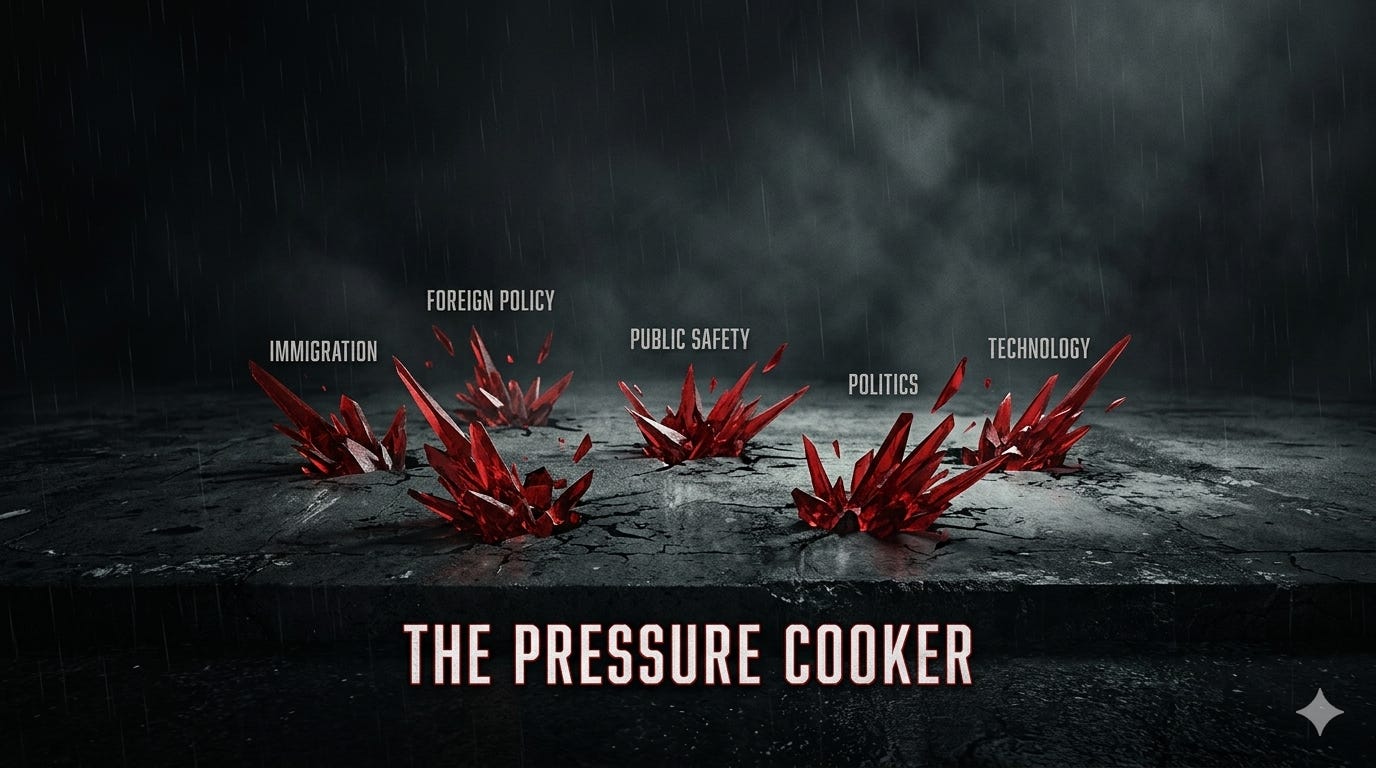
The Pressure Cooker
Everywhere you look, the pressure is building.
Economic pressure.
Housing pressure.
Political pressure.
Technological pressure.
Pressure on families.
Pressure on communities.
Pressure on young people trying to build a life that feels increasingly out of reach.
And the institutions that were supposed to relieve that pressure increasingly seem designed to manage it instead.
The border isn’t just an immigration story.
It’s a pressure story.
Toledo isn’t just a crime story.
It’s a pressure story.
Artificial intelligence isn’t just a technology story.
It’s a pressure story.
Iran isn’t just a foreign-policy story.
It’s a pressure story.
Different symptoms.
Same diagnosis.
The slow, grinding squeeze on ordinary people.
More effort.
Less security.
Higher costs.
Lower trust.
The sense that the rules keep changing.
The sense that every year requires a little more sacrifice for a little less stability.
The sense that the people running the system are better at explaining problems than solving them.
And when enough people start feeling that way at the same time...
history tends to stop asking politely.
History tends to stop asking politely.
Now here’s the uncomfortable part.
Because once you accept the diagnosis...
you have to explain why the symptoms keep getting worse...
Xditorial
And it’s uncomfortable for everyone.
Republicans are often better at identifying the frustration.
Democrats are often better at identifying the structural causes.
Neither party has shown much interest in confronting the incentives that keep producing the frustration in the first place.
One side tells voters every problem can be solved with enforcement.
The other tells voters every problem can be solved with compassion.
Reality is rude enough to require both.
Cable news picks a team and yells.
Both teams keep throwing lunch while the building leaks.
The Voters Are Telling Us Something
So what would it actually take to rebuild trust with the voters who increasingly feel abandoned by both parties?
Democrats happen to face that challenge most immediately because they are the party currently losing significant portions of the working-class coalition they once dominated.
But the underlying lesson applies far beyond one party.
The warning signs are not hidden.
They’re visible everywhere.
Immigration
Stop treating it like a binary culture war.
The public has made its position remarkably clear.
People want borders that function.
People want legal pathways that function.
People want a system that is orderly, predictable, enforceable, and connected to actual economic needs.
Those goals are not mutually exclusive.
They’re complementary.
Pretending one side of that equation doesn’t exist is how parties lose the working-class voters they claim to represent.
Enforcement without humanity becomes cruelty.
Humanity without enforcement becomes chaos.
A functioning nation requires both.
Public Safety
The evidence from cities that have successfully reduced violence points in the same direction.
The answer is not slogans.
The answer is sustained, targeted work.
Illegal firearms.
Repeat offenders.
Neighborhood intervention.
Community investment.
Focused policing.
Long-term prevention.
Short-term response.
All of it.
Root causes matter.
But root causes operate on years.
People bleeding out at community festivals operate on minutes.
The bleeding has to stop now.
You cannot surrender that conversation to the other side and expect voters to trust you with public safety.
The Economic Future
AI is not coming.
AI is here.
For twenty years we told young people:
Learn computers.
Learn technology.
Learn to code.
Adapt.
Be flexible.
Then the computers adapted faster than they did.
Let that sink in.
An entire generation was promised that education would be the ladder.
Now many are watching the ladder move while they’re still climbing it.
The party that wants to represent working people cannot keep acting as if this is a future problem.
It isn’t.
It’s a present reality.
That means:
Serious workforce retraining tied to actual employer demand.
Serious discussion about how productivity gains are distributed.
Serious investment in helping workers navigate technological displacement.
Serious acknowledgment that economic growth alone is not enough if ordinary people never share in it.
You don’t have to be anti-technology.
You do have to be pro-worker.
And being pro-worker requires more than press releases celebrating “good jobs.”
Foreign Policy
The foreign-policy piece is simpler in theory, though rarely in practice.
Every dollar spent abroad carries an opportunity cost at home.
Every unit of political capital spent managing another open-ended foreign commitment is a unit of political capital unavailable for domestic repair.
That doesn’t mean isolationism.
It means prioritization.
Because a nation cannot indefinitely ignore the conditions that determine whether its own citizens believe the system still works.
The Missing Ingredient
None of this requires abandoning principles.
It requires confronting reality.
It requires noticing that the current political coalitions are missing too many of the people who used to be inside them.
And the reasons are not mysterious.
They’re visible in the polling.
Visible in the economic data.
Visible in neighborhoods.
Visible in conversations.
Visible in the answer millions of Americans give to a simple question:
“Are things getting better for people like you?”
For too many Americans, the answer is becoming:
No.
The Great Pressure Cooker
Same story as last week.
Same story in different costumes.
Same story for longer than most of us want to admit.
The pressure is building at the border.
The pressure is building in our cities.
The pressure is building in our economy.
The pressure is building in our politics.
The pressure is building inside the lives of ordinary people trying to raise children, pay bills, stay safe, and build a future.
The question is not whether the pressure is real.
The question is whether our institutions still know how to release it.
Because history is full of societies that ignored warning signs.
History is not full of societies that ignored them forever.
The Test
Every civilization eventually faces the same test.
Can its institutions solve problems faster than they create frustration?
Can its leaders respond faster than public trust collapses?
Can ordinary people still see a future worth investing in?
Those are the questions hiding underneath this week’s headlines.
Not Iran.
Not Toledo.
Not immigration.
Not AI.
Those are just the costumes.
The real story is older than any of them.
The real story is whether institutions can adapt to reality faster than reality overwhelms them.
Because every society eventually reaches a moment when the gap between what people experience and what leaders say becomes impossible to ignore.
And when that happens, trust begins to break.
The Real Story
The real story is not Iran.
The real story is not immigration.
The real story is not crime.
The real story is not artificial intelligence.
The real story is whether the American system still possesses the capacity to correct itself before the people stop believing it can.
Because eventually every pressure cooker releases pressure.
The only question is whether it happens through reform...
...or rupture.