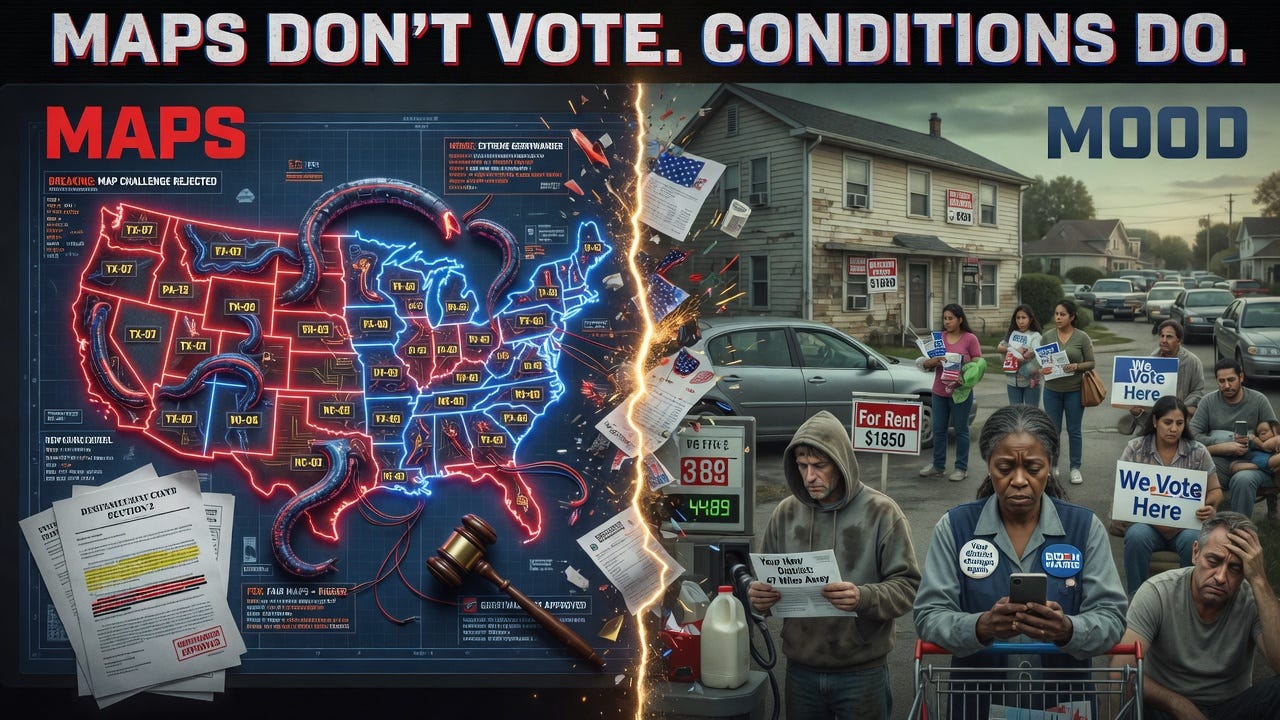
The Redistricting War Everyone's Misreading
Republicans are winning the map fight. Democrats are still favored to win the House. Those statements only sound contradictory if you misunderstand what actually decides midterms
Republicans are winning the redistricting war.
Democrats may still win the House.
Those statements sound contradictory only if you misunderstand what actually decides midterms.
“The maps are rigged. It’s over.”
Maybe.
Just not the way they’re selling it.
Here’s the version everyone’s running with:
The Narrative
Republicans gerrymander → Democrats lose seats
Courts greenlight the maps → structural advantage locked in
House majority secured → midterms over before they start
Clean. Cynical. Easy to package as proof that democracy is broken.
One problem:
Maps don’t vote. Conditions do.
What the Data Actually Shows
Redistricting follows a predictable pattern — and the political press is misreading it on both ends.
Republicans gained ground - but less than advertised.
The realistic net gain from all this redistricting is five to seven seats. Not the doomsday scenario Democrats are fundraising off. Not the guaranteed firewall Republicans are celebrating.
History shows even aggressive gerrymanders struggle to survive strong national wave environments.
No structural map advantage has ever fully contained a midterm when presidential approval is in freefall. The environment sets the ceiling. The map sets the floor
.
Democrats are already overperforming the maps.
Several special elections in 2025 and 2026 have shown Democratic margins running 15 to 20 points ahead of their 2024 baselines — in districts the new maps were supposed to make safe Republican territory.
The headline says Republicans locked in the House.
The data says the House is still very much in play.
What Neither Side Will Admit
Democrats.
They’re losing the redistricting war badly — and they’re still likely to win the House anyway. Admitting that kills the fundraising email that starts with “MAPS ARE BEING STOLEN.”
Republicans
Gerrymandering works best in a neutral environment. In a wave, it’s a speed bump. They built a structural advantage into a deteriorating headwind — and the headwind is getting stronger, not weaker.
Both parties
Neither side wants to say the quiet part: both benefit from pretending maps are destiny. Republicans get to project inevitability. Democrats get to monetize outrage. Structural panic is politically profitable even when the electorate remains fluid
Winning the map fight and losing the election aren’t contradictions.
In a bad enough environment, they’re inevitable.
Where the Analysis Breaks Down
Everyone covering this story is treating redistricting as the variable that decides the midterms.
It isn’t.
Redistricting sets the floor. Approval ratings set the ceiling. And right now, the ceiling is dropping fast.
The map debate dominates because it’s visible — you can draw it, litigate it, put it on a graphic. Voter sentiment is harder to show on cable news. So the map gets the coverage, and the mood gets a footnote.
That footnote is the actual story.
The Real Take
This doesn’t simplify the 2026 picture. It complicates it.
If the environment holds → Democrats flip the House despite the maps
If conditions stabilize → redistricting becomes decisive, Republicans hold
If the map fight drags into court → results get messy, legitimacy takes the hit regardless of who wins
This isn’t a stolen election story.
It’s a structural story wearing a stolen election costume… and we don’t know yet which one voters will believe when November comes.
The media keeps covering redistricting like it overrides public sentiment.
It doesn’t.
Maps matter. Conditions matter more
.
And if voters are angry enough, even the most carefully engineered districts become temporary speed bumps instead of political fortresses.
The real question isn’t whether Republicans won the map fight.
It’s whether voters are angry enough to make the maps irrelevant.
Most political coverage tells you what to think.
This breaks down what’s actually happening — with data, history, and zero party loyalty.
Get to know Rxan before considering becoming a free or paid subscriber:


We voted to change the district boundaries in Virginia. That was a pure measure of our citizens’ sentiment. Our message was clear: the voters in each district still each have the right to vote. If MAGA candidates want to win, they should need to appeal to the voters.
Great overview thank you, cut right to the chase of what’s happening and raw incentives for each —brilliant piece formatting