
The New American Palace
How a Privately Funded White House Ballroom Became a Billion-Dollar Symbol of Fortress Government | Senate Security Funding Request for Broader White House Complex + Secret Service Modernization
Rxan Smith | Power & Architectur
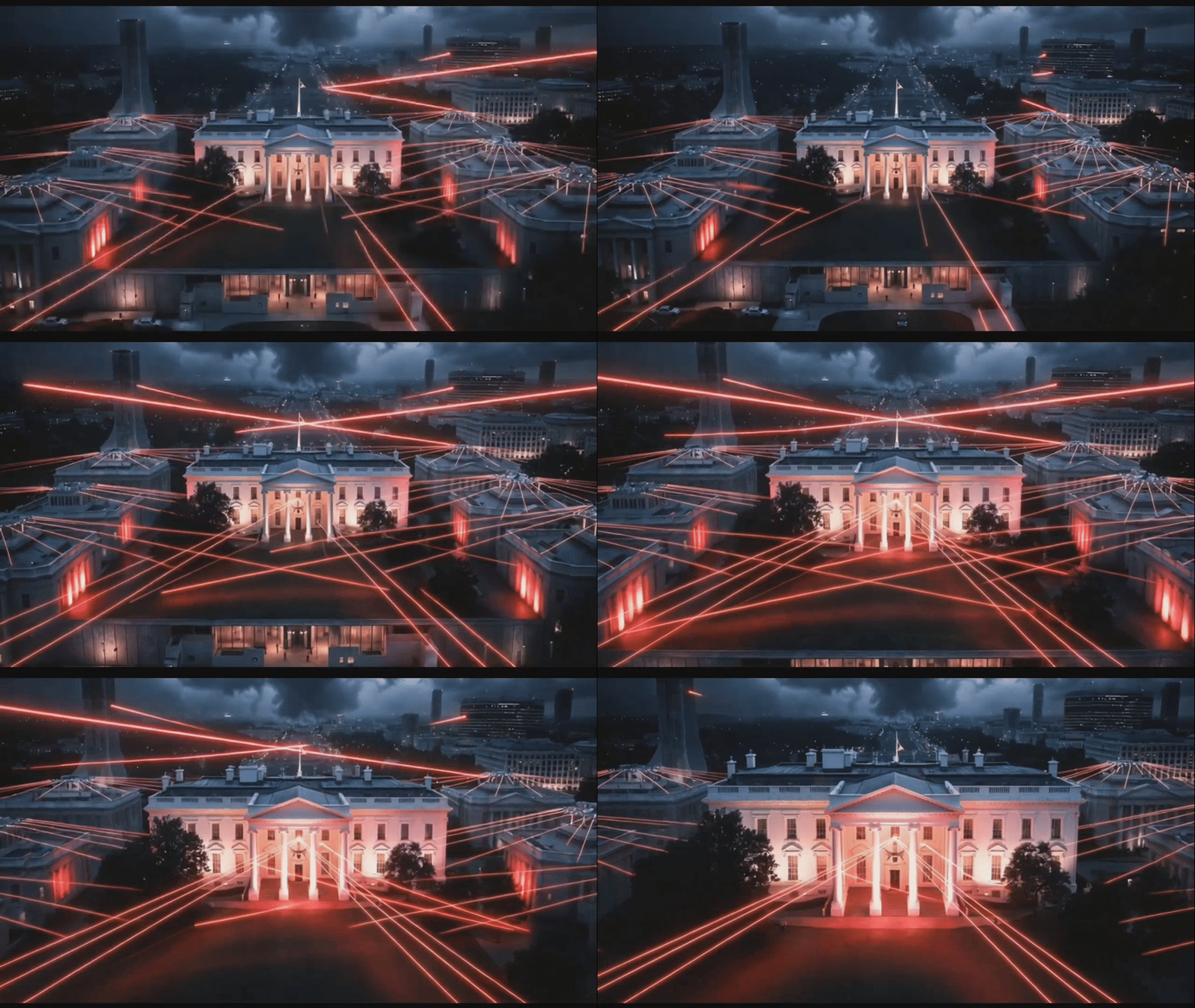
America cannot afford housing, childcare, functioning infrastructure, or public trust. But it can apparently afford a fortified ceremonial palace attached to a billion-dollar security expansion. Officially, the ballroom will be privately funded: a patriotic gift, a prestige project, a symbol of restoration. That story is technically accurate. It is also almost entirely beside the point.
That is the real story. Not “ballroom bad.” Not aesthetic outrage. Not another disposable cable-news cycle about gilt and optics. The story is structural: it is about where private influence and public power have stopped being distinguishable from each other — and about what that blurring has made normal.
The distinction between a private gift and a public security apparatus disappears when they share the same subterranean architecture. Follow the money, and you arrive somewhere considerably more significant than a ceremonial room.
Key Contradictions
Private funding↔public infrastructure
Democracy aesthetics↔monarchy optics
Public distrust↔fortress governance
Security necessity↔permanent escalation
Corporate donors↔regulatory dependence
The Compound Presidency
American presidents have always lived behind walls. But the nature of those walls — their purpose, their cost, their symbolism — has changed in ways that deserve serious accounting.
The modern security state around the presidency did not emerge from a single event or a single administration. It is the accumulated sedimentation of political violence, asymmetric threat, and institutional distrust: motorcades that grew longer, perimeters that expanded, underground facilities that multiplied. What was once a public house became a compound. What was once a compound is now, apparently, a hardened fortress requiring a billion dollars in further reinforcement.
The ballroom project matters precisely because it arrived at the end of that trajectory — not as an anomaly, but as its logical culmination. When you want to understand a system, look at what it builds when it has money and no one is watching closely.
The ballroom may function as a visible shell around a much larger security modernization project — prestige architecture layered over military infrastructure.
Political Violence and the Normalization of Escalation
Every major security expansion around the American presidency has a triggering event. Every triggering event is real. And every expansion outlasts the conditions that justified it, because bureaucratic infrastructure does not voluntarily contract.
The result is a ratchet: each threat expands the perimeter, increases the budget, deepens the subterranean footprint. Nothing removes it afterward. Temporary emergency infrastructure has become one of the permanent architectural styles of modern governance. So what you are looking at, when you look at a billion-dollar security funding request attached to a ballroom, is not a single decision. It is forty years of ratchet clicks — rendered visible in one line item.
The reported security additions include drone defense, chemical detection, aerial threat mitigation, and advanced subterranean facilities. These are not frivolous. The threats they address are documented. But their attachment to a privately-funded prestige ballroom is where the story becomes interesting — because it obscures the accountability question entirely. The optics of private donation absorb the political heat that billion-dollar public security expenditure would otherwise generate.
The Donor Ecosystem
Consider who reportedly wrote checks.

This is not a random cross-section of American commerce. This is a near-comprehensive list of the corporations with the largest active federal interests: defense contractors, technology platforms operating under ongoing regulatory scrutiny, financial institutions, and the dominant players in AI infrastructure — an industry whose regulatory fate is being decided in Washington right now.
The White House reportedly disclosed some donors while criticism emerged around anonymity, undisclosed amounts, and the structural conflict of interest embedded in the arrangement. But the conflict is not incidental to the story — it is the story.
Many of the corporations reportedly donating to the project are simultaneously seeking favorable outcomes from the very government complex they are helping modernize: AI regulation, antitrust scrutiny, defense contracts, surveillance partnerships, energy policy, tax structures, cryptocurrency regulation, cloud infrastructure procurement, and national security integration. This is not a list of unrelated concerns. It is the entire surface area of federal power over the technology and finance economy — and every corporation on the donor list has active skin in at least one of those decisions.
America increasingly operates through public-private influence ecosystems rather than clean institutional boundaries. The donation framework is not corruption in the classic sense. It is something more insidious: the normalization of structural dependency between state and corporate power, visible enough to be defensible, opaque enough to be unaccountable.
Public Trust Collapse and Fortress Governance
Most Americans will never see the inside of this ballroom. Many will never get within a quarter mile of the security perimeter surrounding it. But they will pay for the world it represents every single day: longer institutional distance, higher distrust, greater surveillance, more inaccessible leadership, and a political class increasingly insulated from the lived conditions of the people beneath it. The fortress is not a metaphor for something they feel. It is the thing itself.
There is a feedback loop operating here that is worth naming explicitly. As institutional trust declines, political leaders increasingly govern from fortified positions — physically, rhetorically, and architecturally. As they govern from fortified positions, the distance between the governed and the government increases. As the distance increases, trust declines further.
The fortress is both symptom and cause. The ballroom represents its most visible expression: a room designed for public-facing ceremonial use, built inside a compound that is progressively closing itself off from the public it nominally serves, funded by the corporate class with the most to gain from proximity to power.
This is not a partisan observation. The trajectory predates this administration and will outlast it. The question is whether the public ever develops the institutional vocabulary to describe what has happened — or whether the normalization is already complete.
The question is not whether the threats are real. They are. The question is who benefits from conflating security infrastructure with private donor spectacle — and why that conflation is being allowed to stand
.The Monarchy Optics Problem
Modern American political power increasingly resembles a monarchy in its aesthetic logic, even as it maintains the procedural vocabulary of a republic. The compound. The ceremony. The donor class with privileged access. The legacy architecture commissioned in one’s own name. The security apparatus that renders the leader physically inaccessible to the people who ostensibly elected them.
The ballroom is, in this reading, less a functional amenity and more a signal — an architectural statement about what kind of power is being exercised, by whom, and for whose benefit. Monarchs built grand rooms. Not because they needed the space. Because the room communicated something about the permanence of the regime.
American democratic culture has historically resisted that logic, or at least maintained the performance of resisting it. What the ballroom project suggests is that the resistance is becoming harder to sustain — and that the donor class has decided it no longer needs to.
The ballroom will get built. The security infrastructure will be funded, one way or another. The donors will retain their access. The stories will be told about restoration and patriotism and the grandeur of the American project.
What will not be told — unless someone insists on telling it — is the structural story: how a nation that cannot fund its schools built a fortified ceremonial hall with corporate money, attached it to a billion-dollar security apparatus, and called the whole thing a gift.
That is the story. Everything else is décor.
© 2026 Rxan Smith: Uncomfortable · The Epilogue
uncomfortable.rxansmithmedia.com · Rxan Smith


