

The Great American Dine & Dash (aka the U.S. National Debt)
We want the empire. We want the safety net. We want the Cayman Islands tax code. And we’ve decided our grandchildren will pick up the check. Welcome to $40 Trillion of regular white & blue denial

Uncomfortable
Equal-opportunity discomfort since the republic started charging us for it.
Fiscal Reality · Long Read | @RxanSmith | Uncomfortable | April 14, 2026
The $39 Trillion Illusion
There is a clock.
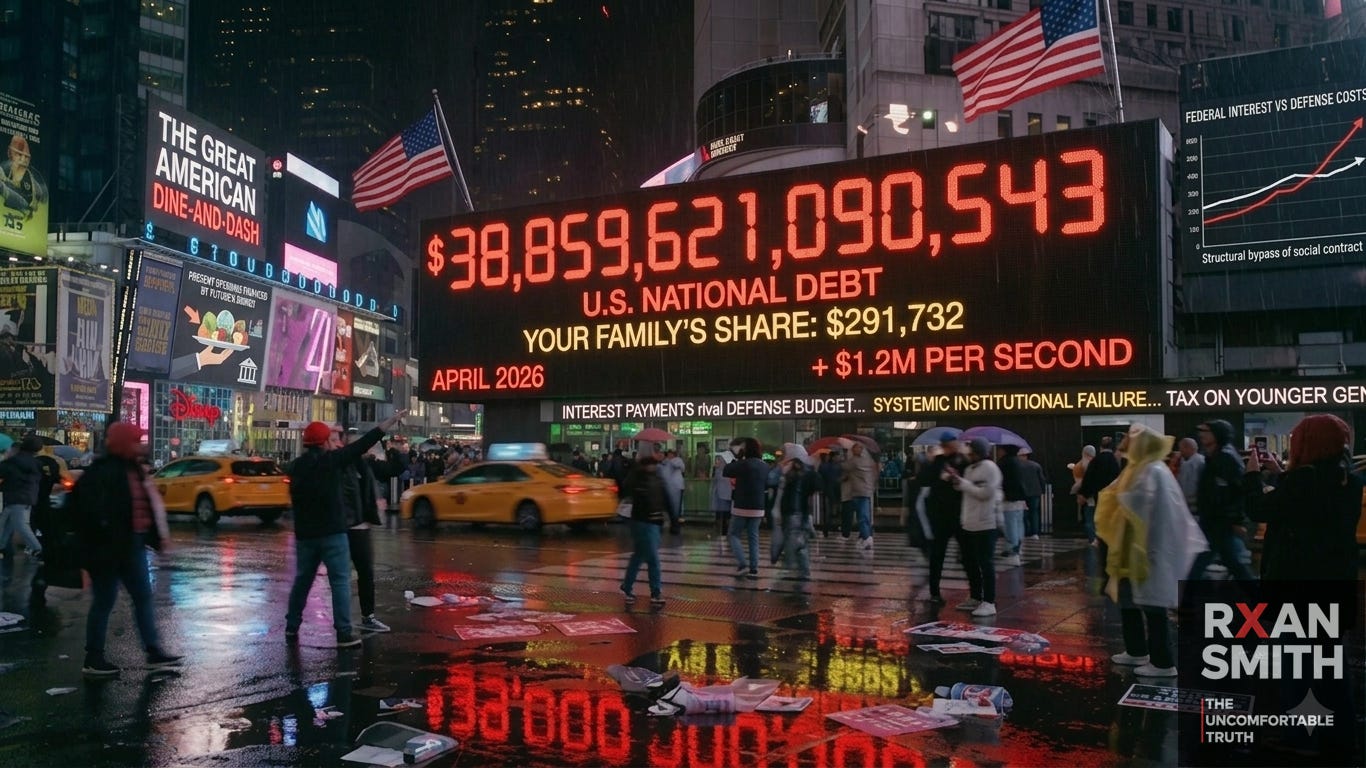
You’ve seen it. Hanging in Midtown Manhattan, flipping digits fast enough to give a finance major a panic attack. Politicians roll it out at press conferences. Cable news points at it like it’s the countdown to Armageddon.
And Americans stare at it the way dogs stare at ceiling fans — vaguely threatened, deeply confused, and completely unsure what to do about it.
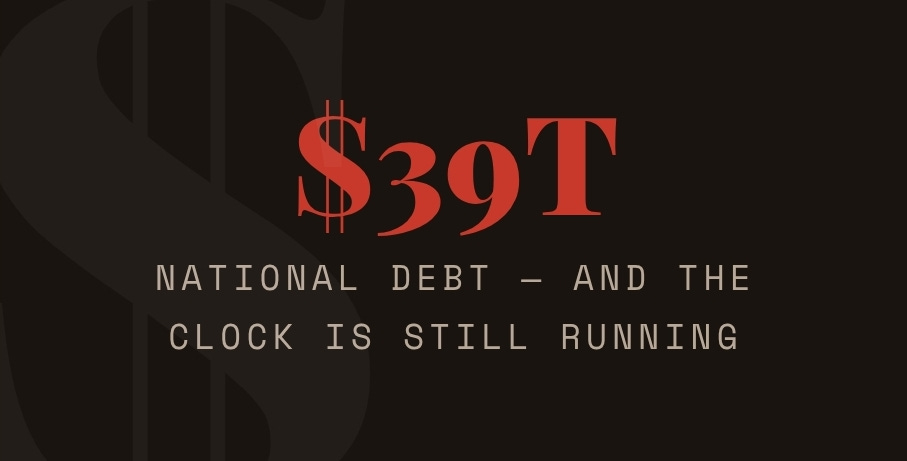
The National Debt Clock hit $39 trillion on March 17, 2026
.
That number is real.
What it means? That’s the part nobody explains honestly, because the honest version makes everyone in Washington look like a getaway driver who stopped for gas mid-heist.
Here’s the truth:
If we had $39 trillion in debt, $100 trillion in productive growth, and near-zero interest rates, we’d be in uncomfortable-but-manageable territory.
But that’s not the situation.
The engine is on fire.
The dashboard is sponsored by the people who built the engine.
And we’re arguing about whether the fuzzy dice are a cultural issue.
“We are not arguing about the size of the pile. We are arguing about the odometer while the engine is on fire — and the interest on our roadside assistance just hit $1 trillion a year.”
— Rxan Smith, Uncomfortable
The debt isn’t a math problem.
It never was.
It’s a structural bypass of the American social contract — a system where:
Politicians deliver benefits today
Send the bill to the future
Then run for reelection before it arrives
This isn’t incompetence.
It’s design.
The people running it understand exactly what they’re doing.
The only people not in on the joke are the ones expected to pay for it.
Keep Reading Inside Uncomfortable
If this section hit, don’t pretend it didn’t. Keep going:
Or skip the polite reading order and go straight to the deeper breakdowns:
@RxanSmith Substack (Full archive)
👉 https://buymeacoffee.com/rxansmith (Support the work)
Equal-opportunity discomfort since the republic started charging interest for it.
America Isn’t Broke, It’s Addicted
Let’s drop the polite fiction.
There is no reasonable middle ground being blocked by partisan dysfunction. There’s no secret compromise waiting in a committee room somewhere.
The truth is simpler. And worse.
We want three things:
A Scandinavian social safety net
A Roman Empire military
A Cayman Islands tax code
Those three things cannot coexist in any functioning fiscal universe.
And yet, for the last sixty years, we’ve been trying to have all three — and charging the difference to a credit card that doesn’t belong to us.
The debt isn’t government malpractice.
It’s a receipt.
A running total of national habits we refuse to break, because breaking habits requires pain — and in a democracy, pain is political suicide.
You don’t win elections by promising people less for more.
You win by handing out appetizers, calling it dinner, and slipping out before the bill hits the table.
Let’s translate the numbers into something less abstract:
That $39 trillion?
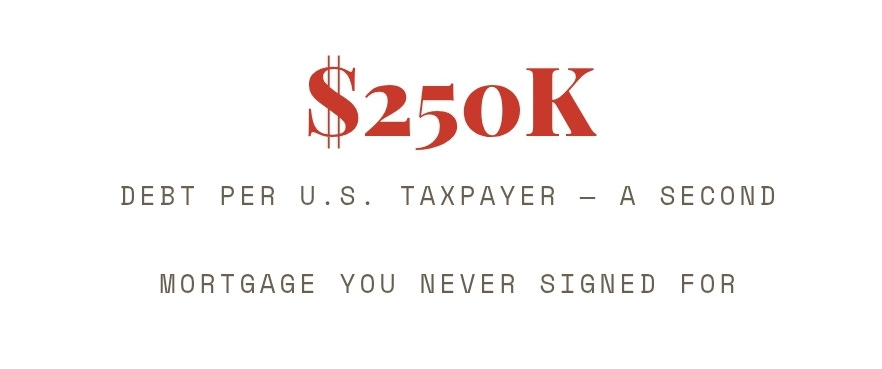
→ Roughly $250,000 per U.S. taxpayerAnnual interest payments?
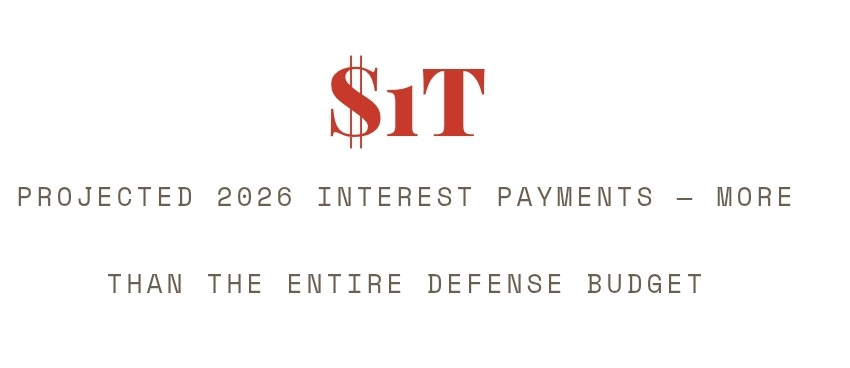
→ Closing in on $1 trillion per year
We are now spending more money servicing debt than we are funding entire pillars of government.
And still pretending this is sustainable.
Republicans call it freedom when they cut revenue.
Democrats call it compassion when they expand spending.
Both are allergic to the only tool that actually works:
Pain.
Real, shared, politically survivable pain.
And because neither side will touch it, they’ve quietly agreed on something they’ll never say out loud:
Borrow forever.
Blame the other side.
Let the future deal with it.
That “future”?
That’s us.
We are not waiting for the consequences anymore.
We’re living inside them.
And the math has started to bite.
The Silent Cosigner
That $39 trillion?
That’s not “government debt” in some abstract, harmless sense — like saying the city has a pothole problem.
That’s your liability.
About $250,000 per taxpayer.
A second mortgage on a house you don’t own, for renovations you didn’t approve, taken out by people who won’t be around when the foundation cracks.
You didn’t sign the paperwork.
Doesn’t matter.
You’re still on the hook.
You are the silent cosigner on a loan you never agreed to take.
And the lender?
A mix of foreign governments, institutional investors, and financial entities that expect to be paid — with interest — regardless of how uncomfortable that becomes.
We love to romanticize the Founders — selectively, of course — but there’s one thing they were absolutely unhinged about:
Taxation without representation.
It was worth a revolution.
What we’ve built is arguably worse:
Liability without representation.
We are binding the labor, wages, and future productivity of people who:
Cannot vote
Cannot object
And may not even be born yet
…to cover decisions they had no voice in.
“This is taxation without representation for the 21st century.
Except instead of tea in a harbor, it’s $39 trillion in compounding interest — and the people getting the bill weren’t born when the balance started.”
— Rxan Smith, Uncomfortable
This isn’t partisan.
That’s what makes it dangerous.
The debt expanded under Reagan
Accelerated under Bush
Continued through Obama
Surged under Trump’s tax cuts
Exploded during COVID under both parties
And hasn’t meaningfully slowed since
This is not a story of one party failing.
It’s a system producing exactly what it was designed to produce.
There is no villain to vote out.
No single policy to reverse.
No election that magically resets the balance sheet.
There is only a structure that:
Rewards short-term benefit
Punishes long-term responsibility
And quietly assigns the cost to people who aren’t in the room
And that’s the part people don’t like to sit with.
Because once you understand it, you lose the comfort of blaming “the other side.”
You realize something worse:
The system isn’t broken.
It’s working.

The Interest Trap
This is where it stops being theoretical.
This is where it gets… ugly.
Not “think tank report” ugly.
Actually ugly.
The kind of ugly where, if you explain it at a dinner table, people stop eating.
In just the first six months of fiscal year 2026, the U.S. government spent:
→ $529 billion on interest payments alone
That’s about:
→ $88 billion per month
Not on defense.
Not on infrastructure.
Not on education.
Just… interest.
Let that sink in for a second.
We are spending more money servicing past decisions than we are investing in future ones.
And it’s accelerating.
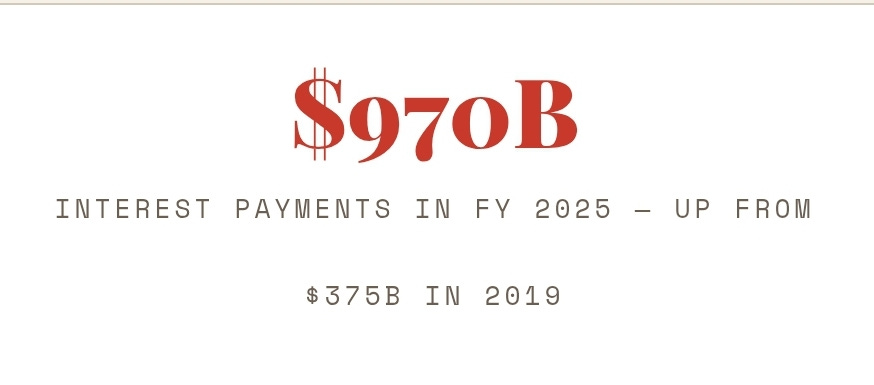
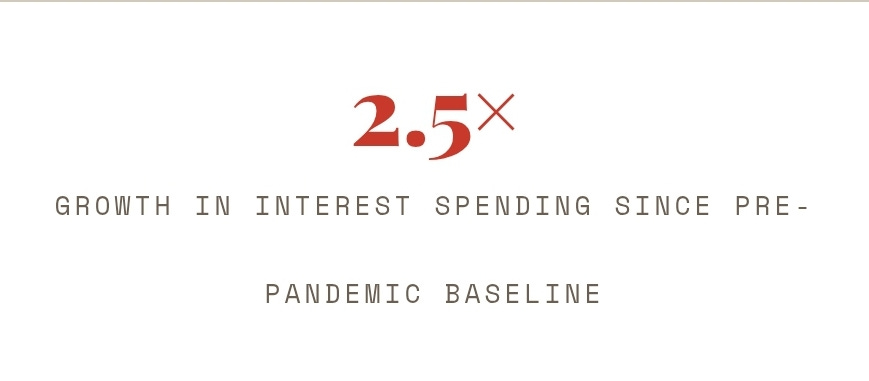
$970 billion in interest in 2025
Projected to exceed $1 trillion in 2026
Rising year after year, with no structural slowdown
At this pace, interest is becoming one of the largest line items in the federal budget.
It has already overtaken major spending categories.
It’s on track to consume a larger share of federal spending than at almost any point in modern history.
Let’s translate that into something less polite:
We are paying more to not pay our bills
than we are to fund core functions of the country.
“We’ve reached the payday loan stage of empire — borrowing money to pay interest on money we borrowed to fund programs that assumed growth we never delivered.”
— Rxan Smith, Uncomfortable
This is the part where the metaphor stops being a metaphor.
We are effectively:
Financing one credit card with another
Paying interest with borrowed money
Betting that future growth will outrun compounding reality
That’s not strategy.
That’s dependency.
And here’s the real problem:
Interest doesn’t negotiate.
It doesn’t care about elections.
It doesn’t respond to messaging.
It doesn’t wait for bipartisan consensus.
It compounds.
Relentlessly.
Every dollar spent on interest is a dollar that cannot be spent anywhere else.
Which means, over time, the government loses flexibility.
Then it loses options.
Then it loses control.
And once that happens, the decisions stop being political.
They become forced.
Interest is the part of the bill you don’t get to argue about.
Deficits, Delusion, and Denial
So why doesn’t anyone fix this?
Because fixing it requires a politician to stand in front of voters and say:
“We need to raise your taxes and cut the programs you like.”
That sentence is political suicide.
Not metaphorically.
Historically.
There is no version of fiscal responsibility that wins applause in real time.
There never has been.
Because the actual solution is painfully simple:
Take more in
Spend less out
Do both at the same time
And do it in a way that people can feel.
Fiscal responsibility is the broccoli of public policy.
Everyone agrees it’s good for you.
No one orders it voluntarily.
And any politician who builds a menu around it gets voted out before dessert.
So instead of solving the problem, we perform concern about it.
We get:
Debt ceiling standoffs that end exactly the same way every time
Floor speeches about responsibility followed by votes for more spending
“Fiscal hawks” who appear on schedule and disappear on impact
It’s not dysfunction.
It’s choreography.
Republicans sell tax cuts as freedom.
Democrats sell spending increases as investment.
Both arguments contain just enough truth to be defensible.
And nowhere near enough honesty to be complete.
Because the part left out is the only part that matters:
Someone has to pay for it.
And the person who tells voters that directly?
Doesn’t stay in office.
“Democracy isn’t failing here. It’s functioning exactly as designed — selecting against anyone willing to tell the truth about what this costs.”
— Rxan Smith, Uncomfortable
This is the uncomfortable reality:
The system is not broken.
It is optimized.
Optimized for:
Short-term reward
Long-term avoidance
Maximum political survival
Economists across the spectrum already know what the fix looks like.
It’s not mysterious.
It’s not hidden.
It’s just… untouchable.
Some combination of:
Raising revenue in ways voters will feel
Slowing spending growth in areas voters care about
Restructuring long-term obligations
Building automatic triggers that force correction when debt crosses certain thresholds
None of this is radical.
All of it is politically toxic.
Because it requires something the system does not reward:
Honesty about tradeoffs.
So instead, we get delay.
We get messaging.
We get narratives designed to make each side feel like they’re right and someone else is responsible.
And while we argue about who’s to blame…
The math keeps moving.
The truth isn’t hidden. It’s just politically unviable..
And Finally…
Stop calling it the “National Debt.”
That name is doing a lot of public relations work.
It sounds civic.
Shared.
Almost patriotic.
Like something we all stand for.
Call it what it actually is:
The Great American Dine-and-Dash
Because that’s the move.
We ordered everything:
The world-class military
The full social safety net
The tax structure that pretends neither has to be paid for
We ate the appetizers.
The entrées.
Dessert.
And now we’re slipping out the back…
…while assigning the bill to a table that hasn’t even sat down yet.
I get it.
Debt is boring.
Fiscal policy is where attention spans go to die.
But that boredom?
That’s not accidental.
It’s functional.
We stopped paying attention decades ago.
The people who needed us to stop noticed immediately.
And they’ve been moving at full speed ever since.
For years, we’ve been living like a rock band with a stolen credit card:
Blow things up with military spending
Patch ourselves back together with social programs
And pay for it with money we don’t have
And the politicians?
They’re not irrational.
They’re responding perfectly to incentives.
They’re the bartender who keeps pouring drinks for someone already crying into their glass…
…because the card hasn’t declined yet.
And election day is still months away.
Republicans sell you tax cuts.
Translation:
We’ll leave the tip for the next generation.
Democrats sell you new spending.
Translation:
The appetizers are on the house — and by “house,” we mean your grandchildren.
Both will stand at a microphone and blame the other side.
Neither plans to pay the bill.
We’ve built a system where every path leads to the same ending:
Borrow more.
Delay consequences.
Repeat.
And now we’ve crossed the line where:
We are spending more money to not pay our bills
than we are to protect ourselves from the people we owe the money to.
That’s not a superpower.
That’s a guy juggling credit cards in a dark basement, hoping the repo man knocks on someone else’s door first.
So here’s the reality:
We can keep doing this.
Keep the speeches.
Keep the blame.
Keep the illusion.
Or—
We can act like adults.
Cut things we like
Tax things that should be taxed
Build automatic constraints so this can’t keep happening
And admit the truth:
We are currently taxing future labor to fund present comfort.
And the people doing that future labor…
Have no vote.
No say.
No escape.
If we’re not going to fix it — and statistically, we’re not — then at least be honest about it.
Change the motto on the dollar bill:
From “In God We Trust”
To:
“Check, Please.”
I’m Rxan Smith.
I run Uncomfortable — for the uncomfortable reason that the truth doesn’t care what team you’re on.
And no…
I’m not picking up the tab either.
We all enjoyed the meal. That doesn’t mean someone else should get the bill.
— Rxan Smith · rxansmith.substack.com · Support the work
Further Reading — Top Substack Voices Covering This.
Slow Boring · Top 10 US Politics Paid Slow Boring — Matt Yglesias — The go-to for wonkish, numbers-driven policy analysis on why fiscal reform doesn’t happen. His “political economy of bad decisions” framing maps cleanly onto every section above.
The Signorile Report · Rising US Politics The Signorile Report: Michelangelo Signorile: Rapidly growing political commentary cutting through partisan noise. Currently trending in the Rising category.
Status Kuo · Rising US Politics Status Kuo, Daniel Jang: Political and legal analysis with a dose of clarity in chaotic times. Rising fast for accessible takes on structural failure.
Unprecedented · Rising US Politics Unprecedented: Joyce Vance: Former U.S. Attorney providing legal and political accountability analysis. Among the fastest-growing voices in the rising tier for coverage of institutional breakdown.
More from the Archive
These pieces explore the same systems of hidden incentives, economic pain, and political theater that keep the debt machine running.
Government Transparency Is a Myth
Why real accountability stays hidden — and how the same mechanisms that obscure secrets also protect the debt lie.
Why Government Transparency Is a Myth: The Hidden Secrets They Don't Want You to Know

The system isn’t broken because it’s secretive. It’s secretive because it’s working exactly as designed — for everyone but you. - Rxan Smith
Uncomfortable America: 25 Hard Truths
The systems driving economic reality (and why “decline” narratives miss the deeper structural problems).

How Our Misplaced Outrage on the Left Elected Trump — Again

I updated February 2026. Originally published 2025. Same thesis. More receipts.
RXAN SMITH: UNCOMFORTABLE
Independent. Non-partisan. Structurally argued.
rxansmith.substack.com | buymeacoffee.com/rxansmith | paypal.me/phireballsports
IF THIS HIT — SHARE IT. IF IT DIDN’T — ARGUE WITH IT.
EITHER WAY, THAT’S THE POINT.