


Rxan Smith · Uncomfortable · Reader Ballot Result

Eight months ago I told you: “America doesn’t have a left problem or a right problem. America has a structural problem.”
Twenty-five episodes later, I had a book. Twenty-five changes that would help the most people in the biggest ways - if you could actually build them.
That’s the catch. Most of them cost money. Transparency was number one. Tax reform was number two, and I made the case that those two could theoretically help fund a chunk of the rest.
Not all of it. Not even close.
With Value Added Tax (VAT) Implementation that's half the average rate of Europe, we'd come close to healthcare - but with the pricing structure we have now, fixing it the way the book proposed runs somewhere around $30 trillion over ten years. That’s not a rounding error. That’s the number that turns “idealistic” into “dead before reaching committee hearing.”
So a few weeks ago, I tried something different. I handed you fourteen candidates and asked you to help write chapter twenty-six — not more idealism, but representational reforms that cost $0, change everything, and make politicians on both sides of the aisle beg for the next question.
You didn’t just vote. You argued. Some of you cited case law. One of you cited Donald Trump as Exhibit A for conflict of interest, which - fair. I read every ranked comment personally, over three weeks, and it forced me to do something I don’t usually do in public: show my work in real time, the same way I ask you to show yours.
Here’s how I counted it, so you can check my math.
The scoring: every ranked comment got weighted — 5 points for a #1 pick, down to 1 point for #5. No favorites. No editorial thumb on the scale. Just the math.
And before anyone asks — yes, every vote counted here came from a real person who took the exercise seriously enough to rank, not just react.
Thank you to everyone below — in the comments, and scattered through the Notes on this publication — who dropped a ballot, or just added real thinking to the question underneath all of this: what would actually change this country.
Hendu Hammer · Claire Clelland · Ed Smith · David Karr · Terry Bruno · Steven Erick · Patti Lee · Dee The Unwavering · James (HVR) · Lauren Luber · Lincoln Media Group Robert N Abernethy Fritz DeKatt Liz LaSorte
This piece exists because you did the work.
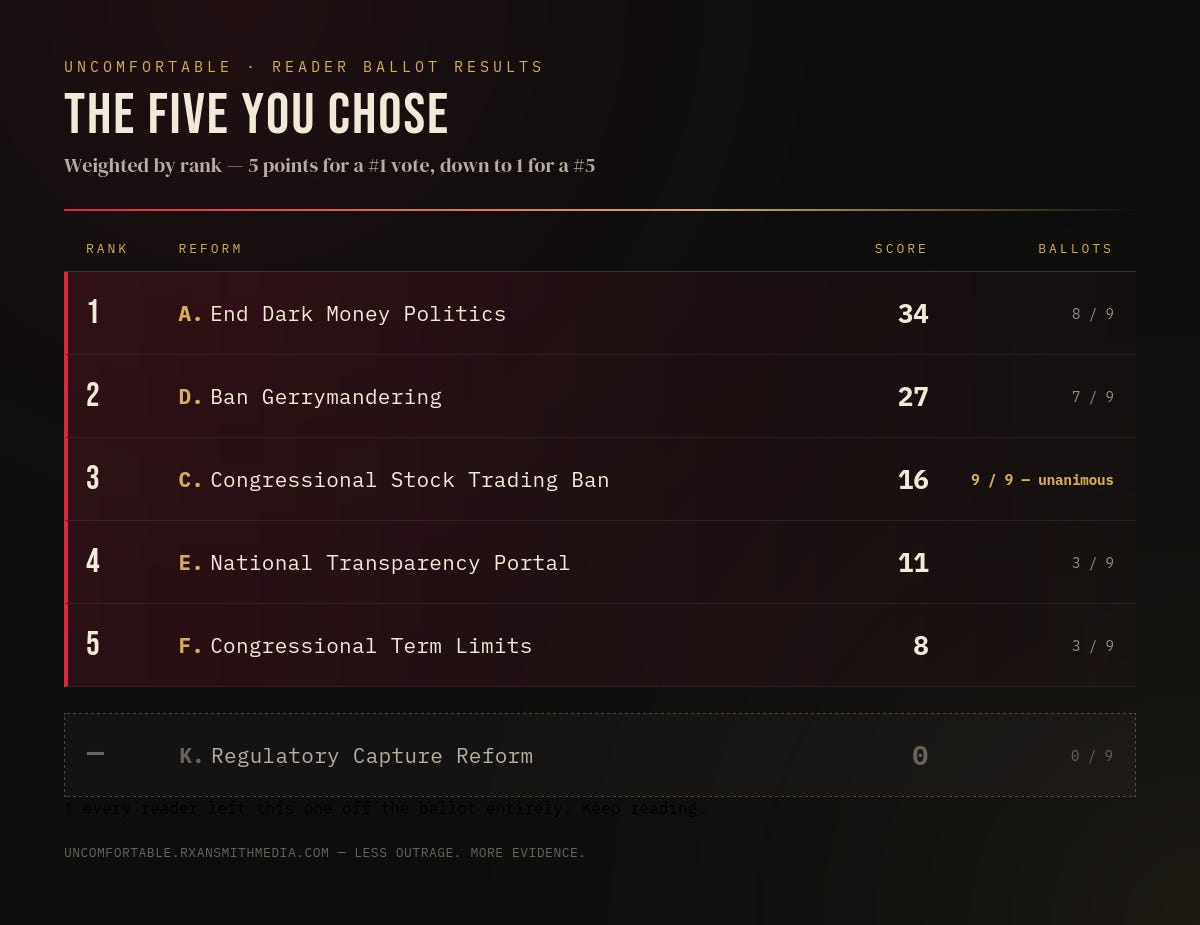
Five reforms separated themselves from the pack. Here they are, in your words.
1. END DARK MONEY POLITICS
Nearly everyone who voted put this in their top two. Ed Smith put it bluntly: the problem isn’t policy, it’s the infrastructure both parties built underneath policy — and Citizens United sits at the foundation of that infrastructure. The Unwavering framed it as part of a bigger diagnosis: dark money, Pentagon opacity, stock trading, gerrymandering, transparency failures — all different symptoms of the same disease, institutions that have learned to protect themselves from the public instead of serving it.
Nobody in the comments disagreed with that framing. They just disagreed on which symptom to treat first. You told me: treat this one first.
2. BAN GERRYMANDERING
Steven Erick made the sharpest version of this case: confine redistricting to census years, no exceptions, drawn by an impartial body, paired with an expanded House to actually improve representation instead of just reshuffling the same 435 seats. Ed Smith’s version was blunter — gerrymander every ten years, no exceptions, full stop.
Different levels of detail, same instinct: the election shouldn’t be decided before anyone votes.
3. CONGRESSIONAL STOCK TRADING BAN
This is the one nobody left off their ballot. Nine for nine. Not always ranked first — most of you put it fifth, the closer — but every single reader who voted included it. That’s rare. When a reform shows up on every ballot regardless of ideology or priority, that’s not enthusiasm, that’s consensus. Ed Smith’s line stuck with me: he’s sure we all know someone who traded on inside information and served time. Members of Congress, largely, have not.
4. NATIONAL TRANSPARENCY PORTAL
This one split the room in an interesting way — most readers ranked it low or left it off, but the two who included it put it first. Steven Erick’s case: transparency isn’t just one fix among fourteen, it’s the root cause underneath the other thirteen, because professional integrity is impossible to enforce on people you can’t see clearly. Claire Clelland made the same call independently, transparency portal at the top of her list.
Small group, strong conviction, good argument. That’s how it earned the fourth slot.
5. CONGRESSIONAL TERM LIMITS
The reform I was most surprised to see crack the top five, and the one I want to be honest with you about. Steven Erick’s case was that permanent incumbency breeds entitlement to serve. It’s a real argument, and readers clearly felt it.
Here’s the steelman for the other side, because I’d be lying to you if I left it out: some political science on term limits suggests they don’t reduce the power of money and lobbying, they just redirect it toward unelected staff and industry experts who become the only people in the building who know how anything actually works. Term limits might treat the symptom of career politicians while making the underlying capture problem worse, not better.
You voted for it anyway. I’m honoring the vote. But you should sit with that tension the same way I had to.
6? THE SIXTH ONE
Before I read a single reader comment, I ran this same ballot through my own analysis plus two additional, independent AI analysis engines… same fourteen reforms, same rules, no coordination between any of them. To keep this honest, I scored all three exactly the way I scored your ballots: 5 points for a model’s #1 pick, down to 1 point for its #5. No system got extra weight for being newer, longer, or more confident-sounding than the others.
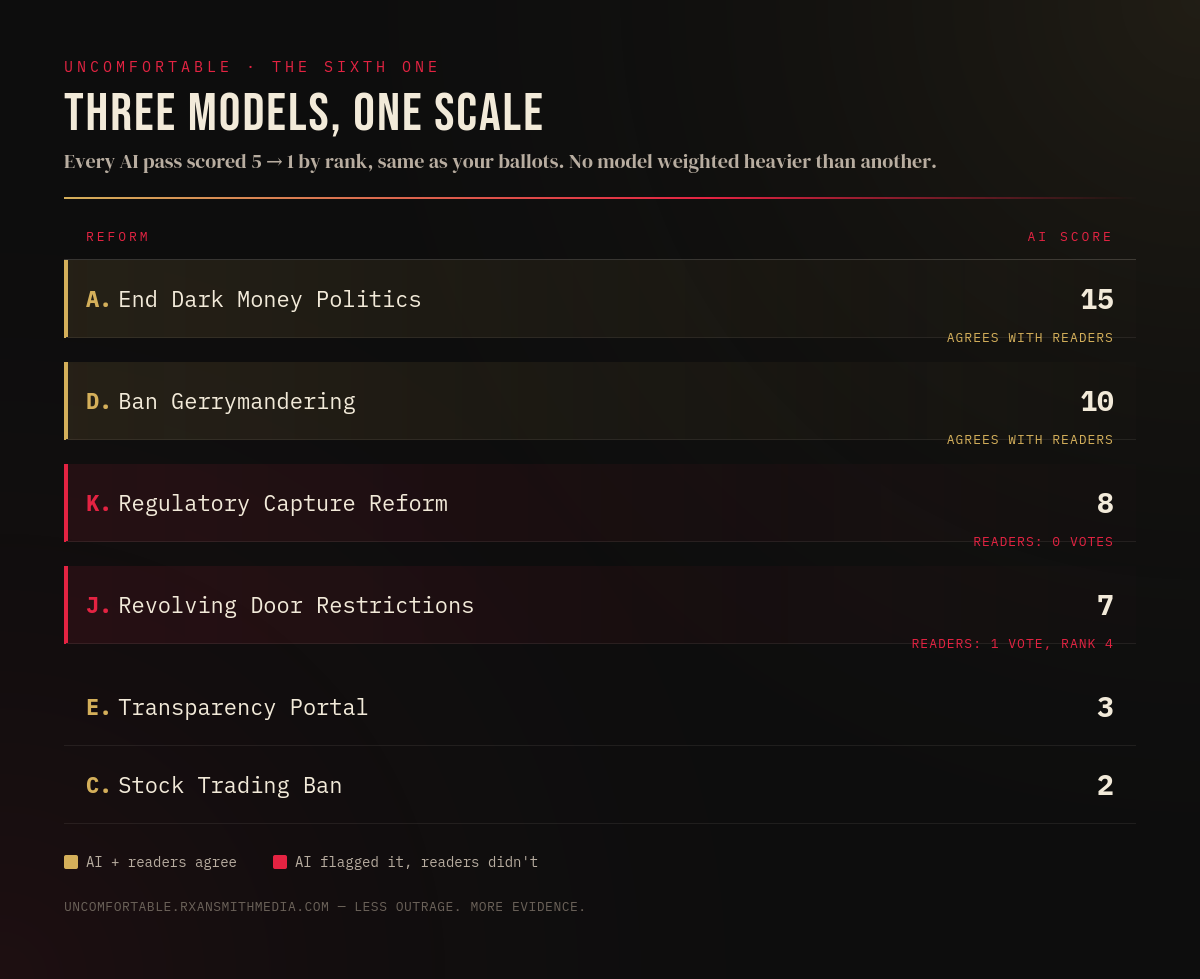
All three systems agreed on A and D immediately… same as you. But where your votes cooled on K and warmed toward E and F, all three AI passes did the exact opposite. That’s the gap this section is about.
REGULATORY CAPTURE REFORM.
Zero of you put it in your top five. Not one ballot.
I think I know why. Dark money and gerrymandering and stock trading bans are visible. You can picture the villain. Regulatory capture is quieter — it’s the FDA advisory panel with three former pharma executives on it, the FAA safety board staffed by ex-Boeing people, the bank regulator who used to work at the bank. It doesn’t have a face. It just has a body count you never connect to the cause.
Every independent model said this is one of the deepest problems on the ballot. Every reader said it’s the one they feel the least. Both things are true at once, and that gap is the whole reason this publication exists.
So I’m doing something I told you I wouldn’t do at the start of this. I’m adding a sixth.
Five, because you voted. A sixth, because the machine doesn’t stop being real just because nobody can see it.
K. Regulatory Capture Reform joins the next five episodes.
The Declaration isn’t finished. It never was going to be. You just proved that the argument works — that people who disagree about almost everything can still look at the same fourteen problems and mostly agree on which five are real.
That’s not a small thing. Don’t let anyone talk you out of noticing it.
- R❌AN SMITH


Thank you @QueenBonita !!!
Rxan, I too have gone back and forth on term limits, for the same reasons you mentioned. After fifty years of monitoring this fairly closely, I've come up with a radical solution I am sure everyone sane will disagree with. Which makes me like it even more.
Put a five year cap on every government job, elected or otherwise. All branches of government. Judges, Senators, Janitors, Presidents, Typists.
More people get to serve, learn how the government works. People in government get a chance to feel the pinch in their pocketbooks every time they see a budget increase. Power and information on every level can't be centralized and controlled for over five years.
This is the part most people would totally disagree with: Total transparency. Every visit by a corporate constituent, every expense, every vacation. This would include the military and intelligence departments. If you want to argue it would make their jobs harder, that's exactly the point. They've had a literal free ride since the end of World War Two. If they had to start reporting what they were doing and spending, we'd have a lot less of them working a lot more efficiently in a massive hurry. And what about the Chinese finding out what we're doing? Well, we'd have a lot less trouble with China and our other adversaries if we didn't have hundreds of our own secret agencies poking and prodding them every day.
Anybody can get recalled by a one thousand citizen petition followed by a vote.
No primaries. I believe this is a good first step toward the end of the party system, which I think is even more important than all the rest of the items we just voted on. Even lobby money becomes way less important when no candidate can hide behind his party affiliation or expect a colleague's support just because of his party.
Thanks for including me in this poll.