
The Doom Generation
What Gen Z got right about the world... and what the algorithm taught them to get catastrophically wrong.
Rxan Smith Narrative vs. Reality #006
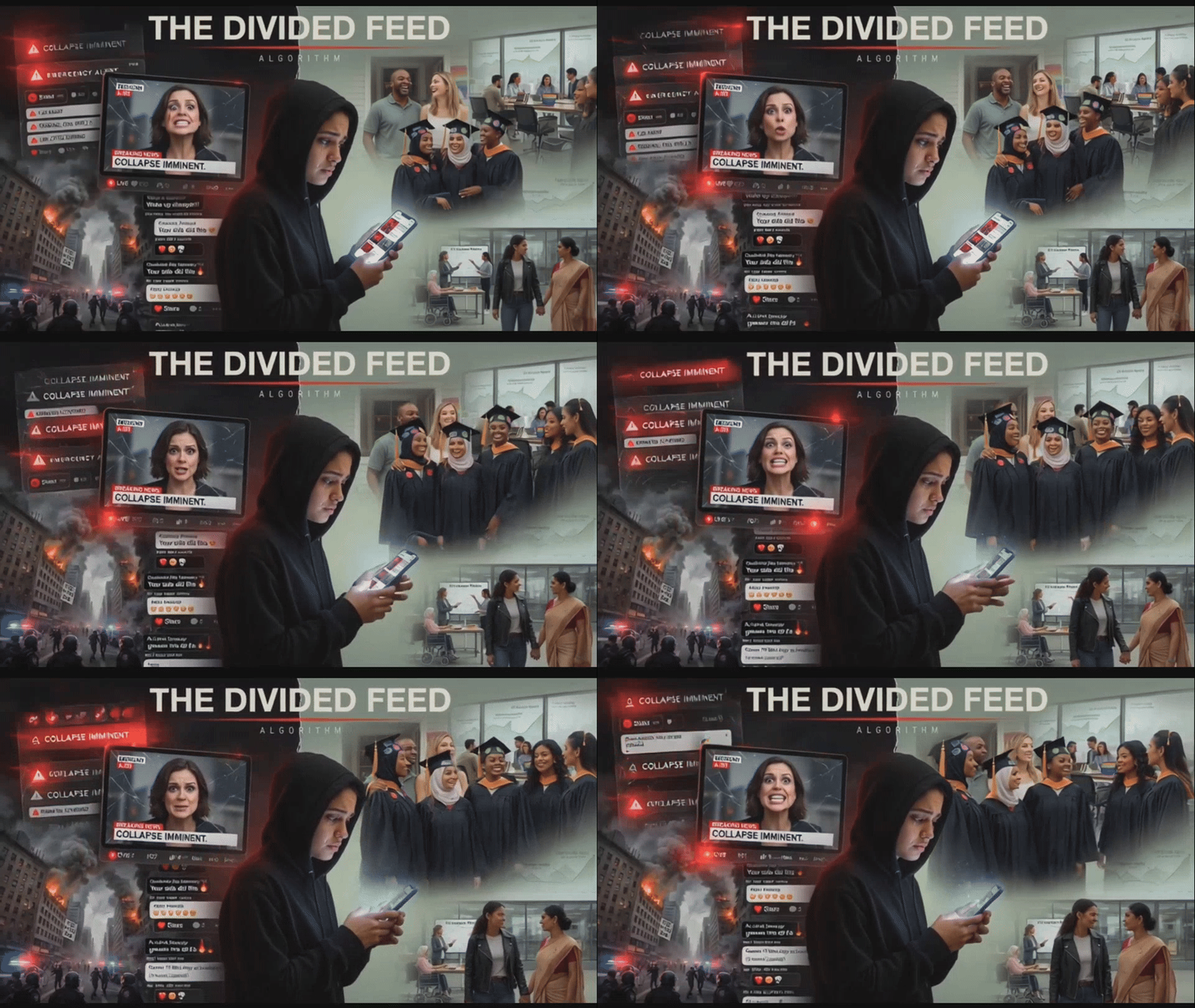
A generation raised on genuine injustice was handed a device that monetizes outrage and handed a culture that rewards victimhood… and we acted surprised when they concluded the world was ending. The problem is not their anger. Anger can be good. The problem is what was done with the anger.
This is not a conservative argument.
It is not a dismissal of real problems.
It is not a demand that anyone stop being angry.
It is not mistaking progress for completion.
It is something far more uncomfortable than that.
It is a factual correction delivered to a generation that was raised inside systems specifically designed to distrust factual corrections. A generation taught, by the platforms that shaped it, to interpret disagreement as invalidation… nuance as betrayal… and evidence that contradicts emotional consensus as a form of oppression.
The Data They Were Never Shown
Start with race, because it is the most charged terrain and therefore the most important place to be precise. The narrative that American racism is at a historic peak, or that it is worsening, is not supported by the longitudinal data. It is contradicted by it.
Interracial marriage, once illegal in seventeen states and opposed by the majority of Americans as recently as the 1990s, now commands approval rates above 90% across every age group. Explicit racial bias in survey data… including implicit association testing… has declined measurably over thirty years. The percentage of Americans who say they would not vote for a qualified Black presidential candidate has dropped from over 50% in 1960 to single digits. Black Americans hold more elected offices, corporate leadership positions, and academic appointments than at any prior point in recorded American history.
None of this means racism is gone.
None of it means the structural residue of centuries of policy discrimination has been resolved.
Both of those things can be true simultaneously: genuine remaining problems, embedded in a trajectory of genuine improvement. That nuance is not a concession to complacency. It is the only accurate description of reality.
The same pattern holds elsewhere. Hate crimes, while undeniably real, are reported at levels that, adjusted for population and increased reporting rates, do not represent a historic surge. LGBTQ+ acceptance among Americans under 40 is at levels that would have been unrecognizable to any prior generation. Gender pay gap numbers, while contested in their methodology, have narrowed consistently for fifty years. The child poverty rate, before recent policy reversals, hit historic lows.
The feed never showed them this. It showed the worst day, on loop, forever.
The response to tables like this, in certain spaces, IS VERY Easy to predict:
statistics are tools of oppression
data is weaponized by the comfortable to dismiss the real suffering of the marginalized
anyone citing improvement is complicit in erasure.
That response contains a critical structural flaw:
If no data can ever constitute evidence of progress, then the premise is unfalsifiable. An unfalsifiable premise is not a political position. It is a religion.
The Algorithm That Monetized Despair
Understanding why a well-educated, data-adjacent generation arrived at conclusions that often contradict longitudinal data requires understanding the information architecture they grew up inside.
This is not a character flaw. It is an engineering outcome.
Social media platforms optimized for engagement discovered something early and decisively:
Fear spreads faster than nuance.
Outrage outperforms relief.
Catastrophe holds attention longer than progress.
A post documenting improvement gets scrolled past.
A post documenting injustice gets shared, commented on, amplified, algorithmically rewarded.
The algorithm is a non-neutral is a machine that systematically selects for the most emotionally destabilizing version of reality and surfaces it preferentially… because it is most profitable, not the most representative.
Gen Z grew up entirely inside this architecture and did not experience news as a filtered but broadly representative sample of events. They experienced it as a curated highlight reel of the worst things happening anywhere, at any time, delivered through an infinite scroll optimized for the neurological vulnerabilities of a developing adolescent brain.
The result = a generation with genuine moral seriousness, paired with a systematically distorted picture of the world this seriousness is being applied to.
The anger Gen-Z feels is absolutely real, the object of their anger is a funhouse mirror.
And this is not a phenomenon unique to the left. The right built its own version. Earlier, in many ways:
The replacement theory ecosystem.
The manosphere collapse narrative.
The apocalyptic nationalist content machine.
The “great replacement” grievance pipeline that migrated from fringe forums to mainstream media ecosystems. Different branding. Same architecture. Essentially, a generation of young men was fed a steady diet of civilizational collapse content, demographic panic, and algorithmically reinforced paranoia about identifiable enemies supposedly responsible for their suffering.
The outrage machine does not check party registration. It finds the psychological vulnerability available… and monetizes it.
On the left, that vulnerability was often genuine historical injustice.
On the right, it was economic displacement, social alienation, and cultural destabilization.
Both were real. Both were captured. Both were amplified into unfalsifiable doom narratives by systems financially dependent on emotional escalation.
The thesis here is not that “the left is uniquely distorted.” The thesis is that outrage systems distort everyone. And the distortion follows the same predictable pattern regardless of ideology:
Real grievance.
Algorithmic amplification.
Identity attachment.
Emotional escalation.
Epistemic distortion.
Permanent catastrophe.
Grievance is real.
The infrastructure built on top of grievance produces the funhouse mirror.
The Identity Economy
The algorithmic distortion alone does not fully explain the phenomenon.
There is a second system operating in parallel: a cultural economy built around victimhood identity. It emerged inside progressive spaces over the past fifteen years and became absorbed, often without sufficient critical examination, into the political formation of a significant portion of Gen Z and young Millennials.
Within this economy:
suffering confers authority.
Trauma becomes social currency.
The severity of one’s oppression increasingly determines the legitimacy of one’s political claims.
And inside that framework, acknowledging progress becomes morally complicated. Not merely factually inconvenient. Morally dangerous.
Because progress threatens to devalue the currency on which political standing is increasingly built. Now, this distinction matters: This is not an argument that trauma is fake, that oppression is fake, or that people who experienced genuine injustice are wrong to name it. They are not.
The problem is the institutional infrastructure that formed around those genuine experiences.
Nonprofit fundraising mechanisms are downstream of perceived crisis.
Donations spike during emergency framing and flatten during periods of reported progress.
Academic social capital accrues to researchers who identify and define new categories of harm.
Media engagement algorithms reward outrage regardless of whether that outrage is calibrated proportionally to reality.
Political organizations build membership and fundraising pipelines through fear-based mobilization.
Independent creators build audiences by promising revelations that confirm the audience’s worst suspicions.
None of this requires conspiracy.
These are simply the logical outputs of the attention economy applied to political identity. And together, they create a system that rewards grievance amplification not as an aberration… but as a structural feature.
The stronger version of this critique is not:
“People enjoy victimhood.”
That version is lazy.
The stronger critique is this:
Systems reward grievance amplification because attention, legitimacy, funding, status, and institutional influence increasingly flow downstream of perceived crisis.
Most individuals inside these systems are not cynical actors. Most genuinely believe what they are saying. But the system selects for people who believe it most intensely… and then continuously shapes the information they receive to reinforce the belief.
What the economy rewards
Maximizing the severity of injustice. Rejecting evidence of progress. Expanding the category of harm. Centering identity as the primary unit of political analysis.
What it punishes
Acknowledging improvement. Distinguishing between structural and interpersonal harm. Holding complexity. Finding common ground across identity lines.
What it produces
A generation with genuine moral urgency, permanently attached to a narrative of irreversible catastrophe, with no framework for recognizing or building on progress.
Who benefits
Platforms. Advocacy organizations. Politicians whose power depends on maximized grievance. Publishers. The attention economy in its entirety.
The generation caught inside this system is not stupid. Many of them are among the most informed, most ethically serious young people America has produced. The tragedy is that their seriousness was captured by an algorithm and a cultural framework that neither of them chose. It was redirected away from the structural work of actually fixing things, toward the performative work of signaling how catastrophic everything is.
Catastrophism is not activism. Despair is not analysis. And the ability to celebrate a victory or to say “we moved the needle, here is the evidence, here is what came next,” is not complacency. It is the basic cognitive infrastructure required to sustain a movement across generations.
What the Doom Gets Right
This needs to be said clearly, because the argument so far is vulnerable to a specific and legitimate objection: some of the pessimism is rational.
Gen Z inherited a housing market that has effectively closed the path to ownership for anyone without significant family wealth. They came of age during a loneliness epidemic that is clinically measurable and worsening. They are navigating a labor market that has increasingly decoupled credential attainment from economic security. They are the first generation for whom social media was ambient from childhood, meaning the psychological damage of comparison architecture and infinite scroll was not chosen but simply atmospheric.
Climate anxiety is not irrational. It is a response to a real, documented, accelerating problem that every prior generation declined to solve. Economic insecurity is not a perception distortion either. Wages adjusted for housing costs have declined for young workers relative to where they stood for their parents at the same age.
The argument here is not that their instability is imaginary. The argument is more precise:
Material conditions and social trajectory narratives are different things, and conflating them produces errors in both directions.
You can be economically squeezed and politically misled simultaneously. You can face real hardship and still be fed a systematically distorted picture of whether that hardship is improving or worsening, whether it is shared or unique to your moment, whether the systems causing it have ever moved or whether they are permanently fixed.
The doom about the present can be partially right while the doom about the arc of history is demonstrably wrong.
That distinction is not a small one.
Why Celebrating Progress Is Not Surrender
There is a version of this argument that the left understood for a long time and has recently abandoned: naming victories is essential to sustaining the will to fight.
Every civil rights movement in history required its participants to believe change was possible because they had seen it happen. The March on Washington did not follow a decade of messaging insisting nothing had ever improved. It followed decades of local victories, small and large, that proved the system could be moved.
The current framework inverts that logic. It insists acknowledging progress is itself a threat to progress, that any positive data point will be weaponized as an excuse to stop.
This is psychologically understandable. It is also strategically catastrophic.
A movement that cannot tell its own members when something worked cannot learn from what worked. It cannot replicate it. It cannot build on it. It can only escalate the rhetoric of crisis. And crisis rhetoric, uncoupled from evidence, eventually produces one of two outcomes:
mass burnout
political overreach that invites backlash
Both have happened.
Both are happening now.
The willingness to say:
“This improved. Here is the data. Here is who made it happen. Here is what it cost.”
...is not a concession to the people who want to stop.
It is the foundation of a politics serious enough to continue.
What This Generation Deserves Instead
The argument here is not that Gen Z and young Millennials should be less angry, less politically engaged, or more comfortable with the status quo.
The argument is the opposite:
They deserve a more accurate picture of the world they are trying to change, because an accurate picture is what makes effective change possible.
They deserve to know the people who marched in Selma did not do so because they believed nothing had ever improved. They believed the opposite: that the arc existed, that it could be bent further, and that the bending required them specifically.
They were right.
And the evidence that they were right now exists in longitudinal surveys, legislative records, and public opinion data that a subsequent generation has been systematically prevented from absorbing.
They deserve a politics that treats them as agents of change rather than permanent victims of it.
Agency requires accurate information. It requires the cognitive ability to distinguish between:
“This is bad and must be fixed”
“This is the worst it has ever been and is getting worse”
Those are not the same sentence.
They have never been the same sentence.
Collapsing them, in the name of urgency, solidarity, or algorithmic engagement, is not a service to the people most affected by injustice. It is a disservice dressed up as allyship.
The doom scroll does not show you the world.
It shows you a curated exhibition of the world’s worst moments, stripped of context, stripped of trajectory, stripped of evidence that previous generations actually moved things.
That is the theft.
Not optimism. Optimism is optional.
The theft is information. Historical memory. The ability to know what worked so you can do more of it.
The cheap culture-war version of this argument is:
“Kids these days think everything is racist.”
That is not what this is.
This is a structural observation about what happens when a generation’s political formation is outsourced to algorithms designed to maximize emotional activation, combined with a cultural economy that rewards the performance of suffering more than the analysis of systems.
The answer is not to tell young people their anger is wrong.
The anger is frequently correct.
The answer is to give that anger accurate targets, historical context, and the cognitive tools to recognize a victory when it happens.
Because a movement that cannot recognize its own victories will eventually become incapable of producing them.
Progress is not the enemy of urgency, rather the only evidence that urgency ever worked.
Key Contradictions
Moral seriousness↔ distorted information
Genuine injustice↔ catastrophist framing
Political engagement↔ unfalsifiable premises
Victimhood identity↔ agency and change
Algorithmic outrage↔ longitudinal reality
If this made you uncomfortable, good… it means that I did my job. Discomfort is not an evil feeling, rather the place we get when real discussions and real learning and real growth occur.
— Rxan
© 2026 Rxan Smith: Uncomfortable | rxansmith.substack.com · @RxannSmith


