⚡ Updated with confirmed reporting through early 2026
I wrote the first version of this piece the night of September 10, 2025, in a state of shock—like most Americans. I didn’t know much about Charlie Kirk beyond his headlines. I didn’t know who pulled the trigger. What I did know was that something had cracked, and I wanted to say so while the wound was fresh.
Now, months on, I’ve updated this with the facts as they have emerged: the suspect, the charges, the motive evidence, the political fallout, and the chilling pattern this event fits into. Kirk was a complicated figure—someone I disagreed with on much—but his murder was not an act of justice. It was an act of terror, and our response to it has been, in many ways, a disaster.
This is what I believe, still: that political violence belongs to no single side, that it corrodes democracy from the inside, and that we cannot grieve selectively. The bullet that killed Charlie Kirk was also a bullet aimed at the idea that we can disagree without destroying each other.
✦ ✦ ✦
What Actually Happened — The Confirmed Fact
s
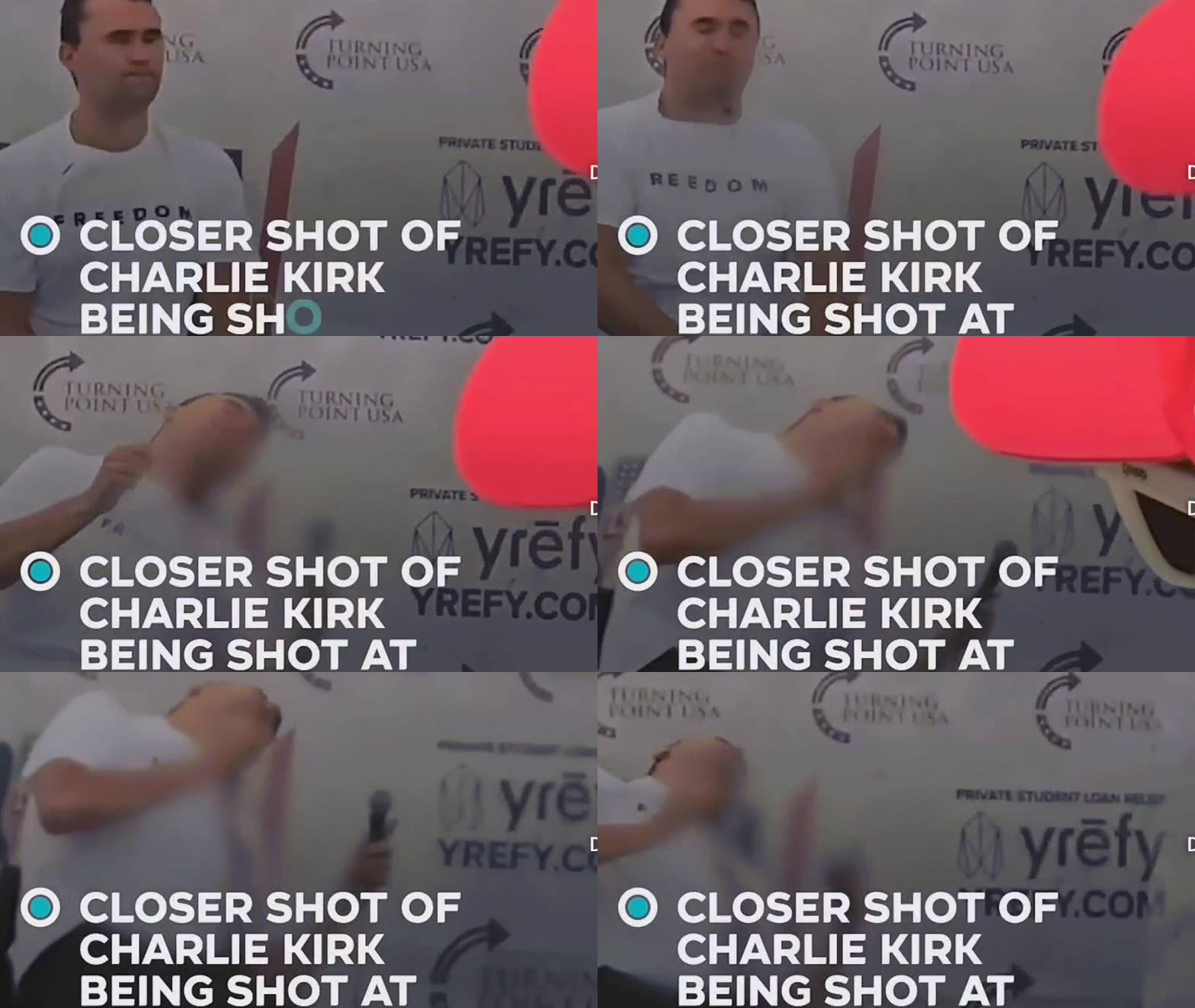
Shortly after noon on Wednesday, September 10, 2025, Charlie Kirk—31 years old, founder of Turning Point USA, close ally of President Donald Trump, and one of the most influential conservative voices of his generation—was answering a student’s question at an outdoor debate event at Utah Valley University in Orem, Utah. About 3,000 people were in attendance.
A single shot rang out. It had been fired from the rooftop of the Losee Center, a campus building approximately 175 yards away. The bullet struck Kirk in the neck. He collapsed. Chaos erupted. He was rushed to a nearby hospital and pronounced dead.
📋 Key Confirmed Facts
Kirk was 31 and a father of two young children, ages 1 and 3, when he died
He was fielding a question about mass shootings, gun violence, and transgender people when he was shot
The shooter fired from a rooftop, jumped off afterward, and fled — leaving a rifle hidden nearby
The FBI released surveillance footage of the shooter on September 11 and offered a $100,000 reward for information
Kirk’s death was not an isolated incident. As CNN documented, it followed a string of political violence in 2025 alone: the June assassination of Minnesota Democratic state Rep. Melissa Hortman and her husband; the May killing of two Israeli embassy staffers in Washington D.C.; and an arson attack on Pennsylvania Governor Josh Shapiro’s residence in April. It also followed two attempted assassinations of President Trump in 2024. According to University of Maryland terrorism researcher Michael Jensen, through the first half of 2025 alone, the U.S. saw roughly 150 politically motivated attacks — nearly twice the rate of the same period the year before.
🎥 Watch: PBS Washington Week Panel — “Kirk’s Assassination and Escalating Political Violence”
PBS Washington Week with The Atlantic panel discusses the assassination’s fallout and America’s escalating political violence. (Full episode at PBS.org)
✦
Who Did It: Tyler James Robinson
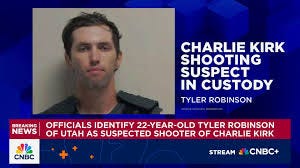
The manhunt ended the next day. On September 11, after his own parents recognized him from FBI surveillance images the bureau had released publicly, Tyler James Robinson, 22, of Washington, Utah, surrendered peacefully through a family friend—a retired sheriff’s deputy. Authorities described him as a high-achieving student who scored in the 99th percentile nationally on standardized tests and had once been a scholarship recipient. His neighbors described him as a “normal person.” His former classmates said he had once been a “diehard Trump” supporter.
Something changed. Over the course of roughly a year, according to his mother’s account to investigators, Robinson had drifted sharply leftward — becoming increasingly outspoken in support of gay and transgender rights, increasingly hostile to his conservative family’s politics, and increasingly absorbed in what Utah Governor Spencer Cox described as “deep, dark internet” spaces, including Reddit communities and other online forums. His father and he had grown bitterly estranged over politics.
Sept. 10Kirk assassinated at UVU. Robinson flees, hides rifle in bushes, texts his partner a confession on Discord.
Sept. 11FBI releases shooter footage; Robinson’s parents recognize their son and help facilitate his peaceful surrender to U.S. Marshals.
Sept. 16Charges filed: aggravated murder, felony use of firearm, obstruction of justice, witness tampering. Death penalty sought.
Early 2026Judge clears path for death penalty after rejecting defense’s conflict-of-interest motion.
✦
The Motive Question — What We Know, What We Don’t
This is where things get complicated, and where I want to be more careful than the original version of this piece allowed for. The facts matter more than the framework.
Prosecutors have declined to formally state a motive, but the evidence points toward Robinson’s anger at Kirk’s rhetoric on transgender people. Robinson’s partner is a transgender woman with whom he was romantically involved. In texts to her after the shooting, Robinson wrote: “I had enough of his hatred. Some hate can’t be negotiated out.” He also told his father on the phone that he killed Kirk because “there is too much evil and the guy spreads too much hate.”
“I had enough of his hatred. Some hate can’t be negotiated out.”— Tyler Robinson, in texts to his partner after the shooting, as cited in the charging documents
Kirk, for his part, had made extraordinarily inflammatory statements about transgender people — including, at one point, calling for a “Nuremberg-style trial” for gender-affirming doctors. That context is relevant without being an excuse. Understanding what drove someone to violence is not the same as justifying it.
The bullets themselves added a layer of dark symbolism. One casing was engraved “Hey fascist! Catch!” — a phrase Governor Cox said “speaks for itself.” Others referenced anti-fascist imagery and, apparently, a video game anthem associated with left-wing causes. Researchers who study extremist violence noted a troubling performative quality to the killing — Robinson appeared to be staging himself within the cultural script of mass shooters and political assassins, seeking a particular kind of legacy in online spaces.
What the evidence is not
Partisan actors on both sides immediately distorted the facts. The right falsely claimed the shooter was trans, or was connected to organized antifa networks — neither of which authorities have established. The left, early on, floated claims that Robinson might be from the far-right — also unsupported. CNN’s analysis put it plainly: acts of violence often feature suspects whose beliefs don’t fit neatly on the left-right continuum, “despite politicians’ and partisans’ attempts to blame the other side.”
01
Personal grievance via rhetoric
Most supported by evidence. Robinson grew to hate Kirk’s statements about transgender people, who included his romantic partner.
02
Online radicalization
Investigators found Robinson had been in “dark” online spaces. The performative nature of the crime — engraved casings, choreographed escape — suggests internet culture’s influence.
03
Organized ideological network
Authorities investigated and found no evidence of coordination with organized leftist groups. Robinson appears to have acted alone.
04
Foreign interference / proxy
China, Iran, and Russia did spread disinformation in the aftermath — but as a destabilization tactic, not as architects of the killing itself.
✦
The Ugly Aftermath — Free Speech Under Pressure
Ironically, the murder of one of America’s most prominent free-speech advocates triggered an immediate crackdown on speech. The response from the political right — and from the Trump administration — was to use Kirk’s death as political ammunition.
Workers across the country were fired for social media posts about Kirk’s death. ABC suspended Jimmy Kimmel indefinitely after he criticized conservative commentary on Robinson. MSNBC terminated analyst Matthew Dowd. The Washington Post fired opinion columnist Karen Attiah. Attorney General Pam Bondi initially threatened to prosecute “hate speech” about Kirk — a position the Supreme Court has repeatedly ruled is protected under the First Amendment, and which she had to walk back.
“Today, a young man was murdered in cold blood while expressing his political views. It happened on a college campus, where the open exchange of opposing ideas should be sacrosanct. Violence and vitriol must be purged from the public square.”— Former President George W. Bush, statement following Kirk’s death
The Trump administration went further. On September 25, Trump signed a national security memorandum directing the DOJ, FBI, and Joint Terrorism Task Forces to focus on anti-fascist political violence — with “indicators” that critics said were breathtakingly broad, including “anti-capitalism” and “hostility towards those who hold traditional American views.” A hundred liberal philanthropies responded with an open letter warning against using political violence as an excuse to silence opposition.
The New York Times described the conservative response as morphing into a “cancel culture” of its own — the very practice Kirk had spent years railing against.
CNN covers the free speech paradox that followed Kirk’s assassination. (Full CNN analysis here)
✦
A Pattern, Not an Aberration
What troubles me most is that Kirk’s assassination was not a bolt from the blue. It was a point on a curve. According to University of Maryland researcher Michael Jensen, 2025 was tracking at nearly double the rate of politically motivated attacks from the year before.
The historian Aniko Bodroghkozy, writing in TIME, drew a haunting parallel to the 1960s — another era of assassination, upheaval, and eroding institutional trust. The difference is social media. When JFK was shot in 1963, it took over a decade for most Americans to see the Zapruder film. When Kirk was shot, graphic video flooded TikTok, Instagram, and X within minutes — reaching millions who never sought it out.
“You’ll never have an assassination again that we don’t have footage of.”— Tevi Troy, presidential historian, quoted in Fox News
Researchers at New Lines Magazine made a disturbing observation: Robinson appeared to understand the “script” of the online mass-shooter ecosystem. He inscribed his bullets with memes. He staged his escape. He may have calculated that a politically targeted killing would generate more sustained attention than a mass shooting. If so, that is a deeply frightening new dimension of political violence — not impulsive but performative, designed for an audience.
Political violence has long existed on both ends of the spectrum. A 2022 PNAS study found that while political violence exists across the ideological spectrum, right-wing extremists have historically carried out a greater share of lethal attacks. But the data from 2025 suggests the landscape is shifting and growing more volatile for everyone. The Network Contagion Research Institute noted that polling found a concerning minority of self-identified liberals viewing violence against public figures as at least “somewhat justified” — a trend Kirk himself had warned about in the months before his death.
✦
If this essay moved you, share it.
This Substack is reader-supported. Free and paid subscribers keep this kind of work alive. Join a community that’s trying to think honestly about America’s divisions.
I’ll be honest: I did not agree with much of what Charlie Kirk said or built. Some of his rhetoric—especially toward transgender people—was genuinely inflammatory and harmful. I believe that. I also believe none of it earned him a bullet.
We are living through something historically unusual: a feedback loop between dehumanizing rhetoric, algorithmic amplification, and actual violence — with no institutional structure strong enough to break the cycle. When we reduce political opponents to existential threats, we hand weapons to the people on the fringe who are already looking for permission.
Kirk himself warned about this dynamic — ironically, primarily pointing the finger at the left. He was not wrong that a dangerous normalizing of violence was happening there. He may not have fully reckoned with what the same dynamic looked like on the other side. That’s a conversation we can no longer have with him, and that loss matters regardless of ideology.
The response to his death has been, in many ways, a dark confirmation of everything he feared: media figures fired, speech chilled, the machinery of government pointed at political opponents. That is not justice for Charlie Kirk. That is the exploitation of his murder for power.
What this moment requires is not the weaponization of grief. It requires us to ask honestly: what kind of country produces this? And what kind of country do we want to be?
Kirk’s final public act was a debate. He had driven across the country to argue with people who disagreed with him, face to face, in a public square. Whatever you think of his positions, that is an American act. The bullet that ended it was the anti-American one.
If we’re going to lose our minds over politics — and it appears we are — let us at least do it as Americans together. Arguing, disagreeing fiercely, even furiously. But not killing each other.
Because if we can’t find our way back to that, the American experiment won’t survive its own divisions.
Rxan SmithIndependent writer at rxansmith.substack.com. I write about American politics, identity, and the strange and difficult project of staying a democracy. I try to be honest about what I don’t know.
Great commentary. If I’m not mistaken I think Kirk wanted Epstein files released. Until our leaders start acting like a leader and stop belittling the other party, this will never change. Actions and words have consequences



Great commentary. If I’m not mistaken I think Kirk wanted Epstein files released. Until our leaders start acting like a leader and stop belittling the other party, this will never change. Actions and words have consequences