

Severity Without Memory: The High Cost of Reactionary News
We are living in a permanent state of emergency that erases our history. Here is how the modern media cycle destroys our ability to think—and how to reclaim it.
The most reliable predictor that a news story does not matter long-term is that it is trending right now.
Not because the crises ended. Because the attention moved. That distinction… between a crisis concluding and a crisis being abandoned… is the thing modern media is engineered to prevent you from noticing.
This is not an argument about partisan bias. It is not a conspiracy. It is an argument about structure — the architecture of an outrage cycle governed by algorithmic amplification and the psychology of an attention economy that has no financial interest in your long-term understanding of anything.
The structure is working exactly as designed.
Not because crises ended.
Because attention moved.
That distinction changes everything.
This is not an argument about partisan bias or ideological conspiracy. It is an argument about structure — the architecture of the modern media outrage cycle, shaped by algorithmic amplification and governed by the psychology of the attention economy.
And the structure is working exactly as designed.
The Numbers Don’t Lie. They Expire
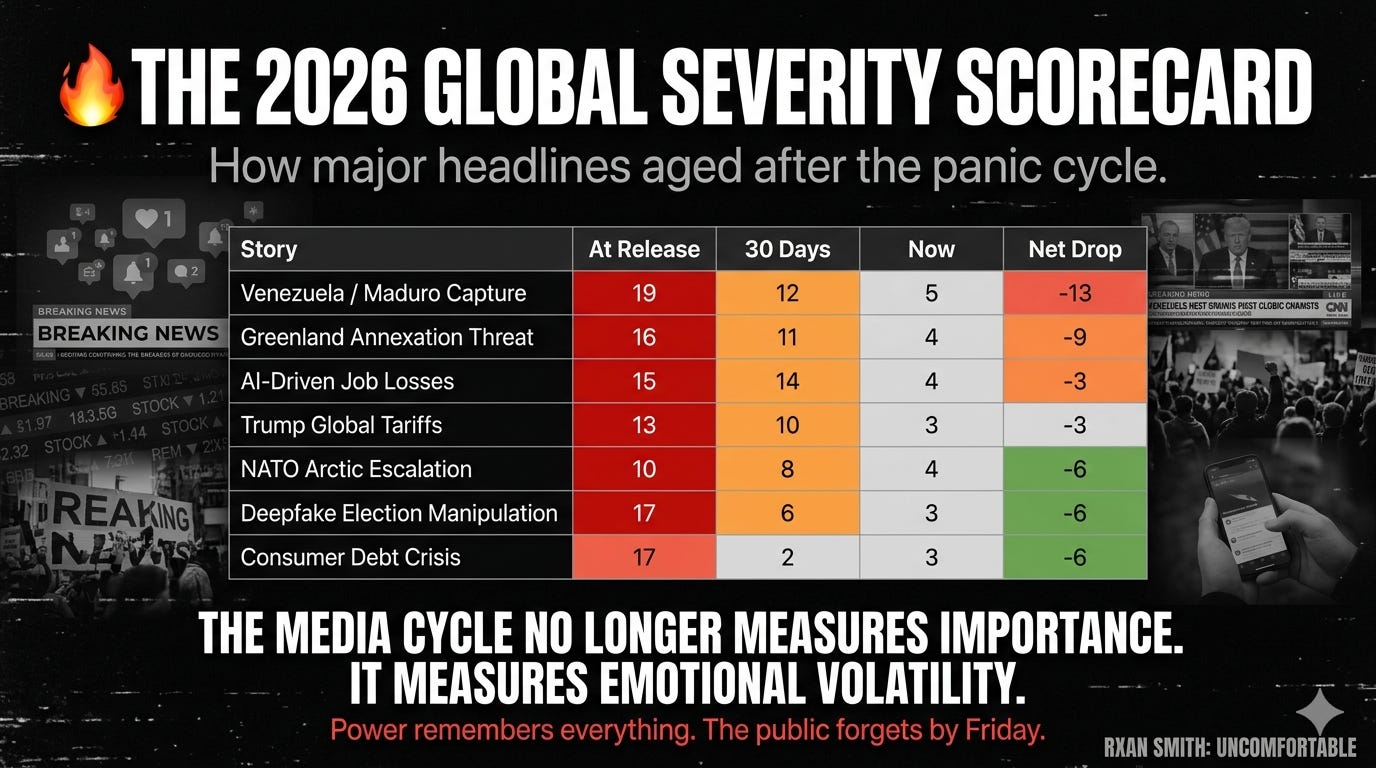
Across the first seven weeks of 2026, dominant headlines followed an identical trajectory:
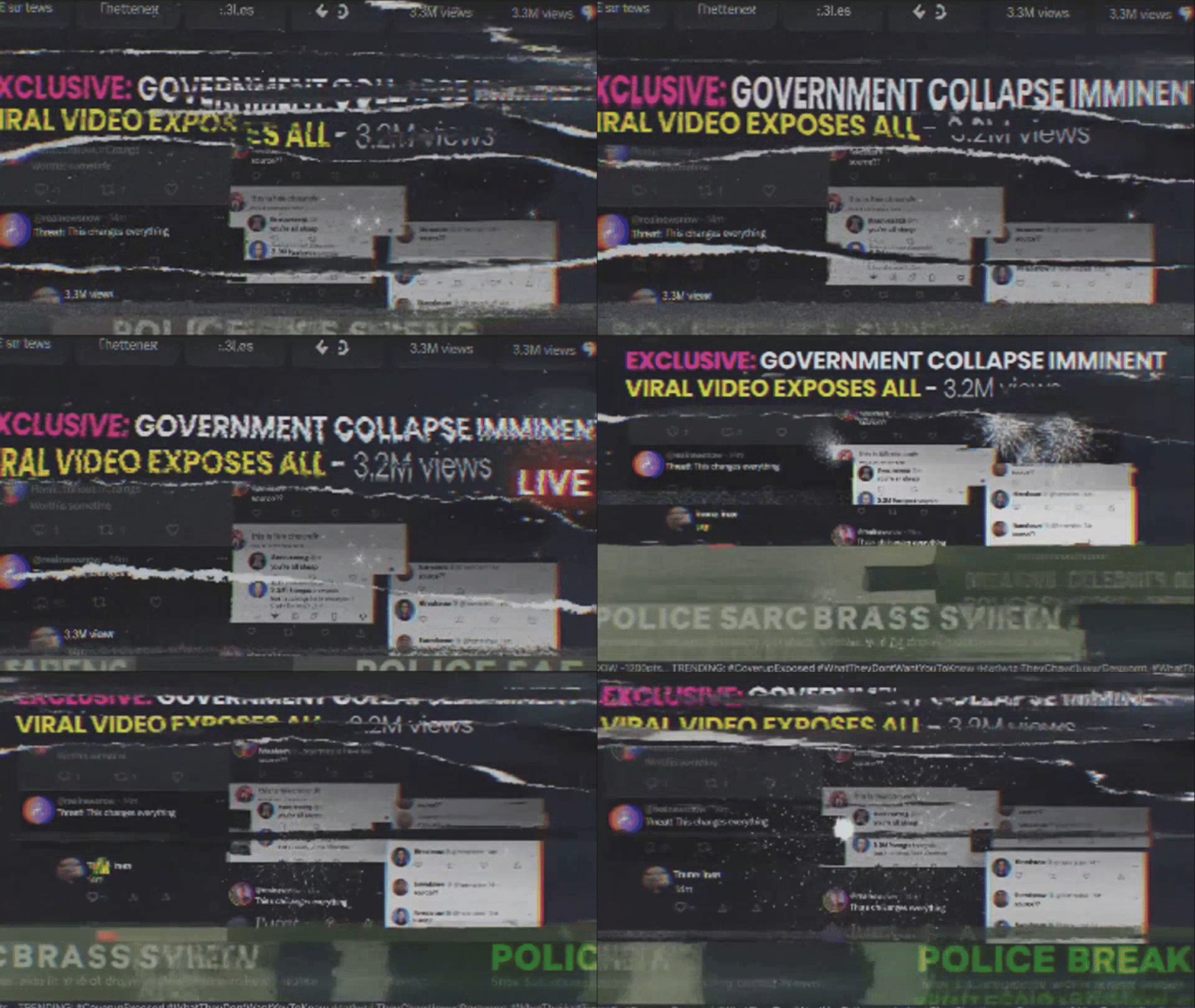
Extreme urgency at release
Rapid decline in perceived importance
No public follow-through
A U.S. military operation involving the capture of Venezuela’s sitting head of state “launched at a public severity rating of 10/10. Seven weeks later it sits at 6… 100 days later it’s at 3. That's almost as severe as it gets, to what it looks like when a local department store goes on strike. This shift is not because the geopolitical consequences resolved, but because something else hit a 19. Greenland annexation threats that triggered emergency NATO consultations opened at 8, absorbed into diplomatic background noise before any accountability structure could form, now registering near 3.
Nothing resolved. Attention rotated.
The only story still rated at 8 when this analysis concluded was a newly announced global tariff policy that broke the same day we finished counting. History suggests what happens next.
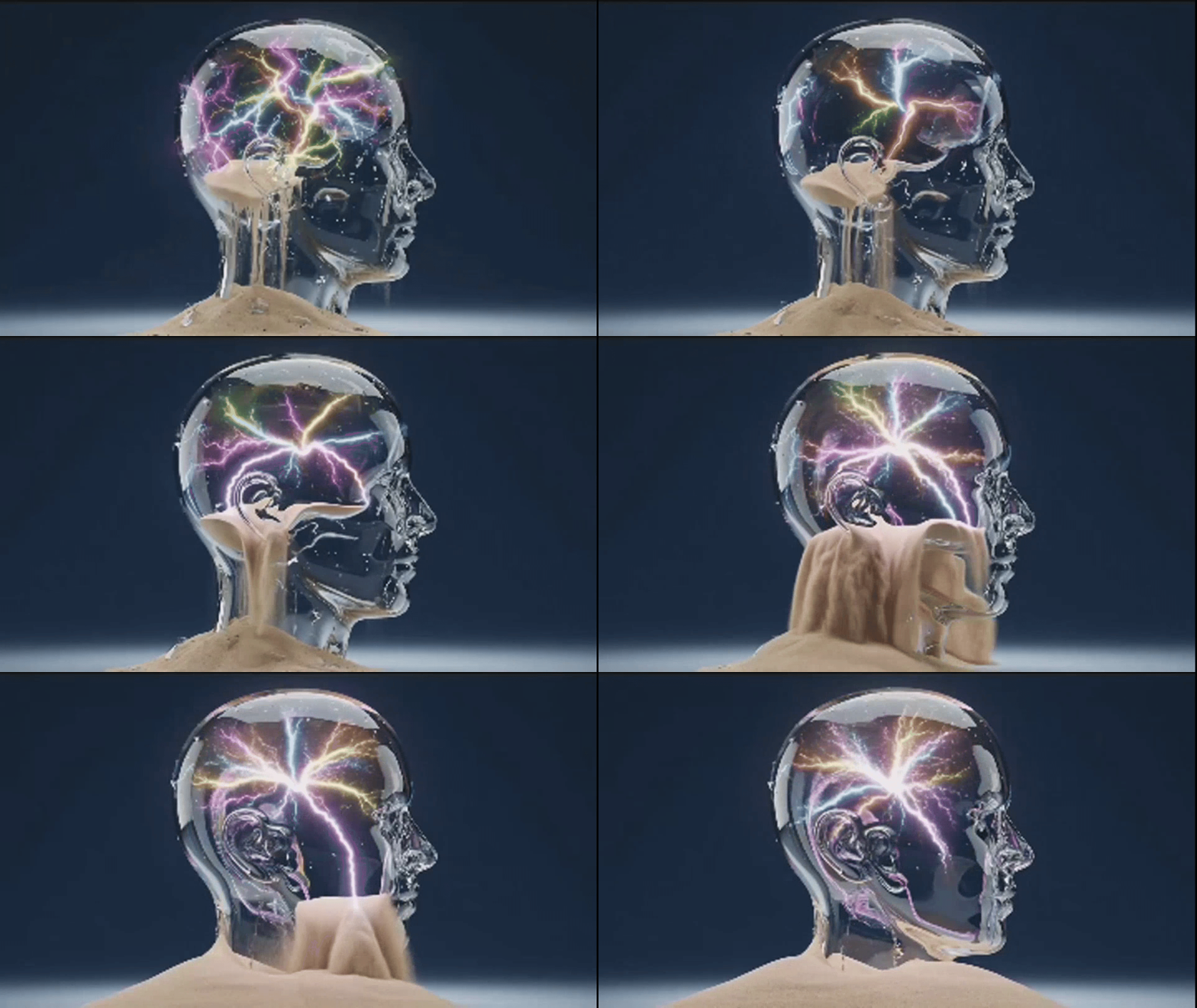
Google Trends analysis cited by Axios places the median lifespan of a major news story at seven days. Parse.ly analytics finds the median article lifespan online at 2.6 days. Policy timelines operate in months or years. Attention expires before accountability can begin. This is not prioritization. This is interruption
Devil’s Advocate: Maybe This Is Healthy?
A reasonable objection exists. Humans cannot care about everything indefinitely. News cycles move because reality moves.
If that were true, attention would decline after resolution.
The data shows the opposite.
Google Trends analysis cited by Axios and Schema Design places the median lifespan of a major news story at seven days. Parse.ly analytics finds the median article lifespan online is 2.6 days.
Policy timelines operate in months or years.
Attention expires before accountability can begin.
This is not prioritization.
This is interruption
.
The Hidden Mechanism: Emotional Front-Loading
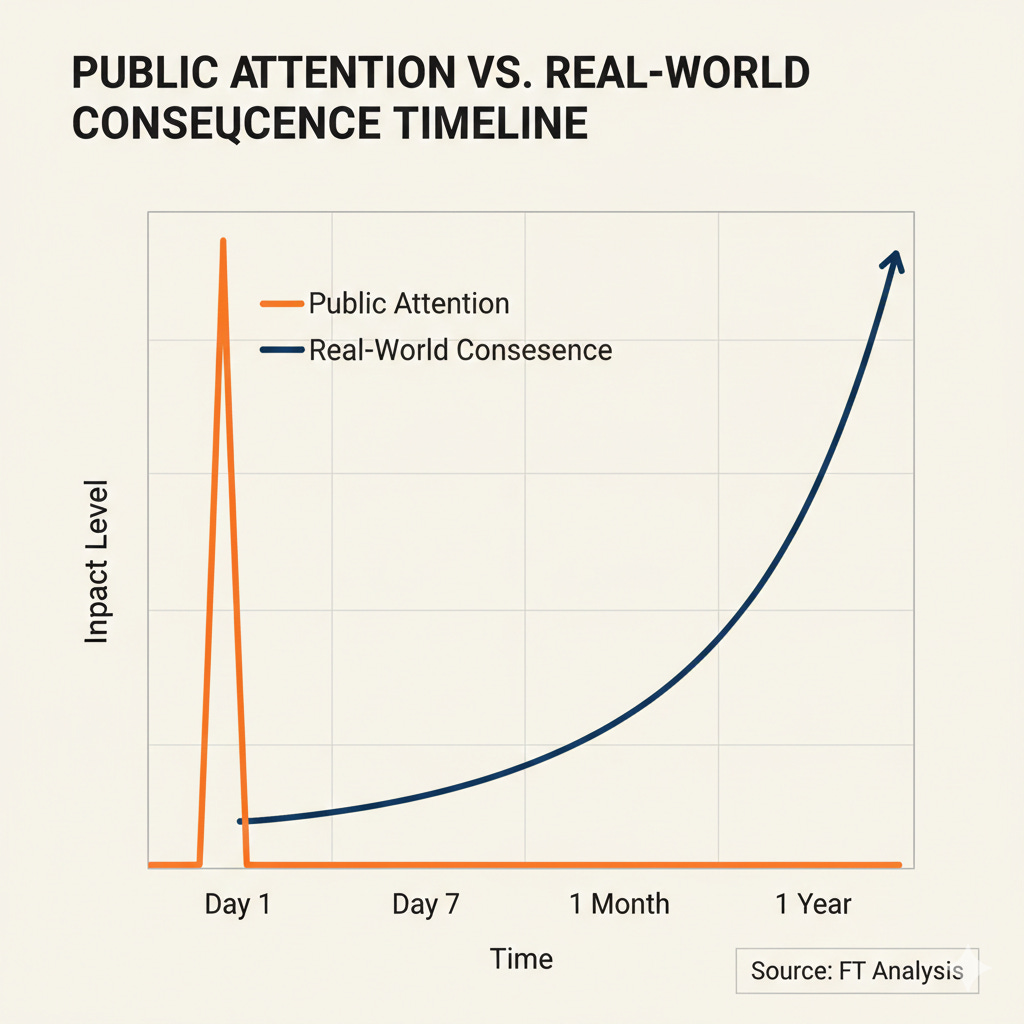
Research into attention economy psychology shows negative news fades faster than positive news because emotional intensity is front-loaded.
The brain experiences urgency first and processing later.
Modern platforms never allow the “later” phase.
UC Irvine psychologist Gloria Mark’s news fatigue research shows sustained digital attention has collapsed from roughly 2.5 minutes in 2004 to about 47 seconds today — a measurable digital attention span decline.
The audience did not demand shorter news cycles.
The environment trained shorter attention.
You are not informed sequentially.
You are stimulated continuously.
The global digital advertising market exceeded $700 billion in 2025. Platforms dominated by Google and Meta capture more than half. Revenue depends on attention duration. The most reliable driver of attention is emotional activation. Internal Meta research disclosed by whistleblower Frances Haugen confirmed anger and fear outperform positive emotions in engagement metrics by a significant margin. Outrage is not collateral damage from a broken system. It is the product the system was designed to sell.
[
![Algorithmic Amplification Feedback Loop]](https://substackcdn.com/image/fetch/$s_!oatc!,f_auto,q_auto:good,fl_progressive:steep/https%3A%2F%2Fsubstack-post-media.s3.amazonaws.com%2Fpublic%2Fimages%2F764ac9f3-bd63-4edf-a6c8-8401dd31579a_1024x1024.png "Algorithmic Amplification Feedback Loop]")
Devil’s Advocate: Isn’t the Audience Responsible?
Yes.
Media companies optimize for engagement because engagement works.
Users click urgency, share outrage, and reward novelty over follow-up.
A false rumor about emergency presidential powers became Snopes’ most-read story of 2025, outperforming verified global crises.
The infrastructure exploits psychology, but participation remains voluntary.
The machine runs on audience behavior as much as algorithms.
What Gets Crowded Out
The greatest damage is not misinformation. It is displacement. Every degree of public attention devoted to the spectacular is a degree withheld from the structural.
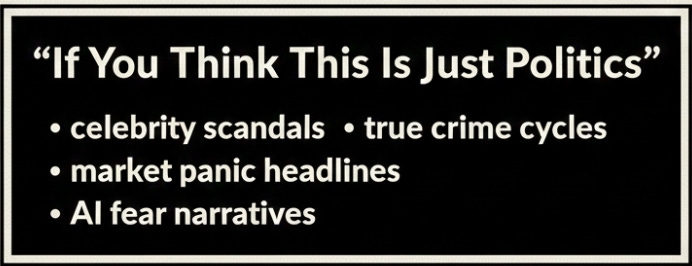
The stories dominating early 2026… military operations, celebrity scandals, geopolitical threats, layoffs… were significant. None of them will shape daily American life as profoundly as the stories that trended nowhere: long-term monetary policy decisions, regulatory staffing changes, judicial appointments, infrastructure implementation timelines, demographic shifts tied to AI labor disruption.
These stories lack spectacle.
Therefore they lack trend velocity.
Therefore they lack attention.
Therefore they lack democratic pressure.
That is not an accident of the news cycle. That is a feature of it
The Constitutional Problem No One Is Naming
Freedom of the press was not designed to enable the most emotionally efficient distribution of daily stimulation. It was designed to enable sustained scrutiny of power over time.
Watergate was not broken in a week and abandoned. It accumulated over two years of persistent coverage because the institutional architecture of mid-century journalism rewarded continuity. Reporters stayed on beats. Editors held stories. Papers printed follow-up. Civil rights reporting built pressure across decades because the press understood its function was to maintain public memory, not just public stimulation.
Today’s architecture makes that impossible by design. Seven-day attention cycles collide with multi-year governance processes, and governance wins every time.. not because it is more powerful, but because it is more patient.
The result is a constitutional paradox that nobody in the press has any incentive to name: a technically free press producing an effectively uninformed public. Citizens feel intensely aware while lacking any continuity of understanding. Trending gets mistaken for importance. Exposure gets mistaken for knowledge.
The American Psychological Association reports 61% of Americans feel emotionally exhausted by constant news exposure. Gallup records media trust at 28%… the lowest level ever measured. The predictable result: exhausted people disengage, distrust spreads, and citizens retreat into smaller tribal information systems that confirm rather than challenge. The architecture designed to maximize awareness ultimately fragments the shared reality that democratic accountability requires.
When the press stops functioning as memory, power stops requiring accountability. It only requires patience.
And patience is the one thing an outrage cycle never teaches.
The Uncomfortable Conclusion
Here is what I need you to sit with for a minute… you are not going to like it.
You think you are a victim of this system. You are also its primary investor.
Every time you screenshot the outrage of the day and send it to your group chat. Every time you refresh for the update on the story you were enraged about four hours ago and have already half-forgotten. Every time you feel genuinely, righteously informed for forty-seven seconds before the next thing lands — you are not resisting the machine. You are the machine. You are the reason the machine works. Your engagement is not a byproduct of the attention economy. It is the economy.
There is no cabal. There is no secret architecture being maintained by people in a room somewhere deciding what you are allowed to remember. There is just seven hundred billion dollars in annual digital advertising revenue that requires your sustained emotional activation, and a perfectly legal system of incentives that has been optimizing toward that number for two decades. Nobody had to conspire. The math did the conspiring.
What the math produced is a civilization that is simultaneously the most informed and the most amnesiac in human history. You know, right now, more about what is happening in the world than any citizen in any prior era. And you will remember almost none of it. The Venezuela story — the one where the United States captured a sitting head of state, which would have been the defining foreign policy crisis of any other decade — is already a 3. It was a 6 three weeks ago. Nobody resolved it. You just moved.
And the consequences of that story… the diplomatic fallout, the precedent, the second and third-order effects on regional stability… those do not trend. They compound. They show up in your foreign policy, your fuel prices, your grandchildren’s geography. They show up everywhere except the place where democratic accountability is supposed to live, which is your sustained attention.
The question worth asking in 2026 is not whether these crises are real. They are. It is not whether the media is biased. It is. The question — the one that indicts all of us and that none of us want to answer honestly — is whether a democratic system can survive being governed by citizens whose attention expires faster than any policy can mature.
The press did not lose its memory. We stopped paying it to have one.
The most subversive thing you can do right now is remember something from last month. Not the feeling of it. The facts of it. What happened, what was promised, what was never followed up on, what quietly became permanent while you were watching the next fire.
Memory is not nostalgia. In this environment, memory is a threat to the business model.
Which is exactly why they’re betting you don’t have any left.
Based on every number we’ve got so far…
We fucking do not.
And that’s not a glitch.
That’s the business model.
Sleep tight.

Sources & Data
Severity ratings synthesized from top 10 trending U.S. media stories (Jan–Feb 2026). Google Trends / Axios / Schema Design (median story lifespan: 7 days). Parse.ly analytics (median article lifespan: 2.6 days). Gallup Media Trust Survey (2025). Edelman Trust Barometer (2025). Cornell University news diffusion research. NYU moral-emotional language study (PNAS). Gloria Mark, UC Irvine attention research. American Psychological Association news fatigue findings. EU Digital Services Act transparency reports.
This idea that every crisis feels like the end of the world until we forget it rings painfully true. The way you bring severity and memory into conversation makes it clear that panic isn’t just about the event, but about how short our timeline of perspective often is. It reminded me of standing too close to a painting so all you see is a dark smudge, and only when you step back do you realise it’s part of a much larger scene. Your words feel like that gentle hand on the shoulder telling us to take three steps back before deciding that everything is doomed.
It's all so much bigger than "politics," but nobody wants to see it that way.