

Orbán Lost. The System He Built Didn’t.
Hungary just had its most consequential election in sixteen years. The celebrations started before the votes were counted. That’s exactly the problem

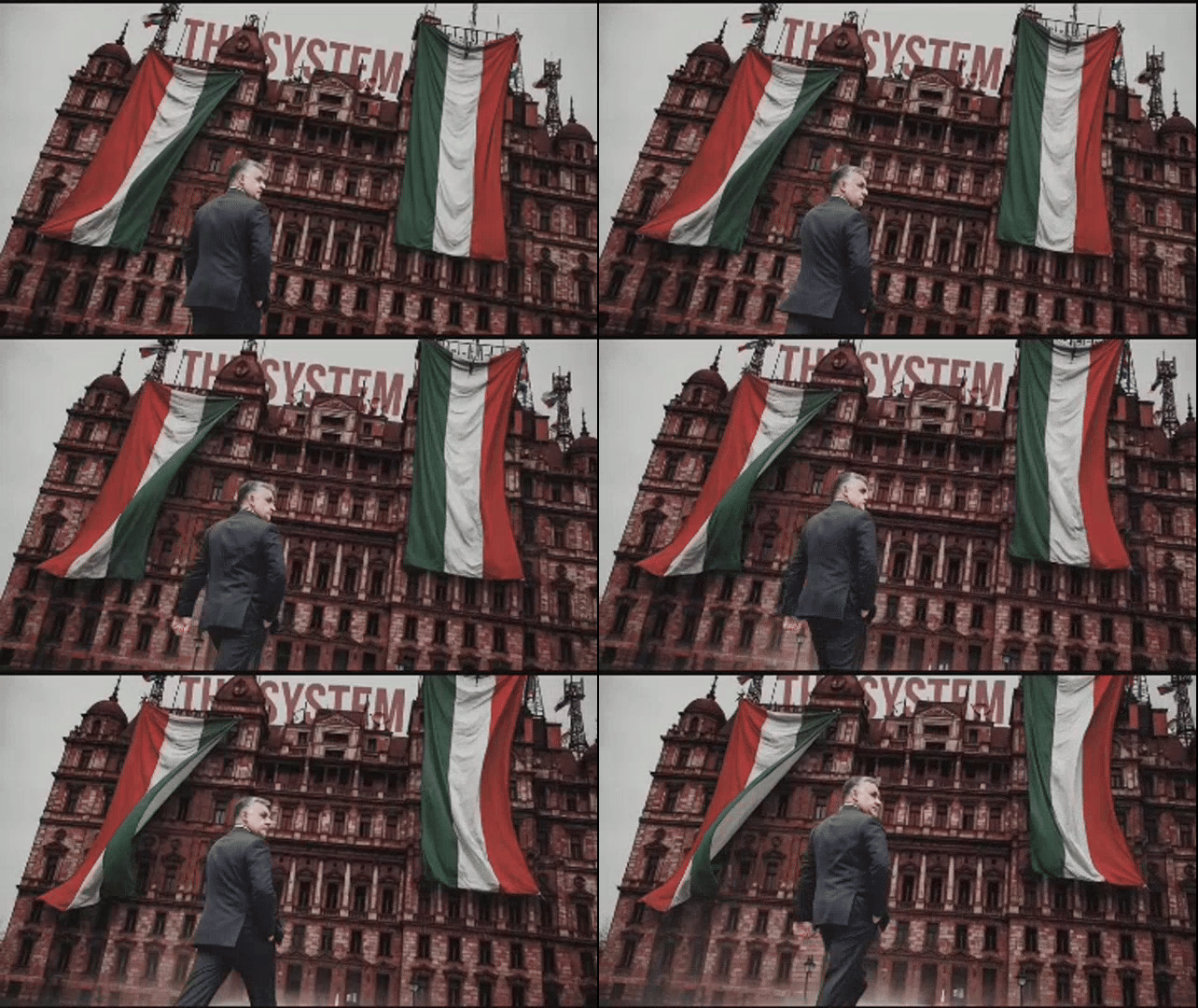
Orbán Lost. The System He Built Didn’t.
Democracy didn’t win. It just passed a stress test it might already be failing.
“You’re celebrating the weather while ignoring the climate.”
⚠️ CALLOUT: READ THIS BEFORE YOU CELEBRATE
Orbán didn’t lose power. He converted it into systems that don’t require him to stay in office.
What just happened in Hungary isn’t a victory lap.
It’s a diagnostic test.
The Reaction Was the Story. Not the Result.
The reaction wasn’t analysis.
It was relief dressed up as intelligence.
Champagne takes. Instant history. Clean narratives.
A sixteen-year strongman loses an election and suddenly the story writes itself.
That’s convenient.
That’s also wrong.
If you closed the tab after the headline, you’re doing exactly what systems like this depend on.
“The scariest political system isn’t the one that cancels elections.
It’s the one that holds them—and no longer needs them.”
What Actually Happened
One Election Doesn’t Kill a 15-Year System
Péter Magyar didn’t lead a revolution.
He ran a cleanup operation.
Former insider
Pro-European conservative
Ran on corruption, healthcare, infrastructure
Not ideological war. Administrative correction.
He didn’t defeat Orbánism. He optimized it.
Call it what it is:
A revolution
A software update
📦 CALLOUT: THE NUMBERS PEOPLE AREN’T THINKING ABOUT
Magyar’s Tisza Party: ~53%
Orbán’s Fidesz: ~38%
Projected seats: 135 vs 57
Turnout: ~6 million (record-level participation)
This wasn’t quiet dissatisfaction.
This was a system under pressure.
What Everyone’s Missing
Orbán Already Won the Bigger War
Elections were never the main battlefield.
Orbán went structural:
Courts → reshaped
Media → consolidated (500+ outlets)
Electoral maps → engineered
Narrative → branded (“illiberal democracy”)
None of that disappears because of one loss.
Magyar didn’t inherit a country. He inherited a machine.
UNCOMFORTABLE LINE
Losing power isn’t the same as losing control.
Orbán understands that. Most people don’t.
If Magyar governs inside that system:
He legitimizes it
He stabilizes it
He proves it works
Winning inside the system is not defeating it. It’s validating it.
The Question Nobody Wants
Why Did This Work at All?
This is where analysis usually folds.
Because the moment you ask why, you lose the luxury of blaming just the villain.
Orbán didn’t break a healthy system. He exposed a weak one.
Underlying conditions:
Economic frustration mishandled by both sides
Cultural backlash dismissed instead of addressed
Institutional trust already collapsing
EU promises that felt distant and abstract
He didn’t invent the fire.
He pointed at it and sold gasoline.
“If you don’t solve the conditions, you’re not defeating the next Orbán. You’re preparing him.”
⚠️ BIAS CHECK (CALLOUT BLOCK)
Yes, this is a democratic win
No, it is not a systemic fix
Confusing the two is how systems survive.
The Part Americans Won’t Like
This Isn’t Just About Hungary
You already know where this is going.
You just don’t like hearing it out loud.
The methods are transferable. The branding changes.
Hungary (Orbán Model) United States (Trajectory) Media consolidation Fragmented but siloed media bubbles Gerrymandering dominance Ongoing redistricting battles Court packing Rapid judicial reshaping “Illiberal democracy” “America First” framing Legal, incremental changes Legal, incremental changes
The overlap isn’t ideology. It’s method.
UNCOMFORTABLE LINE
Elections change the face.
They don’t automatically change the machine.
The 2028 Problem
Two Scenarios. Same Destination.
Let’s drop the polite analysis.
Scenario A — Movement Wins
Institutional consolidation accelerates
Executive norms stretch further
System becomes self-sustaining
Scenario B — Movement Loses
Power shifts to states + media
Strategy becomes more disciplined
Movement becomes harder to dislodge
Different outcomes. Same trajectory.
CALLOUT: THE REAL RISK
A system that still holds elections…
but no longer depends on them.
A Prescription Most People Will Read & Ignore
I don’t usually do this. But the feedback I get most is: okay, now what? So here it is. Not comfortable. Not comprehensive. But real.
None of this is complicated. That’s what makes it dangerous. It’s just inconvenient enough that most people won’t do it. Most people would rather be right than be effective. That’s how systems win.
You don’t need genius solutions.
You need inconvenient ones.
1. Learn how systems actually work
Not headlines. Mechanisms.
2. Stop obsessing over presidential elections
Local power builds national outcomes.
3. Audit your information diet
If it always agrees with you, it’s not information.
4. Stop treating politics like a team sport
Because systems don’t care who you’re rooting for.
REALITY CHECK
Most people want solutions
Most people want validation
That’s why systems win.
And Finally
For everyone who spent tonight refreshing vote counts…
waiting for something to finally feel like a win.
I want to say something to you.
Because I understand the feeling.
After sixteen years of watching a man dismantle every institutional check on his own power—
while the international community responded with concerned op-eds and polite warnings—
tonight felt like exhaling.
I get it.
⚠️ CALLOUT
But here’s what you need to understand about the exhale:
It doesn’t clean the air.
It just means you were holding your breath.
What Orbán Actually Built
Viktor Orbán didn’t just build a party.
He built a method.
A step-by-step demonstration of how a democracy can slowly consume itself—
while still calling the process governance.
That method doesn’t disappear with him.
It doesn’t sit in a desk drawer somewhere in Budapest.
It lives in the minds of every ambitious authoritarian who watched, studied, and took notes.
The original author getting fired doesn’t destroy the manual.
It makes it easier to copy.
The Part Nobody Wants to Sit With
The courts are still his courts.
The media infrastructure is still his network.
The electoral architecture is still his geometry.
Magyar didn’t walk into a neutral system.
He walked into a structure designed to resist anyone who wasn’t supposed to run it.
He didn’t just win power.
He inherited constraints.
We’re about to find out whether the new tenant understands the building he just moved into.
You weren’t watching a system collapse.
You were watching it prove its durability.
The Mistake Everyone Keeps Making
If your politics depends on one man losing,
you were never fighting the system.
You were gambling on a personality collapse.
And sometimes, you win that bet.
But the house?
The house doesn’t lose.
The Ending Nobody Wants
One man lost.
The system didn’t.
⚠️ FINAL CALLOUT
And until people stop confusing those two things…
It won’t.
Do something about the system.
Because if you don’t,
it will keep evolving—
with or without your permission.
— Rxan Smith
Uncomfortable
rxansmithmedia.com
📣 RESTACK LINES (Support my Growth)
“You’re celebrating the weather while ignoring the climate.”
“He didn’t defeat Orbánism. He optimized it.”
“The vote changes the face. Not the machine.”
“Systems don’t collapse. They evolve.”
“You weren’t fighting the system. You were betting on a personality.”
If this is the first time you've read me, or you've read my posts before, the video below is tells you who I am… and WHAT I'm about… in 3 minutes.


"No Kings Day" & The Business of Protest: When Movements Thrive on Motion Instead of Results

Last Saturday, somewhere between 5 and 9 million people marched across 3,300 events in all 50 states under the No Kings banner. It was, by any measure, a massive show of force. I won't even get into the fact that our amazing American Free Press has a 80% margin of error for crowd estimates.
Connect With Rxan Smith Across the Web
📺 YouTube
🐦 X
📸 Instagram (Main)
📸 Instagram (Alt)
🧵 Threads
💰 Suppor
I really needed Darby's Headlines of Hope post today. It's so easy to get bogged down by your constant dread politics (kidding 😜), but his 'Far Side Effect' approach has had me smiling more with every headline. Love the story about the tiger and the boar.
https://darby687.substack.com/p/headlines-of-hope?r=6ehzuh&utm_campaign=post&utm_medium=web