

Obama, Trump, and the Forgotten Middle Class
Why America’s most unlikely twins reveal the system’s deepest flaw... and what neither of them actually fixed.

Rxan Smith · Uncomfortable · September 4, 2025
🔴 If you’re a Conservative… start here
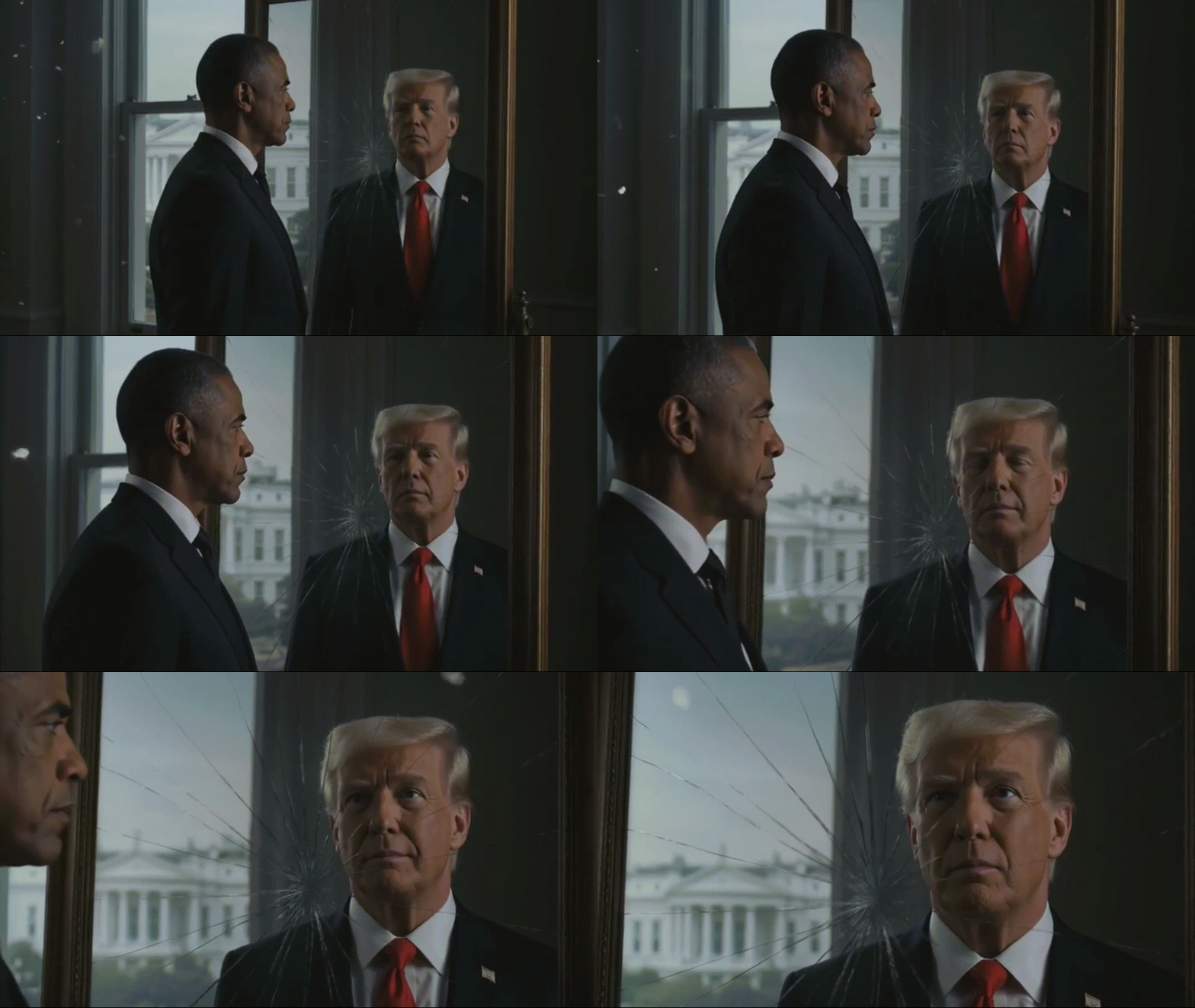
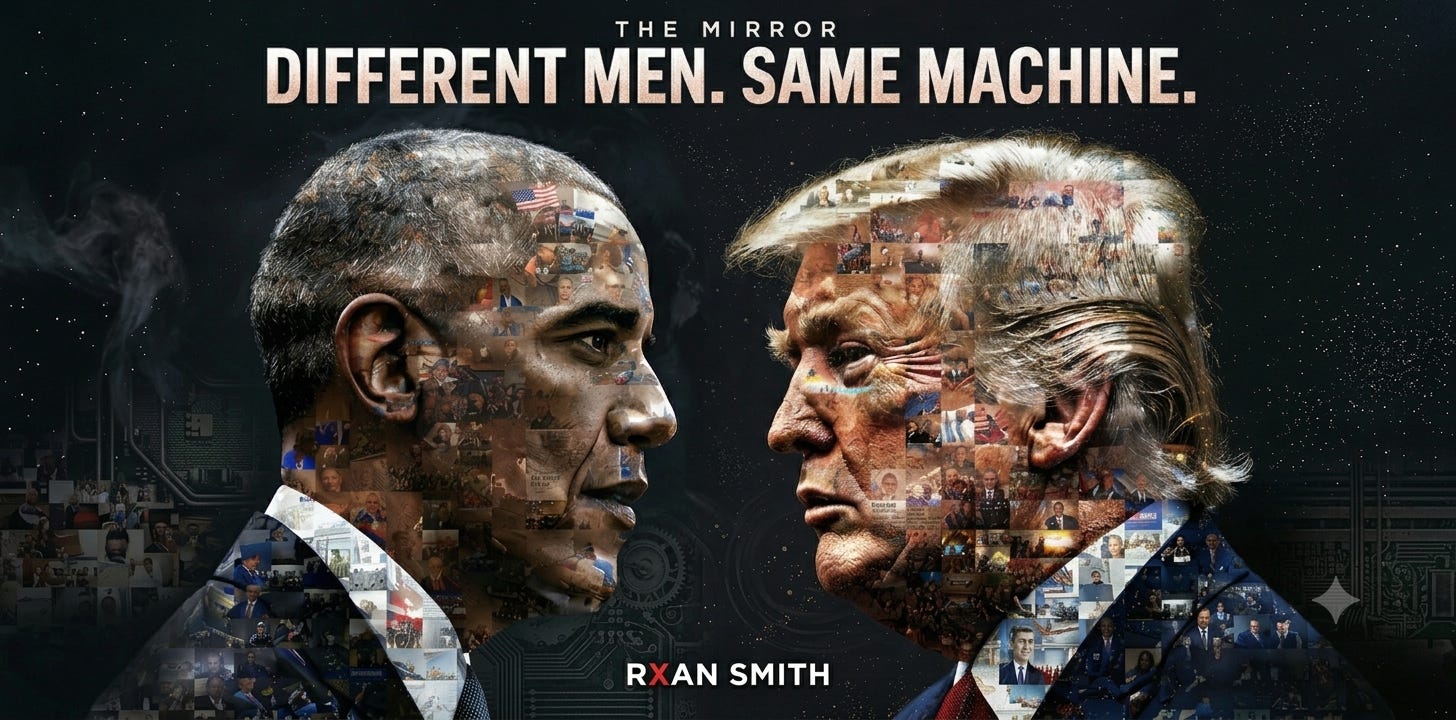
Let me start with something that might sound crazy: Barack Obama and Donald Trump… two men you probably see as polar opposites… actually reveal the same story about America. Both outsiders to the donor class. Both underestimated by every pundit in every cycle. Both speaking directly to a working class that Washington had written off. And if we’re honest, both exposed just how broken the system really is… before getting swallowed by it.
🔵 If you’re a Liberal… start here
Brace yourself. Obama and Trump… the figures you see as night and day… share more structural DNA than either side wants to admit. Outsiders who disrupted their party establishments. Charismatic communicators who rewrote the rules of political media. Cultural earthquakes who proved the middle class was screaming to be heard. The comparison isn’t about moral equivalence. It’s about what the system does to everyone who tries to change it from outside.
⚪ If you’re exhausted by both… start here
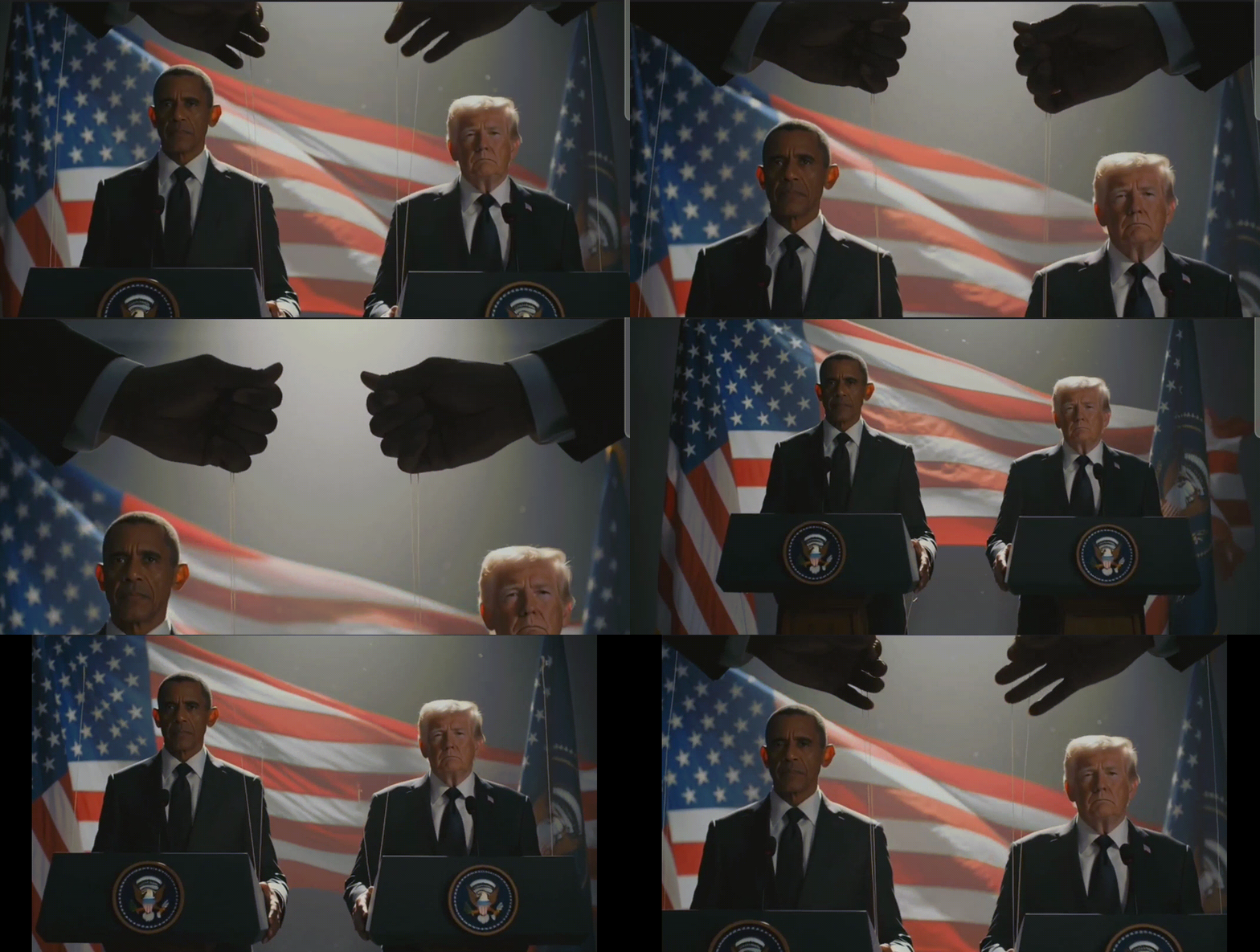
Obama and Trump mirrored each other in ways neither camp will acknowledge. Different styles. Different ideologies. Same pain. Same frustration underneath. Same working-class voters… documented, county by county… who voted for one in 2008 and the other in 2016. That’s not a paradox. That’s a diagnosis. And neither man actually treated the disease
.
Outsiders Who Refused to Wait Their Turn
Obama was a one-term junior senator from Illinois with a “funny name,” as he often said himself: no executive experience, no party machine behind him, no obvious path. Trump was a real estate mogul and television personality with zero political background, no ideological credibility with the GOP base, and a party establishment that spent 2015 convinced he was a prank.
Neither had the résumé. Neither had the blessing. Neither waited their turn.
Obama leapfrogged Hillary Clinton in 2008 (the most prepared, best-funded candidate in Democratic primary history) by running directly to voters the party had taken for granted. Trump bulldozed through seventeen Republican candidates in 2016 by doing the same thing from the other direction.
The “outsider” axis that actually matters
Calling Obama and Trump both “outsiders” sounds like a stretch until you specify: outsiders to what? Not to wealth or education or media access — Obama had Harvard Law and Trump had 400 million dollars. What they were both outside of was the…
... donor-class consensus
on what was politically safe to say. Obama ran against the Iraq War when Democratic primary voters weren’t supposed to. Trump ran against free trade deals when GOP donors depended on them. That specific kind of outsider is what both parties’ establishments tried… and failed… to stop.
Their stories even intertwined in ways that feel almost scripted. In 2004, Obama couldn’t get a floor pass to the DNC. Four years later, he was the nominee. In 2011, Obama publicly humiliated Trump at the White House Correspondents’ Dinner… mocking his birtherism, his TV show, his entire brand… while Trump sat frozen in the audience. That night is widely reported to be a turning point in Trump’s decision to run for real. The man who lost the joke became the man who won the election. You can’t write that.
Speaking to the Same America
At their core, both men spoke to the same audience: a middle class that felt ignored, betrayed, and exhausted. Obama spoke with hope. Trump spoke with fury. But both spoke directly in a media environment where every other politician was speaking at people through carefully rehearsed talking talking points.
Obama & Yes We Can’ = Cry for civic optimism.
Trump & Make America Great Again = Cry for restoration.
Different tones. Same translation:
I see you. I hear you. I will fight for you.
The most uncomfortable data point in American politics (the one almost nobody will say plainly) is this:
Counties that swung hardest for Obama in 2008
were THE SAME COUNTIES that swung hardest for Trump in 2016
This wasn’t voter stupidity, but a coherent message: we tried hope.
Now we want war.
Macomb County, Michigan. Erie County, Macomb County, Michigan. Erie County, Pennsylvania. Luzerne County. Ashtabula County, Ohio. These weren’t confused voters who couldn’t make up their minds. These were working-class communities that voted twice for the candidate who promised to burn down the Washington consensus — regardless of which party that candidate came from. The party label was never the point. The promise was.
The Obama-to-Trump voter is real and documented
A 2017 University of Massachusetts Amherst study found that roughly 9 million Obama voters switched to Trump in 2016… enough to decide the election in five states. They weren’t voting for Trump’s ideology. They were voting against a Democratic Party that had stopped talking about wages, healthcare costs, and manufacturing jobs, and started talking primarily about representation and identity. That’s not a moral judgment. That’s a recorded preference.
Media Masters: Different Weapons, Same War
Obama’s 2008 campaign changed digital politics permanently. His platform my.barackobama.com recruited 13.5 million supporters, raised over $600 million… most of it in small donations… and demonstrated that a candidate could build a mass movement while bypassing traditional party infrastructure entirely.
Trump did the same thing eight years later with a single Twitter account. He bypassed the press, hijacked the news cycle daily, and made himself the unavoidable center of every conversation… for free. Every outraged retweet was earned media. Every cable segment spent debating his latest post was advertising he didn’t pay for.
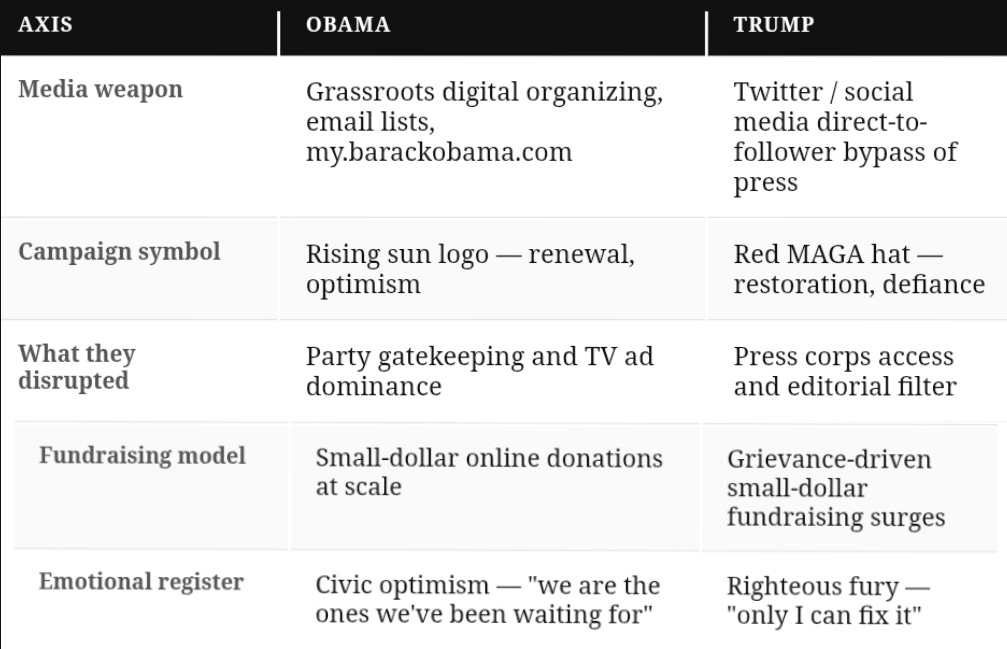
Both campaigns were emotional, viral, and cultural before they were political. Neither was selling a platform. Both were selling an identity: the kind of American you are if you’re with this man.
Where They Actually Agreed & Why It Matters
The surface-level policy overlaps — “nation-building at home,” “working-class appeals,” “attacks on elites” — are real but weak. Every politician claims these. The overlaps worth noting are the specific ones both parties’ donors hated:
The four overlaps that actually cost them both (1) Both ran against foreign wars and nation-building - and both expanded drone strikes and military operations anyway. (2) Both promised to crack down on Wall Street - Obama signed Dodd-Frank, Trump loosened it. Neither put a banker in prison. (3) Both promised infrastructure - neither passed a transformative bill until after their political momentum had peaked. (4) Both promised to lower prescription drug prices - both got outmaneuvered by the pharmaceutical lobby. The overlap isn’t in their rhetoric. It’s in what the machine prevented both of them from actually doing.
Both faced relentless institutional resistance from Congress, from entrenched agencies, from industries that had spent decades building regulatory capture. And both responded by personalizing the presidency: making themselves the message when the policy got blocked. That’s the trap. Charisma fills the gap when governance stalls — and it’s addictive for both leader and follower.
The Honest Accounting & What the Middle Class Actually Got
This is the section neither fanbase wants to read. But it’s the only section that matters.
What Middle Class Was Promised vs. Received
Obama (2009–2017)
What was promised
Universal healthcare. Wall Street accountability. Middle-class tax relief. End to “stupid wars.” Bridge the partisan gap.
What was delivered
✅ ACA covered 20M+ uninsured. Unemployment fell from 10% to 4.7%. Stock market tripled.
What was left on the table
❌ No public option. Zero banker prosecutions after 2008. Drone strikes expanded. Manufacturing job losses continued. Opioid crisis exploded. Real median wages barely moved for six years.
Trump (2017–2021, 2025– )
What was promised
Bring back manufacturing. Lower drug prices. Rebuild infrastructure. Drain the swamp. Put America First. No Wars
What was delivered
✅ Pre-COVID unemployment hit 50-year lows. Some supply chain reshoring began. USMCA replaced NAFTA.
What was left on the table
❌ Drug prices unchanged. Infrastructure bill failed first term. Tax cuts flowed to corporations and top earners. Swamp personnel replaced with different swamp personnel. Manufacturing employment at 2019 levels. Tariff costs passed to consumers. War with Iran followed invasion of Venezuela and I'm both of their leaders were uprooted and replaced. I ran worked and bring this country to its knees because of the Strategic and financial interests involved
The uncomfortable through-line
Both men gave the working class a compelling story about why their lives were hard. Neither fundamentally changed the structural reasons why. The stock market recovered. The donor class recovered. Corporate profits recovered. Wages recovered last, slowest, and least — exactly as they did after every previous crisis. Charisma, it turns out, is not a substitute for sustained structural reform. And a base that loves you will wait longer than is healthy for the promised results to arrive.
The Cost of Division & Who Actually Paid It
Neither man fully delivered on unity. Obama’s presidency deepened polarization — not because he was divisive, but because his very presence activated a cultural backlash the party was unprepared to manage. Trump’s presidency exploded institutional trust — not just among his opponents, but eventually among supporters who expected more than theater.
“A weakening of the values that make us who we are.” — Obama’s farewell, 2017.
“American carnage.” — Trump’s inaugural, 2017.
Same year. Same diagnosis. Neither party’s supporters could hear the other’s version of it.
But here’s the part we don’t say: the failure wasn’t just theirs - it was ours. We became addicted to the conflict. We debated tweets while infrastructure crumbled. We fought culture wars while healthcare, housing, and wages ticked like time bombs. We chose the drama of the leader over the boring, grinding work of holding institutions accountable.
The real threat isn’t foreign — it’s structural
Collapse doesn’t arrive in tanks. It arrives in water systems that stop working, bridges that close, schools that graduate kids who can’t read, hospitals that only the insured can afford, and a political class so captured by donor money that the word “reform” became a punchline. We rename oceans while schools fail. We argue about statues while the pension funds are raided. We cancel each other while the institutions that would protect us from all of it hollow out from the inside. Unity isn’t a slogan. It’s the only structural condition under which any of the fixes in this series are possible.
The Closing Argument
Stop scoffing at the comparison. Obama and Trump both tapped into something real… a middle class that had been functionally abandoned by both parties’ donor classes, and was willing to vote for anyone who acknowledged the abandonment out loud.
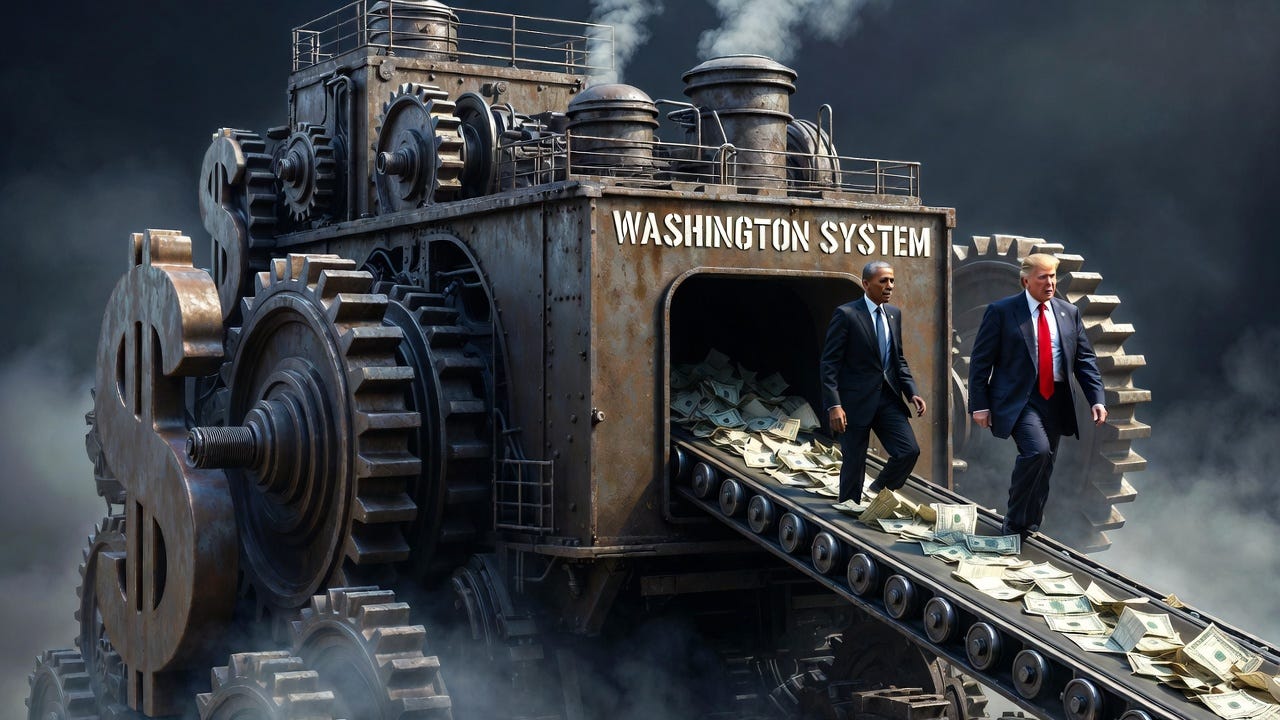
The problem isn’t that charismatic outsiders keep winning. The problem is that the system is specifically designed to absorb them. Give the outsider enough institutional resistance and enough media pressure and enough donor dependency, and two years in, they’re governing like an insider — or getting nothing done at all.
We don’t need another charismatic outsider. We need boring, structural, sustained reform — the kind that doesn’t make good television and doesn’t generate viral moments and doesn’t fill arenas. The 25 fixes in this series aren’t exciting. A functional transparency infrastructure, a tax system that can’t be optimized away, a healthcare system that doesn’t bankrupt people — none of this is a revolution. It’s maintenance. It’s what every other comparable democracy figured out decades ago.
The clock isn’t ticking toward the next charismatic leader.
It’s ticking toward a moment we run out of time to fix the plumbing before the house floods (regardless of who's standing at the podium when it happens)
If this reframed something
Subscribe before the algorithm buries it. Send it to the one person in your life who needs to read the other door’s version. Every subscriber dollar goes to expanding reach — not to coffee, not to gear, not to anything but getting this in front of more people.
Subscribe free → · Support the work → · Read the full series →
Rxan Smith — Uncomfortable
I don’t do hot takes — I do obvious systemic truths months before others catch on.
YouTube · X · Instagram · Facebook · Buy Me a Coffee · PayPal.
Thanks for engaging, Danni. I’m thrilled you get the importance of this. If you check out my recent posts (non-pandering ones that are gaining traction), and this one in particular, you’ll see solid likes and restacks. I tried presenting a different angle: the 9 million Obama-to-Trump swing voters in 2016 effectively moved 18 million votes. For context, Lyndon Johnson has the largest margin of victory ever, with 16.4 million. It’s not complicated... which makes it all the more frustrating that it’s so rarely discussed.
The most radical thing citizens can do isn’t switching parties... it’s demanding politicians and parties stop controlling the narrative and answer directly to us.
That’s why I started writing. Independent platforms like Substack give us a real shot at restoring the free press: delivering unspun information to citizens instead of partisan reinforcement. The Free Press’s $150 million sale shows strong demand for truth over clicks. And what follows that? A full court Blitz saying that Barry weiss, someone who has voted against Trump in the last three elections, and identifies as a classic liberal, was accused of being the new puppet of trump and heading up Fox News 2.0. If you want to interesting experiment , go search YouTube for anything CBS News has reported. You won't find anything that even resembles right-wing pandering. The best Trump in every bit of coverage.
Bari definitely has a bias when it comes to covering Israel but she's Jewish so I give her a pass in that area and I don't know when hating Israel become a liberal point of view anyway. I think we can say that everything that goes on in that region is against our values. There doesn't always have to be a villain and the hero there can be a bunch of villains . Again, that doesn't sell
Too many creators follow the corporate playbook: “breaking news” hooks, emotional framing, omitted nuance, and constant subscribe prompts. They chase engagement by reinforcing opinions. They don't try to inform and spark honest discussion.
I’ve hit the top 100 U.S. political writers 3x times but never stuck there, little bit because I've only started promoting my publication in april. That piece I wrote in December only had 82 subscribers receive it. But even after the growth I've seen in the last 60 days, I have only about a quarter of the following than I should have because pandering wins.
I’ve chosen the slower road of uncomfortable truths, even if it limits growth. Subscriber models *should* reward better incentives, but many still play the old game.
Real change starts w/ writers and readers demanding objectivity, full context, and facts over framing. If mainstream & independent outlets committed to that, quality journalism would dominate, discourse would improve, and informed citizenship would return. I’d happily be put out of business by it.
Fact-check what challenges your views. The ecosystem only changes when we do.
Thank you!
You said what I’ve been thinking.
We need to start over from the beginning, and have a do-over.
Next time we’ll know what we’re doing.
Hopefully.