

"No Kings Day" & The Business of Protest: When Movements Thrive on Motion Instead of Results
A data-driven liberal critique of No Kings... and why people keep choosing visibility over victory

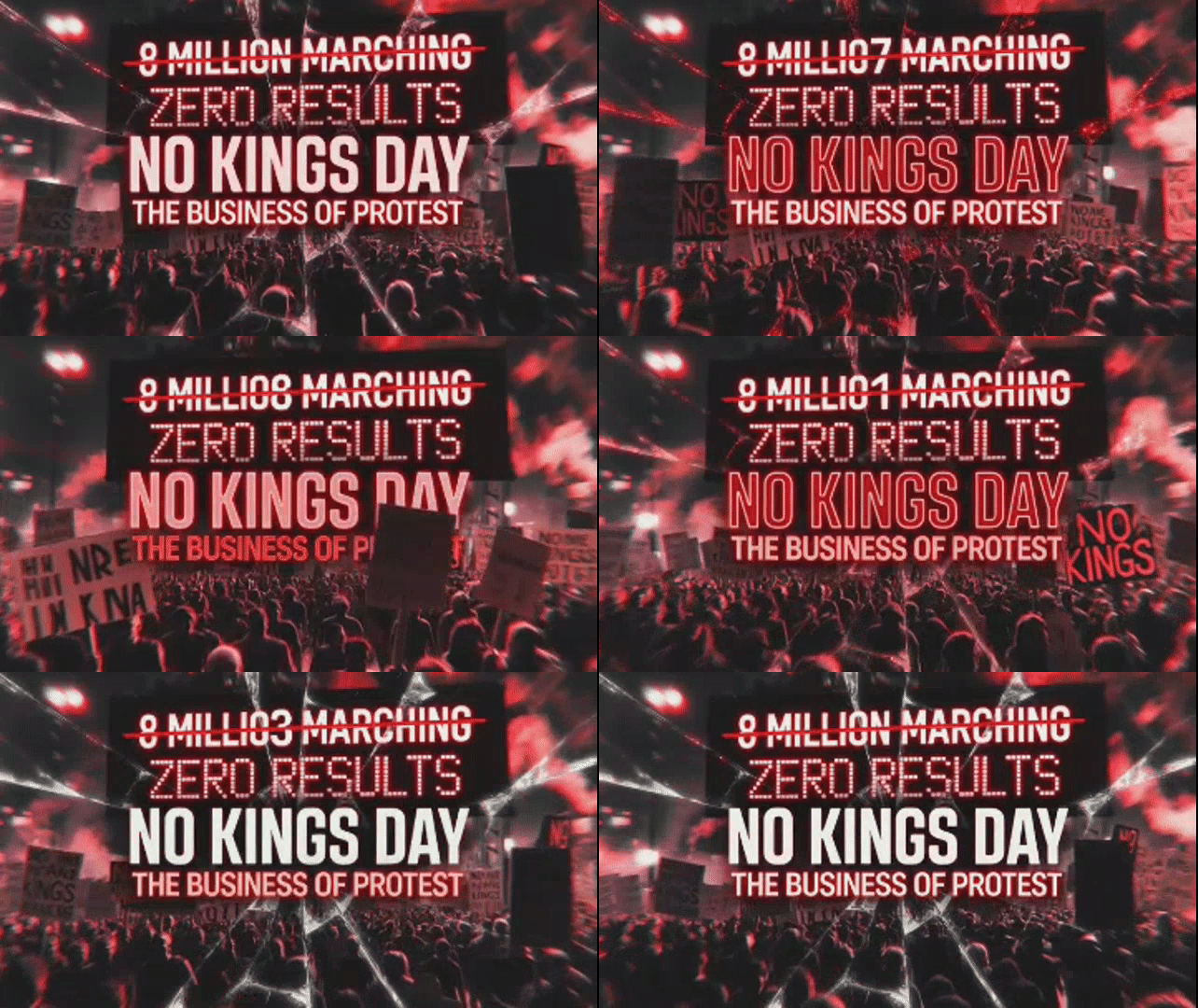
Last Saturday, somewhere between 5 and 9 million people marched across 3,300 events in all 50 states under the No Kings banner. It was, by any measure, a massive show of force. I won't even get into the fact that our amazing American Free Press has a 80% margin of error for crowd estimates.
So why can’t anyone tell you what it was supposed to achieve?
That question isn’t cynicism. It’s the whole argument
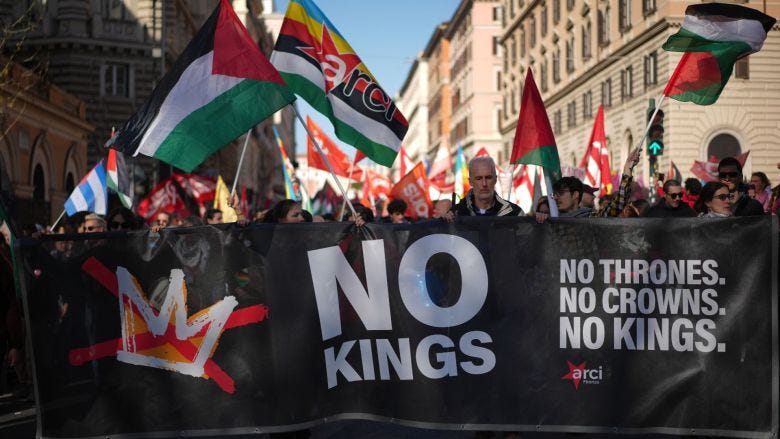
Modern activist coalitions like No Kings often operate as attention systems, not outcome systems — prioritizing visibility, coalition growth, and recurring mobilization over measurable policy wins. The result is a cycle where the absence of resolution sustains the movement itself.
This is a critique from the left. From someone who wants Democrats to deliver affordable housing, higher wages, corporate accountability, and secure borders. From someone who thinks endless anti-Trump marches without a positive platform are failing the exact working-class voters the left needs to survive.
“If a movement can’t tell you what success looks like, it can never fail.”
The Illusion of Momentum
Three nationwide protest waves. Bigger crowds each time. Same question, still hanging in the air like smoke: what changed?
June 2025 — ~5 million turnout
October 2025 — ~7 million
Reality check: turnout is always fuzzy. Different counting methods, different incentives. Fine. The exact number doesn’t matter. The pattern does: bigger crowds, same lack of outcomes.
The goals? Broad enough to fit on a protest sign:“Tyranny”
Immigration enforcement
Iran conflict
Voting rights
Cost of living
Yes, policy asks technically exist somewhere in press releases. That’s the defense. But if a demand never becomes a vote, a deadline, or a political consequence, it’s not a demand. It’s a disclaimer.
If a movement can’t define success, it can’t fail.
Coalition ≠ Accountability
No Kings runs on a massive coalition: Indivisible, MoveOn, ACLU, Planned Parenthood, AFL-CIO, NEA, BLM affiliates, and hundreds more.
Impressive infrastructure. Also a built-in accountability problem.
Because when everyone’s involved, no one’s responsible.
Compare that to Occupy Wall Street. Less organized, more raw anger, zero legislative wins. It changed culture, not policy.
No Kings has better logistics. Same unanswered question:
Win what, exactly, by when?
The uncomfortable comparison? The Tea Party.
2009: protests, vague anger
2010: scorecards, primaries, 63 House seats flipped
The difference wasn’t passion. It was structure.
Specific targets. Specific consequences. Actual power.
Video: Millions rally in the third wave of No Kings protests (Firstpost coverage)
The stated goals remain broad and unchanging: opposition to “tyranny,” masked ICE agents, the Iran war, voting rights, economic pain for billionaires. No specific legislative demands, timelines, or post-event outcome reports appear on nokings.org.
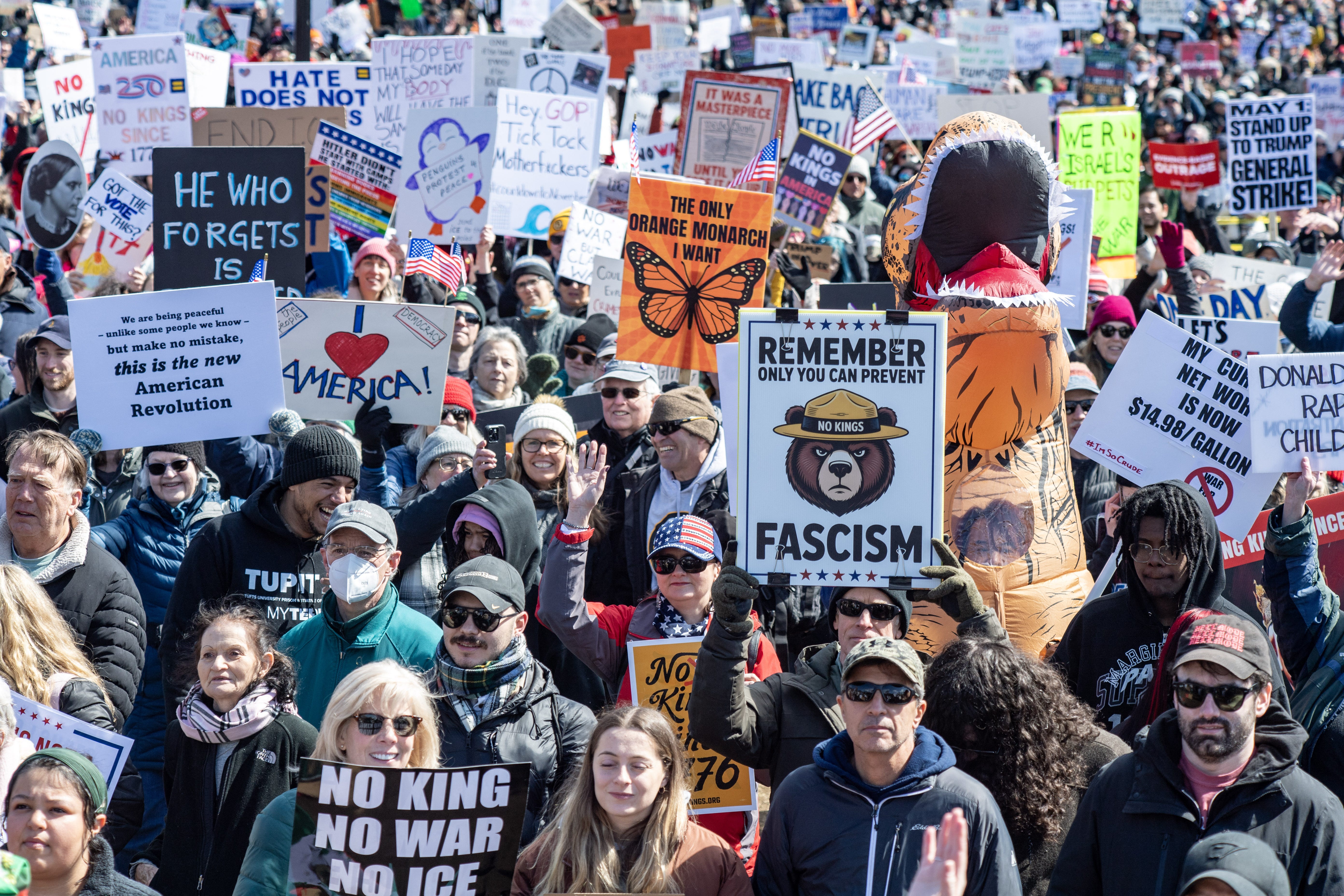
The pattern is the point. Motion replaces measurable progress. And the absence of resolution sustains the movement itself.
Follow the Money
The money exists. It's just diffused. Donations route through ActBlue-style platforms and fiscal sponsors to partner organizations - there is still no single "NoKings.org" Form 990 publicly available. Indivisible, the lead organizer, has received substantial support from major philanthropic foundations. (InfluenceWatch summary)
The broader network behind these protests spans hundreds of groups with combined annual revenues in the billions. The critique here is structural, not conspiratorial: a decentralized funding model makes it nearly impossible to evaluate impact relative to investment. Revenue and staff grow with each protest cycle - but outcomes do not track with the spend.
The more decentralized the money, the harder it is to measure whether anything was actually achieved.
The Incentive Problem
Movements may be unintentionally structured to never solve the problem. Resolving the issue means the movement loses its urgency - its donors, its energy, its reason to email you tomorrow. Sustained grievance means continued engagement, continued donations, continued relevance. This isn’t cynicism about individuals; it’s a structural observation about institutional incentives.
Consider Black Lives Matter (2013–present). BLM drove real, measurable local wins: body camera mandates, chokehold bans, no-knock warrant restrictions in dozens of cities, and federal oversight consent decrees in places like Ferguson. (Brookings) It shifted public opinion - a majority of white Americans acknowledged the systemic dimensions of officer-involved shootings by 2017. Those are genuine achievements worth naming.
Video: Nationwide coverage of the March 28 No Kings protests (MS NOW)
But BLM also illustrates the ceiling: it captured unprecedented national attention and failed to translate it into durable federal legislation. The George Floyd Justice in Policing Act died in the Senate. “Defund” commitments were reversed in city after city. Cultural transformation outpaced structural change — and that gap between what was possible and what was locked in is the operating environment No Kings has inherited. Except No Kings stripped away even that partial policy focus, leaving pure anti-Trump resistance with recycled marches. The gap widens. The absence of resolution sustains the movement itself.
“Awareness is the product. Change is the promise.”
The Moving Target Problem
Each march reframes the issue instead of resolving the previous one. June 2025 focused heavily on immigration and ICE. October layered in voting rights. March 2026 added the Iran war and cost-of-living. Slogans stay emotional (”No Kings,” “No tyranny”) rather than actionable. No public dashboards track progress toward stated goals. When the target moves, accountability moves with it — and the question of whether the last march did anything never gets answered.
The serious counter here is that sustained visible pressure has produced real executive reversals - deportation policy pauses, court injunction victories, specific agency backdowns — none of which require legislation. That’s fair, and it’s not nothing. But a court win that stems from a constitutional challenge, not a march, isn’t evidence that the march strategy is working. It’s evidence that lawyers are working. Conflating the two lets the march claim credit it didn’t earn.
The other objection worth naming: the Civil Rights Movement took a decade. Labor took longer. Why judge No Kings at nine months? Because the question isn’t age - it’s architecture. A movement with no outcome framework at month nine will have the same framework at year nine. The Civil Rights Movement had specific targets, specific legislation, and specific dates by which it demanded action from the moment it organized. It didn’t figure that out later. The infrastructure of accountability was present at the start. That’s the difference.
When the target moves, accountability disappears with it.
Video: Live scenes from major No Kings rallies across cities including Minnesota, DC, and New York (Associated Press)
What Effectiveness Actually Looks Like
A functional movement operates with a scoreboard. That means specific policy demands, timeline benchmarks, public progress tracking, and clear win/loss criteria. The contrast across American protest history is instructive — and worth laying out plainly
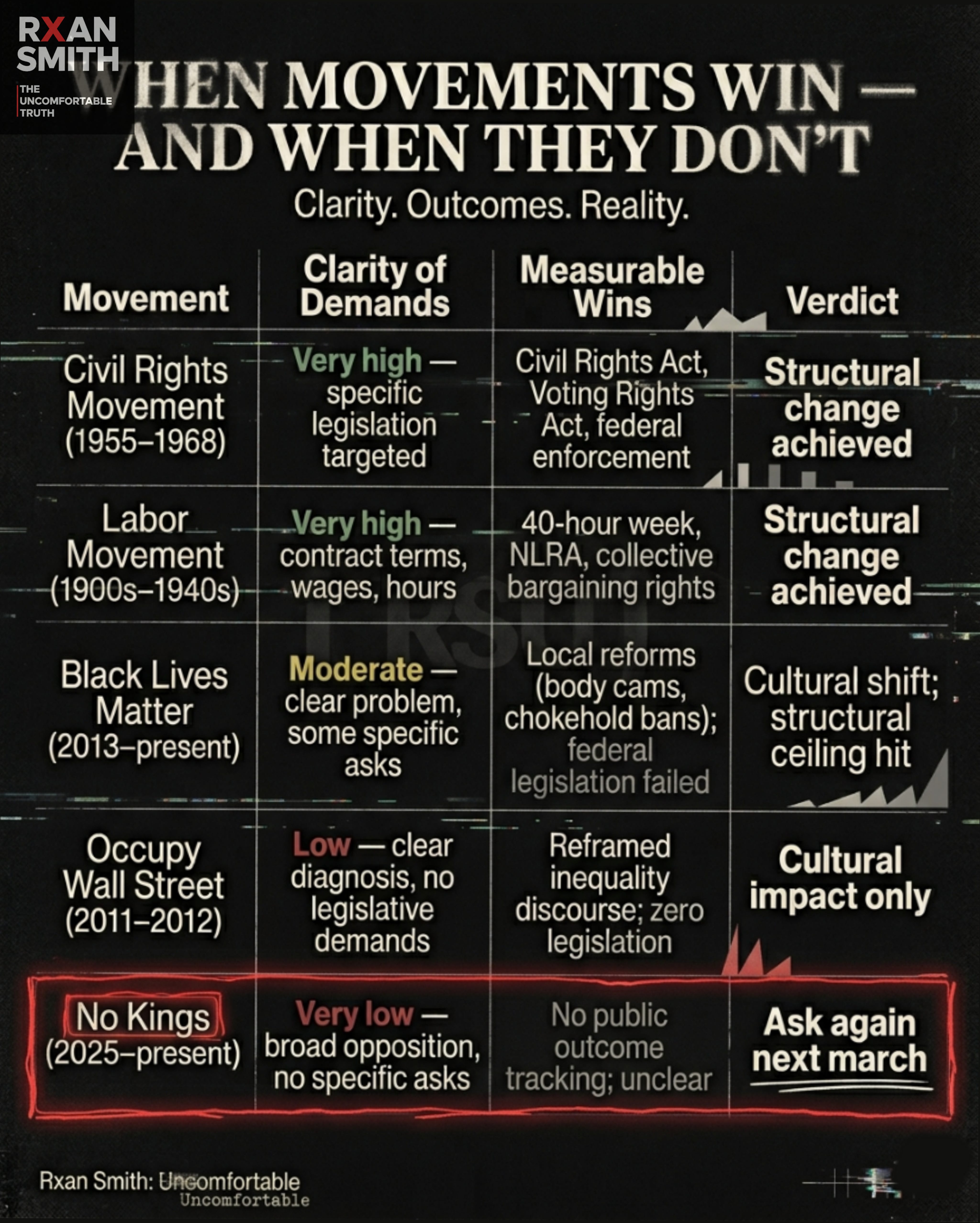
Real movements risk ending. Performative ones are designed to continue.
The Uncomfortable Truth
This is the piece most political criticism misses: the problem isn’t that these organizers are cynical. Most of them aren’t. The problem is that the system rewards movements for staying ineffective. Visibility gets funded. Grievance drives clicks. Ongoing urgency fills email lists. A movement that delivered its goals would dissolve its own infrastructure.
Not every modern movement is a grift. But many are structurally incapable of proving success. And in a system where visibility is rewarded more than outcomes — where the march is the content, the livestream is the product, the coalition email is the deliverable — failure can look exactly like progress. The absence of resolution does not kill these movements. It sustains them.
From a liberal perspective that wants the Democratic Party to actually govern: the left has spent a decade as the party of “we don’t like the other side.” Whatever your policy priorities are — housing, wages, borders, corporate accountability, civil liberties — a movement with no scoreboard cannot deliver them. That’s not a liberal problem or a conservative problem. It’s a math problem. Biden had genuine legislative wins. They were erased in public memory by public perception shaped by inflation, immigration pressures, and late-cycle political instability. Young voters increasingly see no daylight between parties on who holds real power.
Without a shift toward measurable governance outcomes — demands that can be won or lost, tracked or abandoned, held up as proof of competence — these marches risk becoming systems that sustain engagement rather than resolve the problems that created them. The Tea Party proved the alternative is possible. The question is whether anyone on the left is paying attention to the lesson instead of the messenger.
They succeeded culturally more than structurally - and that gap is where modern movements get stuck.
And finally…
Look, I get it. Marching feels good. The signs are clever, the chants are loud, the livestream numbers are through the roof, and Bruce Springsteen even showed up to sing for the cause in Minnesota. But here’s the uncomfortable punchline nobody wants to hear at the after-party: you didn’t change a single vote, pass a single bill, or move the needle on anything except your own dopamine levels.
You built the biggest crowd since Woodstock, posted the most viral clips since the last viral clips, and tomorrow the exact same problems will still be sitting on the same desks in Washington. Because while you were busy being seen, the other side was busy being counted.
So keep marching if it makes you feel righteous. Just don’t pretend the motion is the same thing as movement. Real power isn’t measured in hashtags or headcounts — it’s measured in seats, laws, and results. Everything else is just expensive performance art with really good lighting.
If this made you uncomfortable, it did its job.
Share it with someone who needs to hear it — especially if they’re on your side.
Subscribe to: Uncomfortable with Rxan Smith, for more of this.
Sources hyperlinked inline. Turnout figures sourced from press coverage and organizer reports; independent verification of protest attendance is structurally difficult and noted accordingly in the text. Funding data from InfluenceWatch, ProPublica 990 filings, and published foundation grants. Policy outcome data from Brookings Institution. All data current as of March 29, 2026.
This is a structural critique of incentives and accountability architecture — not of intentions, organizers as individuals, or the legitimacy of political opposition. The argument is that the system rewards motion over outcomes. That’s a problem regardless of which side you’re on.
Uncomfortable America · rxansmith.substack.com
I would suggest a No Kings Day for a GENERAL STRIKE against the TRUMP government .
I know of a group of Veterans that are so angered at this regime that they want to besiege the WTH!! And seriously—they said, “They’re ready to die trying..”