

Enough Is Enough: America's Wake-Up Call
What the Divide Is Actually About, Who’s Profiting From It, and What Every Citizen — Left, Right, and Done With Both — Can Do Now

Rxan Smith | Uncomfortable | September 2025 and beyond
I'm Rxan Smith and I’m done pretending this country belongs to a party. It belongs to the people… and we are so far past the line that it’s time to scream it from the rooftops proclaiming, “enough is enough!” We know what it’s going to take. And no amount of surveillance, pressure, or institutional muscle is going to shake me. CIA. NSA. All of you. Bring it. That’s where I stand. How about you?
It’s not left vs. right. It’s citizens vs. the people writing laws they’ll never live under, cashing checks from wars they’ll never fight, and counting on your tribalism to cover their tracks. You’ve been played. Keep reading.
Before you blame the neighbor, the coworker, the uncle at Thanksgiving understand this: the divide didn’t come from you. It was engineered. Manufactured by the same political and corporate class that profits every single time you pick a side instead of picking a fight with them.
The Con In Plain Sight
When the Founders penned the Declaration, they laid it out plainly: certain truths self-evident, rights unalienable, government existing to serve the people - and answerable to them when it stops. That framework wasn’t naïve idealism. It was a specific warning, written by people who had just lived through what happens when power stops being accountable.
Here’s the uncomfortable update for 2025: those rights are not self-sustaining. They don’t enforce themselves. They survive only when citizens defend them… and for the past quarter-century, too many of us have been too busy defending our team to notice what’s being stolen while we argued.
The theft doesn’t happen in the dark. It happens in legislation written by lobbyists. In districts drawn to be unwinnable. In campaign finance laws that turned democracy into an auction. In a defense budget where roughly half the money evaporates into consulting contracts before a single soldier gets a dollar. It happens in plain daylight, in public documents, with public money — and it continues because the people doing it correctly identified that keeping us angry at each other is cheaper and more reliable than anything else they could spend on.
The mechanism: how the distraction works
Culture war issues cost nothing to manufacture and generate maximum emotional engagement. Solving housing affordability requires policy, money, time, and political risk. Arguing about symbols, language, and identity costs nothing and keeps people enraged. So the system (politicians, media, and industries that fund both) floods the zone with the issues that produce the most heat and the least accountability. Meanwhile, voters tell pollsters the same things every year: cost of living, healthcare, housing. The gap between what people NEED and what the system delivers isn’t an accident. It’s the point.
The Machinery - By the Numbers.
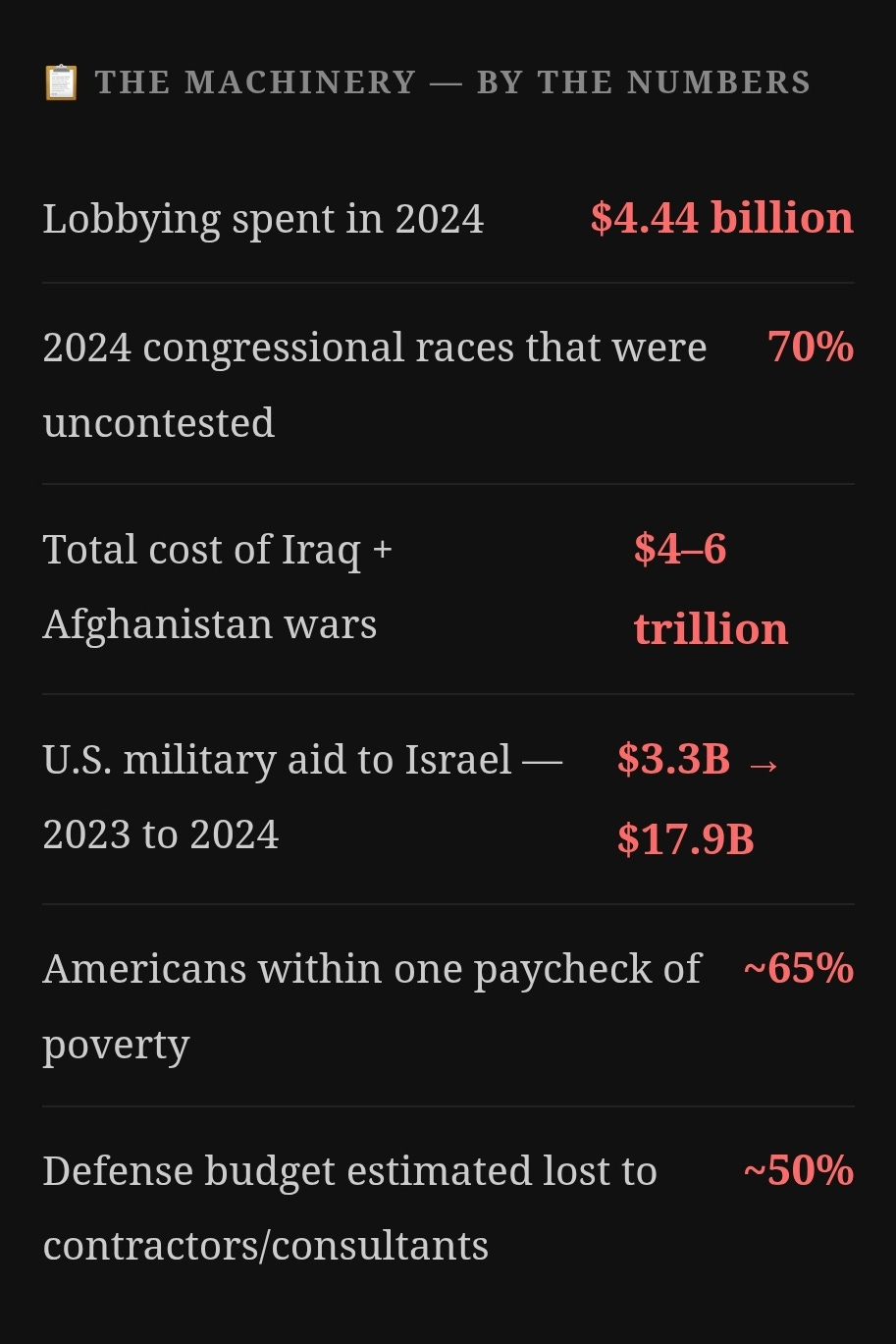
These aren’t partisan numbers. They don’t belong to one party’s ledger. They accumulated across Republican & Democratic administrations, through Republican & Democratic Congresses, under the watchful eye of a media ecosystem that found them too boring to cover… and too systemic to make into a villain story. Villains are good for ratings. Systems are complicated.
We’ve Done This Before. Then We Forgot How
This country has a specific, documented track record of snapping back from the brink when the pressure gets real enough. Not because Americans are uniquely virtuous. Because when the crisis is undeniable and the enemy is identifiable, the tribalism evaporates.
1941 - Pearl Harbor: The Last Time We Had a Common Enemy
2,403 Americans killed before 8 AM on a Sunday. The Pacific Fleet devastated. The weapons locked up. And within twenty-four hours, the most divided country in the developed world — still fighting about whether to enter the war at all — became one. Factories converted overnight. Men from every background enlisted together. The postwar boom that followed built the most robust middle class in American history on unions, shared sacrifice, and collective investment in the country’s future.
What it proved: Division is not the natural American condition. It’s the manufactured one.
1990s | The Last Time the Books Balanced
Under Clinton, the federal government ran budget surpluses from 1998 to 2001 — totaling roughly $236 billion by 2000. Tech expansion created genuine broad-based employment. Moderate governance, imperfect as it was, kept the center functional. It wasn’t utopia. It was a country that was at least paying its bills and not manufacturing crises for sport.
Governance that isn’t driven by permanent outrage is possible. We just stopped demanding it.
2001 | September 11: The Moment They Slipped the Knife In
2,977 lives lost. For one brief window, the country was one again. Bush at 90% approval, left and right standing in the same grief. And that’s exactly when the machinery moved. $4 - $6 trillion funneled into wars that no one in power fought, profited by contractors who will never be held accountable, dismantling a surplus we’d built while the flags were still waving. The 2008 financial collapse was assembled in the aftermath while our attention was elsewhere.
Unity is the moment they’ve learned to be most dangerous. The grief was real. The exploitation of it was deliberate.
2008 | The Outsider Era: What the Machine Did to Each of Them
Obama ran against the Washington consensus and won. Then: $700 billion bailout to the banks that caused the crash, zero prosecutions, corporate capture of the presidency on display for anyone paying attention. Trump ran against the Washington consensus and won. Then: tax cuts that flowed to the top, infrastructure that never materialized, swamp personnel replaced with different swamp personnel. Sanders sidelined. Yang sidelined. Gabbard sidelined. Biden installed past his capacity to serve. Harris chosen without a primary vote cast.
The machine doesn’t care which outsider threatens it. It absorbs them all. The charisma wins the election. The donor class wins the term.
9M Americans voted for Obama in 2008, Trump in 2016
They didn’t change their values between elections.
They voted twice for whoever promised to burn the consensus down.
The consensus is still standing. They noticed.
United We Stand Is Not a Bumper Sticker. It’s a Mathematical Fact
Here’s the piece of this that I need you to sit with — regardless of which side of any issue you’re on.
The forces that benefit from the current system are not fragile. They have institutional depth, legal infrastructure, generational wealth, and thirty years of practice at making you fight the person next to you instead of them. They have made an industry out of keeping the left furious at the right and the right furious at the left — because a country fighting itself is a country not fighting the people actually in charge of its decline.
One person fighting this? Suicide mission. That’s not rhetoric. That’s arithmetic. The institutional resources arrayed on the other side of any individual or single-faction movement are specifically designed to isolate and exhaust challengers. They’ve been doing it for decades. They’re good at it.
United We Stand: What it actually means in practice
The conservative who’s furious about government waste, endless wars, and a political class that hasn’t served working people in thirty years… and the progressive who’s furious about corporate capture, dark money, and a healthcare system that bankrupts people who did everything right… are describing the same problem. Different vocabulary. Same disease. The same $4.44 billion in lobbying is the reason drug prices don’t get controlled And why the border stays broken. The same Citizens United decision that flooded liberal causes with dark money flooded conservative ones too. The same contractor class that wasted $3 trillion in Afghanistan was bipartisan in its billing.
You don’t have to agree on immigration policy to agree that 70% uncontested congressional races is a broken democracy. You don’t have to agree on tax rates to agree that writing laws you’ll never live under is corruption. You don’t have to agree on anything except:fix the machine first. Then argue about what to do with a machine that actually works.
The argument for unity isn’t idealistic. It’s strategic. The people who benefit from your division are not going to give it back voluntarily. They are not going to be shamed into accountability. They are not going to be outraged into reform. The only leverage that has ever moved entrenched institutional power in this country is the organized, sustained, cross-partisan pressure of a citizenry that has stopped playing the game designed for them.
Pearl Harbor didn’t unite the country because people stopped disagreeing. It united the country because the threat was finally too obvious to manufacture a different enemy in front of. The manufactured enemy right now — the neighbor with different politics, the coworker with different values, the uncle with different news sources — is doing exactly the job it was designed to do.
The Path — In Order of Escalation
This isn’t a fantasy. It’s a sequence. Every step here has worked before in American history. None of it requires waiting for permission.
Organize independently — outside party structures
Build networks of people who are done with both parties’ management of their outrage. Not a third party — third parties lose. Independent local organizing: citizen audit demands, town halls that aren’t run by incumbents, oversight panels that shine light into every dark corner of local and state governance. The national machine is hard to move. The local machine is not. Start there.
Escalate with the tools that have actually worked
Civil rights marches moved institutional power. Anti-war protests moved institutional power. Labor strikes moved institutional power. Sustained, disciplined, broad-based economic pressure — boycotts that cut into revenue, work stoppages that make the cost of inaction higher than the cost of reform — these are documented tools with documented records. They work when they’re broad, disciplined, and cross-partisan. They fail when they’re narrow, performative, and designed to signal virtue rather than apply pressure.
Fix the machinery the specific structural reforms that change incentives
End gerrymandering. Make districts competitive and the political incentive for extremism evaporates. Reverse Citizens United or pass federal disclosure requirements that make dark money visible. Tax corporations through a value-added tax that cannot be optimized away through accounting. Close the lobbyist revolving door with legislation that has teeth and criminal consequences. Redirect the billions currently lost to contractor waste into job creation, infrastructure, and the communities that have been paying for wars they never voted for. These aren’t radical proposals — every comparable democracy has versions of all of them. We just haven’t had a political class with the incentive to pass them, because the current system rewards them for not doing so.
Agree to disagree on everything except the foundation
Left: you do not need the right to agree with you on every social issue to build a coalition against corruption. The conservative who agrees that lobbying has captured democracy is your ally in fixing it — even if you disagree on immigration, even if you disagree on tax rates, even if you disagree on almost everything else. Right: you do not need the left to share your values to agree that a government that writes laws for donors and not citizens is a government that has broken its contract with you too. Park the policy debates until after the machine that’s blocking all of them is repaired. You’ll have better fights once the playing field is level.
On the Second Amendment and constitutional leverage
The Founders built the constitutional framework specifically because they understood that governments drift toward self-interest. The remedies they provided are layered and sequential: vote, organize, petition, protest, withhold economic cooperation, and — as the documented final failsafe of a free people — the right of citizens to bear arms as the ultimate check on tyranny. That sequence matters. Every lawful democratic tool comes first, not as a courtesy but as a constitutional obligation. The Second Amendment’s political power isn’t in its use — it’s in its existence as the line that reminds the government where citizen sovereignty ends. Every peaceful and democratic avenue gets used first, completely, and with everything we have. That’s not weakness. That’s what winning looks like before it gets to anything else.
The Closing Shot
For a quarter-century, these institutional leeches have gambled on our burnout. On our smartphone stupors. On our knee-jerk tribal tantrums. They figured we’d be too busy clawing at each other’s throats to notice the grand larceny unfolding in plain daylight.
They studied us. They mapped our divisions. They funded media ecosystems designed to keep us separated. They gerrymandered reality itself — not just districts.
And here’s what they got wrong: they confused our patience for exhaustion. They confused our restraint for defeat. They confused our arguing with each other for forgetting who we actually are.
We’re the people who broke the weapons locker at Pearl Harbor without waiting for orders. The people who marched across the Edmund Pettus Bridge into billy clubs because the alternative was accepting that the bridge couldn’t be crossed. The people who built the middle class out of collective bargaining and shared sacrifice when the owners of capital said it couldn’t be done.
We’ve been played. Now we know it. And knowing it changes everything.
The con collapses the moment enough people stop pretending it isn’t happening. The machine breaks the moment enough people refuse to run in the grooves it cut for them. The division holds only as long as we let it hold — and we are done letting it hold.
This is not a revolution that comes from one side.
It comes from the middle — where most of us actually live.
Wide awake. Done being managed. Done being divided.
Enough is enough.
Game over, you hacks.
🔥 If this lit something
Spread it. Not to your echo chamber — to the person on the other side of the aisle who needs to read the half that confirms what they already suspected. Subscribe so the algorithm doesn’t bury this before it reaches the people who need it. Every dollar goes to getting this further, faster. Nothing else.
Subscribe free → · Support the work → · Read the 25 structural fixes →
Rxan Smith — Uncomfortable
I don’t do hot takes. I do obvious systemic truths months before others catch on.
YouTube · X · Instagram · Facebook · Threads · TikTok · Buy Me a Coffee · PayPal

X (Twitter)
https://x.com/rxannsmithInstagram
https://instagram.com/rxansmithBuy Me a Coffee
https://buymeacoffee.com/rxansmith
You are spot on. I have read all your posts and can’t wait to follow all your new material. You have a strong and unique take that forces eyes wide open.
-New Subscriber and Fan