

Capital Punishment. We Can’t Get It Right So We Keep Playing God.
The death penalty debate isn’t about whether some people deserve to die. It’s about whether we are remotely qualified to make that decision.

Capital Punishment Edition | The System | June 2026 | Death & The State
The death penalty debate isn’t about whether some people deserve to die.
It’s about if we’re even remotely qualified to make that decision.
Spoiler: we demonstrably are not.
The legal system isn’t a machine that produces truth. It’s a machine that produces verdicts. Those are not the same thing. My lawyer used to remind me, that just because he got me a not guilty verdict in court, does not mean that I get to declared innocent. Guilt is a legal term. It suggests the prosecution has met certain burdens of proof. Innocence is not even debated in a courtroom.
Let’s set the table with two people.
The System’s Nightmare
Confessed to murder. Confessed to what happened after. Has swastika tattoos on his face. Laughed at victims’ families in court. Does not dispute any of it. His guilt is not a question anyone is losing sleep over.
The System’s Product
Has maintained innocence since the first hour. Has never wavered. Charges were filed under circumstances that, in most jurisdictions with functioning legal standards, would not yet have cleared the threshold for prosecution. She is currently serving 15 to life.
These two cases are not hypothetical. They are in your feed right now. I got them actually from recent Netflix Top 10 shows: Crash and My Ex is a Monster. And they are compelling because after viewing both, you see a clear line between POSSIBLE guilt.. turning into judge issued certainty of guilt.. as well as… confessed guilt turning into proud murderer posturing.
They helped me illustrate the only argument against capital punishment that should ever need to be made:
The system that would administer it cannot tell the difference between guilt and innocence…
We can argue the philosophy all day. We can debate whether a man who confessed to murder, desecrated a body, and has swastikas tattooed on his face deserves to live. That’s a fine dinner table conversation. What we cannot argue — what no serious person can argue with a straight face — is that the same system capable of sending an innocent woman to prison for over a decade on charges that couldn’t even be properly filed yet is also capable of reliably identifying who deserves the ultimate, irrevocable penalty.
That’s the uncomfortable part.
Not the morality of death.
The incompetence of the machine delivering it.
The Only Distinction That Matters
The legal system isnt a machine that produce truths. It's one that produces verdicts. Those are not the same thing.
Sometimes they overlap. Sometimes they don’t. A verdict is society’s best guess after a structured argument. The death penalty demands we treat that best guess as infallible. It isn’t.
The Number That Should End The Conversation
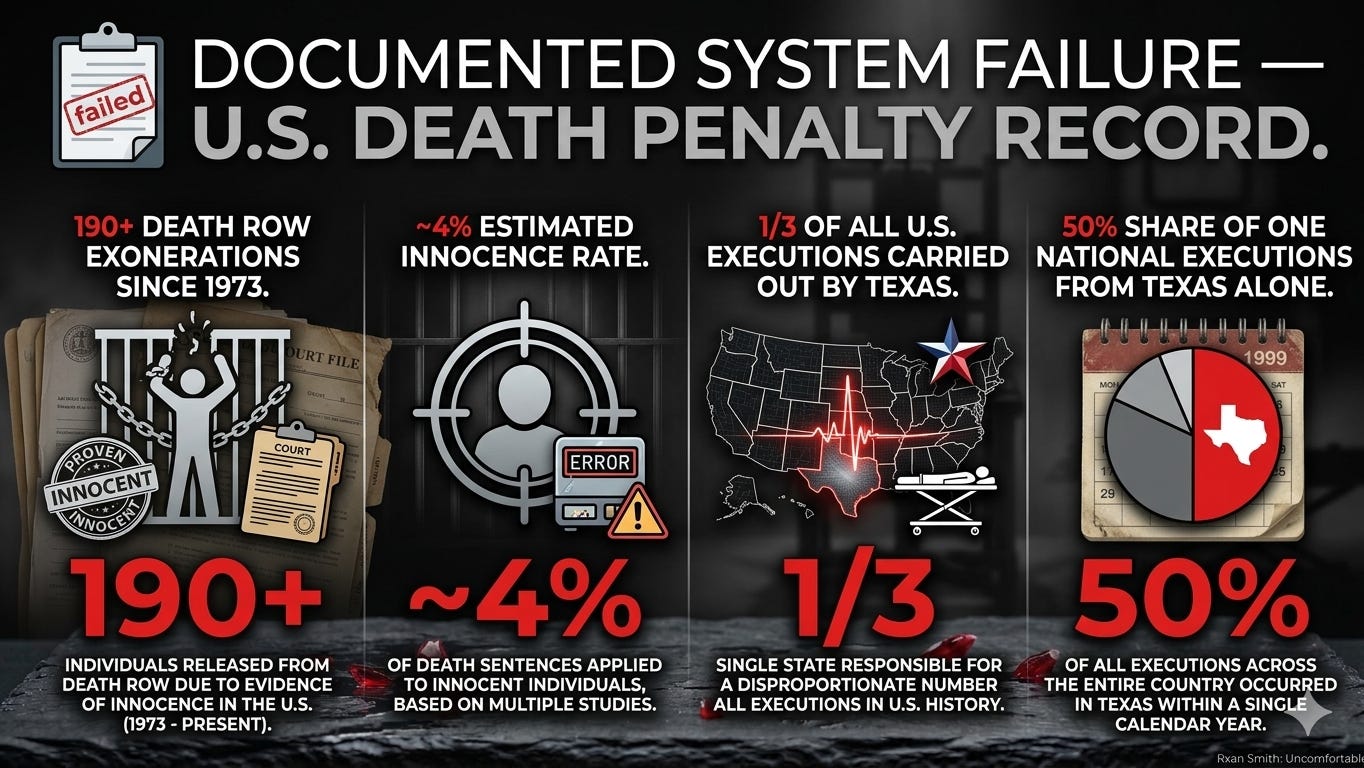
Those aren’t arguments. Those are documents. Every one of those exonerations is a person who was days — sometimes hours — from being killed by the state for something they did not do. And those are only the ones we caught.
The ones we didn’t catch are buried.
You cannot be sure of his guilt. You simply cannot. And failing that… how can you kill him?
Paraphrased from legal arguments before a Texas appeals court
That question has never been adequately answered. Courts have a habit of treating it as rhetorical when it is, in fact, the only question that matters.
And the answer to uncertainty should not be confidence. Confidence is not the same thing as being right. DNA exonerations shook public trust precisely because they proved what courts kept refusing to admit: “guilty beyond a reasonable doubt” and “actually guilty” are not identical concepts. If we are still discovering innocent people decades after their conviction, the death penalty is not an expression of certainty. It is an expression of confidence. And that difference is everything when the sentence cannot be reversed.
The Consensus That Isn’t
Proponents of capital punishment often invoke the phrase “national consensus.” It is a phrase that has done a great deal of work it was never qualified to do.
When Louisiana moved to expand the death penalty to non-homicide cases — specifically, child rape… the argument was made that other states were joining a movement. The count at the time: five states. Five. That was the consensus. And of those, Louisiana stood alone in authorizing death for first-time offenders.
More telling: the people who work closest to child abuse victims — doctors, social workers, trauma specialists — filed legal briefs asking the court to strike the law down. Not because they were soft on child rape. Because they understood something the lawmakers didn’t, or chose not to: children are less likely to report abuse when the penalty for the abuser is death. No child wants to be responsible for a family member’s execution. And child testimony, under pressure, under coercion, in a system that needs convictions — is among the least reliable evidence in the criminal canon.
System Failure Point — Child Testimony
Children are uniquely susceptible to suggestion and coercion. Prosecutions built on child witness testimony have one of the highest rates of wrongful conviction in the American legal system. Adding capital punishment to that equation does not make justice more certain. It makes irreversible mistakes more likely. The worst outcome isn’t an acquittal. It’s execution. And we reach that outcome before discovering the error.
The “national consensus” argument is, in practice, a political argument dressed in judicial language. Death penalty laws are not crafted by criminologists. They are passed by politicians running for re-election who need to appear tough on crime before November. The laws reflect electoral calendars, not data.
The Pandora’s Box Problem
Here is where the conversation always goes sideways, and it needs to be said plainly.
The instinct is understandable. If any crime deserves death, surely it’s something worse than ordinary murder. Surely it’s the predator who destroys a child. Surely it’s the monster who has no remorse, who laughs in court, who tattooed his ideology onto his face. Surely the man who confessed to everything and is proud of it is the one case where the state can act with confidence.
Maybe. Probably. That instinct is not wrong.
But the moment you start designing a tiered system of which crimes deserve death, you have handed politicians the most dangerous toy in the democratic arsenal. You have given them the power to define “the worst of the worst” — and that definition will expand. It always expands.
It expands toward drug trafficking.
It expands toward repeat offenders.
It expands toward political enemies.
It expands toward people who frighten the current majority.
History has a very consistent record on this point.
Historical Data
Capital offense lists have expanded in every country that has retained the penalty over 50+ years.
88% of countries have had their lists expanded
What begins as a society saying we reserve this for the absolute worst becomes, within a generation or two, a society where the absolute worst has been quietly redefined to include whatever the powerful want it to include.
That is not a slippery slope fallacy. That is recorded history. It is what dictatorship looks like in slow motion.
The Race Arithmetic Nobody Wants To Print
Louisiana executed twenty-nine men for rape over a hundred-year span. All of them were Black.
This is not an accusation. It is a documented statistic from the state’s own records. And it forces a question that the death penalty debate in this country perpetually refuses to sit with: if the penalty is applied in a racially disparate pattern over a century, at what point does the pattern become the point?
The building that houses the Supreme Court reads “Equal Justice Under Law” across its facade. It is a beautiful sentence. It describes an aspiration that the legal system has spent most of its history failing to meet, particularly when the sentence in question is permanent.
The one defendant singled out for death was the one with an IQ of seventy. Does it strike anyone as coincidental that the only man selected for execution from an entire pool of prosecutions was the one who was least equipped to defend himself?
Paraphrased from capital appeals arguments, Louisiana case
That is the system working exactly as designed — or, more precisely, exactly as it has always worked. The death penalty does not fall equally. It falls on the broke, the under-represented, the mentally diminished, and, at statistically undeniable rates, the Black and brown.
This is not a political argument. It is an actuarial one.
The Innocent Man They Moved To Huntsville Anyway
Consider the mechanics of an execution in a state still running its appeals.
A court denies a final appeal. Six hours before the ruling, the condemned is transferred to the death house — regardless of any pending hope. That is not cruelty for its own sake. That is logistics. The system has timetables. The system has procedures. The system does not pause for mercy.
A man with an IQ of eighty was interrogated for sixteen hours. His lawyer, by the lawyer’s own admission, was abusing cocaine and alcohol during trial. The lawyer never gave an opening statement. Never cross-examined several prosecution witnesses. Never pursued sentencing arguments. A later court reviewed all of this and ruled the representation “adequate.”
Legal Concept.. Ineffective Counsel Standard
The legal standard for “ineffective assistance of counsel” is extraordinarily difficult to meet. Courts have ruled that a lawyer who never gave an opening statement, never questioned prosecution witnesses, and was chemically impaired throughout trial still met the constitutional minimum. This is the system’s self-designed floor for what it considers acceptable defense. If the floor is this low, the people most likely to fall through it are the ones least able to afford a ladder.
And here is the part the appeals process will not say out loud: when innocence becomes irrelevant during a discussion about execution, the system has stopped searching for justice and started protecting procedure.
DNA placed someone else at the scene. Not an alternative suspect in theory — actual DNA evidence. The court’s response: that does not disprove your client was also present. Which is technically true and morally catastrophic as a standard for killing someone.
The man asked to be remembered as strong. He got ice cream before the injection. Chocolate, maybe with sprinkles. He wasn’t sure about the sprinkles.
He was executed anyway.
What The Process Actually Protects
The finality of execution is also the finality of inquiry.
Prison allows for new evidence. New DNA. New witnesses. New legal standards. Death forecloses all of it. Every execution is not just a sentence carried out — it is every future discovery about that case, permanently ended. The system isn’t just killing the person. It’s killing the question.
The Evolving Standard Nobody Wants To Admit Has Evolved
The international standard on capital punishment has moved. This is not opinion. It is observable fact.
The majority of the world’s nations have abolished the death penalty in law or practice. The countries that retain it most aggressively are not a list that any American politician running on exceptionalism wants to be associated with. When a legal argument was made that the U.S. was joining an international consensus by expanding capital punishment to non-homicide rape, the company in that consensus included Saudi Arabia, Uganda, and China.
That is not a rhetorical cheap shot. That is the actual coalition. And if the standard for what constitutes civilized criminal justice is meant to evolve — which American courts have explicitly held it does — then it has evolved in one clear direction. The U.S. is not leading it.
Meanwhile, the Pope has now formally and explicitly condemned capital punishment as inadmissible. Not hedged. Not nuanced. Inadmissible. The moral authority most associated with the sanctity of life has taken its position. Reasonable people can disagree with the Vatican on many things. But when the institution most theologically committed to eternal damnation as ultimate consequence has concluded that the state shouldn’t kill people — it is worth asking what that institution understands about irreversibility that we don’t.
What This Is Actually About
The death penalty conversation always gets framed as a question of desert. Do they deserve to live? That framing is the trap.
It is the wrong question. The right question is: Are we qualified to answer it?
Laws aren’t written for easy cases. They are written for the hard ones.
The defendant with a low IQ.
The defendant represented by an exhausted public defender.
The defendant whose confession came after sixteen hours of interrogation.
The defendant convicted on eyewitness testimony.
The defendant convicted before DNA existed.
The defendant who insists he’s innocent while everyone rolls their eyes.
History is littered with people who looked guilty right up until the moment they didn’t. The death penalty asks us to pretend that certainty exists in a system that routinely demonstrates the opposite.
The man who confessed, who laughed, who decorated his face with symbols of mass murder — he is not a sympathetic figure. Nobody is asking you to feel sorry for him. But here is what we know: the same system that would put a needle in his arm is the system that put an innocent woman away for a car accident that couldn’t legally be charged as murder in most states. The same system that produced that outcome is the one you are being asked to trust with a decision that cannot be walked back.
The question is not whether some people deserve to die. The question is whether you trust this system… overburdened, under-resourced, racially skewed, politically influenced, and demonstrably wrong at a documented rate… to correctly identify which ones.
And then to kill them before anyone finds out the mistake.
Here’s the part nobody says out loud: this isn’t a debate between bloodthirsty conservatives and soft-on-crime liberals. That’s a cable news construct.
The real divide is between people who trust the system enough to let it make permanent decisions — and people who have read the documented error rate and concluded that permanent decisions require a level of certainty the system has never demonstrated.
We have a show on Netflix right now that documents a woman convicted of murder for a car accident in a case that most prosecutors in most states would not have brought. We have another that puts a camera on a man who killed people, desecrated bodies, and wears his ideology carved into his face.
And we have a system that, given access to both of them, cannot reliably tell you which one should spend the rest of their life in prison — let alone which one the state should put down.
The death penalty is not a question of whether monsters exist. They do.
It is a question of whether you can trust the monster-identification process. And if you’ve been paying any attention at all — to the exonerations, to the disparities, to the coerced confessions and the impaired lawyers and the all-white juries and the children who got it wrong — you know the answer.
I understand the argument that some people deserve death. There are cases that test my own convictions. But the death penalty was never ultimately about the worst criminal.
It was always about the government.
The question isn’t whether the monster deserves to die. The question is whether you trust the same institutions that lose evidence, misidentify suspects, coerce confessions, overturn convictions, and release the wrong people every year to make an irreversible decision in your name.
Because once government acquires the power to kill, the real danger isn’t what happens when it gets it right.
The real danger is what happens when it gets it wrong. And history suggests that eventually, it always does.
We are not playing God because we are righteous enough to do it. We are playing God because no one has yet built a courtroom large enough to hold our arrogance.
Rxan Smith: Uncomfortable
rxansmith.substack.com
uncomfortable.rxansmithmedia.com
uncomfortablerxansmith@gmail.com
Anti-partisan. Both sides held accountable. Every time.
You can paste this directly under the article as a source section:
Sources & Further Reading
Wrongful Convictions & Death Row Exonerations
Death Penalty Information Center, Innocence Database
Since 1973, at least 202 people who were wrongly convicted and sentenced to death have been exonerated in the United States.Death Penalty Information Center, The 200th Exoneration Underscores Critical Flaws in the U.S. Criminal Legal System
More than 70% of death-row exonerations involved official misconduct by police, prosecutors, or other government officials.Innocence Project, Innocence and the Death Penalty
Citing DPIC data, the Innocence Project notes that at least 200 people have been exonerated from death row since 1973 and references research estimating that approximately 4% of death-sentenced prisoners may be innocent.Equal Justice Initiative, Death Penalty
Documents more than 200 death-row exonerations and details systemic issues involving race, poverty, and ineffective legal representation.
Race & Capital Punishment
Equal Justice Initiative, Study Finds Racial Bias in Louisiana’s Death Penalty
Found that Black defendants accused of killing white victims received death sentences at dramatically disproportionate rates compared to other homicide cases.Death Penalty Information Center, Louisiana Study Finds Race and Gender Bias in Capital Sentencing
Documents the continuing impact of race and victim demographics on death sentencing outcomes in Louisiana.NAACP Legal Defense Fund, Death Row USA
Reports that at least 108 of the nation’s death-row exonerees are Black and discusses racial disparities throughout capital punishment systems.
Child Rape & The Death Penalty
Kennedy v. Louisiana, 554 U.S. 407 (2008)
The U.S. Supreme Court ruled that the death penalty for child rape where the victim did not die violates the Eighth Amendment.Cornell Law School, Kennedy v. Louisiana Resource Materials
Documents that only a handful of states had enacted child-rape death penalty statutes when Louisiana argued a national trend existed.
Louisiana Wrongful Convictions
Justice & Accountability Center of Louisiana, Wrongful Convictions in Louisiana
Louisiana has one of the highest known wrongful-conviction rates in the nation, with documented exonerations across numerous parishes.ACLU, Damon Thibodeaux Exonerated After 15 Years on Louisiana Death Row
DNA evidence and subsequent investigation established that a man sentenced to death for rape and murder was innocent.
Thank you for taking on this topic. Sadly, it continues to demand our attention. The problem is that people are mistakenly found guilty and sentenced to death. Even 1 case of this type requires us to stop this barbaric practice.