

The Blueprint Democrats Ignored — and Why It Might Be America's Last Chance to Rebuild: Enter a 2020 Plan That Speaks For Itself Today
From Tech Entrepreneur & UBI Pioneer to Reluctant Disruptor, Andrew Yang Could Torch-Pass MAGA Energy into a Fairer America for people who want true Progressive Change for a Disappearing Middle Class

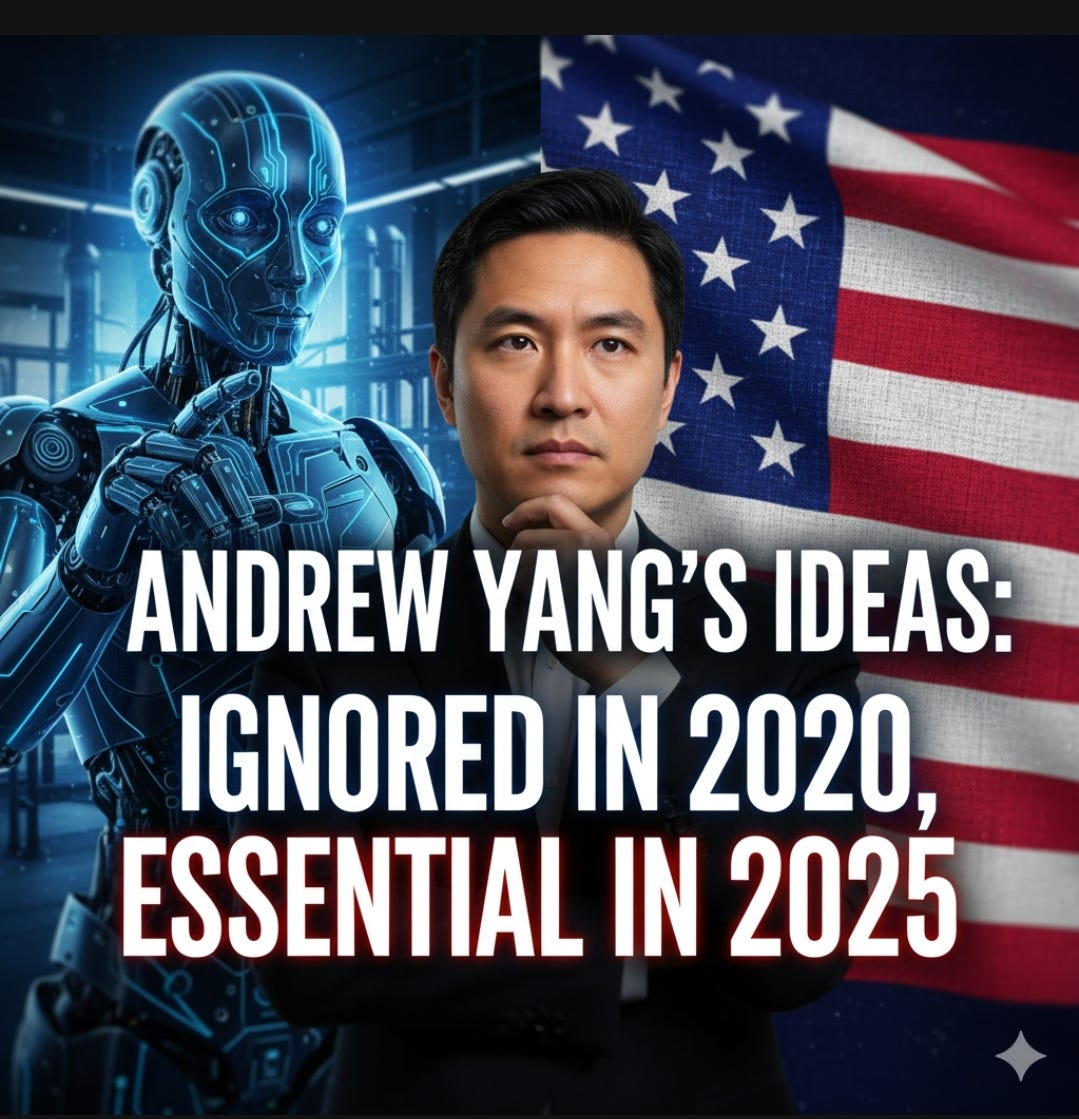
The Blueprint Democrats Ignored — and Why It Might Be Their Last Chance
As Democrats hunt for fresh leadership post-shutdown, Andrew Yang’s 2020 vision—UBI, ranked-choice voting, people-first policies—offers the blueprint to rebuild. Demand it now or watch the party fade.
Democrats need to parlay the energy from the No Kings Day Rally and last week’s elections into a three-year march toward something bigger. That energy should fuse diverse voices into one demand: the resurrection of a plan we already had in 2020 but foolishly abandoned. Why was it abandoned? Because, like the GOP, the Democratic Party is owned by corporations and billionaires who refuse to let anyone remind them their job is to govern for the people, not the donors.
And so we keep getting candidates offering different takes on the same safe half-measures—band-aids on a system bleeding out.
Imagine this:
It’s 2030. Your job’s been automated out of existence by an AI that works tirelessly without complaint. Your savings are drained by healthcare costs and climate disasters that swallowed your hometown. Corporations like Amazon amass trillions tax-free while you’re piecing together gig work, wondering how the American Dream became a survival game.This isn’t sci-fi—it’s the path we’re already on. One man laid to sell clearly over five years ago.
Back in 2020, Andrew Yang foresaw it all, offering bold solutions like Universal Basic Income, human-centered capitalism, and even turning Tax Day into a national holiday. We dismissed him as an eccentric outsider. Now, with AI replacing jobs en masse and inequality boiling over, his ideas aren’t just timely—they’re our last lifeline before collapse.
But in a world where partisanship trumps foresight, who listens to prophets?
Yang’s platform burst onto the scene like a system glitch—pragmatic, data-driven fixes from an entrepreneur who had revitalized Rust Belt communities. UBI to cushion the AI apocalypse. Corporate-accountability reforms to rein in greed. Policies that put people before profits.
Yet Democrats, obsessed with defeating Trump, sidelined him. It wasn’t about governing with vision; it was about survival. The 2020 primary felt rigged, shoving aside disruptors like Yang and Tulsi Gabbard for a Biden coronation. The VP pick checked boxes but lacked spark, and the administration governed on autopilot: no bold blueprint, just incremental tweaks while automation advanced, healthcare crushed families, and corporations dodged taxes.
Democrats often shame without governing effectively, while Republicans govern without shame. Beating Trump wasn’t enough—we needed to govern like it mattered.
Instead, we got a mismatched ticket—a shoe and a mop. The joggers loved the shoe, the cleaners the mop, but Middle America needed a plan. Without one, the 2024 rout was inevitable: Trump’s return, a hemorrhaging Democratic base, and the installation of DNC chair Ken Martin to pick up the debris. If I were writing this Substack one year ago, I would have had about 10 posts between July and November detailing every single reason that every single move the party made would lead to a lost election. When people told me that they were certain Paris would win I sometimes wondered if they were being serious because I couldn't fathom that anyone could actually believe that. It's not necessarily HER fault but I could see a carefully orchestrated plan unfolding with one inexplicable move after another by the Democrats after Trump was shot.
(You can read more about that in this article How & Why the Dems USED Kamala to tank 2024 Election but keep reading right for now because this article has all of these things that you need to know to begin to actually reform the country). I'll repost this link at the bottom
From 2024/5 chaos comes 2026+ opportunity.
We don’t need new slogans. We need new spine. Andrew Yang’s 2020 blueprint—UBI, ranked-choice voting, people-first capitalism—wasn’t radical. It was reality catching up. The party that revives it will own the future. The one that ignores it will vanish.
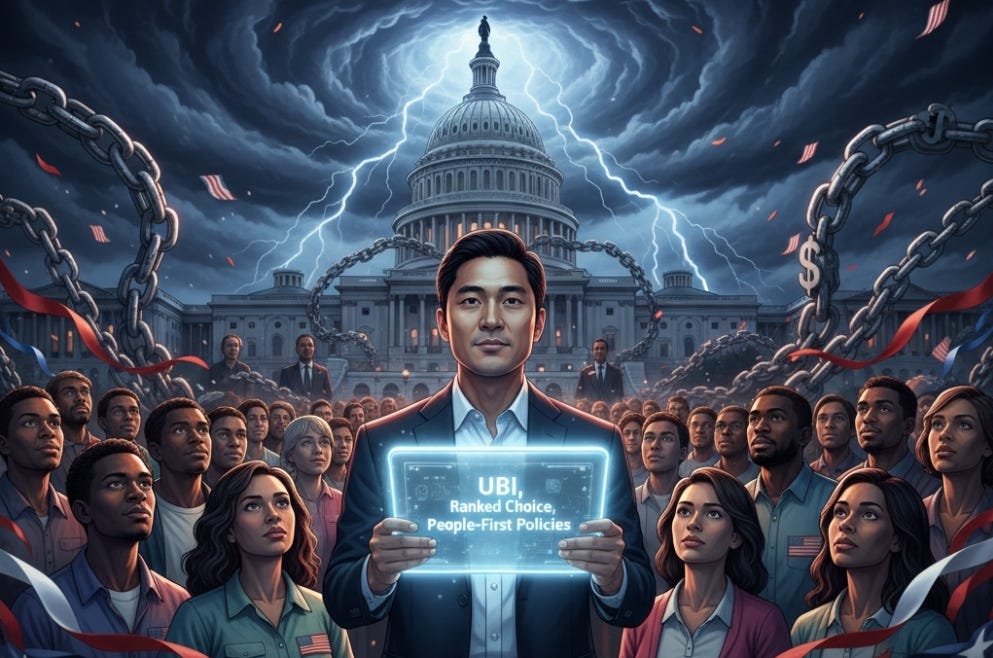
Let’s Cut to the Chase
This country doesn’t need tweaks—it needs restructuring. A hard reset that puts people over profits without torching the engine that built us.
Yang tried to play within the system, threading the needle between innovation and accountability. And yet, like Tulsi Gabbard before him, he got the boot from the Democratic primaries. Two of their most intriguing candidates in a generation—both skewering the establishment with surgical precision—both drummed out for daring to question orthodoxy.
Tulsi found comfort on the right, embraced for her anti-interventionist grit.
Yang founded the Forward Party—a centrist refuge for the disaffected—but even there, he’s a prophet without a congregation.
Republicans might scoff, but maybe they shouldn’t. He’s not the caricature they imagine—no virtue-signaling platitudes, no endless grievance cycles. And no, he’s not flipping parties. The point is deeper: his ideas transcend the divide, forcing America to reconsider what “values” actually mean.
In a time when trust in institutions is at rock bottom, Yang’s exile reveals how both sides now prize loyalty over ingenuity.
The left pushed him out for being too pragmatic, too willing to mix markets with morality.
The right? They see the same betrayal they feel in their own ranks.
Both parties’ leadership—those cozy insiders who’ve turned politics into a club—couldn’t handle a man speaking directly to working stiffs, small-business owners, and families just trying to keep the lights on.
Tulsi called out forever wars.
Yang called out forever inefficiencies.
Result? Exiled.
But here’s the uncomfortable invitation: listen to his policies anyway.
I’ll frame them not as liberal wish lists, but as targeted, cross-partisan fixes that respect conservative values—personal responsibility, fiscal discipline, and secure borders—while restoring progressive ideals like fairness, dignity, and innovation.
Unlike politicians who promise the moon without a map, Yang’s approach is data-driven, not dogmatic.
He doesn’t demonize success; he demands it be shared fairly.
To maximize impact, we’ll start where frustration runs deepest: taxes and borders.
Then move through economic fairness, healthcare, and climate reform reframed as working-class protection.
Finally, we’ll end with the Freedom Dividend—Yang’s boldest idea, but the one that ties everything together.
Rooted in The War on Normal People, these aren’t hypotheticals.
They’re detailed, actionable plans—problems identified, goals measured, implementation mapped.
This isn’t about left or right.
It’s about what works.
The left pushed him out over ideology—too pragmatic, too willing to embrace markets with guardrails. The right? Well, if you’re guessing they see echoes of their own frustrations in his sidelining, you’re not wrong. Both parties’ leadership—those cozy insiders who’ve turned politics into a club—couldn’t handle a guy who spoke directly to the working stiffs, the small-business owners, the families just trying to keep the lights on. Tulsi called out forever wars; Yang called out forever inefficiencies. Result? Exiled. But here’s the uncomfortable invitation: Listen to his policies anyway. I’ll frame them not as liberal wish-lists, but as targeted fixes that respect right-wing principles like personal responsibility, fiscal smarts, and strong borders. Unlike the bombast from other candidates who promised the moon without a map, Yang’s approach is different because it’s grounded in data, not dogma. He doesn’t demonize success; he demands it be shared fairly. To maximize appeal, we’ll start with everyday frustrations like taxes and borders that hit everyone, move to economic fairness and healthcare that bridge divides, tackle climate as a working-class issue, and cap with the Freedom Dividend—his boldest idea, but one with surprising bipartisan roots that ties it all together. Drawing from his 2020 platform and insights from his book The War on Normal People, these aren’t hypotheticals—they’re detailed, actionable plans he laid out, complete with problems solved, goals set, and implementation steps. The order here starts with ideas that feel centrist or even leaning right—practical, efficiency-focused reforms—then shifts toward more inclusive approaches that might lean left, before landing on something truly new: an innovative policy that’s neither left nor right, but a fresh ideology for our automated future.
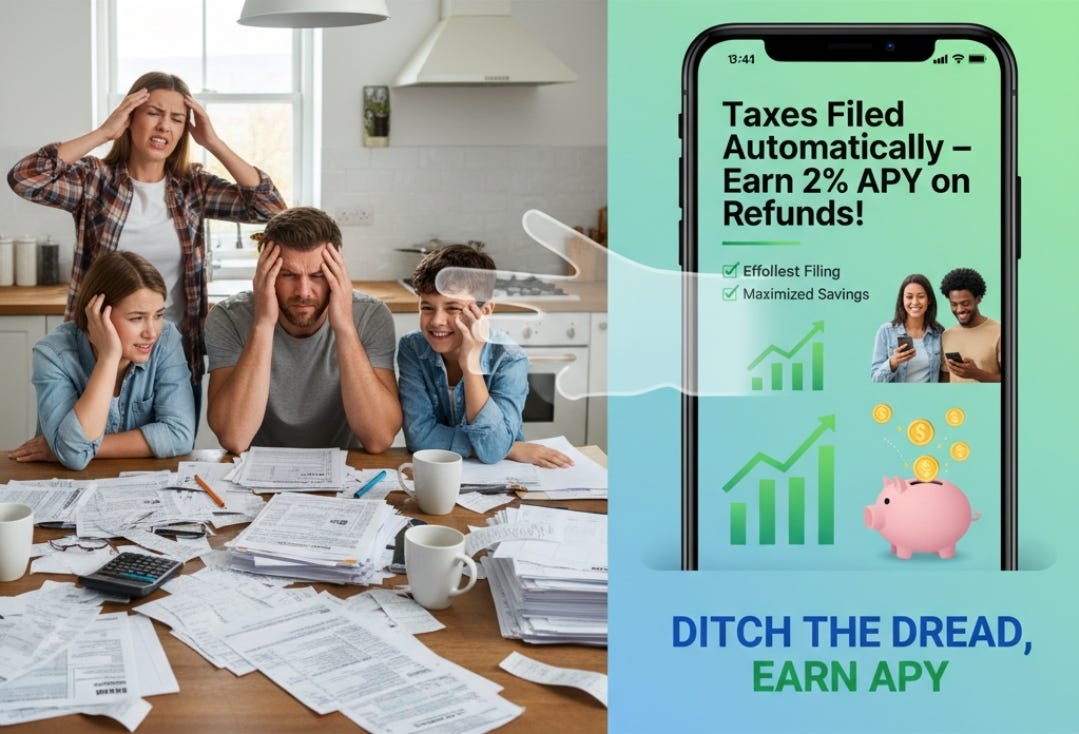
Make Taxes Fun: Ditch Dread, Embrace Patriotism
Let's kick off with something that unites us all: the universal hatred of tax season. Who among us hasn't cursed the IRS come April, buried under a mountain of receipts, software glitches, confusing forms, and the looming fear of audits that could drag on for months? It's a national ritual of pain—75% of Americans get refunds, meaning they've essentially given the government an interest-free loan all year long, tying up money that could be in their pockets for bills or investments. The other 25% scramble to find cash for balances, adding unnecessary stress and sometimes penalties. Preparing returns devours countless hours (or hundreds in accountant fees), and audits? They're a nightmare of extra costs, time, and anxiety, even if you've done nothing wrong—often hitting small errors from the system's own complexity.
Yang flips this entire script, transforming taxes from a dreaded burden into a patriotic celebration called Revenue Day—a federal holiday where we highlight what our contributions actually achieve, like new bridges, veteran care, disaster relief, or community projects that make America stronger. Unlike approaches that focus solely on raising rates or cutting them without addressing the mess, Yang's plan is different: It's about radical simplification, empowerment, and accountability. Instruct the IRS to implement an opt-in system where they auto-file your taxes using data they already collect (from W-2s, 1099s, bank reports, and more), calculating accurately to ensure you keep more money throughout the year—no more over-withholding or pricey prep services like TurboTax or H&R Block. If there's a balance due, it's straightforward and fair; if a refund, it's processed faster, injecting cash back into the economy sooner.
To combat evasion and bring the agency into the 21st century, increase the IRS budget by 50% to about $17 billion, equipping it with AI and cutting-edge tech to boost compliance and efficiency—this isn't bloating government; it's a smart investment that pays for itself many times over through recovered revenue (closing the $600 billion annual tax gap) and reduced citizen waste. The truly innovative part? On Revenue Day, send every taxpayer a personalized breakdown of where their dollars went (e.g., defense, education, foreign aid), complete with stories and impacts, and let each direct 1% of their taxes to a specific project, department, or initiative—like the National Endowment for the Arts, Veterans Affairs, rural broadband, or space exploration. Highlight completed projects from the prior year with inspiring visuals and real-world testimonials, and tease upcoming ones to build national excitement and pride.
This shifts the entire narrative: Taxes aren't theft or punishment; they're investments in our shared society, with transparency and choice baked in. Imagine less bureaucratic hassle, more personal control over spending, and a system that fosters ownership, patriotism, and efficiency—turning a pain point into a point of unity. It's capitalism with a user-friendly, accountable upgrade—why not rally around that? This appeals broadly because it touches everyone who files taxes, saving time and money while restoring faith in government, starting from a place of practical reform that feels centrist at its core.
Border Security: Smart Walls, Not Symbolic Ones

Next up: Borders, an issue that divides but shouldn’t—most Americans want security without cruelty or waste. If there’s one area where Yang sounds like he could grab a beer with border-state conservatives, it’s this. Unlike approaches that downplay enforcement or fixate on massive concrete monoliths that ecology experts decry as environmental disasters, ineffective boondoggles, and symbols over substance (costing billions while ignoring how most crossings happen elsewhere), Yang’s plan is pragmatic, tech-savvy enforcement that prioritizes results over rhetoric. He recognized the core problems: Large numbers of unauthorized entries straining resources, risky crossings that endanger lives and fuel humanitarian crises, cartels trafficking drugs (like fentanyl, killing 100,000+ Americans yearly) and humans across the border, an overwhelmed asylum system buried in backlogs that delays justice for all, and a political debate stuck on single, flashy solutions like a full-length wall that would disrupt ecosystems, cost $20-30 billion, and fail to address ports where 90% of threats enter.
Yang’s approach? Beef up those ports of entry—where a staggering 90% of drugs and most unauthorized crossings actually occur—with increased funding for advanced detection tech (scanners, AI screening) and personnel to intercept threats at the source. More resources for Customs Enforcement teams specifically tasked with dismantling human trafficking networks, protecting vulnerable women, children, and migrants from exploitation while securing the homeland—saving lives on both sides. For the remote, sparsely crossed stretches of the 2,000-mile border, deploy efficient, non-intrusive technologies like ground and aerial sensors, video towers, drones, and satellite monitoring to detect and respond without the ecological devastation or massive upkeep of physical barriers. Mandate body cameras for all border agents to ensure accountability, reduce corruption risks, and build public trust via transparency—body cams have proven to de-escalate encounters and protect officers too.
And here’s a smart nod to natural and bilateral solutions: Invest heavily in protecting and renewing the Rio Grande, which already serves as a formidable natural boundary but is ecologically struggling due to overuse, pollution, and climate stress—revitalizing it would enhance security while supporting local ecosystems, agriculture, and communities on both sides. He’d collaborate directly with the Mexican government on joint anti-cartel initiatives, sharing intelligence, resources, and economic development aid to stem violence spillover and address root causes like poverty driving migration. Finally, provide all necessary funding to overhaul the asylum court system, hiring more judges and staff to slash backlogs so legitimate claims are processed swiftly and fairly—distinguishing between economic migrants and true refugees without overwhelming resources or detaining families indefinitely.
Goals? Safeguard Americans from threats, drastically cut illegal drug flows that devastate communities, end human trafficking horrors, prevent cartel violence from bleeding north, and ensure a humane experience for asylum seekers that upholds the rule of law. This isn’t lax policy or performative toughness; it’s efficient, no-nonsense security that saves taxpayer dollars, preserves lives, and respects sovereignty—drawing on expert input from border agents, immigrant advocates, and international partners. This aligns perfectly with emphasis on law and order, fiscal responsibility, and strong international partnerships, minus the wasteful theater of symbolic gestures. Why kick out a guy pitching real, measurable results that could have bipartisan buy-in? It appeals widely because it addresses safety concerns without demonizing people, focusing on solutions that work for red and blue states alike, leaning into centrist pragmatism from the start.
Value-Added Tax (VAT) : Close Corporate Loopholes
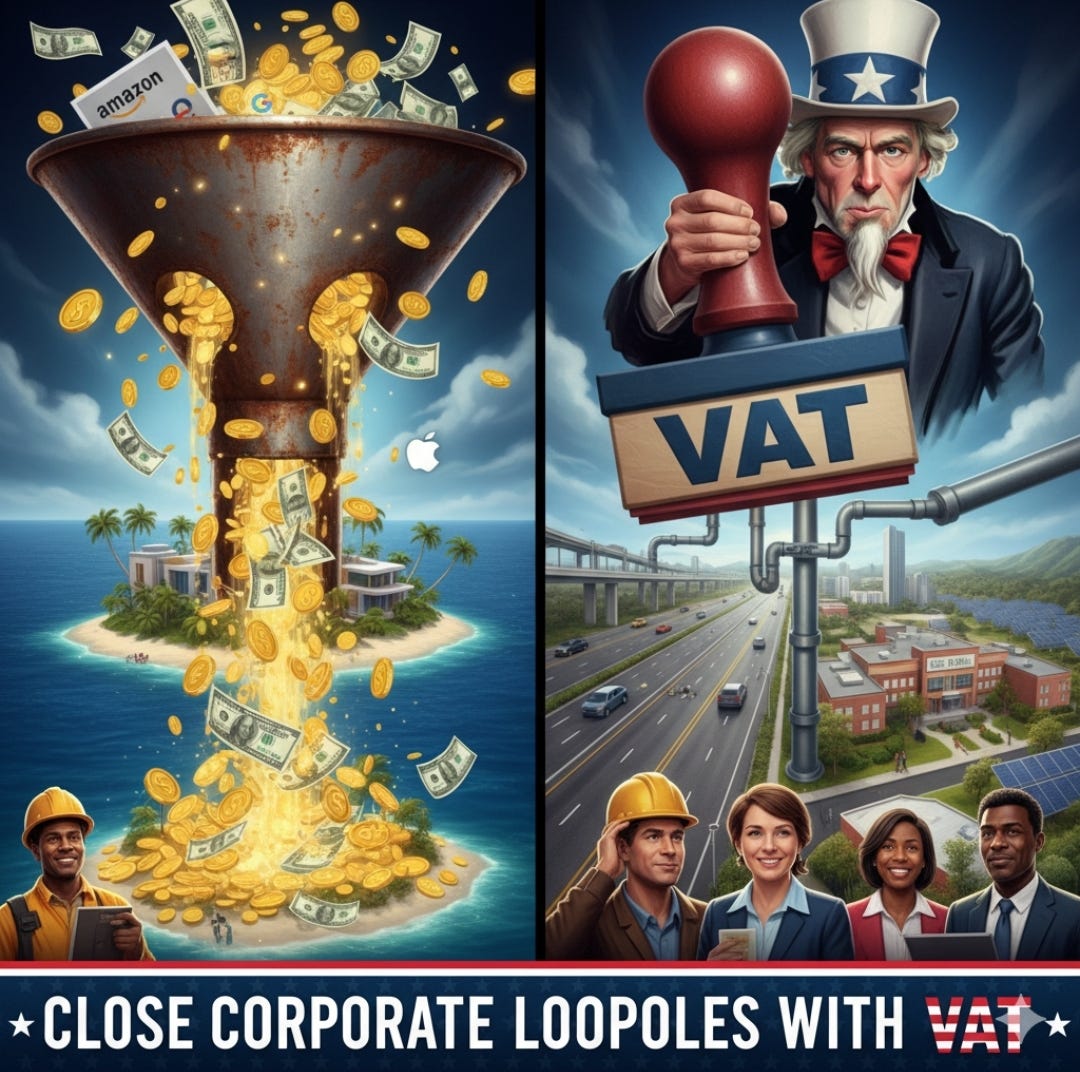
Clever metaphors and comparisons that are based in facts paying less in taxes is the absolute Cornerstone of the right wing and has been since the beginning of time but the problem is that when you get to a certain level of success the people that enforce tax law are not as smart as the ones that you can hire as forensic accountants and lawyers to help you avoid paying taxes. So i want to start with saying listen we all have to admit that if we're not worth hundreds of millions of dollars or CEO of the Fortune 500 company we have no idea what that tax game looks like and it's more something that's sold to us that we truly don't care about but I promise if you knew the truth you would care and you would say that's not left when we're right when that's just literally raping the country that allows you to do business here and we are the country we are the Americans so you can't do that. When you see that companies in Europe and Asia pay double in value-added tax than what we are proposing here, proposition by the way that puts $1,000 a month extra in everyone's pocket right off the bat before any other changes and that companies are still going to be posting profits in the high billions and the big difference will be that the profits are actually accurate and not things that you need to guess because of all the secret write-offs and offshore account. Building on taxes and fairness, Yang’s Value-Added Tax (VAT) tackles the elephant in the room: How corporations and the ultra-rich game the system, dodging billions while everyday workers foot the bill. Think of it like a toll on America’s economic highway—everyone who uses the road pays a small fee at each stop, with bigger trucks (corporations) naturally contributing more because they haul heavier loads. Currently used in 160 countries (every developed nation except the U.S.), a VAT is a 10% levy on goods and services—half the European average—applied at each supply-chain stage, making it nearly impossible to evade. Big tech like Amazon, Google, and others funnel hundreds of billions overseas, paying zero taxes despite profiting massively from American infrastructure, consumers, and innovation. Yang highlighted how income taxes are increasingly ineffective in an automated economy: “Take a company like Amazon—it can do tens of billions in business and pay no income tax while storing income overseas.” Corporations exploit deductions and loopholes that average Americans could never dream of—like writing off massive investments as if buying a house erased your entire year’s income, leaving them paying a fraction of what they should.
Unlike wealth taxes that get gamed and repealed abroad (as seen in Europe) or traditional income taxes that miss automation’s true value, Yang’s VAT is evasion-proof: If you do business here, you contribute. Exempt or low-rate staples like food and necessities to protect low-income folks, while hiking rates on luxuries for progressivity—ensuring it’s not regressive. This generates consistent revenue as robots and AI take over jobs, ensuring the winners of the 21st-century economy—like trillion-dollar tech firms—pay their fair share. Problems solved: Corporations avoiding taxes, disproportionate burdens on the least wealthy, funding social services without relying on volatile income streams. Goals: Create an unavoidable revenue stream that grows with automation, funding initiatives like the Freedom Dividend without punishing individuals.
Don’t think of this as anti-conservative because it asks companies to pay more—think of it as restoring fairness and closing the barn door before more horses escape through loopholes. After all, this tax would be half of what successful European nations like Italy (22% VAT) and France (20%) charge, and look at their thriving luxury brands: Ferrari posted a net profit of 1.5 billion euros in 2024 with an EBITDA margin of 38.3%; Lamborghini raked in 3.09 billion euros in revenue the same year with a 27% return on sales; Gucci, part of France’s Kering group, contributes to billions in annual profits despite the higher rates. These icons of innovation and craftsmanship aren’t crying broke—they’re booming, proving that a sensible VAT doesn’t stifle success; it sustains the ecosystem that makes it possible. In the U.S., corporations were supposed to pay 35% before the 2017 cut to 21%, but many now effective rates dip to around 15% or less (Amazon at just 6% on 35 billion in 2021 income). No corporation making billions should pay a lower effective rate than an American earning $80,000—it’s like letting the biggest players in a game rewrite the rules mid-play while the rest follow them strictly. Without a VAT, the wealthy hire armies of accountants to find write-offs, but this simple mechanism levels the field, bringing in hundreds of billions without needing a label. It’s our only practical option in an age of global loopholes, appealing to principles of equity on one side and market integrity on the other
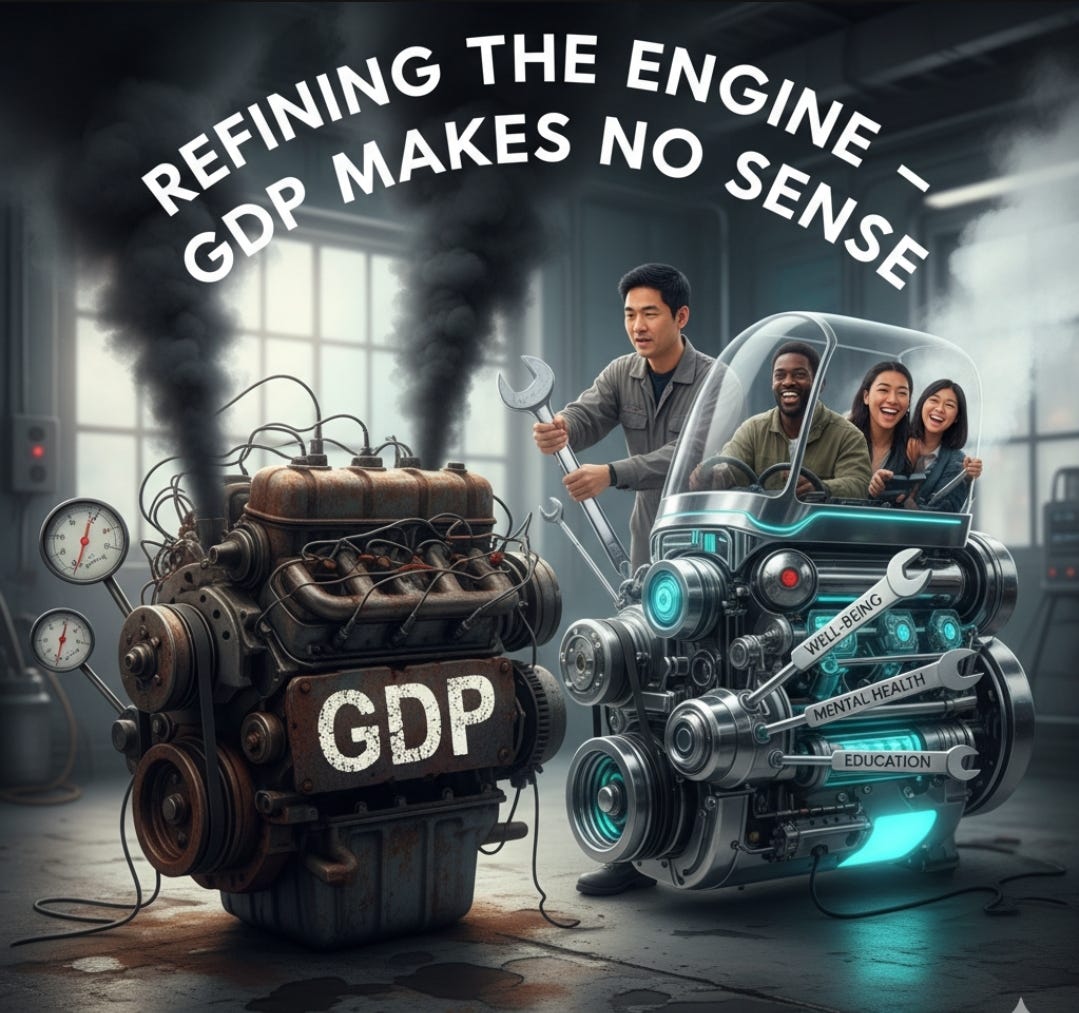
Human-Centered Capitalism: Upgrading the Engine, Not Scrapping It – How GDP Measures Nonsense
Yang didn’t hate capitalism—he revered it as the force behind unparalleled innovation and human progress, but argued our current version, “institutional corporatism,” has veered off course, prioritizing corporate profits over people. As he put it in his book The War on Normal People: “Capitalism is a wonderful, magical, powerful thing. But it optimizes for capital efficiency above all else.” This leads to suboptimal outcomes: Airlines bumping loyal customers for higher bidders, pharma companies jacking up life-saving drugs because desperate patients have no choice, or automation enriching a few while gutting communities—think record GDP highs masking epidemics of depression, financial insecurity, and student debt.
Yang’s vision upgrades to “Human-Centered Capitalism,” where the economy’s unit is each person, not each dollar. Core tenets: Humans are more important than money; markets exist to serve common goals like health, education, and family stability; focus on maximizing human welfare through metrics beyond GDP. Government steps in to correct market failures, like when profit motives undervalue essential roles (caregiving, teaching) or exacerbate issues like job loss from AI—ensuring the system works for the many, not just the mighty.
This resonates with those who built this nation on innovation, faith, and community: It’s Henry Ford’s ethos—pay workers enough to buy the cars—updated for the digital age. In an era where automation threatens to “disintegrate society,” as Yang warned, it prevents a “war on normal people” by ensuring progress benefits all. Not revolution—evolution toward a system where markets serve us, not the other way around. It appeals broadly by honoring capitalism’s strengths while fixing its flaws, speaking to entrepreneurs and workers alike, bridging centrist efficiency with a more inclusive lean.
Medicare for All: Root Out Healthcare Waste, Don't Just Expand the Mess
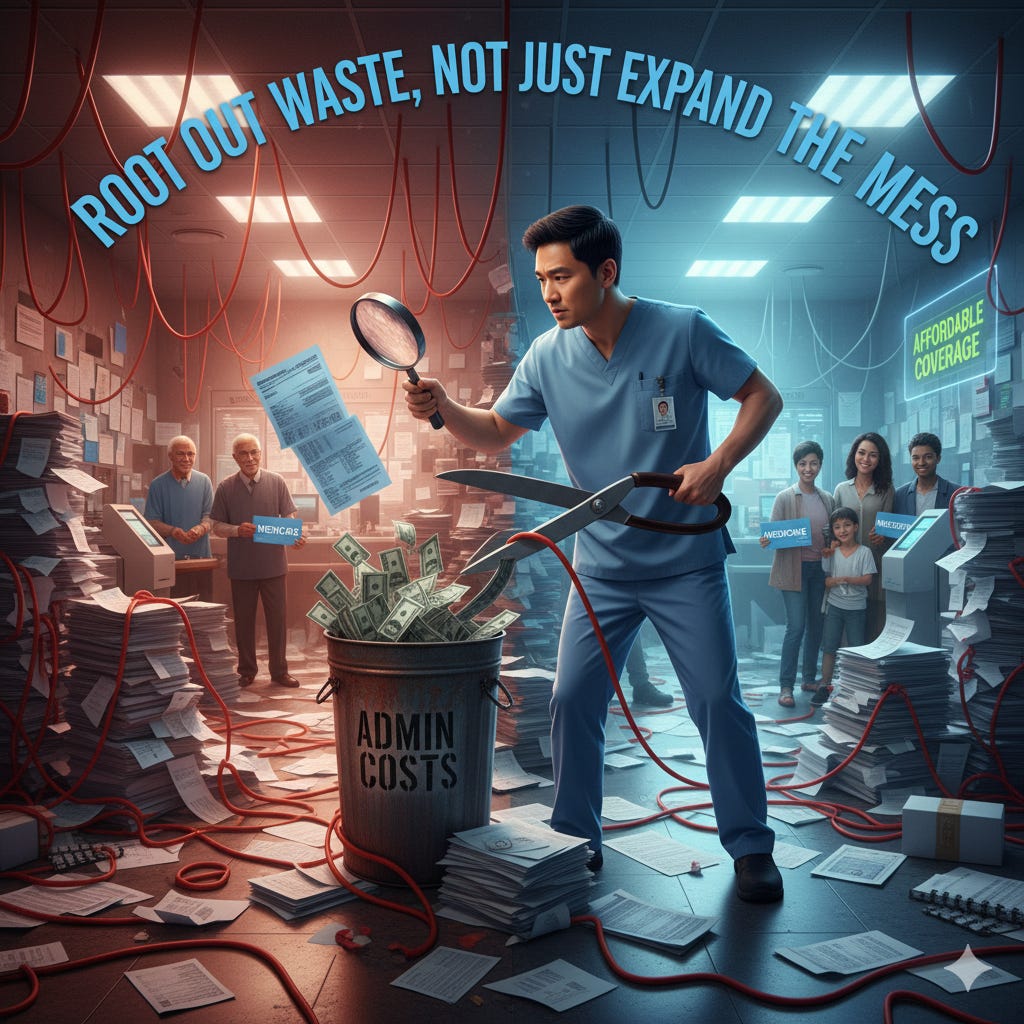
Healthcare's a beast—swallowing 18% of GDP, bankrupting millions with surprise bills, locking workers to dead-end jobs for insurance, and leaving gig economy folks (now 1/3 of the workforce) exposed. We spend more per capita than any nation for worse outcomes: Shorter lifespans, higher infant mortality. Yang supported the "spirit of Medicare for All" but slammed the debate as misguided: "We're spending all our time arguing over who is the most zealous in wanting to cover Americans... instead of addressing underlying problems driving unaffordability."
Unlike single-payer purists ignoring the chaos of reformatting 18% of the economy overnight (potentially disrupting private insurance for 150 million) or ACA apologists who patch without fixing pharma greed, Yang targeted roots: Control prescription drug costs through negotiation and caps (ending big pharma's extortion), invest in tech to eliminate waste (admin costs eat 30% of every dollar), shift incentives toward preventive care including mental health and wellness, and expand coverage stages to include telemedicine and holistic services. No more job lock or bankruptcy from medical debt—the leading cause for families.
It's universal, affordable coverage without immediate private sector annihilation: Focus on lowering costs first, then expand. For right-wing skeptics: This curbs lobbyist influence, saves trillions long-term through efficiency, and echoes free-market reforms like price transparency and competition. Why exile a reformer who could bridge the divide?
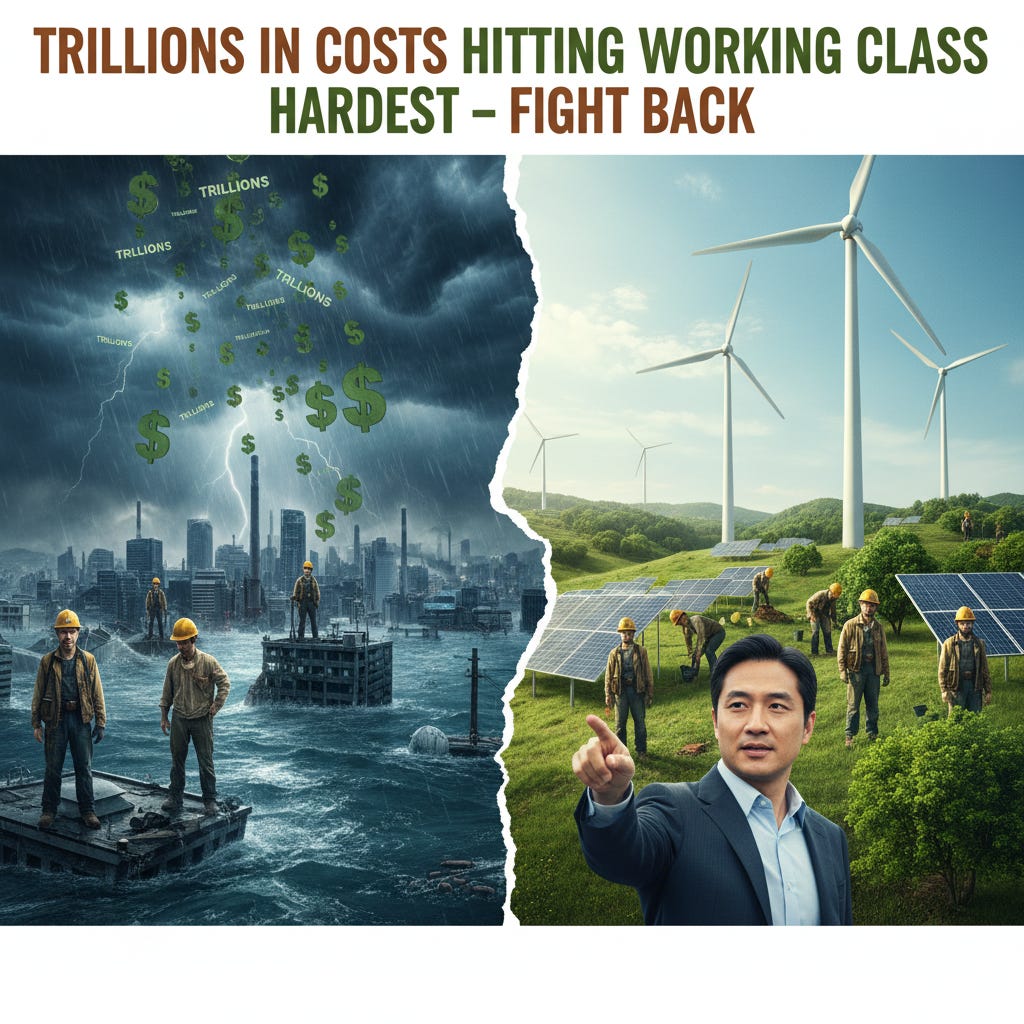
Combat Climate Change: Trillions in Costs, Hitting the Working Class Hardest (that gets my attention)
You know what? I didn't think climate was my priority—hurricanes and wildfires felt like coastal elite problems, distant from heartland realities. But then I heard the numbers: It's already costing us hundreds of billions yearly in disasters (think Hurricane Helene's $200B+ tab), trillions overall in projected damages, and guess who's getting screwed? The working class and poor, always. Flooded farms in the Midwest wiping out family livelihoods, skyrocketing energy bills in rust-belt towns where coal jobs vanished without replacements, respiratory diseases like asthma and COPD surging in polluted factory corridors—hitting low-income and minority communities hardest, exacerbating inequality just like every other systemic failure.
Yang called climate an "existential threat" on par with automation, noting we're already living its effects: More powerful storms, rising seas flooding parts of Florida and Virginia, disproportionate burdens on disadvantaged groups least equipped to adapt. Unlike Green New Deal utopians promising vague jobs without concrete timelines or outright deniers fiddling while ecosystems burn, Yang's plan is comprehensive yet realistic: Achieve net-zero emissions by 2049, with aggressive milestones—net-zero standards for new buildings by 2025, new nuclear reactors online by 2027 (boosting energy independence), zero-emission cars by 2030, a 100% emissions-free electric grid by 2035, net-zero transportation by 2040, and 85% methane recapture by 2045.
Mix all tools: Transition from fossil fuels to renewables, upgrade infrastructure for efficiency, improve farming and land use with sustainable practices. Public financing options to help families "go solar" without high upfront costs, massive investments in geo-engineering like shoring up glaciers and reducing solar exposure (because "waiting for oceans to rise isn't the American way"—and if we don't lead, China will). Build a sustainable world through American innovation, move people to higher ground from disaster zones, reverse damage via carbon removal research, and pass a constitutional amendment mandating federal and state environmental stewardship to hold future leaders accountable.
This isn't tree-hugger mandates or socialist overreach; it's defending the heartland economy from avoidable catastrophes, creating millions of jobs in clean tech, nuclear, and agriculture innovation while protecting the vulnerable from elite neglect. Republicans: It's proactive leadership, like Eisenhower's interstate system, safeguarding freedom from foreign oil dependence and climate chaos.
The Freedom Dividend | Showing AI Some Respect 🇺🇸 By Giving Americans What They're Owed 🇺🇸
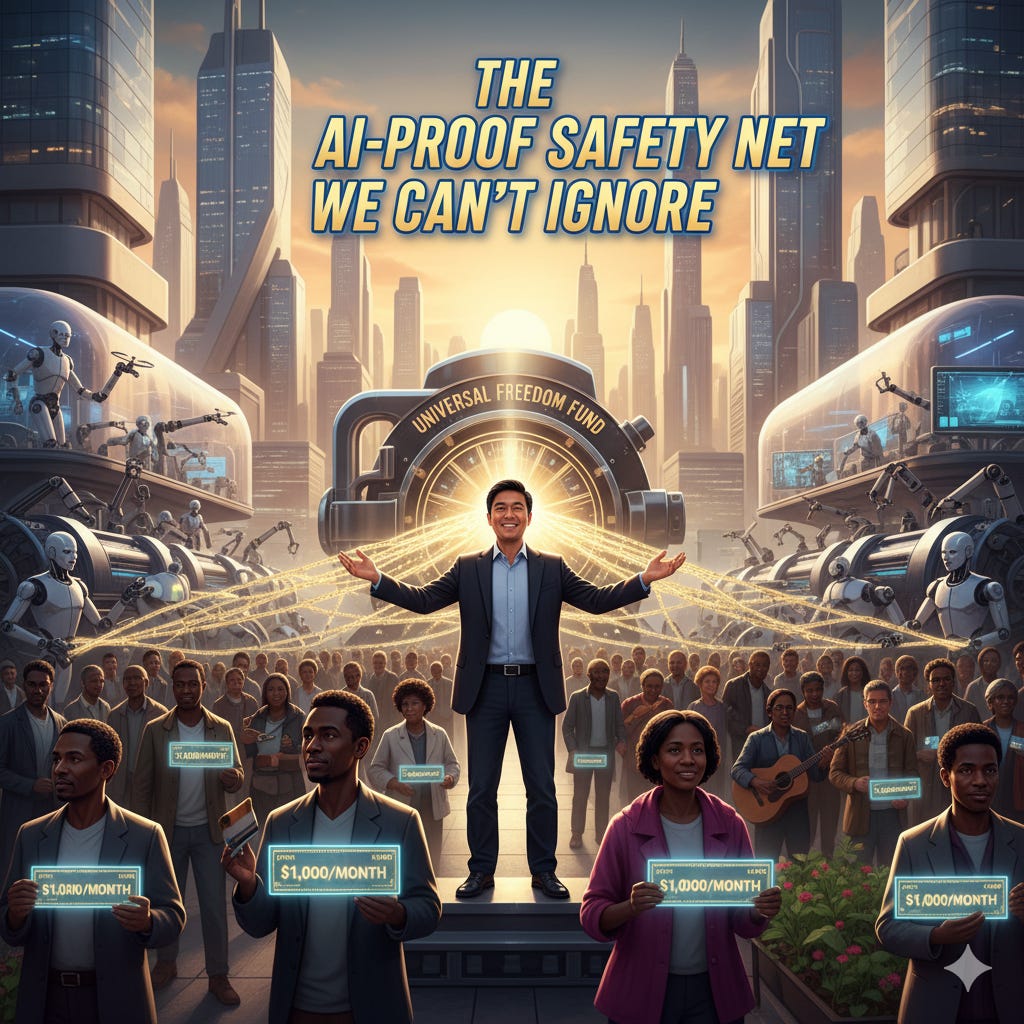
With all these changes—VAT revenue streaming in billions, waste cuts from streamlined taxes and healthcare, corporate accountability closing loopholes—funding flows naturally for Yang’s capstone: The Freedom Dividend, a universal basic income (UBI) of $1,000 per month ($12,000/year) for every American adult over 18, no means testing or work requirements. Pegged to cost-of-living adjustments and protected by constitutional amendment requirements for changes, it’s independent of employment status, letting people pay bills, educate themselves, start businesses, relocate for opportunities, or care for loved ones without fear. As Yang explained in The War on Normal People: “Universal Basic Income, or UBI, is a version of Social Security where all citizens receive a set amount of money per month independent of their work status or income. Everyone from a hedge fund billionaire in New York to an impoverished single mom in West Virginia would receive a monthly check of $1,000. If someone is working as a waitress or construction worker making $18,000, he or she would essentially be making $30,000. UBI eliminates the disincentive to work that most people find troubling about traditional welfare programs—if you work you could actually start saving and get ahead.”
Here’s the gut-punch: AI’s not sci-fi anymore. Amazon just axed 14,000 jobs; they’re eyeing 100,000 more in three years, with automation projected to displace one-third of U.S. workers by 2030. What then? Mass homelessness? Social unrest? Yang foresaw this: “With the growing threat of automation, the concept has gained renewed attention, with trials being run in Oakland, Canada, and Finland as well as in India and other parts of the developing world.” The Dividend isn’t a handout—it’s a foundation, growing the economy by $2.5 trillion through consumer spending (57% of Americans can’t cover a $500 emergency; this fixes that) and adding 4.5 million to the labor force by enabling risk-taking.
And get this: It’s nothing new, with universal appeal from respected figures across the spectrum. Today, people associate UBI with tech utopians, but it almost became law in the U.S. in 1970-1971, passing the House twice under Republican Richard Nixon before stalling in the Senate. Champions include Founding Father Thomas Paine (1796: “There shall be paid to every person... as a compensation... for the loss of his or her natural inheritance”), Martin Luther King Jr. (1967: “The solution to poverty is to abolish it directly by... the guaranteed income”), Nixon himself (1969: “Build a foundation under the income of every American family”), Nobel economist Milton Friedman (1980: “A negative income tax... more efficiently and humanely”), Bernie Sanders (2014: “Every American is entitled to at least a minimum standard of living”), Stephen Hawking (2015: “Machine-produced wealth [must be] shared”), Barack Obama (2016: “We’ll be debating unconditional free money over the next 10 or 20 years”), Warren Buffett (2017: “Figure out how to distribute it... where government comes in”), Bill Gates (2017: “Take those extra resources and... direct to them in terms of... income policies”), Elon Musk (2017: “Universal basic income... is going to be necessary”), Mark Zuckerberg (2017: “Explore... universal basic income so that everyone has a cushion”), and Nicole Sallak-Anderson (2017: “UBI... acknowledges that the work of the home is real”).
Bipartisan thinkers from various perspectives (Nixon, Friedman, Buffett; MLK, Sanders, Obama) have backed versions for decades—it’s not an extreme idea or anti-American; it’s an evolution of programs like Social Security, where we pay in and get back a return adjusted for inflation and investment. Our ability to fund it stems from America’s size and corporate success, but those corps haven’t paid their share: They owe what feels like a quarter-century of minimum back taxes, paying half what they did 10 years ago—less as a percentage than the average citizen. No American thinks a $50,000 earner should pay more proportionally than Amazon, yet corps deduct massive investments like a homeowner claiming a house purchase erased income. Smart offsets for benefits: If on disability or Social Security over $1,000, opt out; under, it bridges or replaces, axing overlap and saving billions. The companies in America have taken all our money through profits built on public infrastructure—this is our way of getting back something they owe the country, and the country is us.
Nobody wants to not work; this empowers upskilling, entrepreneurship, or community without starvation. You and your wife wouldn’t want $2,000/month extra? Of course you would. Use it for church, college, or donate. It’s insurance against robots, funded by tech giants. Tulsi saw through war profiteers; Yang sees through tech barons. Both got the boot for truth-telling. Broadest appeal: By highlighting historical bipartisanship and corporate fairness, it demystifies UBI as practical, not radical—something new, whether you look at it from left, right, or a different angle altogether, a fresh ideology for an automated world.
Conclusion
In a country where billionaires blast off to space while families drown in debt, maybe it’s time to stop exiling the visionaries and start stealing their playbooks. Yang’s not coming to save us—he’s already tried, and we showed him the door. But as AI marches on and the middle class crumbles, ignoring him isn’t just dumb; it’s suicidal. Tulsi found her tribe on the right; Yang's found his home in the Embrace of reality and nothing more. The Forward party speaks to things that are real issues and you don't hear about them enough and that alone is terrifying to this writer. Whether it's Andrew Yang or somebody that Embraces the ideas that he speaks about as well as the ideas of the forward party, the direction that their platform is headed speaks to more Americans than either Party by such a long shot you couldn't call it Center because it has nothing to do with left or right… this is just common sense. If the left is the liberal party and the right is the conservative party then I would have to say that the Foward Party and the ideals that Yang brought to the Forefront in 2020 are the platform of what can only be describes of as a Solutions-Based party.
We stop pretending GDP is the scoreboard of a healthy nation. If it were, we’d be the happiest, most secure people on Earth—ranked #1, baby! But drive through any rust-belt town, talk to a laid-off factory worker, or check the suicide rate in rural America, and you’ll see the truth: **We don’t make anything anymore.** The number goes up, the jobs go away, and the profits go to three guys in Silicon Valley who just taught a robot to fold laundry.
Andrew Yang said it five years ago: Capitalism is a brilliant engine, but it’s been hacked to optimize for capital, not people. So here’s the fix—call it Human-Centered Capitalism: same V8 power, just tuned to run on human fuel.
Measure success not by how much the market makes, but by how many Americans can actually *live*—without two jobs, without medical debt, without wondering if their kid’s school has working heat.
New Rule: **If the system rewards a company for replacing 10,000 workers with software, it should also fund the $1,000 a month those workers need to retrain, relocate, or raise the next generation of innovators.**
Because here’s the punchline: **The robots aren’t coming for your job—they already took it. And they’re not paying taxes.**
So let’s stop worshiping a dashboard that says “Mission Accomplished” while the factory’s a parking lot. Upgrade the engine. Put people back in the driver’s seat.
If GDP is king, we’re all serfs. Time to crown a new metric—one that asks, Can a family thrive?” not “How many billionaires did we mint this quarter?”
Andrew Yang didn’t lose in 2020.
We did.
Fix the system. Or the robots will.
👉 Subscribe for unfiltered analysis and new episodes weekly.
Rxan Smith | Stay Uncomfortable | Stay Independent
If you want journalism that doesn't need to be pre-approved by corporate sponsors or party handlers, before it gets to the readers, you’re in the right place.

📺 Watch 📰 Read 🐦 Debate 💬 Thread 📸 Glimpse 🎵 Rant 💰 Support
📩 Subscribe & Share If something here made you think—or pissed you off in a productive way—subscribe, share, and keep this platform alive witho please Subscribe if you have read this
Regarding the topic of the article, you've captured the essence perfectly. Andrew Yang's early warnings about AI and automation were trully prescient. It's a bit ironic how we dismissed him then, only to face these issues now. Thanks for highlighting his vision; a wake-up call indeed.